MAAYAN JAFFE-HOFFMAN
35 people infected in gyms since June * Buses to run after 10 p.m. * Death toll spikes to 362.
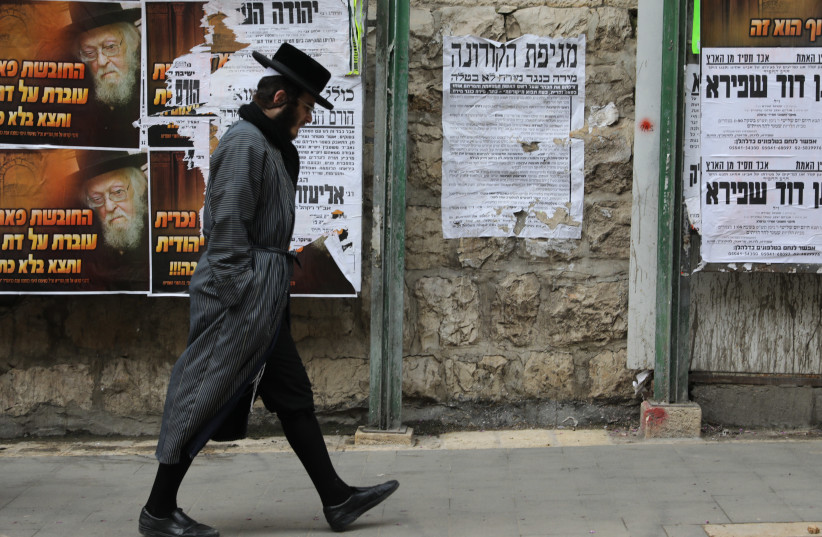 Border Police go about coronavirus inspections in Mea Shearim, a haredi neighborhood in Jerusalem. / (photo credit: MARC ISRAEL SELLEM)
The Knesset coronavirus committee meeting is expected to once and for all vote on Monday whether or not to reopen gyms and public pools after a heated debate Sunday and on the backdrop of yet another spike in cases.
Some 1,151 people tested positive for coronavirus on Saturday, the Health Ministry reported on Sunday, and more than 1,300 on Friday. There were another 646 people diagnosed on Sunday between midnight and press time.
On Saturday, only 20,294 people were screened, meaning that the percentage of people who tested positive increased to around 6%, a percentage that Dr. Emilia Ennis, director of the Department of Epidemiology at the Health Ministry, called, “worrisome” during her presentation at the committee meeting.
When comparing early July data to April data, Israel’s most difficult month in the fight against coronavirus, so far, she showed, the number of patients infected is trending to be higher than the final number in April. However, the discrepancy could be due to the number of tests being done.
On Sunday evening there were 151 people in serious condition, including 47 who were intubated. Some 362 people have died in Israel from the virus.
Despite the high numbers, buses are expected to resume running past 10 p.m. on Monday, Transportation Minister Miri Regev said, revoking a decision that went into effect only a few days prior.
“I came here immediately after the government meeting to take a close look at the bus operation,” Transportation Minister Miri Regev said Sunday in a statement that was disseminated by video, “and I see that things are going well… I made a decision: starting tomorrow, buses will run even after 10 p.m.”
At the same time, Interior Minister Arye Deri convinced the cabinet that the Health Ministry should be required to publish its “red zone” criteria ahead of designating any new neighborhoods as such. The move came after push back from the haredi (ultra-Orthodox) community that decisions were made to discriminate against their community.
During the Knesset coronavirus committee meeting, it was revealed that some 170 cases of infection originated since June from weddings, 35 from gyms, 21 from restaurants and six from bars.
Ennis, however, said that “in most cases the source of infection is difficult to identify.”
She said in as many as one-third of cases, the source of infection is unknown. However, a Health Ministry report that came out soon after her presentation indicated that this number was even higher, perhaps as high as 58%.
The Health Ministry showed that from the beginning of the pandemic until July 6 there were 30,162 people infected with coronavirus, but only 21,562 for which the ministry made efforts to track the origin of their infection. The ministry was unable to determine how 12,581 (58%) of those patients were infected.
Of the 8,981 (42%) that they could track, the most common places for people to contract the virus are: at home ( approximately 65.8%), educational institutions (10.3%), medical institutions (5.8%), events or conferences (3.95%), synagogues (2.2%), shopping centers or stores (2%), or at recreational locations (1.8%). Another 8.2% were not exposed to any of these places but came in contact with a sick person at an unknown location.
Ennis told the committee that the conditions at gyms and pools lend themselves to increased infection and that is why the Health Ministry advised the government to shut them down. Among the conditions at gyms: close quarters, heat, humidity, breathing more and more deeply and touching the surfaces of shared equipment. Among the conditions at pools: No mask wearing, crowding and difficulty in observing the rules of hygiene.
“It is imperative to find the delicate balance between maintaining public health and the duty to maintain people’s livelihoods,” said Knesset coronavirus committee chairwoman Yifat Shasha-Biton at the start of the session. “We must understand what underlies every decision – understand the logic behind these decisions. The issue of social distancing and the observance of Health Ministry guidelines are critical to preventing an outbreak, but also to allowing the economy to function.”
“We have no magic solution,” Health Ministry deputy director-general Itamar Grotto said at a previous meeting earlier in the day.
In her presentation, Ennis showed that there is an increase in the number of difficult patients.
According to the Health Ministry, there was no change in the criteria for who is considered a serious patient, despite reports by the Hebrew media outlet N12 to the contrary.
The Health Ministry released a backgrounder on Sunday detailing this criterion, as defined by the World Health Organization. Those with mild symptoms have a low fever, cough, weakness and potentially a loss of taste or smell. Those with moderate symptoms have been diagnosed via a clinical or X-ray with “COVID-19 pneumonia.” Serious patients, as suffering from dyspnea (a respiratory rate of 30 or more breaths per minute), have a blood oxygen saturation of 93% or less, a ratio of the partial pressure of arterial oxygen to the fraction of inspired oxygen (PaO2:FiO2) of less than 300 mm Hg.
“If the upward trend in the number of serious patients continues, then the number of these will exceed the number in the first wave,” she continued. “Two days ago, there were 35 new serious patients added in one day, which is more than the peak day in the first wave – 29 new serious patients in a day.”
“It is our job to stop the outbreaks before they start,” Ennis said, “After there is already an outbreak, it is very difficult to stop the spread.”
Gil Hoffman and Tamar Beeri contributed to this report.
 News From Israel – July 14, 2020