Archives

Virtual trainer keeps you fit even when stuck at home

Virtual trainer keeps you fit even when stuck at home

Brian Blum


Israeli tech startup Kemtai brings a personal trainer into your home even when you’re in lockdown.

Kemtai uses computer vision to customize home workouts. Photo: courtesy

In the new normal of lockdowns and quarantines, home exercise videos provide a way to move your body while maintaining social distance.

Israeli startup Kemtai is adding an extra dimension of interactivity to a format that’s been a hit since Jane Fonda popularized the home workout in the 1980s.

Kemtai is more akin to a personal trainer. Using the camera on your computer, Kemtai employs computer vision to scan your body. You can then choose one of the dozens of workout routines on the Kemtai website.

As you exercise, Kemtai’s virtual “trainer” compares what it sees you doing with the exercise routine previously input into the Kemtai system, then nudges you in the right direction. The trainer will give you real-time instructions and feedback, telling you to bend this way or that, squat lower, straighten your back or hold your elbows at more of a 90-degree angle – all based on what you’re actually doing.

The Kemtai system watches you exercise and gives you feedback to improve your routines. Photo: courtesy

All the processing is done on your desktop or laptop computer. The software doesn’t yet work on iPhones, iPads or smart TVs. (An iPad can’t handle the real-time comparisons, and smart TVs lack a camera.)

The Kemtai system was officially launched May 19, sooner than originally expected.

Kemtai Chief Business Officer Mike Telem. Photo: courtesy

“The plan was to do small user testing for a few months,” Mike Telem, Kemtai’s chief business officer, tells ISRAEL21c.

“But when people started getting quarantined, we thought we have something that’s ‘good enough’ to help people right now. We felt, let’s let people use and enjoy it.”

During the initial beta period, Kemtai conducted a feedback survey, Telem told ISRAEL21c.

“Of the random 400 people polled, 82 percent of the respondents said they felt Kemtai’s feedback helped them to improve their home workouts and more than 90% said they would recommend Kemtai to a friend,” reports Telem.

The company’s long-term goal is to become a platform for personal trainers to connect with their clients when they can’t be there in person. That will also free trainers post-Covid crisis from the limitation of how many hours they have in a day to work with their clients.

Kemtai has been adding trainers and workouts during its beta period, so that users can choose a style that appeals to them most. The latest trainers hail from Israel, New York and Tokyo. At the time of its official launch, Kemtai already had 10,000 registered users in 20 different countries.

Kemtai software is available on a “freemium” model — the basics come at no cost, but you pay for extras such as specific workouts (marked clearly as “premium.”). A month-to-month subscription costs $20 with a discount for an annual plan. Fees are shared between Kemtai and the participating trainers.

Kemtai’s system guides you through choosing fitness routines. Photo: courtesy

Telem emphasizes that Kemtai’s interactivity, as well as its scoring functionality – you get a “grade” at the end of each session so you can see how well you’re improving session by session – “are essential for having an effective and fun workout. It feels like there’s someone out there with you.”

Kemtai shows each exercise step by step. Photo: courtesy

The six-person company that Telem launched with cofounders Naomi Keren (chief product officer) and Mor Amitai (CEO) only opened shop last year. Kemtai is raising money through the Jerusalem-based online crowd investing platform OurCrowd.

That goal may just have become a bit easier, given the dramatically increased interest in being able to stay active while sheltering in place.

You can try out Kemtai by signing up for a free account here 

Other Israeli workout technologies

While Kemtai doesn’t have any direct competition using computer vision to customize a workout, it is not the only Israeli startup aiming to keep us fit during the pandemic and beyond.

Fitness22 offers a suite of apps to guide conditioning and training workouts with the help of a digital personal trainer.

EyeClick’s BEAM interactive projector game system converts any space into a virtual playground on which kids can engage in the system’s 200 interactive movement activities.

MoonRun has a sling trainer device embedded with movement sensors for at-home aerobic exercises such as walking, running, sprinting, turning, jumping, and squatting.

FitMyTime facilitates live, online, one-on-one or group fitness and yoga workouts on a pay-by-the-hour basis.


Zawartość publikowanych artykułów i materiałów nie reprezentuje poglądów ani opinii Reunion’68,
ani też webmastera Blogu Reunion’68, chyba ze jest to wyraźnie zaznaczone.
Twoje uwagi, linki, własne artykuły lub wiadomości prześlij na adres:
webmaster@reunion68.com


Monthly Recap – December 2019 Top10, TV7 Israel News

Monthly Recap – December 2019 Top10, TV7 Israel News

TV7 Israel News


Zawartość publikowanych artykułów i materiałów nie reprezentuje poglądów ani opinii Reunion’68,
ani też webmastera Blogu Reunion’68, chyba ze jest to wyraźnie zaznaczone.
Twoje uwagi, linki, własne artykuły lub wiadomości prześlij na adres:
webmaster@reunion68.com


The strategic significance of journalist expulsions by US and China

The strategic significance of journalist expulsions by US and China

ALEXANDER B. PEVZNER


Both countries would be wise to remember that no hostility lasts forever, as demonstrated by the gradual improvement in China’s relations with (and media coverage of) Japan.

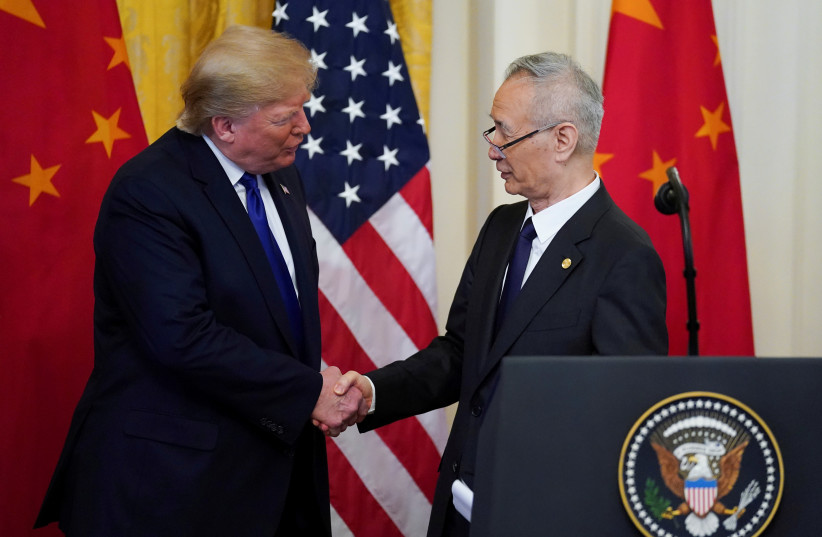
U.S. President Donald Trump shakes hands with Chinese Vice Premier Liu He during a signing ceremony for “phase one” of the U.S.-China trade agreement in the East Room of the White House in Washington, U.S., January 15, 2020 / (photo credit: KEVIN LAMARQUE/REUTERS)

In mid-March 2011, I met in Beijing with the Israeli ambassador to China and a very senior Chinese media editor. This was after a major earthquake and tsunami on March 11 caused damage to the Fukushima Daiichi nuclear plant, and as the two sessions – the National People’s Congress (NPC) and the Chinese People’s Political Consultative Conference (CPPCC) – drew to a close.

The editor was telling us how he and other CPPCC delegates were listening anxiously to then-Chinese premier Wen Jiabao at the closing press conference on March 14.

“We were hoping to hear the premier express sympathy with the Japanese people” after the nuclear disaster, the editor said. (At the time, Wen did extend condolences to Japan and offered to send help).

The year 2011 was a bad one for China-Japan relations, with angry anti-Japanese protests in Beijing and studios churning out anti-Japanese movies by the hundreds. So Wen’s statement was a mildly bold move.
In the following years, China-Japan ties would sink further still, until being resuscitated by US President Trump’s “trade war” against China. Still, the aforementioned incident offers a lesson for US-China relations, especially for the role of media.

In recent months, China and the US engaged in an unprecedented series of tit-for-tat expulsions of journalists, hammering the relationship to a nadir not seen in decades, and reflecting the breakdown of trust between the strategic rivals exacerbated by the coronavirus pandemic.

After the Trump administration identified five Chinese government-owned media outlets as foreign missions, and after The Wall Street Journal ran an opinion essay February 3 titled, “China Is the Real Sick Man of Asia,” China revoked the credentials of three WSJ reporters, the first time that China had expelled a credentialed foreign correspondent since 1998.

In recent years, pressured by an increasingly nationalistic public, China has taken to shortening the lengths of journalist visas or withholding them altogether as retaliation against critical coverage by foreign media, according to the Foreign Correspondents’ Club of China. In retaliation, the US on March 2 cut the quota the five media outlets allowed to employ to a maximum 100 Chinese nationals, effectively expelling 60 reporters.

China’s next move was unfortunate but predictable. On March 18, the Foreign Ministry said that US journalists working with The New York Times, The Wall Street Journal and The Washington Post whose press credentials were due to expire before the end of 2020, would be required to hand back their press cards, effectively forcing a dozen or more reporters to leave the country.

China also revoked the permits of at least six Chinese nationals employed at foreign media as assistants. Chinese nationals aren’t allowed to work for foreign media as journalists, but in reality, Chinese staffers at foreign media bureaus conduct important journalistic work, providing crucial language skills and cultural nuance to foreign reporters.

FOREIGN OUTLETS that send journalists to China are those whose readers are interested in a more nuanced perspective that can only be obtained on the ground. China is acutely aware of the advantage possessed by foreign, especially Anglophone media, and Xi Jinping has urged the Chinese media to “tell China’s story well” in an effort to boost its global image. In the absence of experienced American journalists on the ground, the China story will be shredded in the “Washington spin cycle,” as The New York Times put it.

Some say China feels Western media has outlived its usefulness. That is unlikely. Rather, the increasing assertiveness of Chinese diplomacy indicates the enormous public pressure on the Chinese government. As Foreign Ministry spokesperson Geng Shuang said on March 18, “China is compelled to make such countermeasures.”

Western diplomats were taken aback on March 12, when another Foreign Ministry spokesman, Zhao Lijian, tweeted a claim that the US military might have brought the coronavirus to Wuhan. In fact, both sides peddle conspiracy theories on the origin of the virus, but it is clear Zhao enjoys strong support from the Chinese public.

Some in China are critical of this more strident tone. Mme. Fu Ying, former vice foreign minister and one of China’s most astute diplomats, published an op-ed on April 2 in the People’s Daily, the official publication of the Chinese Communist Party, calling for greater sophistication. As Fu, who is currently vice-chair of the Foreign Affairs Committee of the National People’s Congress put it, to convincingly tell China’s story to foreign publics, there is a need for a more diversified approach.

THE US IS also a loser in this “race to the bottom.” By simply casting Chinese reporters as “propagandists,” the US misses an opportunity to influence China directly. Despite the professional straitjacket imposed on them by the state, Chinese journalists can actually act as an important bridge between the US and China.

It is true that Chinese reporters must report largely within party-proscribed limits, and with the US-China bilateral ties in tatters, the media simply reflect the realities of the relationship. But even Chinese journalists have agency, and can write non-political stories that reflect empathy. The nearly 370,000 Chinese students currently enrolled in the US attest to the limits of “Chinese propaganda.”

Israel’s example can be illuminating. China has broad economic and energy interests in the Middle East, so the Chinese narrative prioritizes relationships with the Arab and Muslim world. Chinese media frequently criticize Israel’s position on Palestine, but Chinese journalists based in Israel also write sympathetic stories about regular people caught in the conflict on both sides of the divide, in addition to numerous positive articles about Israeli innovation. Most importantly, they have the opportunity to directly interact with Israel’s government and society.

The Trump administration also inveighed against Chinese media’s involvement in intelligence operations in the US. Quite different from spying, China does have an internal system of reporting called neican, by which Chinese journalists write reports for internal publication on subjects deemed too sensitive for public consumption and intended for the eyes of the senior leadership only.

For example, during the tense days of demonstrations in Hong Kong in the summer of 2019, with Chinese troops conducting anti-riot exercises across the border in Shenzhen, it was practically certain that Chinese journalists were quietly sounding their DC sources for a potential US reaction to an escalation in Hong Kong. This would have provided a real-time corrective for Chinese policymakers.

With the breakdown of trust over the origins of COVID-19, and the approaching US presidential elections, journalist expulsions will likely not be the last counterproductive moves the US and China make. Both countries would be wise to remember that no hostility lasts forever, as demonstrated by the gradual improvement in China’s relations with (and media coverage of) Japan.


The writer is founding director of Israel’s Chinese Media Center at the College of Management Academic Studies, and a fellow at the Jerusalem Institute for Strategy and Security.


Zawartość publikowanych artykułów i materiałów nie reprezentuje poglądów ani opinii Reunion’68,
ani też webmastera Blogu Reunion’68, chyba ze jest to wyraźnie zaznaczone.
Twoje uwagi, linki, własne artykuły lub wiadomości prześlij na adres:
webmaster@reunion68.com


Don’t be fooled – American Jews support sovereignty – opinion

Don’t be fooled – American Jews support sovereignty – opinion

YITZ TENDLER


Despite the noise, empirical evidence does not support the premise that engaged American Jewry opposes Israeli sovereignty in Judea and Samaria. In fact, the exact opposite is the case.

PRIME MINISTER Benjamin Netanyahu addresses the American Israel Public Affairs Committee (AIPAC) policy conference in Washington in 2015.
(photo credit: REUTERS)

Petitions against Israel’s planned extension of sovereignty over Judea and Samaria (or as they put it: annexation of the West Bank) are all the rage these days. Last week we read that “Jewish Studies Scholars Oppose Annexation,” and the week before that “Gap-year alumni are against annexation.” At this pace, expect a petition by American Jewish Gerbil Owners Against Annexation some time next week.

No doubt the planned extension of sovereignty over 30% of Judea and Samaria is triggering hand-wringing in certain quarters of the American Jewish community. In an article in Ha’aretz last month – histrionically titled “Will Annexation Be a Death Blow for American-Jewish Support of Israel?” – one young American Jew was quoted as warning, “Annexation will push American Jews deeper into what has already been the trend, which has been to decide to not identify with the State of Israel because it is either way too complicated or because they fundamentally cannot have a relationship with a country that is behaving so counter to their values.”

In another opinion piece in Ha’aretz – titled “The Real Reason for ‘Mainstream’ Jewish America’s Appalling Silence on Annexation” – the head of Americans for Peace Now, Hadar Susskind, tried to marshal opposition to sovereignty by admonishing, “[W]e will fight for the vision that reflects both Israel’s founders and the view of the vast majority of American Jews. We call on all our colleagues to join us in protecting a Jewish and democratic Israel by clearly and forcefully opposing annexation.”

In the coming weeks we will be seeing even more headlines trumpeting polls and petitions that will seek to paint the planned move as being contrary to the wishes of American Jewry. No doubt the American Jewish establishment will lament that the proposed plan will be another “nail in the coffin” in the already strained relationship between American Jewry and the State of Israel, joining a long litany of examples of this supposed rift.

Despite the noise, empirical evidence does not support the premise that engaged American Jewry opposes Israeli sovereignty in Judea and Samaria. In fact, the exact opposite is the case.

A highly accurate survey of American Jewish attitudes toward Israel occurred this year as American Jews elected delegates to represent them in the 38th World Zionist Congress (WZC). More than 120,000 American Jews of all stripes participated in this open election directly in the shadow of Benjamin Netanyahu’s pledge to extend sovereignty. This election was conducted in a highly professional manner with third-party monitoring, providing American Jews passionate about having a say in Israel with the perfect opportunity to make their voices heard.

And vote they did, in unprecedented numbers. Parties supporting the settlements in Judea and Samaria won a dramatic and under-reported victory over those vowing to fight “occupation’’ and “annexation”– a substantial 80-to-69 seat win. The Hatikvah slate, of which Mr. Susskind’s Americans for Peace Now was a member, only garnered 6.42% of the total vote despite a clear investment on their part to increase their share of the vote.

Let me repeat that: On an even playing field, American Jewish Zionists, by a wide margin, cast their votes for parties which either explicitly endorse sovereignty or do so implicitly by their stated support for the Israeli settlement movement. The WZC elections shed light on a very important fact that flies in the face of contemporary wisdom: American Jews who are engaged on matters related to Israel and who desire to have their voices heard actually support settlements in Judea & Samaria by a significant margin.

These election results provide far more insight into American Jewry’s relationship with Israel than the small-but-very-loud numbers of professional fringe activists falsely claiming to speak on our behalf. The hard numbers tell the real story.

Opponents of sovereignty warn that its application by Israel would erode US Jewish support for Israel. The truth, in fact, is the exact opposite. Not seizing the opportunity to apply sovereignty would have the effect of alienating higher numbers of America’s most committed Zionists than allowing this unique moment in Jewish history to slip through our fingers.


The writer is senior fellow for Israel & Jewish affairs at the American Conservative Union and executive director of Congregation Beth Jacob in Atlanta, GA. He is a ZOA coalition delegate to the World Zionist Congress.


Zawartość publikowanych artykułów i materiałów nie reprezentuje poglądów ani opinii Reunion’68,
ani też webmastera Blogu Reunion’68, chyba ze jest to wyraźnie zaznaczone.
Twoje uwagi, linki, własne artykuły lub wiadomości prześlij na adres:
webmaster@reunion68.com


Coronavirus sparked a new wave of antisemitism

Coronavirus sparked a new wave of antisemitism

JPOST EDITORIAL


Rising antisemitism will be one of the topics addressed at The Jerusalem Post’s inaugural virtual conference on June 30 at 7 p.m. Israel time.

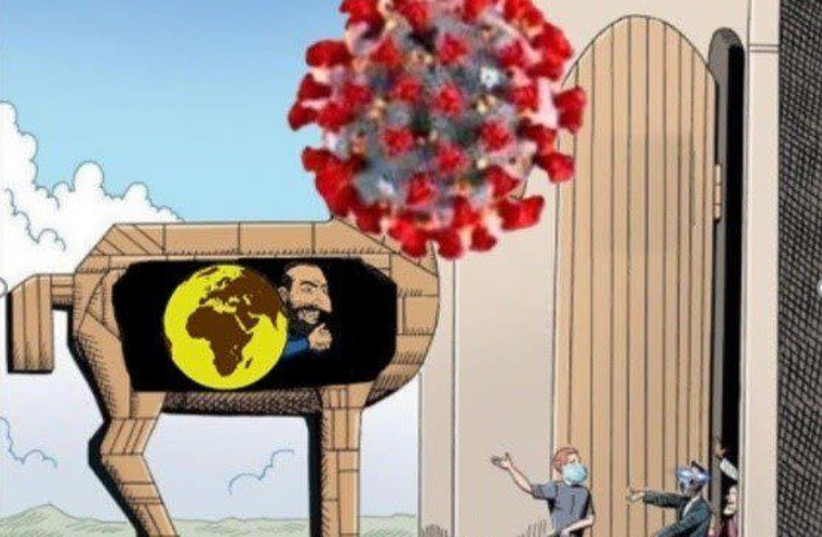
In this image shared on Telegram on March 15, the coronavirus is presented as a trojan horse for “globalist” Jews. / (photo credit: ADL/COURTESY)

A study published by Tel Aviv University’s Kantor Center for the Study of Contemporary European Jewry this week shows that a worrying wave of antisemitism inspired by the coronavirus is sweeping across the world.

“The COVID-19 pandemic has unleashed a unique worldwide wave of antisemitism,” the report states. “The new wave of antisemitism includes a range of libels that have one common element: The Jews, the Zionists and/or the State of Israel are to blame for the pandemic and/or stand to gain from it.”

The study, based on hundreds of reports from researchers in 35 countries around the world, says that coronavirus-inspired antisemitism has gone viral on social media, with claims that Jews either created the disease or were profiting from it. Jews and Israel have even been depicted in countless cartoons and graffiti as viruses themselves.

One example cited is a French caricature of the former minister of health Agnès Buzyn (portrayed with a large nose signifying she is Jewish) smiling as she pours poison into a well, echoing the well-poisoning libel during the Black Plague.

“These common motifs perpetuate antisemitic accusations from previous generations and other global catastrophes, once again presenting the well-known image of the Jew,” says Prof. Dina Porat, head of the Kantor Center. “However, the antisemitism generated by the coronavirus is fiercer and more intensive.”

This antisemitism, according to Porat, has continued unremittingly for several months, and reflects “a high level of anxiety and fear” in many populations. The report found that coronavirus-related antisemitism is strongest in the US and the Middle East – particularly in Iran, Turkey and the Palestinian Authority – but is also prevalent throughout Europe and South America. “While in the US, accusations come mainly from white supremacists and ultraconservative Christians, pointing the finger at Jews in general and haredi [ultra-Orthodox] Jews in particular, accusers in the Middle East mostly blame Israel, Zionism and the Mossad for creating and spreading the virus and intending to make a vast fortune from medications and the vaccine they are already developing,” it says.

This new type of antisemitism, according to the study, includes conspiracy theories alongside medieval blood libels now renewed in a 21st century format.

In the US, since the tragic killing of George Floyd in Minneapolis, anti-Israel activists have injected antisemitic tropes into valid civil rights protests, the report says. According to Kantor Center researcher Dr. Giovanni Quer, the current wave of antisemitism is unprecedented because, spreading very swiftly through social media, it focuses first on COVID-19 and then quickly moves on due to socio-political changes. “Just a few days passed between the coronavirus crisis and the racism-related social crisis in the US, but antisemitic discourse remained just as fierce, with its proponents simply adapting their antisemitic narratives to the changing social contexts,” Quer says.

What can be done to counter this new antisemitism? According to Moshe Kantor, founder of the Kantor Center and president of both the European Jewish Congress and the World Holocaust Forum, global leaders must urgently address the rise of extremism and antisemitism – and take meaningful action against hate speech and hate crimes. As unemployment soars, he warns of a situation comparable to the Great Depression, which led to the rise of fascism and Nazism.

“Alongside trying to control the spread of the virus and taking care to lessen the effects of the financial downturn, the international community should not ignore the societal and political crisis that is already starting to emerge,” Kantor said. “Our leaders need to address the problem of growing extremism and hate now.”

Kantor added what is needed is “a concerted and coordinated international action plan.” Israel, as the Jewish state, should be taking a leading role in combating antisemitism wherever it raises its ugly head.

The government, together with Jewish organizations in Israel and around the world – including the World Jewish Congress and the Jewish Agency – should appoint a global commission to consider the best ways to stem the current tide of antisemitism.

Rising antisemitism will be one of the topics addressed at The Jerusalem Post’s inaugural virtual conference at 7 p.m. Israel time on June 30, titled “COVID-19 and the Jews.” We urge you to watch the broadcast, and take an active part in the new battle against coronavirus-related antisemitism.


Zawartość publikowanych artykułów i materiałów nie reprezentuje poglądów ani opinii Reunion’68,
ani też webmastera Blogu Reunion’68, chyba ze jest to wyraźnie zaznaczone.
Twoje uwagi, linki, własne artykuły lub wiadomości prześlij na adres:
webmaster@reunion68.com