Archives

Actress Helen Mirren to Host Free Online Concert by Israel Philharmonic Orchestra

Actress Helen Mirren to Host Free Online Concert by Israel Philharmonic Orchestra

Shiryn Ghermezian


Helen Mirren. Photo: Wikimedia Commons.

Academy Award-winning British actress Helen Mirren will host later this month a free online concert by the Israel Philharmonic Orchestra (IPO), organized as part of a global fundraising gala to help cover financial losses due to the coronavirus pandemic.

The online concert will take place on June 28 and prior registration is required.

The showcase will feature performances by the orchestra’s new conductor, Maestro Lahav Shani, as well as former IPO conductor Maestro Zubin Mehta, Pinchas Zukerman and Amanda Forsyth, Itzhak Perlman, Yefim Bronfman, Sir András Schiff, Gil and Adèle Shaham, Maestro Gianandrea Noseda, Chen Reiss, Martin Fröst and Evgeny Kissin.

“Following the cancellation of many of the IPO’s performances and fundraising events throughout the world, the IPO Global Gala will raise vital funds to ensure that we can keep the music playing, showcasing musical excellence and bringing a message of peace and harmony,” the IPO said.

Viewers will be able to donate online throughout the event.


Zawartość publikowanych artykułów i materiałów nie reprezentuje poglądów ani opinii Reunion’68,
ani też webmastera Blogu Reunion’68, chyba ze jest to wyraźnie zaznaczone.
Twoje uwagi, linki, własne artykuły lub wiadomości prześlij na adres:
webmaster@reunion68.com


The Israeli Security Establishment Helped Beat Coronavirus

The Israeli Security Establishment Helped Beat Coronavirus — and Is Ready for Future Challenges

Yaakov Amidror


Israeli police wearing masks patrol as they enforce a national lockdown to fight the spread of the coronavirus disease (COVID-19), in the Mea Shearim neighborhood of Jerusalem, April 7, 2020. Photo: Reuters / Ammar Awad.

As Israel gradually lifts the restrictions it imposed to protect public health amid the coronavirus pandemic, concerns remain over the threat of a second wave of infections. If one does materialize, Israel will likely be in a better place to counter it — in no small part thanks to the exertions of its security establishment, whose unique strengths were vital to the country’s fight against the microscopic enemy.

The Defense Ministry became the country’s main logistical arm as the crisis unfolded, leveraging its strong overseas procurement capabilities and its extensive experience handling sensitive shipments arriving by air or sea. The Mossad intelligence agency joined the fray as well, mainly to obtain critically-needed and highly-sought medical equipment from abroad. These efforts helped prevent shortages that might have otherwise crippled the nation’s response to the pandemic.

Within hard-hit municipalities, the Israel Defense Forces (IDF)’s Home Front Command delivered food to at-risk populations, aided the evacuation of the ill to hospitals, and worked with communal groups to care for affected families. The exceptional encounters between these uniformed soldiers and members of the ultra-Orthodox and Arab Israeli communities, two demographic groups that largely forgo military service, reflected the widespread feeling of solidarity within Israel.

The Home Front Command also assumed responsibility for treating individuals arriving from abroad and managing hotels for those who required isolation. The Command’s commendable and tireless activities fell within its central mission — supporting the civilian sector during a crisis.

The IDF likewise facilitated the delivery of wide-ranging assistance to the Palestinians, including testing kits, protective gear, and other medical and humanitarian supplies, in order to mitigate the pandemic’s spread in the Hamas-ruled Gaza Strip and Palestinian Authority territories in the West Bank. These efforts seem to have born fruits, considering the low fatality rate among Palestinians to date.

But the military escalated its involvement even further. The Defense Ministry and the IDF’s advanced technology networks quickly developed systems that allowed hospitals to ventilate more patients, and to establish dedicated coronavirus wards where patients could be treated, monitored, and communicated with — all while isolated.

One of the IDF’s special units helped organize testing to identify coronavirus carriers and determine who needed to be isolated due to contact with the patients. It created a process to significantly shorten and ultimately “cut” the chain of contagion, so that the number of individuals infected by each carrier would be greatly reduced.

The IDF’s Intelligence Corps and C4i Directorate built on existing technologies typically used for military needs to establish a command and control system that conveys critical information, including the number of patients, their status and location, and lab performance. This system offers the Health Ministry a precise measure of the coronavirus threat, and control over relevant testing and monitoring tools.

Researchers at the IDF’s Military Intelligence Directorate took charge of investigating the disease, as well as summarizing research and findings from overseas that could provide valuable lessons. The Research Department produced daily reports on the state of the infection in Israel, and studies of efforts abroad that could aid decision makers — for instance, how other countries managed the easing of restrictions, protecting retirement homes, and the like.

The Shin Bet, Israel’s internal security agency, also played a role, deploying phone tracking technology typically used for counter-terrorism to retrace the movements of coronavirus patients and identify anyone they may have infected. Since this posed a significant breach of privacy, the Shin Bet needed special permission from the Knesset for the operation, which was approved as part of emergency regulations to handle the crisis.

The new capabilities now available to the Health Ministry mark a leap forward from the previous status quo, and the military will likely continue improving them, even though the difficult first wave has already receded in Israel. At the end of the process, the Israeli medical system will be in much better shape on these fronts relative to the eve of the outbreak.

The coronavirus pandemic again highlighted the uniqueness of Israel’s security establishment, which met its newest challenge with creativity and vigor, exceeding all expectations. At the same time, the IDF was able to maintain a high level of operational readiness and, according to foreign reports, it even struck targets in Syria several times. The lessons learned during these recent weeks are likely to shape Israel’s response to future crises, with the security establishment remaining a cornerstone in its defense against national threats — military, health, or otherwise.


IDF MG (ret.) Yaakov Amidror is a Distinguished Fellow at the Jewish Institute for National Security of America’s Gemunder Center for Defense and Strategy. Amidror was formerly the National Security Advisor to Israeli Prime Minister Benjamin Netanyahu, as well as the head of Israel’s National Security Council from 2011-13. He is also the Anne and Greg Rosshandler Senior Fellow at the Jerusalem Institute for Strategic Studies (JISS).


Zawartość publikowanych artykułów i materiałów nie reprezentuje poglądów ani opinii Reunion’68,
ani też webmastera Blogu Reunion’68, chyba ze jest to wyraźnie zaznaczone.
Twoje uwagi, linki, własne artykuły lub wiadomości prześlij na adres:
webmaster@reunion68.com


News From Israel – June 21, 2020

News From Israel – June 21, 2020

ILTV Israel News


The daily spike in #COVID-19 infection cases continues to hover around the 300 mark as the government weighs new measures.
A blow up between the Israeli Prime Minister and a leading Israeli news channel sparks debate.
It’s International #Yoga Day… why Israelis are some of the most enthusiastic yogis in the world.


Zawartość publikowanych artykułów i materiałów nie reprezentuje poglądów ani opinii Reunion’68,
ani też webmastera Blogu Reunion’68, chyba ze jest to wyraźnie zaznaczone.
Twoje uwagi, linki, własne artykuły lub wiadomości prześlij na adres:
webmaster@reunion68.com


Israeli Arab Singer Mira Awad Slams Rogers Waters for BDS Support

Israeli Arab Singer Mira Awad Slams Rogers Waters for BDS Support

Shiryn Ghermezian


Noa (L) and Mira Awad of Israel perform during dress rehearsals for the Eurovision Song Contest, in Moscow, Russia, May 11, 2009. Photo: Reuters / Sergei Karpukhin.

Israeli Arab singer and actress Mira Awad recently criticized former Pink Floyd frontman Roger Waters for his support of the anti-Israel boycott, divestment and sanctions (BDS) movement.

During a podcast interview with the non-profit group Creative Community for Peace, Awad urged Waters — an avid BDS activist — to have the “courage” and “the balls” to visit Israel, perform in the country and share his thoughts while in Israel rather than oppose dialogue between Palestinians and Israelis.

“I would love to have a conversation with Roger Waters about what he’s done…if he would only speak to me. Roger Waters, call me!” Awad said, before passionately adding, “Don’t sit there in London or wherever it is. I love you Roger Waters. I admire your work. But don’t sit your ass there and tell me what to do with my Palestinianism and my Israeli-ism, OK? Don’t tell me how to act…in this complex situation. You do not teach me what to do and how to act. I am trying to build bridges in order to build a future and you just want to talk from there. Big talk. It doesn’t help me.”

Awad starred in the Israeli Opera production of “My Fair Lady” in 2002. She represented Israel at the Eurovision Contest in 2009 together with Israeli Jewish singer Noa, and that same year both musicians received the Haviva Reik Peace Award for their efforts to promote peace and Israeli-Palestinian dialogue. Awad also sits on the board of the Abraham Fund Initiatives, a major Arab-Jewish NGO in Israel promoting shared society and equality.

Awad further said about the BDS movement, “The boycott movement — you’re cutting the conversation. I’m trying to work a conversation and you’re cutting the conversation. You’re deciding for me that I shouldn’t have a conversation? That’s rude…Everyone is entitled to their own opinion. I just don’t like when that opinion means that the other opinion cannot exist.”


Zawartość publikowanych artykułów i materiałów nie reprezentuje poglądów ani opinii Reunion’68,
ani też webmastera Blogu Reunion’68, chyba ze jest to wyraźnie zaznaczone.
Twoje uwagi, linki, własne artykuły lub wiadomości prześlij na adres:
webmaster@reunion68.com


UNHRC arms embargo call against Israel passes by only slim margin

UNHRC arms embargo call against Israel passes by only slim margin

TOVAH LAZAROFF


On Friday afternoon, the 47-member body will vote on five pro-Palestinian and anti-Israeli resolutions, as it wraps up its 43rd session.
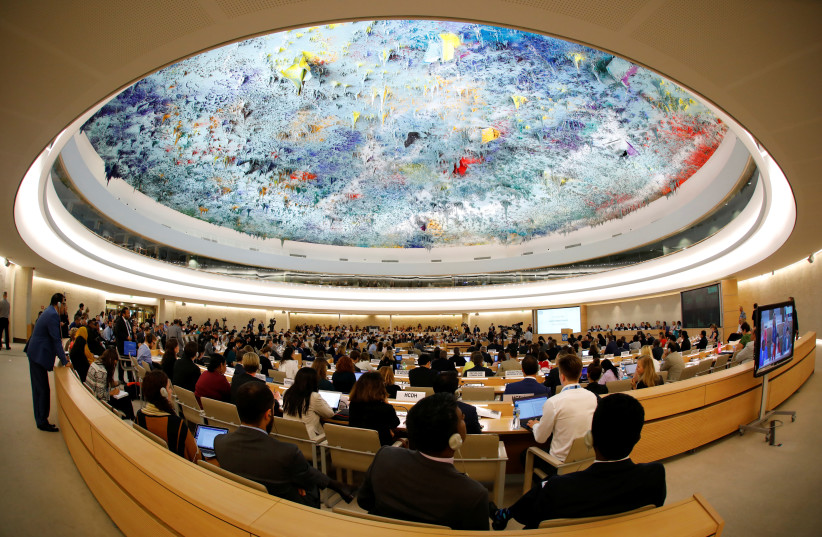
Overview of the Human Rights Council one day after the U.S. announced their withdraw at the United Nations in Geneva, /  (photo credit: DENIS BALIBOUSE/REUTERS)

A United Nations Human Rights Council (UNHRC) resolution that sought to exact harsh penalties against Israel for its settlement activity and alleged human rights violations, including a call for an arms embargo, passed by a slim margin in Geneva on Friday.

It also called on the UN High Commissioner for Human Rights Michelle Bachelet to present a report next year on how Israel can be better forced to comply with UN resolutions that call on it to halt settlement activity and withdraw to the pre-1967 lines.

The 47-member body approved the text by a 22-8 vote, with 17 abstentions as it wrapped up its 43rd sessions.

Those who opposed to the measure were: Australia, Austria, Brazil, Bangladesh, the Czech Republic, Fiji, Togo and the Ukraine.

Those who abstained were: Bahamas, Cameroon, Democratic Republic of the Congo, Denmark, Germany, India, Marshal Islands, Italy, Japan, Nepal, Netherlands, Philippines, Poland, Republic of Korea, Slovakia, Spain and Uruguay.

The relocation of the controversial text from Agenda Item 7 to Agenda Item 2 failed to garner more support. The Palestinian Authority had highlighted the importance of this particular text given the pending Israeli annexation of portions of the West Bank.

The resolution called “upon all States to promote compliance with international law and all High Contracting Parties to the Fourth Geneva Convention … including by ensuring that they do not become involved in internationally unlawful conduct, and to assess the potential that arms could be used to commit or facilitate a serious violation of international humanitarian or human rights law.”

Israel traditionally boycotts all Agenda Item 7 debates to protest the mandate that the UNHRC must debate alleged Israeli human rights abuses at every session. Such a mandate exists only for Israel and is not leveled at any other country.

The placement of the accountability resolution under Agenda Item 7 allowed Israel’s Ambassador to the UN in Geneva Aviv Raz Shechter to take the floor.

She reminded the council that Israel and the Palestinian Authority had worked in partnership to prevent the spread of COVID-19 in the past months.
“The Palestinian representatives here, however, choose to ignore the facts, keep up with their narrative of the victim – as they have for the past 72 years,” she said.

Since Israel’s creation in 1948, Shechter said, “The Arab effort to deny and destroy the Jewish State started immediately – and for some, has never ceased.” Since then, she said, “Israel’s hope for peace was only met twice, by Egypt and Jordan.”

She charged that the council is biased for attacking only Israel when dealing with the conflict.

“This Council has one agenda item designed to condemn only one state. This item 7 is nothing but a systematic mechanism of discrimination against Israel and Israelis, one deeply rooted in the culture of this Council and of some of its member states,” Shechter said.

“Let’s call Item 7 by its proper name, the item of institutionalized antisemitism,” Shechter said. “Spreading false narratives and avoiding taking responsibility is not the path the Palestinians should be taking to promote their cause,” she added.

Shechter told the Council, “you are dealing with a conflict involving the rights of two peoples, not one. A conflict involving the suffering of two peoples, not one. These kind of conflicts need a direct negotiation process that brings peoples together rather than more recriminations of this Council that only serve to pull our peoples farther apart. We have enough of that!”

PLO Ambassador to the UN Ibrahim Khraishi recalled that the International Criminal Court was in the midst of deciding whether it had the jurisdiction to hear war crimes suits against Israelis for their actions against the Palestinians.

“States that abstain from voting for this resolution are sending a message to Israel inviting it to continue with its annexation project over the coming days. Speeches along can not stop this action. If they fail to dod so, then those who obstruct Justice must be held accountable,” Kharishi said.

The Council ended Friday without finalizing the passage of all the resolutions. On Monday when the session is resumed, it is expected to pass four pro-Palestinian and anti-Israel resolutions.

Two of those resolutions will continue to take Israel to task for its military and civilian hold over the West Bank, one of the resolutions affirms the Palestinian right to self-determination and one calls on Israel to return the Golan Heights to Syria.

With Israeli annexation pending, the thrust of the pro-Palestinian resolutions was to affirm Palestinian statehood, a two-state solution, the pre-1967 lines, to declare Israeli settlement activity to be illegal and to call the international community to talk for failing to hold Israel accountable.

The resolution on settlements “condemns the declaration made by Israeli officials calling for the annexation of Palestinian land and reaffirms the prohibition of acquisition of territory resulting from the use of force.”
The resolution on self-determination calls on the international community not to recognize Israeli annexation. It “calls upon all States to ensure their obligations of non-recognition, non-aid or assistance with regard to the serious breaches of peremptory norms of international law by Israel.”


Zawartość publikowanych artykułów i materiałów nie reprezentuje poglądów ani opinii Reunion’68,
ani też webmastera Blogu Reunion’68, chyba ze jest to wyraźnie zaznaczone.
Twoje uwagi, linki, własne artykuły lub wiadomości prześlij na adres:
webmaster@reunion68.com