Archive | August 2023

Gantz could have joined Netanyahu, now he’s complaining about the result

Gantz could have joined Netanyahu, now he’s complaining about the result – opinion

YARON SCHWARTZ


The Israeli opposition could have become a part of the coalition, yet opted to boycott the option. Now they’re complaining about the government that did form.
.
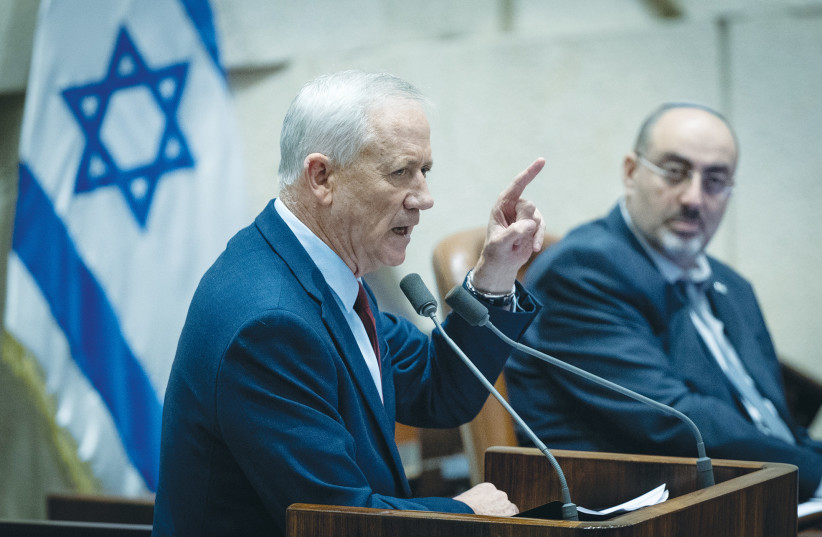
MK BENNY GANTZ addresses the Knesset plenum last month. / (photo credit: YONATAN SINDEL/FLASH90)

MK Benny Gantz can boycott Prime Minister Benjamin Netanyahu’s government or complain about it, but he can’t do both.

For more than four years, Gantz and other opposition leaders have insisted that they would not join a coalition with a “prime minister under indictment.”

There are two problems with that policy.

The first is that after more than seven years of investigations into alleged wrongdoing and a trial that has been ongoing for three years and counting, the key case against Netanyahu is unraveling – and this without a single defense witness having been called to the stand.

The state of the trial was revealed in June 2023 when the three distinguished Jerusalem District Court judges hearing the case informed the  prosecution that it would be “very difficult to establish the bribery charge against Netanyahu.”

It emerged that the very charge that had sparked national turmoil – leading to five senseless rounds of Knesset elections and hindering the momentum of Mideast peace brought about by the historic Abraham Accords – does not hold water.

The second problem with the opposition’s boycott of Netanyahu is that the voters grew as weary of it as they were distrustful of the indictments. Fully informed of all the charges against him, the lion’s share of the public gave Netanyahu and the parties that would end up as his coalition partners a solid parliamentary majority of 64 out of 120 seats.

Rather than spurring Gantz and company to reconsider their intransigent stance and attempt, for the good of the country, to become a part of Netanyahu’s coalition-in-formation, they chose to opt out and to whine about the one that he did forge.

Worse, they dusted off an old mantra used for years by Netanyahu’s detractors at home and abroad – that the government is “the most extreme in Israel’s history.” Indeed, there is nothing new in that label. In a 2009 op-ed in Foreign Policy, for instance, former Israeli peace negotiator Daniel Levy referred to Netanyahu’s government as “the most right-wing… in Israel’s history.” In a 2013 piece for the Daily Beast, journalist Ali Gharib wrote that Israel had “just sworn in perhaps its most right-wing government ever.” In 2014, Jeffrey Heller of Reuters stated that Netanyahu was “well-positioned to form what would likely be the most right-wing government in Israel’s 66-year history.” In 2015, Ishaan Tharoor wrote in The Washington Post: “An 11th-hour deal on Wednesday led to Israeli Prime Minister Benjamin Netanyahu forming the most right-wing government in his country’s history.” And in a farewell speech in 2016, then-outgoing-US Secretary of State John Kerry called Netanyahu’s coalition “the most right-wing in Israeli history, with an agenda driven by its most extreme elements.”

Other examples abound. Today’s chanting of the tired mantra is simply more of the same.

The noise has been drowning out a crucial point, however: The Israeli opposition could have become a part of the coalition, yet opted to boycott the option. And now that Netanyahu has formed a government with other parties, the opposition is complaining.

Although in Israel’s vibrant democracy it is legitimate to simultaneously boycott and complain, after 33 weeks of protests, it’s time for Gantz and his gang to reach a candid compromise with the government.


The writer is a former head of the International Institute for Counter-Terrorism’s office in Washington and a senior analyst at Acumen Risk Ltd., a risk management firm.


Zawartość publikowanych artykułów i materiałów nie reprezentuje poglądów ani opinii Reunion’68,
ani też webmastera Blogu Reunion’68, chyba ze jest to wyraźnie zaznaczone.
Twoje uwagi, linki, własne artykuły lub wiadomości prześlij na adres:
webmaster@reunion68.com


San Diego Police Investigating Hate Crime Against Orthodox Rabbi

San Diego Police Investigating Hate Crime Against Orthodox Rabbi

Dion J. Pierre


The San Diego skyline. Photo: Wikimedia Commons

Police in San Diego, California are investigating a hate crime in which an Orthodox rabbi was verbally abused and assaulted by a young male, an ABC affiliated reported on Friday.

On Monday morning, Rabbi Aharon Shapiro, who works for a local Orthodox Union chapter, was shopping for sodas at a 7-Eleven near San Diego State University when someone asked if he was Jewish and then, he told KGTV, “without taking a breath…launched into a tirade against Israel, against the Jews.”

The man, Rabbi Shapiro continued, also said “all Jews should be dead, all Jews deserve to die” before snatching Shapiro’s tzitzits off his garment and running off.

“[The] alleged assault on a San Diego Rabbi that was accompanied by antisemitic slurs is reprehensible and another indicator of the hatred that exists toward the Jewish community,” the San Diego office of the Anti-Defamation League (ADL) tweeted after the incident. “We are grateful that San Diego Police are investigating this incident as a hate crime and call on local leaders to condemn this latest act of hate.”

Monday’s attack on Rabbi Shapiro is not the first antisemitic incident in San Diego in 2023. In May, an unidentified person used their own excrement to vandalize the walls of a University of California-San Diego (UCSD) residential bathroom with swastikas, while in March, a man toppled a decorative menorah mounted on the lawn of Chabad House at San Diego State University, the second time such an incident occurred in two years and third time overall that center had been vandalized.

California had the second most antisemitic incidents in the nation in 2022, according to an annual audit by the ADL, with 508, coming in only behind New York, where there were 518. In 2023, incidents on college campuses have raised concerns about the safety of students.

In April, back to back antisemitic acts occurred on and near the University of California, Santa Cruz (UCSC). In the first, a group of students organized a party commemorating the birthday of Adolf Hitler, and in the second, someone placed a flyer promoting antisemitic and homophobic ideas on the windshield of a car parked in downtown Santa Cruz. At Stanford University, antisemitic incidents “keep happening,” Rabbi Jessica Kirschner told The Algemeiner in a statement in April after someone etched a swastika into a metal panel of a bathroom and a mezuzah was stolen from an undergraduate resident.


Zawartość publikowanych artykułów i materiałów nie reprezentuje poglądów ani opinii Reunion’68,
ani też webmastera Blogu Reunion’68, chyba ze jest to wyraźnie zaznaczone.
Twoje uwagi, linki, własne artykuły lub wiadomości prześlij na adres:
webmaster@reunion68.com


Koniec przyjaźni Arabii Saudyjskiej i Zjednoczonych Emiratów Arabskich

Saudyjski następca tronu książę Mohammed bin Salman. (Fot. BANDAR AL-JALOUD)


Koniec przyjaźni Arabii Saudyjskiej i Zjednoczonych Emiratów Arabskich

Robert Stefanicki


Obie monarchie z Zatoki Perskiej uchodziły za najbliższych sojuszników. Dziś górę bierze rywalizacja.
Amerykański dziennik „The Wall Street Journal” doniósł o spotkaniu, na jakie w grudniu zeszłego roku saudyjski następca tronu książę Mohammed bin Salman zaprosił lokalnych dziennikarzy. Oznajmił wówczas, że Zjednoczone Emiraty Arabskie (ZEA) „dźgnęły nas w plecy” i że im “pokaże”. Dodał, iż wysłał do Abu Zabi listę żądań wraz z groźbą nałożenia sankcji, jeśli ZEA będą nadal podkopywać interesy królestwa w regionie.

– To będzie gorsze niż to, co zrobiłem z Katarem – cytowali księcia uczestnicy spotkania.

Zabrzmiało poważnie.

W 2017 r. Arabia zerwała relacje z Katarem i zaczęła blokadę gospodarczą emiratu, przy wsparciu ZEA i Bahrajnu. Normalizacja nastąpiła dopiero w 2021 r.

Arabia Saudyjska i Zjednoczone Emiraty Arabskie rywalizują o dominację w regionie

Według źródeł “WSJ”, animozje między Mohammedem bin Salmanem i prezydentem Zjednoczonych Emiratów Arabskich, szejkiem Mohammedem bin Zajedem Al Nahjanem, nie zostały załagodzone. Obaj nie rozmawiali ze sobą od ponad pół roku.

Czego dotyczy konflikt? Ogólnie rzecz biorąc odzwierciedla rywalizację Riadu i Abu Dhabi o dominację w regionie – o to samo zresztą chodziło w sporze saudyjsko-katarskim. Ta rywalizacja zawsze istniała, ale dotąd ustępowała wspólnocie interesów. Nasiliła się, gdy Arabia pod faktycznym kierownictwem młodego księcia, który zdołał spacyfikować krytyków wewnątrz królestwa, zaczęła być bardziej asertywna. Zbiegło się to ze zmniejszeniem zaangażowania w regionie USA.

Ostatnio Rijad naprawia relacje ze wszystkimi okolicznymi państwami, na czele z Teheranem, swoim arcyrywalem – w tym roku obydwa państwa wznowiły stosunki dyplomatyczne. Relacje z Katarem są poprawne. Coraz częściej mówi się o możliwości oficjalnego uznania Izraela przez Saudów, a na razie rozwijają się nieoficjalne kontakty tych państw.

Zbliżenie dyplomatyczne Arabii Saudyjskiej z Iranem zaskoczyło Zjednoczone Emiraty Arabskie. Podobnie jak przejęcie przez Rijad inicjatywy w przywracaniu Syrii do Ligii Arabskiej, o co od dawna starały się ZEA.

Rijad, ku niezadowoleniu USA, intensyfikuje też współpracę z Rosją, ale przede wszystkim z Chinami. Pomaga Libanowi, łagodzi napięcia między zwaśnionymi palestyńskimi partiami politycznymi. Tylko z Emiratami coraz więcej go dzieli.

Prezydent Zjednoczonych Emiratów Arabskich Mohamed bin Zayed Al Nahyan i premier Włoch Giorgia Meloni podczas międzynarodowej konferencji poświęconej problemom migracji. Rzym, 23 lipca 2023 r.

Prezydent Zjednoczonych Emiratów Arabskich Mohamed bin Zayed Al Nahyan i premier Włoch Giorgia Meloni podczas międzynarodowej konferencji poświęconej problemom migracji. Rzym, 23 lipca 2023 r.  Fot. Gregorio Borgia / AP Photo

Arabia Saudyjska i Zjednoczone Emiraty Arabskie – historia kłótni i konkurencji

Oba państwa zaczęły się kłócić już w 2009 r. – o lokalizację proponowanego przez Radę Współpracy w Zatoce (GCC) banku centralnego, który pozwalałby integrować gospodarki państw członkowskich i emitował wspólną walutę. GCC zgodziła się, że bank będzie w ZEA, ale Rijad wycofał się z planu w ostatniej chwili, bez wyjaśnienia. Do dziś nie ma ani banku, ani wspólnej waluty.

W 2015 r. Arabia na spółkę z ZEA zaczęły bombardowania szyickich rebeliantów Huti, którzy obalili sunnicki rząd Jemenu. Stopniowo cele obu partnerów się rozeszły, ponieważ Rijad wspierał uznany na arenie międzynarodowej rząd jemeńskiego prezydenta Abeda Rabbu Mansura Hadiego, a Abu Zabi – Południową Radę Tymczasową, ugrupowanie dążące do niepodległości południowego Jemenu. Dzięki temu ZEA uzyskały kontrolę nad wieloma jemeńskimi portami i wyspami, a tym samym dostęp do strategicznej cieśniny Bab al-Mandab.

Arabia, usiłująca zmniejszyć swoje uzależnienie od eksportu ropy naftowej, stała się dla Emiratów konkurencją również gospodarczą. Mohammed bin Salman zachęca firmy do przeniesienia swoich regionalnych siedzib do Rijadu, uruchomienia tam centrów technologicznych i logistycznych.

Pracuje też nad rozwojem turystyki. Do konserwatywnej Arabii jeździło się na pielgrzymkę do Mekki, a na wczasy do względnie liberalnego Dubaju. To ma się zmienić. W czerwcu zainaugurowała działalność linia lotnicza Rijadh Air, konkurent dla Fly Dubai. Po raz pierwszy pojawiły się również tanie połączenia lotnicze z Polski i paru innych krajów UE do Dammamu nad Zatoką Perską, chociaż wysoka cena saudyjskiej wizy może zniechęcić budżetowych turystów.

Areną sporu jest też OPEC. W październiku Zjednoczone Emiraty Arabskie oskarżyły Arabię Saudyjską o przymuszenie ich do zgody na ograniczenie wydobycia ropy. Emiratczycy zaczęli nawet mówić o wycofaniu się z OPEC.

Sudan – największa zadra w relacjach

Jednak obecnie największą zadrą w relacjach wydaje się Sudan. Obydwa kraje Zatoki Perskiej odegrały tam znaczącą rolę od czasu obalenia dyktatora Omara al-Baszira. Udzieliły znaczącej pomocy finansowej nowym władzom, za co Chartum się odwdzięczył: udzielił wsparcia militarnego Saudyjczykom w Jemenie i uległ namowom Emiratów, by nawiązać stosunki z Izraelem.

Wszystko zmieniło się, gdy w Sudanie wybuchła wojna domowa między regularną armią a potężną milicją RSF, które dotąd dzieliły się władzą. Arabia Saudyjska wspiera szefa armii generała Abd al-Fattaha Burhana, zaś Zjednoczone Emiraty Arabskie – szefa RSF, Mohameda Hamdana Dagalo.

Jest to odbicie wcześniejszej sytuacji w Jemenie, gdzie wojsko sudańskie walczyło po stronie wspieranego przez Rijad prezydenta Hadiego, a bojownicy RSF byli aktywni w południowym Jemenie, następnie w 2019 r. pojawili się w Libii, wspierając gen. Chalifę Haftara, watażkę popieranego przez Abu Zabi.

Podczas gdy Arabia Saudyjska wraz z Egiptem wspiera Burhana, Emiraty kooperują z Moskwą. Od 2017 r. w Sudanie przebywa Grupa Wagnera. Najemnicy kontrolują kopalnie złota, skąd kruszec jedzie do ZEA, a stamtąd do Rosji, co pośrednio pomaga Putinowi finansować wojnę w Ukrainie. 


Zawartość publikowanych artykułów i materiałów nie reprezentuje poglądów ani opinii Reunion’68,
ani też webmastera Blogu Reunion’68, chyba ze jest to wyraźnie zaznaczone.
Twoje uwagi, linki, własne artykuły lub wiadomości prześlij na adres:
webmaster@reunion68.com


Ancient ‘magic mirror’ discovered in northern Israel by youth leader

Ancient ‘magic mirror’ discovered in northern Israel by youth leader

JERUSALEM POST STAFF


Magic mirrors were used to protect against the Evil Eye in ancient times.
.

Youth leader Aviv Weizman holding the magic mirror plaque she discovered at Usha (photo credit: EMIL ALADJEM/ISRAEL ANTIQUITIES AUTHORITY) / Youth leader Aviv Weizman holding the magic mirror plaque she discovered at Usha / (photo credit: EMIL ALADJEM/ISRAEL ANTIQUITIES AUTHORITY)

A 1,500-year-old “magic mirror” from the Byzantine period was discovered by a 17-year-old Israeli taking part in a Young Leaders’ Survival Course at the Usha archaeological site in northern Israel, the Israel Antiquities Authority announced on Thursday.

Aviv Weizman, the youth leader who found the mirror, was taking part in a 90-km survival trek from Mount Meron to Mount Hermon as part of the Education Ministry’s Shelah Young Leaders’ Survival Course. During the trek, the young leaders participate in archaeological digs at sites located around the country.

While taking part in a dig directed by the Israel Antiquities Authority archaeologist Hanaa Abu Uqsa Abud at Usha, a site near Kiryat Ata, Weizman spotted an unusual pottery shard sticking out of the ground between the walls of a building.

Weizman showed the sherd to Dr. Einat Ambar-Armon, director of the Israel Antiquities Authority Northern Education Center, who identified it as the plaque of a “magic mirror.”

What is a magic mirror?

“The fragment is part of a ‘magical mirror’ from the Byzantine period, the 4th–6th centuries CE,” explained Navit Popovitch, Israel Antiquities Authority curator of the classical Periods. “A glass mirror, for protection against the Evil Eye, was placed in the middle of the plaque: The idea was that the evil spirit, such as a demon, who looked in the mirror, would see his own reflection, and this would protect the owner of the mirror. Similar mirror plaques have been found in the past as funerary gifts in tombs, in order to protect the deceased in their journey to the world to come.”

Dr. Einat Ambar-Armon explains what the ”magic mirror” is to Aviv Weizman, who found the mirror. (credit: EMIL ALADJEM/ISRAEL ANTIQUITIES AUTHORITY)

“The participation of the pupils in the archaeological excavations deepens their feeling of belonging to the country and its heritage,” said Eli Shayish, director of the Education Ministry’s Shelah and Land of Israel Studies.

“During the week-long trek, the young leaders discovered additional finds, including pottery jars, coins, decorated stone fragments, and even a water aqueduct,” Eli Escusido, director of the Israel Antiquities Authority, added. “History, usually taught in the classroom, comes to life from the ground. A pupil who uncovers a find in the course of an excavation will never forget the experience. There is no better way to connect the youth to the country and the heritage.”

Saar Ganor, coordinator of the project on behalf of the Israel Antiquities Authority, explained that “this find embellishes the two-way contribution of the cooperation between the Israel Antiquities Authority and the Education Ministry’s Shelah Project: At the same time, uncovering the country’s past, and also providing the youth with a personal empowering experience, connecting them to their roots.”


Zawartość publikowanych artykułów i materiałów nie reprezentuje poglądów ani opinii Reunion’68,
ani też webmastera Blogu Reunion’68, chyba ze jest to wyraźnie zaznaczone.
Twoje uwagi, linki, własne artykuły lub wiadomości prześlij na adres:
webmaster@reunion68.com


Palestinian Militants Use Teenage Girls as Combat Spotters: Report

Palestinian Militants Use Teenage Girls as Combat Spotters: Report

Andrew Bernard


Militants stand during the funeral of two Palestinian Islamic Jihad gunmen who were killed in an Israeli raid, in Jenin refugee camp, in the West Bank on May 10, 2023. Photo: REUTERS/Raneen Sawafta

Armed Palestinian extremist groups in the West Bank have recruited teenage girls as spotters to report on Israeli troop movements, according to a new report.

The Jerusalem Center for Public Affairs, an Israeli think tank, released a report this week citing posts on the messaging app Telegram in a channel used by fighters in the West Bank town of Jenin, which has been a focus of Israeli counterterrorism operations in recent months as extremist groups have expanded their presence in the town. 

One post from April 2022 addressed to “the jihad fighters” of Jenin encourages them to “use children and residents to observe and gather information” in order to ambush Israeli soldiers.

“Young people, do not take your eyes off the [Israeli] Dotan checkpoint,” says another of the Telegram posts from February 2022. “There are special observation units to monitor Dotan, and the checkpoint is subject to 24-hour observation. We will keep you informed of any new [development]. Monitor [the checkpoints] al-Salam and al-Jalameh.”

Such activity raises questions about whether unarmed people observing soldiers on behalf of a militant group — so-called spotters — can be considered combatants who have lost the protections afforded to civilians. According to the US Department of Defense’s Law of War Manual, “providing or relaying information of immediate use in combat operations” or “acting as a guide or lookout for combatants conducting military operations” would make someone a valid target for attack.

One alleged spotter flagged in the Jerusalem Center’s report is Sadil Naghnaghia, a 15 year-old girl who was killed by the Israeli military in Jenin in June.

Video from Naghnaghia’s phone indicates that immediately before she was shot, she was recording video of an Israel Defense Forces (IDF) armored personnel carrier.

While the report doesn’t conclusively show that Naghnaghia was transmitting the video to militant groups, at her funeral she was draped in the regalia of Palestinian Islamic Jihad, a widely designated terrorist group, and had sent messages and posted on social media indicating her desire to become a “martyr.”

The use of child spotters in Jenin is the latest example of the radicalization of Palestinian children by militant groups. Hamas, Palestinian Islamic Jihad, and other extremist organizations in both the West Bank and Gaza actively recruit children into the ranks of their fighters.

This year some 65,000 Palestinian children attended “summer camps” that included combat training and anti-Israel indoctrination.

Meanwhile, despite pressure from the US Congress and European Parliament on the Palestinian Authority to reform its curricula or risk losing aid money, watchdog groups continue to find antisemitic and anti-Israel content in Palestinian school textbooks.

The Israeli education watchdog Impact-se, for example, has tracked examples of antisemitic material provided to children living in territory controlled by the Palestinian Authority. These include study cards for 11th graders accusing Jews of being “in control of global events through financial power,” assignments instructing 7th graders to describe Israeli soldiers as “Satan’s aides,” and a textbook chapter imploring Muslims to “liberate” the Al-Aqsa Mosque in Jerusalem.


Zawartość publikowanych artykułów i materiałów nie reprezentuje poglądów ani opinii Reunion’68,
ani też webmastera Blogu Reunion’68, chyba ze jest to wyraźnie zaznaczone.
Twoje uwagi, linki, własne artykuły lub wiadomości prześlij na adres:
webmaster@reunion68.com