
Archive | 2026/03/28

Wojna z Iranem nie była „niesprowokowana”


Wojna z Iranem nie była „niesprowokowana”

Brendan O’Neill


Od pewnego czasu dużo myślę o określeniu „niesprowokowana wojna”. Od wybuchu działań wojennych w Iranie zwrot ten często pada z ust lewicy. W tym tygodniu Jeremy Corbyn, Zarah Sultana oraz dziesiątki leciwych pacyfistów podpisali list do „Guardiana”, w którym przekonywali, że Wielka Brytania nie powinna mieć nic wspólnego z „niesprowokowaną wojną” Ameryki i Izraela w Iranie.

Głośni krytycy Trumpa i legiony wrogów Izraela używają języka jako broni

Oto moje pytanie: czy gwałt i mordowanie Żydów nie stanowią prowokacji? Czy największa antyżydowska zbrodnia od czasów Holokaustu – 7 października – nie była prowokacją? Tyrani z Teheranu finansowali dżihadystycznych brutali, którzy dokonali tej rzezi. Obsypywali bronią i szkoleniami tę armię antysemitów, która niecałe trzy lata temu najechała Izrael drogą powietrzną, morską i lądową. To nie była prowokacja?

Czy nie jest prowokacją zasypywanie sąsiedniego kraju tysiącami rakiet? Czy nie jest prowokacją poddawanie narodu zmasowanemu ostrzałowi balistycznemu, który prowadzi do wysiedlenia dziesiątek tysięcy cywilów i śmierci wielu niewinnych ludzi, w tym 12 druzyjskich dzieci grających w piłkę? Tym właśnie zajmował się Hezbollah przez ostatnie trzy lata. Hezbollah otrzymał setki milionów dolarów od Islamskiej Republiki, by prowadzić dokładnie takie brutalne nękanie państwa żydowskiego. To nie jest prowokacja?

Można powiedzieć wiele rzeczy o wojnie Ameryki i Izraela z Iranem. Jedni uznają ją za odważną, inni za lekkomyślną. Ale jednego powiedzieć nie można – przynajmniej jeśli chce się być traktowanym poważnie – że jest „niesprowokowana”. Chyba że uważa się, iż masowe mordowanie Żydów nie powinno pociągać za sobą żadnych konsekwencji. Że, tak jak w latach 30. czy w latach 90. XV wieku, tłumy antysemitów powinny móc zabijać Żydów bezkarnie. Na twoim miejscu zachowałbym taki pogląd dla siebie.

Tradycyjnie to zwolennicy wojen uciekali się do językowych sztuczek, by uzasadnić swoje działania lub ukryć prawdziwe motywy. Tariq Ali nazywa to „gramatyką oszustwa”. Dziś jednak taka semantyczna dwuznaczność częściej występuje po stronie przeciwników wojny.

Co więcej, prezydent Trump – w przeciwieństwie do swoich poprzedników, którzy upiększali prowadzenie wojen jako „misje pokojowe” – mówił o naturze wojny z niezwykłą szczerością. Mówił o „śmierci, ogniu i furii”, które spadną na reżim irański. To brzydkie, ale uczciwe. To druga strona – głośni krytycy Trumpa i legiony wrogów Izraela – używa języka nie jako narzędzia wyjaśniania, lecz ukrywania.

„Niesprowokowana wojna” – to nie tylko nieprawda, to świadome wprowadzanie w błąd. Zasłania grubą zasłoną wydarzenia ostatnich trzech lat. Rozgrzesza Islamską Republikę z jej grzechów brutalnego antysemityzmu. Wymazuje z pamięci zbrodnie wojenne finansowane przez ten reżim i skłania nas do postrzegania Iranu jako niewinnej ofiary „imperialnego” ataku ze strony państwa żydowskiego i jego amerykańskich popleczników. To kłamstwo udające krytykę.

Jest jeszcze „nielegalna wojna”. Kto tak twierdzi? Kto uczynił media sędzią, ławą przysięgłych i katem w kwestii tego, kiedy państwom wolno walczyć? Moje stanowisko jest proste: jeśli prawo międzynarodowe zabrania jedynemu żydowskiemu państwu ścigania islamistycznych despotów, którzy finansowali gwałt i mordowanie jego obywateli, to takie prawo jest absurdem. Co gorsza – jest antysemickie.

Jak inni, obawiam się tej wojny. Ale jeszcze bardziej obawiam się sprzeciwu wobec niej. Widać tu świadomą niechęć do zmierzenia się z tym, co jest stawką w tym teatrze napięć. To nie jest „kolejny Irak”. Tamta katastrofa była napędzana nieprawdami o zagrożeniu ze strony Saddama dla Zachodu. Islamska Republika jest zagrożeniem. Zasypywała naszego sojusznika, Izrael, falami przemocy. Jej barbarzyńscy pełnomocnicy sieją chaos na Bliskim Wschodzie. Jej teokratyczna nietolerancja sięga także Zachodu, gdzie finansowała terror.

Infantylizując tę islamistyczną tyranię i przedstawiając ją jako ofiarę tych podłych Żydów, lewica i znaczna część mediów stały się agentami zaciemniania obrazu. Mówi się, że pierwszą ofiarą wojny jest prawda. Teraz jest nią także pierwsza ofiara antywojenności.

Wokół tej wojny unosi się moralny defetyzm, który głęboko mnie niepokoi. Jest w tym pewien rodzaj zadowolonego fatalizmu. Da się to wyczuć. Obecnie wieczorne wydania BBC News sprawiają wrażenie jednego długiego uśmieszku z kłopotów, jakie Ameryka sama na siebie sprowadziła. Można odnieść wrażenie, że niektórzy wręcz chcieliby zobaczyć, jak Ameryka i Izrael „dostają nauczkę”. Dla mnie to wygląda jak kulturowa auto-nienawiść przebrana za pacyfizm – postawa, która ma mniej wspólnego z dawnymi ruchami pokojowymi, a więcej z chorobliwym antyzachodnim nastawieniem szerzącym się na naszych uniwersytetach i w instytucjach.

Obawiam się, że ci ludzie nie doceniają, jak katastrofalne byłoby wyjście Islamskiej Republiki z tego konfliktu wzmocnionej. Zarówno regionalnie – gdzie żydowska ojczyzna znów znalazłaby się pod większym zagrożeniem – jak i globalnie, gdzie islamizm zyskałby nowe życie, byłoby to katastrofalne dla ludzkości. Rozumiem: wojna jest brzydka, „zmiana reżimu” destabilizująca, a Trump nieobliczalny. Mimo to mogę bez żadnych wątpliwości powiedzieć, że chcę, aby Ameryka i Izrael wygrały tę wojnę – i to zdecydowanie.

Tim Shipman, Adrian Wooldridge i Sophie Winkleman omawiają najnowsze wydarzenia wokół kryzysu irańskiego w najnowszym odcinku podcastu Edition.


Link do oryginału: https://spectator.com/article/war-on-iran-was-not-unprovoked/

Spectator, 13 Marca 2026

Brendan O’Neill jest głównym publicystą politycznym „Spiked”. Jego nowa książka After the Pogrom: 7 October, Israel and the Crisis of Civilisation jest już dostępna.


Zawartość publikowanych artykułów i materiałów nie reprezentuje poglądów ani opinii Reunion’68,
ani też webmastera Blogu Reunion’68, chyba ze jest to wyraźnie zaznaczone.
Twoje uwagi, linki, własne artykuły lub wiadomości prześlij na adres:
webmaster@reunion68.com

China Is About to Lose Its Cuban Military Bases


China Is About to Lose Its Cuban Military Bases

Gordon G. Chang


  • Friends of Havana blame the U.S., but the Trump administration had to act before China turned the island into a military bastion.
  • Declassified intelligence showed that Chinese signals-intelligence collection facilities had been operating in Cuba since at least 2019.
  • “China and Cuba are negotiating to establish a new joint military training facility on the island, sparking alarm in Washington that it could lead to the stationing of Chinese troops and other security and intelligence operations just 100 miles off Florida’s coast.” — The Wall Street Journal, June 20, 2023.
  • President Donald Trump acted before the Chinese could base missiles in Cuba.

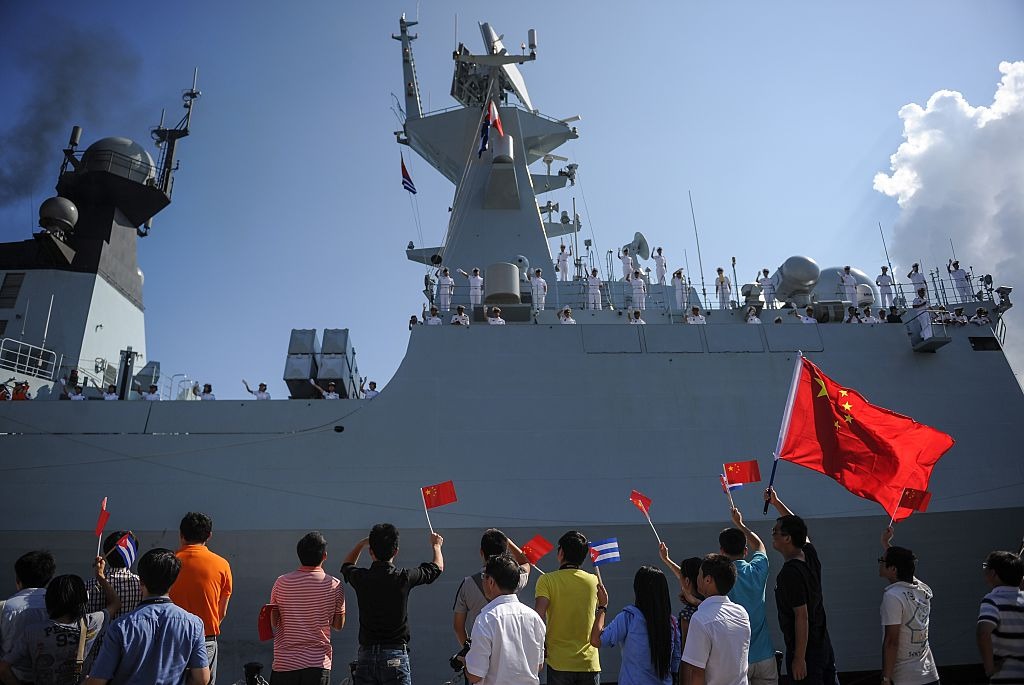
“China and Cuba are negotiating to establish a new joint military training facility on the island,” reported the Wall Street Journal in 2023. So, whatever one thinks of the harsh consequences of the U.S. naval embargo, the Havana regime, by allowing the Chinese to have the run of the island, does pose a threat to the United States. Pictured: People wave the flags of Cuba and China as several Chinese Navy vessels enter the port of Havana on November 10, 2015. (Photo by Yamil Lage/AFP via Getty Images)

Cuban society, due to a U.S. naval embargo, is close to collapse.

Friends of Havana blame the U.S., but the Trump administration had to act before China turned the island into a military bastion.

America took control of Venezuela’s national oil company, PDVSA, after the January 3 raid that resulted in the capture of Nicolás Maduro and his wife. Then the U.S. stopped the flow of Venezuelan oil to the Cuban regime.

At the same time, the Trump administration, by threatening tariffs on oil suppliers, imposed a de facto oil embargo on Havana. The U.S. Navy has deterred vessels from unloading cargo in Cuba.

To get through the American picket line, tankers have been employing deceptive tactics. For instance, the Hong Kong-flagged Sea Horse, carrying gasoil, was falsely broadcasting that it was “not under command” and drifting in the Sargasso Sea for almost three weeks. In reality, the ship spoofed its location and probably unloaded 190,000 barrels in Cuba in the early part of this month.

A delivery from the Sea Horseaccording to the Windward site, would be “the first confirmed arrival of a refined products cargo at the island since early January.”

As a result of the American actions, Cuba has almost run out of energy. The Cuban grid has collapsed three times so far this month, throwing the island into darkness.

“Why is the U.S. doing this?” asks Cambridge University’s Jostein Hauge on X, referring to the blockade on Cuba. “For no reason other than its dislike of the Cuban regime. Cuba poses no threat to the U.S.”

Really?

“China uses Cuba as a platform for many of its regional intelligence and security operations,” Joseph Humire, then executive director of the Center for a Secure Free Society, told this author in 2021.

There is, most prominently, the Lourdes facility just west of Havana near Bejucal, once the Soviet Union’s largest listening station outside its borders. The Chinese are thought to have taken over the facility shortly after the fall of the USSR.

China now has more than just Lourdes. A December 2024 Center for Strategic & International Studies report identifies three more likely Chinese listening posts in Cuba. There is the Soviet-era Calabazar, and a second, Wajay, appears to have been built after the fall of the Soviet Union. There is also a new station, El Salao.

The CSIS report notes that unconfirmed accounts of China’s intelligence presence on the island began with the visit of China’s Defense Minister General Chi Haotian in 1999.

The Chinese may have been operating listening posts in Cuba since 1993, R. Evan Ellis of the U.S. Army War College told Gatestone at the beginning of last year.

China and Cuba, the Wall Street Journal reported in June 2023, agreed in principle to establish a new listening site on Cuban soil. The Biden administration denied the report, but two days later declassified intelligence showing that Chinese signals-intelligence collection facilities had been operating in Cuba since at least 2019.

Cuba is an ideal location to surveil America. “Sitting less than 100 miles south of Florida, Cuba is well-positioned to keep watch on sensitive communications and activities, including those of the U.S. military,” the CSIS report states. “The southeastern seaboard of the United States brims with military bases, combatant command headquarters, space launch centers, and military testing sites.”

Moreover, Cuba is an ideal location for a Chinese military base. “China and Cuba are negotiating to establish a new joint military training facility on the island, sparking alarm in Washington that it could lead to the stationing of Chinese troops and other security and intelligence operations just 100 miles off Florida’s coast,” reported the Wall Street Journal in 2023.

China stated that the Wall Street Journal report was “totally mendacious and unfounded,” but it is nonetheless evident that China wants an enhanced facility on Cuba, just as it has established de facto military sites throughout Latin America.

Moreover, President Donald Trump acted before the Chinese could base missiles in Cuba.

So, whatever one thinks of the harsh consequences of the U.S. naval embargo — there is a worsening humanitarian crisis in Cuba now — the Havana regime, by allowing the Chinese to have the run of the island, does pose a threat to the United States.


Gordon G. Chang is the author of Plan Red: China’s Project to Destroy America, a Gatestone Institute distinguished senior fellow, and a member of its Advisory Board.


Zawartość publikowanych artykułów i materiałów nie reprezentuje poglądów ani opinii Reunion’68,
ani też webmastera Blogu Reunion’68, chyba ze jest to wyraźnie zaznaczone.
Twoje uwagi, linki, własne artykuły lub wiadomości prześlij na adres:
webmaster@reunion68.com


Pro-Palestinian Activists Plan ‘Alternative Eurovision’ in Belgium, Protesting Israel’s Participation in Song Contest


Pro-Palestinian Activists Plan ‘Alternative Eurovision’ in Belgium, Protesting Israel’s Participation in Song Contest

Shiryn Ghermezian


A photographer takes a picture of a TV screen in Wiener Stadthalle, the venue of next year’s Eurovision in Vienna, Austria, Nov. 18, 2025. Photo: REUTERS/Leonhard Foeger

Several Belgian organizations are co-hosting their own singing competition in Brussels in solidarity with Palestinians and in protest of Israel’s participation in the 2026 Eurovision Song Contest (ESC) taking place in Vienna, Austria, in May.

The “United for Palestine” singing competition is being marketed on its website as the “alternative Eurovision Song Contest” and will take place in the concert hall La Madeleine on May 12. That same day, Noam Bettan, Israel’s representative in the ESC this year, will perform his new song “Michelle” in the first semi-finals of the Eurovision.

The pro-Palestinian singing contest will feature several Belgian artists and past Eurovision contestants, including Belgium’s former representatives Gustaph and Geike Arnaert. Palestinian artists will also perform, including Nia Barghouti.

The organizers are protesting against the European Broadcasting Union, which organizes the Eurovision, and its decision to allow Israel to compete in the ESC. The anti-Israel activists want the Jewish state to be excluded from the competition because of its military actions against Hamas terrorists in the Gaza Strip — a conflict that began with the Hamas-led invasion of and massacre across southern Israel on Oct. 7, 2023.

“The Eurovision Song Contest profiles itself as apolitical and connecting. But culture is never separate from reality … And yet Israel will have an international stage,” organizers wrote on the event’s website. “That is not a neutral choice. A decision with consequences. The stage becomes a message that normalizes violence and exposes millions of viewers to Israeli propaganda … We refuse double standards. We refuse business as usual.”

Organizers of the “United for Palestine” competition also launched a petition that calls for Israel to be banned from the ESC this year, and for all public broadcasters and Belgian representatives not to participate and broadcast in the contest.

“While Israel in Palestine is mass killing civilians, blocking humanitarian aid, and tramping on international law, the country gets a place on the stage of the Eurovision Song Contest,” the petition said in part. “That is unacceptable. We refuse to watch.”

The event is an initiative of the organizations 11.11.11 and Intal, the unions ABVV-FGTB and ACV-CSC, and the charities SOS Gaza and Vrede vzw.

Spain, Slovenia, Ireland, Iceland, and the Netherlands have already withdrawn from the ESC in protest of Israel’s participation. Sweden’s representative in the Eurovision this year, Felicia, has publicly called for Israel to be banned from the 2026 competition. In response, the EBU issued a statement reminding all ESC contestants that they must maintain a stance of neutrality, according to the rules of the competition.

“The EBU supports the right to freedom of expression; however, the Eurovision Song Contest operates under rules that ensure neutrality and an environment of mutual respect,” the EBU stated. “Participants cannot use Eurovision as a political stage or create controversies that may divert attention away from the music.”

“The Code of Conduct and Duty of Care protocol, developed by the union’s members, clearly state that participants ‘must not exploit the Eurovision Song Contest’ or use the event ‘as a tool of pressure through political statements or by creating controversies, thereby diverting attention from the purpose of the event, which is the celebration of music and the promotion of unity,’” the union further stated. “The code also emphasizes that mutual respect between artists is essential.”


Zawartość publikowanych artykułów i materiałów nie reprezentuje poglądów ani opinii Reunion’68,
ani też webmastera Blogu Reunion’68, chyba ze jest to wyraźnie zaznaczone.
Twoje uwagi, linki, własne artykuły lub wiadomości prześlij na adres:
webmaster@reunion68.com