
Archive | 2026/03/21

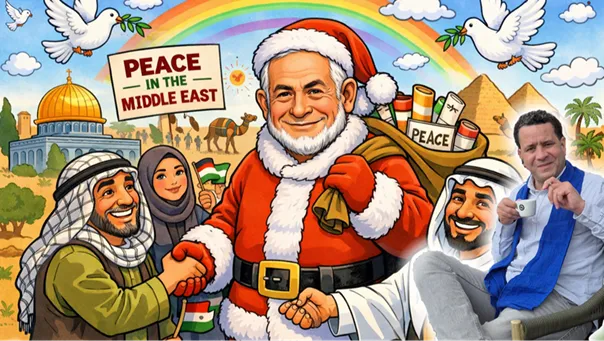
Netanjahu jest Świętym Mikołajem Bliskiego Wschodu


Netanjahu jest Świętym Mikołajem Bliskiego Wschodu

Mohamed Saad Khiralla


Od ataku z 7 października Izrael i jego premier Benjamin Netanjahu dokonali niemożliwego. Odnieśli zwycięstwo – od Gazy przez Liban, Jemen aż po Iran. To początek nowej ery – pisze Egipcjanin Mohame

.

Lampa Aladyna w arabskiej mitologii jest symbolem nadludzkiej mocy i spełniania

niemożliwych życzeń; należy do świata „Tysiąca i jednej nocy”, gdzie wystarczy

potrzeć starą, brązową lampę, aby duch posłusznie się pojawił i spełnił każde

życzenie.

W mitologii zachodniej dominującym obrazem idei spełniania życzeń jest Święty

Mikołaj; pojawia się pod koniec roku, obładowany prezentami, w świątecznej

atmosferze, na którą dzieci czekają z entuzjazmem.

Dlatego nie jest niczym dziwnym, że w kulturze codziennej – zarówno w świecie

arabskim, jak i na Zachodzie – słyszy się zwroty takie jak: „Nie jestem duchem

Aladyna” albo „Nie jestem Świętym Mikołajem”, gdy ktoś oczekuje od nas czegoś

przekraczającego nasze możliwości.

Polityka jednak czasem tworzy postaci, które – w oczach zarówno swoich

zwolenników, jak i przeciwników – zdają się przekraczać wszystko, co wcześniej było

możliwe do wyobrażenia.

Kilka dni temu byłem gościem dziennikarki Marii Abd Rabbo w izraelskiej stacji

radiowej Radio Makan, aby rozmawiać o trwającej wojnie między USA i Izraelem z

jednej strony a Iranem z drugiej. W trakcie rozmowy powiedziałem coś, w co dziś

wierzę jeszcze bardziej: że Benjamin Netanjahu jest Świętym Mikołajem Bliskiego

Wschodu.

Może to brzmieć szokująco, ale dla mnie nie jest to reakcja emocjonalna, lecz

polityczny opis oparty na chłodnej analizie łącznych rezultatów ostatnich dwóch lat i

pięciu miesięcy. Od czasu ataków terrorystycznych z 7 października 2023 roku

„polityczne i militarne dary”, jakie Netanjahu przekazał regionowi, nie ustają –

niezależnie od tego, czy ktoś się z nim zgadza, czy nie.

Kto mógłby uwierzyć, że wielcy liderzy obozu wrogości i wyzerowanych świętych

narracji – tego, co przez lata nazywano „osią oporu” – upadną w taki sposób?

W Gazie obecność Jahji Sinwara i Mohammeda Deifa dobiegła końca, podobnie jak

wielu innych im podobnych, a sam ruch Hamas wyraźnie znajduje się dziś w fazie

schyłkowej.

W Libanie Hassan Nasrallah i wielu jemu podobnych zeszli ze sceny politycznej i

militarnej, a czas dojrzewa do rozmowy o tym, jak zostanie napisany finał

Hezbollahu.

W Syrii Baszar al-Asad odszedł bez powrotu do Rosji, a jego reżim Baas przestał

istnieć. Człowiek, który uderzał we własny naród beczkami z materiałami

wybuchowymi i bronią chemiczną, dziś dogorywa/przebywa na wygnaniu.

W samym Iranie najwyższe kierownictwo państwa weszło w bezprecedensową fazę

wyczerpania po likwidacji Alego Chameneiego w ataku, który stanowił wielki punkt

zwrotny w przebiegu wojny. Następnie kolejne ataki dopisały do listy zabitych

następne znane nazwiska z irańskiej struktury władzy.

Najnowszym z nich, zaledwie kilka godzin temu, był Ali Laridżani – nie zwykły polityk,

lecz mąż stanu z najściślejszego kręgu w pobliżu centrum decyzyjnego Iranu;

wcześniej przewodniczący parlamentu, przez lata odpowiedzialny za kwestie

nuklearne, a później sekretarz Najwyższej Rady Bezpieczeństwa Narodowego. Był

mózgiem koordynującym działania między instytucjami wojskowymi i politycznymi.

Uważano go za jednego z najbardziej zdolnych do prowadzenia kraju po erze

Chameneiego – zanim Izrael ogłosił, że był celem uderzenia w Teheranie.

Razem z nim znajdował się Gholamreza Soleimani, dowódca sił Basidż – nie zwykły

oficer polowy, lecz jeden z kluczowych elementów wewnętrznego aparatu kontroli

reżimu. Basidż, jako formacja bezpieczeństwa związana z Korpusem

Strażników Rewolucji, odegrała decydującą rolę w tłumieniu protestów społecznych,

szczególnie wśród irańskiej młodzieży i kobiet w ostatnich latach. Zwłaszcza podczas

fali poprzedzającej obecną wojnę – w której zginęły tysiące odważnych i niewinnych

młodych ludzi, marzących jedynie o wolności.

Pochodzę z tej części świata, którą nazywa się Bliskim Wschodem, i dobrze wiem, co

uczyniły islamistyczne grupy zbrojne oraz co spowodował irański reżim – ich

największy patron.

Wiem, jak miasta zamieniały się w ruiny, jak marnowano całe pokolenia i jak śmierć

była powielana jako codzienny przekaz polityczny.

Wiem też, jak skutki tego rozlały się na Europę: ostra polaryzacja, podziały

społeczne, napięcia kulturowe i powrót idei, które – jak sądziliśmy – kontynent

zostawił za sobą dekady temu.

Ogromne nagromadzenie nienawiści, budowane przez dziesięciolecia inwestowania

w wrogość, sprawia, że duża część Bliskiego Wschodu nie jest w stanie uznać tego,

co dzieje się na ich oczach.

W świadomości zbiorowej – kształtowanej przez trójcę: meczet, szkołę i państwowy

aparat propagandy – obraz Żyda i Izraelczyka zaszczepiany jest jako obraz

absolutnego wroga, a nie jako przeciwnika politycznego, którego działania można

oceniać według obiektywnych kryteriów.

Dlatego wielu nie potrafi przyznać, że to, co zostało osiągnięte w tej wojnie,

przekracza to, co wydawało się możliwe – nawet w politycznej wyobraźni.

Gdyby sam duch Aladyna się pojawił, albo gdyby Święty Mikołaj zstąpił z bieguna

północnego, nie byłoby im łatwo osiągnąć to, co faktycznie dokonano na ziemi w

tym okresie przez premiera Izraela.

Dlatego mówię: obiektywna i uczciwa analiza prowadzi tylko do jednego wniosku –

że Święty Mikołaj naprawdę pojawił się na Bliskim Wschodzie. Tym razem jednak nie

niósł zabawek dla dzieci; niósł radykalne przekształcenie równowagi sił w regionie,

które może otworzyć nowy horyzont – ograniczyć rozlew krwi, przerwać powtarzające

się cykle przemocy i skierować Bliski Wschód ku innemu początkowi, w którym

zwycięstwo ostatecznie należy do ludzkiej godności.

Dziękuję Ci, Benjaminie Netanjahu!


Mohamed Saad Khiralla

Pochodzący z Egiptu, mieszkający w Szwecji myśliciel polityczny i ekspert w sprawach Bliskiego Wschodu.

Link do szwedzkiego oryginału: https://bulletin.nu/saad-khiralla-netanyahu-ar-mellanosterns-jultomte

Bulletin.nu, 19 marca 2026


Zawartość publikowanych artykułów i materiałów nie reprezentuje poglądów ani opinii Reunion’68,
ani też webmastera Blogu Reunion’68, chyba ze jest to wyraźnie zaznaczone.
Twoje uwagi, linki, własne artykuły lub wiadomości prześlij na adres:
webmaster@reunion68.com



The ethnostate illusion


The ethnostate illusion

Melanie Phillips


Jews should be aware of the cry of pain behind a resurrected antisemitic libel.

Demographic diversity. Credit: geralt/Pixabay.

There’s been growing concern in America over the increasingly mainstream belief that Israel drags it into foreign wars, a belief given rocket fuel by the war against Iran. 

This belief not only ignores demonstrable reality—the thousands of Americans who have been killed by Iranian-backed terrorists or militias for almost half a century; the accelerated progress by Tehran towards nuclear weapons and ballistic missiles that could reach the United States; and the Iranian regime’s implacable goal of destroying America (the “Great Satan”) as well as Israel (the “Little Satan”). 

It also channels the odious image of war-mongering Jews straight out of the ancient antisemitism playbook. It’s an image reflecting the belief embedded in Western culture of the demonic, cunning Jews acting covertly in their own interests to put others in danger. 

This belief was formerly confined to cranks and nut jobs on the fringes of society. No longer. Mainstreamed by the Tucker Carlson faction, it’s cutting a swath across the ranks of conservatively minded, mainly young Americans. 

Last week, Brian McGinnis, a veteran U.S. Marine, burst into a hearing of the Senate Armed Services Committee in Washington, D.C., and yelled: “America does not want to send its sons and daughters to war for Israel!” 

In the United States, this belief has been fueling a widening division in Republican circles over the nature of conservatism, a fissure remarkably being framed around the issue of Israel. 

However, the claim that Iran is Israel’s war and that the Jews are risking World War III has erupted in Britain, too. As in the United States, it’s being expressed not just by dyed-in-the-wool antisemites and political activists on the far-right fringe, but also by apolitical, ordinary people. 

It’s based on a refusal to accept that Jewish and British or American interests actually coincide. Partly, that’s caused by an ignorance of world events so great that such people settle on Israel as the one country in the Middle East about which they ever hear—unfortunately, picking up mainly lies and distortions. 

But why has this trope of sinister Jewish power surfaced now in such volume and with such traction? 

Those listening carefully to such people discover they are telling us the reason. They believe that their culture is being taken away from them. They see the defamation of all white people as “colonialist” and privileged, and all men as violent, abusive and predatory.

In Britain, they have watched mass immigration transform their neighborhoods and their country out of all recognition on the basis that their own historic culture is racist and must be replaced by multiculturalism.

In both the United Kingdom and the United States, they have watched in horror the progressive destruction of social and moral norms, and the hijacking of language itself—producing the whole grisly gamut of intersectional bullying and Soviet-style denial of reason and reality.

And they view the Jews as being the cause of this because it’s the agenda of the left, and they see many prominent Jews on the left.

This is particularly so in America, where some 70% of Jews have embraced liberal ideologies. In Britain, too, Jews are disproportionately involved in public and political life.

Of course, that doesn’t mean that ideological leftism is a Jewish movement. It means that such people only see the Jews who are involved, ignoring the non-Jews who pump this stuff out in the universities and schools, the media, NGOs, the artistic world, the professions—in other words, the entire cultural elite.

There is, however, another element in this complaint that gives it an even more savage edge. The charge—and it’s toxic—is that the Jews who have destroyed the West are themselves immunized from the effects of this because they have the State of Israel to go to.

The Jews, say such people, maintain that it’s right and necessary for them to have a state for themselves, yet they are denying that privilege to the rest of us. They have a home of their own to go to; we don’t anymore.

This ignores the fact that most American or British Jews have no intention of living in Israel. It also fails to acknowledge those Jews who are not on the left, who are themselves American or British patriots and who support the idea that Americans and Brits are entitled to a national identity rooted in their history, culture and tradition.

But the complainants dismiss this because they say bitterly that the Jews have something they themselves aren’t allowed to have: an “ethnostate.” The left uses this to demonize Israel; the right wants one of its own.

This word is now as ubiquitous in these circles as it is absurd. An ethnostate restricts citizenship to members of a particular racial or ethnic group—in this case, defined as white people or born in the United Kingdom or the United States.

Britain was never an ethnostate. On the contrary, Britishness is an umbrella concept that allows immigrants to become equal citizens even if they don’t correspond to its white, Christian or dominant English culture.

America, the nation of immigrants with a large black African-heritage population, was never an ethnostate. And nor is Israel, where 20% of its citizens are Arabs, and a majority of Jews aren’t white-skinned Europeans but brown-skinned or black descendants of Jews from ancient Middle East communities.

Of course, it’s always the case that the deeper the trouble a society is in, the more it will turn on the Jews. And the charge of warmongering is inescapably and profoundly antisemitic.

Yet it’s impossible not to hear the genuine cry of pain—the justified sense of existential isolation, abandonment and betrayal shared by millions who haven’t gone down the antisemitism rabbit-hole, but simply want their nation and its historic culture back.

Jews of all people should be sympathetic to this. After all, the ancient Israelites were the earliest pioneers of the nation-state. More than any other people, Jews understand that in order to have a future, a people must connect to its past and maintain its historic culture.

Jews have benefited hugely from the civilized society that allowed them to prosper in America and Britain. So they have a duty to lend their voices to the defense of the West against Islamization and cultural takeover.

Unfortunately, virtually the only Jewish voices to be heard are those demonizing this as “white supremacy,” racism and “Islamophobia.” In Britain, Jewish leaders have supported government proposals to introduce protection for Muslims that will have a chilling effect on necessary debate about Islamic extremism.

This is very wrong in itself. But it’s also guaranteed to make resentment of the Jews even worse by appearing to prove the charge that the Jews “don’t care about the rest of us.” 

“So what?” many Jews would say in response; “antisemitism lies beyond reason and it’s eternal, so there’s no point even trying to fight it.” 

This is simply wrong. As I say in my new book, published this week, Fighting the Hate: A Handbook for Jews Under Siege, there’s plenty that can and should be done to combat it. 

True, antisemitism can never be defeated, but Jewish passivity makes it worse. Failing to produce arguments and evidence to show that claims of Jewish power over U.S. policy are groundless reinforces the belief that they are true.

Jews have to stand up for themselves in the right way. The Jewish world has consistently been doing so in the wrong way, and then wonders why it hasn’t gotten anywhere.

In my book, I set out a strategy for both individuals and community leaders that turns many of these flawed assumptions upside down. Community leaders should start speaking truths that Jews shy away from, such as the prevalence of Muslim antisemitism or Israel’s legally watertight claim to the land. Individuals should use difficult encounters about Israel as an opportunity to surprise their foes and so open their minds by at least a crack.

Even in today’s poisonous climate, this can have a remarkable effect. In any event, Jews—who have an obligation to stand up for truth against lies—should take on those foaming right now about “war-mongering for Israel” simply because it’s the right thing to do.


Melanie Phillips, a British journalist, broadcaster and author, writes a weekly column for JNS. Currently a columnist for The Times of London, her new book, Fighting the Hate: A Handbook for Jews Under Siege, has just been published by Wicked Son. Her previous book, The Builder’s Stone: How Jews and Christians Built the West and Why Only They Can Save It, was published in 2025. Access her work at: melaniephillips.substack.com.


Zawartość publikowanych artykułów i materiałów nie reprezentuje poglądów ani opinii Reunion’68,
ani też webmastera Blogu Reunion’68, chyba ze jest to wyraźnie zaznaczone.
Twoje uwagi, linki, własne artykuły lub wiadomości prześlij na adres:
webmaster@reunion68.com


´Iran’s Soccer Federation ‘Negotiating’ With FIFA to Relocate World Cup Matches From US to Mexico


Iran’s Soccer Federation ‘Negotiating’ With FIFA to Relocate World Cup Matches From US to Mexico

Shiryn Ghermezian


Soccer Football – FIFA World Cup 2026 – FIFA World Cup 2026 Draw – John F. Kennedy Center for the Performing Arts, Washington, DC, US – Dec. 5, 2025, General view as Draw Assistant Shaquille O’Neal draws Iran during the FIFA World Cup 2026 draw. Photo: REUTERS/Carlos Barria

Iran’s soccer federation said on Monday it is “negotiating” with FIFA to relocate the Islamic Republic’s first-round matches in the 2026 World Cup to Mexico from the United States to ensure the safety of its players.

“When Trump has explicitly stated that he cannot ensure the security of the Iranian national team, we will certainly not travel to America,” said Mehdi Taj, president of the Iranian Football Federation, in a statement shared on X by the Iranian Embassy in Mexico. “We are currently negotiating with FIFA to hold Iran’s matches in the World Cup in Mexico.”

The negotiations are taking place after the US and Israel launched joint airstrikes against Iran in late February, which led to the killing of Iranian Supreme Leader Ayatollah Ali Khamenei and several other high-ranking Iranian officials. Iran has since retaliated with attacks on Israel and US allies across the Middle East.

The 2026 FIFA World Cup will take place from June 11-July 19 in cities across the US, Canada and Mexico. Iran qualified for the 48-team tournament through its participation in the ‌Asian ⁠Football Conference and is set to compete in Group G at the World Cup. Iran’s national soccer team is scheduled to compete against New Zealand on June 15 and Belgium on June 21, both in Los Angeles, before going head-to-head against Egypt on June 26 in Seattle. Soccer fans from Iran are not allowed to enter the United States for the World Cup as part of a travel ban that the Trump administration imposed in June, but Iranian athletes and coaches are exempt from the ban.

Last week, US President Donald Trump wrote on the social media website Truth Social that Iran’s national soccer team is “welcome” to compete in World Cup, but he does not think “it is appropriate” for them to participate “for their own life and safety.”

The Iranian team responded to Trump’s post by saying in a statement on Telegram that a single person cannot exclude a country from the World Cup. They also suggested the US “lacks the ability” to provide security for World Cup-participating teams.

“The World Cup is a historic and international event and its governing body is FIFA — not any individual country. Iran’s national team, with strength and a series of decisive victories achieved by the brave sons of Iran, was among the first teams to qualify for this major tournament,” the statement said. “Certainly no one can exclude Iran’s national team from the World Cup. The only country that could be excluded is one that merely carries the title of ‘host’ yet lacks the ability to provide security for the teams participating in this global event.”

However, Iranian Sports and Youth Minister Ahmad Donyamali reportedly told state television it is “not possible” for the country to participate in the World Cup this year because of the US airstrikes on Iran. “Due to the wicked acts they have done against Iran — they have imposed two wars on us over just eight or nine months and have killed and martyred thousands of our people — definitely it’s not possible for us to take part in the World Cup,” he said, according to the Associated Press.

Trump later posted again on social media about the World Cup. “The United States of America looks very much forward to hosting the FIFA World Cup. Ticket sales are ‘through the roof!’” he added. “It will be the Greatest and Safest Sporting Event in American History. All Players, Officials, and Fans will be treated like the ‘STARS’ that they are!”

FIFA President Gianni Infantino said in an Instagram post last week that he met with President Trump and the latter “reiterated that the Iranian team is, of course, welcome to compete in the tournament in the United States.” FIFA Chief Operating Officer Heimo Schirgi recently said the World Cup is “too big” to postpone amid the ongoing conflict in the Middle East. He added that the organization hopes “everyone can participate that has qualified.”

Meanwhile, the UEFA, Europe’s governing body of soccer, has cancelled the “Finalissima” match in Doha, Qatar, between Argentina and Spain’s national soccer teams following security concerns related to the ongoing war between Iran, Israel, and the United States.


Zawartość publikowanych artykułów i materiałów nie reprezentuje poglądów ani opinii Reunion’68,
ani też webmastera Blogu Reunion’68, chyba ze jest to wyraźnie zaznaczone.
Twoje uwagi, linki, własne artykuły lub wiadomości prześlij na adres:
webmaster@reunion68.com