Archive | 2026/03/10

Zanim zwyciężymy: przetrwać wojnę

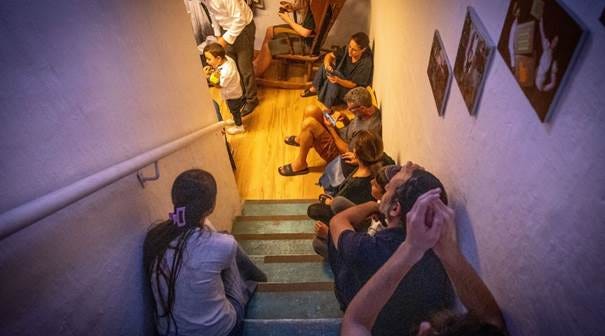
Zdjęcie: Noam Revkin Fenton/Flash 90


Zanim zwyciężymy: przetrwać wojnę

Forest Rain


To, że nie leżymy na podłodze, płacząc i krzycząc, nie znaczy, że jest nam łatwo. Nie jest.

Po napisaniu o Purim jako przewodniku przetrwania dla Żydów uświadomiłam sobie, że są rzeczy trudniejsze do wyjaśnienia — to, jak wygląda przetrwanie w czasie rzeczywistym.

Są rzeczy, o których nie chcę pisać.

Jak choćby o wyczerpaniu po bezsennych nocach, kiedy syreny alarmu przeciwlotniczego każą nam pędzić do schronu. O siedzeniu z innymi wyczerpanymi sąsiadami w nocnym chłodzie i między betonowymi ścianami, czekając na sygnał odwołujący alarm, który mówi, że możemy wrócić do łóżek — jeśli w ogóle da się zasnąć z adrenaliną krążącą w żyłach.

Para z niemowlęciem, w wieku tej wojny — jego mama była w ciąży 7 października. Teraz ma dwa lata i wie, żeby powiedzieć: „Czas iść do schronu”, kiedy rozlega się syrena.

Jak bolesne jest to, że uważa za coś normalnego przychodzenie do schronu w kostiumie na Purim. Albo usłyszeć córkę innego sąsiada, uczennicę czwartej klasy, mówiącą z tęsknotą: „Mam nadzieję, że będziemy mogli świętować Purim, kiedy to wszystko się skończy. Miałam się przebrać za lamparta”.

Nie sądzę, żebym miała słowa, by wyjaśnić różnicę w poziomie stresu w zależności od tego, jaki alert otrzymujemy.

Alert o nadlatujących rakietach z Iranu — ogłuszający alarm w telefonie ostrzegający o niebezpieczeństwie, ale też dający nam błogosławiony czas, by spokojnie dotrzeć do schronu bez biegu. Czekanie na kolejną serię syren. Jeśli się nie włączą i musimy tylko czekać, oznacza to, że rakieta została zestrzelona po drodze. Dobrze.

Kolejna seria syren oznacza, że rakieta jest blisko i może zostać przechwycona w naszej przestrzeni powietrznej — co skutkuje odłamkami wielkości samochodów spadającymi z nieba — albo, co gorsza, rakietą przebijającą się przez nasz system obrony i trafiającą w cel, pozostawiając całe dzielnice wyglądające tak, jakby tornado porwało budynki i rzuciło je z powrotem na ziemię w kawałkach.

Po zobaczeniu skutków takich rakiet, jak ta, która uderzyła w schron w Beit Shemesh, trudno spokojnie siedzieć i czekać na kolejne nadlatujące pociski.

Stres związany z dżwiękiem syreny na zewnątrz bez otrzymania alertu w telefonie to coś zupełnie innego. Rakiety wystrzeliwane z bliższych miejsc, na przykład przez Hezbollah, nie dają czasu na wcześniejsze ostrzeżenie. Ich pociski nie są tak niszczycielskie jak te z Iranu — ale usłyszenie wybuchu zanim dotrze się do schronu nie jest, delikatnie mówiąc, przyjemnym doświadczeniem.

Nie chcę pisać o stresie, który objawia się fizycznymi dolegliwościami. O przeziębieniach łapanych zbyt łatwo. O szczękach zaciśniętych tak mocno, że rozdzierające bóle głowy są nieuniknione. O zmęczeniu, rozbiciu i rozdrażnieniu.

O martwieniu się o innych bardziej niż o siebie. Czy dzieci są bezpieczne. Czy przyjaciele żyją. O pogrążonych w żałobie i rannych.

Boże, proszę, niech piloci wrócą bezpiecznie do domu. Jeden błąd techniczny — szczególnie nad terytorium wroga — to koszmar, o którym nawet nie chcemy myśleć.

Nie chcę pisać o problemach finansowych ani o tym, jak dalej żyć, kiedy wszystko zatrzymuje się przez wojnę.

Nie chcę o tym pisać. Co w tym zresztą nowego? To nie zaczęło się od amerykańskiego ataku na Iran; zaczęło się od inwazji z Gazy 7 października — i od innych irańskich pełnomocników, którzy dołączyli, próbując nas dokończyć.

Jak mam wyjaśnić lodowaty terror bezradności wobec przypływu śmierci próbującego nas wszystkich utopić? Nawet wielu Izraelczyków próbuje odsunąć od siebie pamięć tego uczucia.

Albo fizyczną reakcję ciała, które nie potrafi pomieścić wiedzy o tym, czego umysł właśnie się dowiedział — terroru, że najeźdźcy przyjdą także z północy, będą torturować, gwałcić i palić nas tak, jak zrobili to z naszymi przyjaciółmi na południu. Świadomości, że jeśli im się uda, nasi sąsiedzi również mogą powstać przeciwko nam i dołączyć do ludobójstwa Żydów.

Przez pierwsze kilka dni nasi sąsiedzi byli straszniejsi niż rakiety.

A gdy nasz naród zaczął się bronić, nasz stres zamienił się w strach i żałobę, gdy odkrywaliśmy kolejne stracone życia — dzieci naszych przyjaciół i przyjaciół naszych dzieci — tych, którzy byli na imprezie, i tych, którzy zginęli w walce.

Kto ma słowa, by opisać cień zakładników, który nieustannie nas prześladuje? Wiedzę, że my jedliśmy, kiedy oni nie jedli. Że my mieliśmy wygodę, podczas gdy oni byli torturowani. Ten terror empatii — widmowe współcierpienie z naszymi siostrami krzywdzonymi przez potwory, które zamordowały naszych braci.

Ten ciężar zmalał, gdy zakładnicy zostali uwolnieni. Ale uwolnienie to dopiero początek leczenia, a nie samo wyleczenie. Świadomość, że to samo może wydarzyć się ponownie, dopóki istnieje ten sam wróg z tą samą ideologią, nie daje nam żadnego spokoju.

Nie potrafię wyjaśnić stresu i frustracji związanych z wojnami przerywanymi zbyt wcześnie — w Gazie, w Libanie i w Iranie — w pogoni za nadzieją na „porozumienie”, o którym wiedzieliśmy, że nie jest prawdziwe i nie przetrwa. Wojny muszą kończyć się zwycięstwem, żeby naprawdę się skończyć. Odkładanie wszystkiego tylko pogarsza sprawę. Wiedzieliśmy, że jesteśmy zmuszani czekać, aż ogień znów się rozpali — a im dłużej czekaliśmy, tym bardziej niebezpieczny stawał się ten ogień.

I dlatego znów mierzymy się z Iranem, Hezbollahem i Hamasem, który nadal rządzi większością Gazy.

A jak mówią Izraelczycy: „Nie jest łatwo”.

Bo lubimy narzekać — ale tylko na rzeczy, które tak naprawdę nie mają znaczenia. Im trudniej jest naprawdę, tym mniej narzekamy.

Bo nie bierzemy udziału w olimpiadzie ofiar.

Przetrwamy.
I będziemy się rozwijać.

A teraz nadszedł czas, by wprowadzić w życie lekcje Purim sprzed 2500 lat. Nadszedł czas, by zamienić grozę w świętowanie, żałobę w radość.

Nadszedł czas, żebyśmy zwyciężyli.


Link do oryginału:

  Inspiration from Zion
Before we win: surviving the war
After writing about Purim as a guide for Jewish survival, I realized there are things harder to explain — what survival feels like in real time…
Read more

Zawartość publikowanych artykułów i materiałów nie reprezentuje poglądów ani opinii Reunion’68,
ani też webmastera Blogu Reunion’68, chyba ze jest to wyraźnie zaznaczone.
Twoje uwagi, linki, własne artykuły lub wiadomości prześlij na adres:
webmaster@reunion68.com



Israel’s Unfinished Business in Lebanon


Israel’s Unfinished Business in Lebanon

Eyal Zisser


With Hezbollah’s Iranian patron on the ropes, Jerusalem gets another shot at completing the job it was forced to pause two years ago

Hezbollah and Iranian flags are seen at an event honoring Iran’s Supreme Leader, Ayatollah Ali Khamenei, on March 1, 2026 at Ashoura Square in southern Beirut, Lebanon
Daniel Carde/Getty Images

It took barely 48 hours after the United States and Israel began their joint operation against the Iranian regime for Hezbollah to fire rockets at Israel. As it became clear that regime decapitation was part of the operation’s objectives, the group’s involvement was all but inevitable. Israel retaliated immediately with a wave of targeted strikes and has now begun limited ground operations in south Lebanon, even as its air force maintains an unprecedented tempo of sorties over Iran.

For Israel, Hezbollah is unfinished business. And while the Iranian proxy’s fate ultimately will be affected by that of its patrons in Tehran, the current moment offers Israel an opening to rectify the mistake of two years ago and secure a strategic win independent of the ultimate outcome of the campaign in Iran.

By the end of 2024, Hezbollah was at a low point it had not experienced since its establishment four decades earlier. The blows Israel inflicted on the organization during the war that began in October 2023—culminating in the elimination of nearly its entire top echelon and in the loss of an essential logistical and financial lifeline with the collapse of Bashar al-Assad’s regime in Syria in December 2024—left Hezbollah weakened, exposed, and strategically vulnerable. It appeared that relatively little additional pressure would have sufficed to dismantle it as a powerful militia and prominent political actor in Lebanon.

Yet in November 2024, under American pressure and amid a desire to prioritize other arenas, Israel was forced to accept a cease-fire. In doing so, it granted Hezbollah a lifeline—one the organization has used to regroup and rebuild. It looked as though Israel had been denied a rare strategic opportunity. After all, for decades Israel viewed Hezbollah as its most dangerous enemy. The organization’s missile arsenal had cast a constant shadow over life in northern Israel and had contributed to Israeli strategic hesitation regarding action against Iran’s nuclear program.

While the Iranian proxy’s fate will be affected by that of its patrons in Tehran, the current moment offers Israel an opening to rectify the mistake of 2024.

For a while, it seemed as though an old-new concept, one that was supposed to have collapsed on Oct. 7, had once again begun to take hold in regard to Lebanon: namely, the conceit that Hezbollah had been severely weakened and was now deterred; that time and internal Lebanese pressure would gradually compel it to disarm. This logic, which was encouraged by American envoys and U.S. policy in Lebanon, echoed past strategic assumptions that had proved fatally wrong.

When Hassan Nasrallah decided to join Hamas’ war against Israel, he was convinced it was a win-win situation, based on his experience over three decades as Hezbollah’s secretary general. When Israel’s northern villages cleared out under Hezbollah fire, and when it appeared that Washington had placed limits on Israeli escalation in Lebanon, it looked as though his calculation was sound. However, Nasrallah had made a deadly mistake, as he failed to grasp and internalize the profound shift that had taken place within Israel following Oct. 7. He also underestimated the extent of the intelligence and operational superiority that Israel had gained over the years against his organization.

By the summer of 2024, Jerusalem had made the decision to launch a comprehensive attack against Hezbollah. Within a couple of months, the IDF had succeeded in eliminating the group’s top military command as well as its political leadership, including Nasrallah and his successor, Hashem Safieddine, and had neutralized most of its military capabilities. Facing mounting losses, Hezbollah was relieved by the American push for a cease-fire that took effect on Nov. 27, 2024. Within a month of the cease-fire, the Assad regime collapsed, further compounding Hezbollah’s difficulties.

The incoming American administration convinced itself that these developments had created favorable conditions inside Lebanon for Hezbollah’s opponents, thereby creating a supposedly historic moment for American engagement in support of the Lebanese government and armed forces. In January 2025, the new Lebanese government pledged to restore state sovereignty and disarm non-state militias, including monopolizing arms south of the Litani River. The Lebanese army presented a plan to take over Hezbollah’s military infrastructure in the area, and by the end of 2025, Lebanese official declarations claimed that the mission, south of the Litani, had been accomplished.

In practice, however, declarations did not reflect reality. Hezbollah adopted a low profile, not as an act of surrender, but as a strategic pause intended to preserve its remaining assets and rebuild, and also to facilitate the government’s efforts to secure reconstruction funds for southern Lebanon. But its attitude remained one of public intransigence. A few days before the U.S.-Israeli attack on Iran, the group’s new secretary general, Naim Qassem, openly rejected the government’s stated plan for the area north of the Litani. That meant the plan was effectively dead, as the Lebanese government lacks both political and military cohesion to confront Hezbollah directly. Fear of renewed civil war and the potential fragmentation of the military constrains decisive action. Instead, Lebanese leaders routinely blame their inaction on Israel, claiming that ongoing Israeli military activity prevents stabilization.

Despite being restrained by the 2024 cease-fire, Israel continued to strike in Lebanon almost daily, tailing Hezbollah operatives, complicating its reconstruction efforts in southern Lebanon, and exerting indirect pressure on it by preventing its Shiʽite supporters from returning to their villages along the border with Israel. For all its advantages in continuously degrading Hezbollah’s capabilities and command structure, the Israeli-sustained campaign nevertheless lacked strategic decisiveness, stopping short of overwhelming Hezbollah or even halting the organization’s rehabilitation process.

Although it was the less friendly Democratic administration that pressured Israel to halt its war on Hezbollah in 2024, the Trump administration has also placed some restrictions on Israeli activity in Lebanon, even as it has accepted continued IDF targeted strikes against the group. That’s because the Trump administration shares the bipartisan Washington consensus over propping up the Lebanese government. This conventional wisdom contained an inherent contradiction: Even as the U.S. proclaimed the government and armed forces to be the instruments for containing Hezbollah, it simultaneously excused them for avoiding precisely this course of action.

But the Trump administration came in with an even more ambitious plan: namely, the expansion of the Abraham Accords to include Syria and Lebanon. It was convinced that in the face of the regional momentum, and supposedly under internal pressure from within Lebanon, Hezbollah will have no choice but to relent. The administration’s envoys Tom Barrack and Morgan Ortagus urged Israel to engage in talks with the Lebanese government to build momentum toward some agreement—albeit without disrupting the near-daily targeted strikes against Hezbollah. This fantastical thinking not only assumed political dynamics in Lebanon that do not correspond to reality but also had the effect of continuing a key feature of the Biden administration’s policy: preventing a full-scale Israeli operation in Lebanon.

In the first 24 hours after the strike against Iran, Israel reportedly relayed to Beirut via the Americans that it would not strike in Lebanon if Hezbollah didn’t engage. Unsurprisingly, that proved short-lived, as Hezbollah inevitably heeded Tehran’s priorities rather than the growing voices within Lebanon urging it not to drag the country into yet another destructive war.

The question now is how far Israel will go in this second round. Three obvious scenarios come to mind: one, an intensified version of the campaign of precise targeting, aimed at degrading capabilities and preventing any serious threat to the home front, while the Israeli Air Force continues its operation in Iran; two, a limited ground operation to create a de facto buffer zone near the border in order to protect northern communities in Israel and prevent their mass evacuation, while clearing the area in south Lebanon of any remaining, or newly rebuilt, Hezbollah infrastructure; three, a full-scale operation to inflict a decisive defeat on the group.

As things currently stand, Israel appears to be implementing a combination of the first two scenarios—with high-profile targeted assassinations, which in recent days have included the head of Hezbollah’s intelligence headquarters, Hussein Makled, and, more significantly, the Islamic Revolutionary Guard Corps Quds Force’s commander in Lebanon, Daoud Ali Zadeh. Reportedly, the United States has sent reassurances to the Lebanese that Israel would not attack Beirut’s airport or seaport—a long-standing American request to the Israelis.

Both these scenarios, however—provided they don’t change—are more of a variation on the existing theme and appear to be pegged to other developments, be they the fate of the regime in Iran, or any U.S.-backed plan with the Lebanese government and army. The IDF’s Chief of the General Staff Lt.-Gen. Eyal Zamir’s statement on Tuesday—“We are determined to eliminate the threat Hezbollah poses and will not stop until this organization is disarmed”—could also be understood in line with a more limited scenario. That is, the IDF would apply increased pressure and then bet on the option of the Lebanese government, under a U.S. umbrella, disarming the group. Given that this option is without historical precedent, the likelihood of it going nowhere is high. Which would then mean that Israel would have to settle, once again, for a holding pattern.

The underlying problem remains: Hezbollah’s disarmament will not result from persuasion or internal Lebanese pressure. As in the case of Iran, the issue is not the terms of negotiation, but the continued existence of a heavily armed militia operating outside state control. Hezbollah will not voluntarily relinquish its weapons. What is needed is a decisive military campaign that will lead to its defeat.

The opportunity missed in November 2024 should not be missed again.


Eyal Zisser is the Vice Rector of Tel Aviv University and the holder of The Yona and Dina Ettinger Chair in Contemporary History of the Middle East. He is the author of, among other books, Assad’s Syria at a Crossroads; Lebanon: the Challenge of Independence; Faces of Syria; The Bleeding Cedar; and Syria: Protest, Revolution, Civil War.


Zawartość publikowanych artykułów i materiałów nie reprezentuje poglądów ani opinii Reunion’68,
ani też webmastera Blogu Reunion’68, chyba ze jest to wyraźnie zaznaczone.
Twoje uwagi, linki, własne artykuły lub wiadomości prześlij na adres:
webmaster@reunion68.com


Argentine Prosecutor Seeks Indictment of 10 Suspects — Including Iran’s New IRGC Chief — in 1994 AMIA Bombing Case


Argentine Prosecutor Seeks Indictment of 10 Suspects — Including Iran’s New IRGC Chief — in 1994 AMIA Bombing Case

Ailin Vilches Arguello


People hold images of the victims of the 1994 bombing attack on the Argentine Israeli Mutual Association (AMIA) community center, marking the 30th anniversary of the attack, in Buenos Aires, Argentina, July 18, 2024. Photo: REUTERS/Irina Dambrauskas

The lead prosecutor in the case of the 1994 bombing of the Argentine Israelite Mutual Association (AMIA) Jewish community center in Buenos Aires on Wednesday requested the indictment of 10 Iranian and Lebanese nationals suspected of involvement in the deadly attack.

Among those named was Ahmad Vahidi, who on Sunday was appointed the new head of Iran’s Islamic Revolutionary Guard Corps (IRGC), an Iranian military force and internationally designated terrorist organization. He replaced Mohammad Pakpour, who was killed last week during the US-Israeli military campaign against Iran, which has resulted in the death of several high-ranking officials.

In 1994, Vahidi commanded the IRGC’s Quds Force, which is responsible for managing Iran’s proxies and terrorist operations abroad. Argentine President Javier Milei designated the force as a foreign terrorist organization in January, as the country’s Jewish community marked the 11th anniversary of the death of prosecutor Alberto Nisman, who investigated the AMIA bombing.

“What I asked was for authorities to move swiftly against the 10 defendants so a trial in absentia can be held as soon as possible and the public can see the evidence the Argentine state has compiled over the past 30 years,” the current Argentine prosecutor on the case, Sebastian Basso, told local news outlet Radio Mitre.

The 10 suspects set to stand trial include former Iranian and Lebanese ministers and diplomats, all of whom are subject to international arrest warrants issued by Argentina for their alleged roles in the country’s deadliest terrorist attack, which killed 85 people and wounded more than 300.

Last year, Basso — who took over the case after the 2015 murder of his predecessor, Nisman — also requested that federal Judge Daniel Rafecas issue national and international arrest warrants for Iran’s Supreme Leader Ayatollah Ali Khamenei over his alleged involvement in the attack.

Basso’s legal action marked a significant departure from Argentina’s previous stance in the case, under which the Iranian leader was regarded as having diplomatic immunity. 

Khamenei was also killed during Saturday’s US-Israeli strikes targeting senior Iranian leadership in Tehran.

Since 2006, Argentine authorities have sought the arrest of eight Iranians — including former president Ali Akbar Hashemi Rafsanjani, who died in 2017 — yet more than three decades after the deadly bombing, all suspects remain still at large.

Despite Interpol issuing red notices for their arrest, neither Iran nor Lebanon has granted their extradition, allowing the suspects to remain beyond the reach of Argentine authorities.

“It was them who carried out the attack,” Basso said. “They are puppets of Iran and both the masterminds and perpetrators behind the bombing.”

According to Basso, the investigation unit made contact in 2025 with a group of Iranian dissidents who provided inside information that helped advance the case.

“That was vital for us, because it allowed us to reconstruct what happened in Iran, understand how the regime works, and how Hezbollah was created and sustained,” the Argentine prosecutor said.

Last year, Argentina ordered, for the first time, that suspects be tried in absentia following a legal change in March that removed the requirement for defendants to be physically present in court.

Despite Argentina’s longstanding belief that Lebanon’s Shiite Hezbollah terrorist group carried out the devastating attack at Iran’s request, the 1994 bombing has never been claimed or officially solved.

Meanwhile, Tehran has consistently denied any involvement and has refused to arrest or extradite any suspects.

To this day, the decades-long investigation into the terrorist attack has been plagued by allegations of witness tampering, evidence manipulation, cover-ups, and annulled trials.

In 2006, former prosecutor Nisman formally charged Iran for orchestrating the attack and Hezbollah for carrying it out.

Nine years later, he accused former Argentine President Cristina Fernández de Kirchner — currently under house arrest on corruption charges — of attempting to cover up the crime and block efforts to extradite the suspects behind the AMIA atrocity in return for Iranian oil.

Nisman was killed later that year, and to this day, both his case and murder remain unresolved and under ongoing investigation.

The alleged cover-up was reportedly formalized through the memorandum of understanding signed in 2013 between Kirchner’s government and Iranian authorities, with the stated goal of cooperating to investigate the AMIA bombing.

However, Milei, who took office in 2023, branded Iran “an enemy of his country last year and has expressed strong support for his country’s Jewish community and the State of Israel.


Zawartość publikowanych artykułów i materiałów nie reprezentuje poglądów ani opinii Reunion’68,
ani też webmastera Blogu Reunion’68, chyba ze jest to wyraźnie zaznaczone.
Twoje uwagi, linki, własne artykuły lub wiadomości prześlij na adres:
webmaster@reunion68.com