 French Far-Left Leader, Presidential Candidate Under Fire for Antisemitism Threatens Israel With Military Force
Ailin Vilches Arguello
[Wikipedia: Jean-Luc Mélenchon, född 19 augusti 1951 i Tanger, Marocko, är en fransk politiker. Mélenchon var medlem i Parti Socialiste (PS) från 1976 till 2008. Han lämnade PS 2008 och grundade tillsammans med Marc Dolez 2009 det ekosocialistiska ”Parti de Gauche” (PG) som han var med och styrde fram till 2014.]
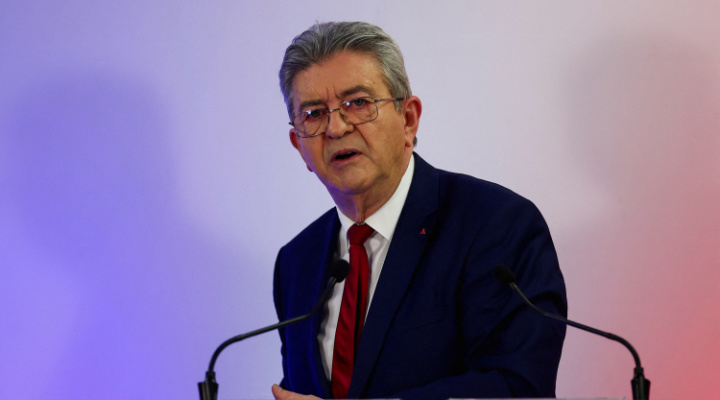 Jean-Luc Melenchon, leader of French far-left opposition party La France Insoumise (France Unbowed – LFI), delivers a speech during a campaign rally to support the list “Etre Bondy” for the upcoming mayoral election in Bondy near Paris, France, March 4, 2026. Photo: REUTERS/Abdul Saboor
The leader of France’s largest leftist coalition in parliament and a 2027 presidential candidate appeared to threaten Israel with international military action, marking the latest controversy surrounding the longtime anti-Israel lawmaker, who critics have accused of helping fuel the ongoing surge in antisemitism across France.
On Sunday, Jean-Luc Mélenchon claimed that Israeli Prime Minister Benjamin Netanyahu is seeking to occupy southern Lebanon, where Israeli forces have been fighting the Iran-backed terrorist group Hezbollah, and called for an international military deployment against Israel.
“Israel is invading and annexing all of southern Lebanon. Netanyahu has raised his flag over Beaufort Castle. This French name should remind us of the thousand-year history that binds us to Lebanon. We owe the Lebanese people aid, solidarity, and support in the face of genocidal forces,” Mélenchon wrote in a post on X.
“The aircraft carrier would serve as a more useful symbol in the Mediterranean than in the Strait of Hormuz, to remind Netanyahu that his interference in our elections and his invasions of our allies’ territories are viewed as threats by the French,” he continued. “The UN Security Council must condemn Israel and organize the withdrawal of its forces from the occupied territory.”
.
In a second post, Mélenchon even called on French President Emmanuel Macron to form an international coalition “to send troops under his military command to oversee the withdrawal of the Israeli army and protect the immediate ceasefire that must be imposed on the invader.”
Far from his first controversy, far-left La France Insoumise (LFI) leader Mélenchon — who has announced his candidacy for next year’s presidential election — has been repeatedly criticized by French Jews as a threat to their community as well as those who support Israel.
Mélenchon has a long history of pushing anti-Israel policies and of making antisemitic comments — such as suggesting that Jews killed Jesus, echoing a false claim that was used to justify antisemitic violence and discrimination throughout the Middle Ages in Europe.
Last week, Israel’s ambassador to France, Joshua Zarka, said Mélenchon’s rhetoric toward Jews “reminds [him] of Hitler,” warning that some French Jews are now hiding their identities to get through daily life amid an increasingly hostile climate in which such rhetoric fosters hatred.
“The way Jean-Luc Mélenchon speaks in front of a crowd reminds me of Hitler. The way he uses the idea of uniting against one enemy by speaking of Israel is similar to the way Hitler used to speak about the Jews,” the Israeli diplomat told Fox News Digital in a recent interview.
Mélenchon has previously said that “antisemitism remains residual in France,” remarks critics said downplayed a sharp surge in anti-Jewish hatred that erupted following the Hamas-led invasion of and massacre across southern Israel on Oct. 7, 2023.
He has also appeared to openly support Hezbollah and referred to the French Jewish community as “an arrogant minority that lectures to the rest.”
In the wake of the Oct. 7 atrocities, Mélenchon and his party also issued a statement declaring the attacks “an armed offensive of Palestinian forces” as a result of continued Israeli “occupation.”
Despite a sharp rise in antisemitism in France, Mélenchon’s rhetoric and policy positions have appeared largely unchanged, with critics accusing him of contributing to an increasingly hostile climate for Jews through inflammatory anti-Israel language.
According to a newly released report by the French Interior Ministry, anti-religious incidents have surged sharply across the country since the outbreak of the war in Gaza, fueled by a dramatic rise in antisemitic acts and, to a lesser extent, anti-Muslim incidents.
“These anti-religious acts undermine freedom of conscience and the free exercise of religion,” the report says. “They weaken national cohesion and threaten the very balance of our society.”
Since 2015, anti-religious acts have surged sharply across France, with patterns varying significantly between faiths, but antisemitic incidents now make up more than half of all such attacks.
In the last 10 years, antisemitic incidents have steadily increased, reaching a record peak in 2023 following the Oct. 7 attacks.
“The resurgence of antisemitic acts began as early as the day after Oct. 7, 2023, even before any Israeli response,” the report notes, highlighting a staggering 1,209 percent increase between September and October of that year.
Although anti-Jewish hate crimes in France declined slightly in 2025, the report says they still remain at “a historically high level,” accounting for roughly 53 percent of all anti-religious acts and marking a 203 percent increase compared to 2022. Jews make up less than 1 percent of France’s population.
French officials also warn that the figures are likely “underestimated,” noting that many victims of anti-religious attacks never file formal complaints.
Among the most alarming trends identified in the report is the growing number of attacks targeting individuals — representing 67 percent of antisemitic acts — alongside a sharp rise in physical assaults against Jews, with violent incidents tripling since 2022.
Earlier this year, the French Interior Ministry released a report revealing a troubling rise in antisemitic incidents documented in a joint dataset compiled with the Jewish Community Protection Service.
Antisemitism in France remained at alarmingly high levels last year, with 1,320 incidents recorded nationwide, as Jews and Israelis faced several targeted attacks amid a relentlessly hostile climate despite heightened security measures, according to the data.
Although the total number of antisemitic outrages in 2025 fell by 16 percent compared to 2024’s second highest ever total of 1,570 cases, the report warned that antisemitism remained “historically high,” with more than 3.5 attacks occurring every day.
Over the past 25 years, antisemitic acts “have never been as numerous as in the past three years,” the report said, noting a dramatic spike following the Hamas-led Oct. 7 attack.
Zawartość publikowanych artykułów i materiałów nie reprezentuje poglądów ani opinii Reunion’68,
ani też webmastera Blogu Reunion’68, chyba ze jest to wyraźnie zaznaczone.
Twoje uwagi, linki, własne artykuły lub wiadomości prześlij na adres:
webmaster@reunion68.com