Archive | 2026/07/21

“Izrael, Dreyfus wśród narodów” – Wywiad z Joëlem Rubinfeldem – część 1

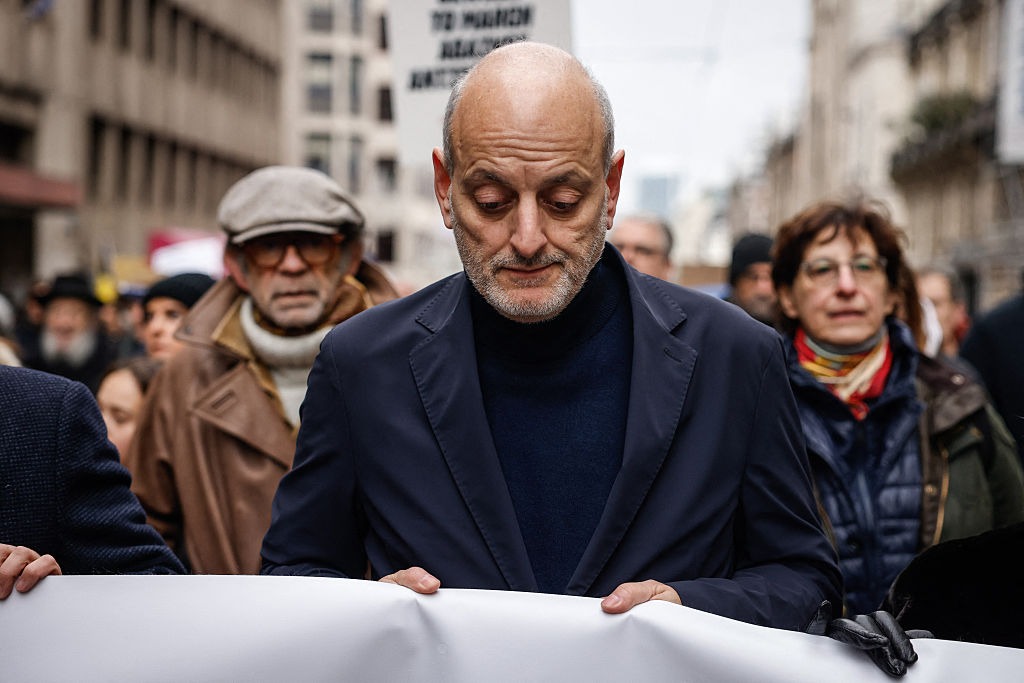
Na zdjęciu: Joël Rubinfeld (środek) niesie transparent na marszu przeciwko antysemityzmowi w Brukseli, 10 grudnia 2023 r. (Zdjęcie: Simon Wohlfahrt/AFP via Getty Images)

“Izrael, Dreyfus wśród narodów” – Wywiad z Joëlem Rubinfeldem – część 1

Grégoire Canlorbe
Tłumaczenie: Andrzej Koraszewski


Joël Rubinfeld współzałożyciel i przewodniczący Belgijskiej Ligi Przeciw Antysemityzmowi.

Canlorbe: Określił Pan Izrael jako “Dreyfusa wśród narodów”. Co to oznacza?

Rubinfeld: Od 7 października 2023 roku żyjemy w pewnego rodzaju niekończącym się “procesie Dreyfusa”, z jedną zasadniczą różnicą: państwo zastąpiło jednostkę. Kiedyś na ławie oskarżonych stał Dreyfus; dziś jego miejsce zajęło państwo żydowskie.

“Oskarżycielami” w tym permanentnym procesie są agencje ONZ, “sprawozdawcy”, Amnesty International, Human Rights Watch, Oxfam, Liga Praw Człowieka — która, jak na ironię, została założona w 1901 roku w następstwie afery Dreyfusa. Istnieje również cały ekosystem organizacji twierdzących, że przemawiają w imieniu praw człowieka, wraz z ich przekaźnikami w redakcjach, środowisku akademickim, kręgach aktywistycznych i kulturalnych oraz w kawiarniach i na ulicach.

Kiedy widzę tych tak zwanych demonstrantów “pro-palestyńskich”, odnoszę wrażenie, że wielu z nich w ogóle nie obchodzi los Palestyńczyków. Gdyby naprawdę byli pro-palestyńscy, najpierw wzywaliby do likwidacji Hamasu, który jest trucizną i koszmarem przede wszystkim dla samych Palestyńczyków. Niestety, ta trucizna została szeroko zaakceptowana przez absolutną większość (56%) Hamasu w ostatnich palestyńskich wyborach parlamentarnych w 2006 roku.

Te demonstracje w Europie — 300 000 ludzi w Londynie, 100 000 w Brukseli i setki tysięcy we Francji — przypominają mi marsze z początku lat 30. w Niemczech. Oczywiście nie jest to dokładna analogia historyczna, ale widać podobieństwo w zajmowaniu przestrzeni publicznej, dynamice tłumu i presji wywieranej na życie polityczne. Są też nienawistne hasła — kiedyś wymierzone w Żydów, dziś w państwo żydowskie i jego zwolenników: “Śmierć Żydom” staje się “Śmierć Izraelowi”, “Bojkotujcie Żydów” staje się “Bojkotujcie syjonistów” — nowym, grzecznym, “politycznie poprawnym” określeniem nienawiści do Żydów.

Ta gorączka uliczna wywiera nacisk na przywódców politycznych. Wielki problem polega na tym, że wielu z nich myśli wyłącznie w kategoriach arytmetycznych. Mają skłonność do uproszczonego, a tym samym rasistowskiego postrzegania wspólnot: “Żydzi” równa się “Izrael”, a “muzułmanie” równa się “Palestyna”. Gdy dokonają takiego rachunku, pojawiają się wnioski.

W Belgii jest około 30 000 Żydów i 900 000 muzułmanów — stosunek jeden do trzydziestu. Cynicy dochodzą do wniosku: “Mam wszystko do stracenia, broniąc Żydów lub Izraela, i wszystko do zyskania, wspierając ‘Palestynę’ — płynąc na fali tego, czym Hamas stał się w wyobraźni aktywistów — bo to daje mi głosy”.

W Brukseli, ze względu na jej specyficzną demografię, antysemityzm stał się atutem wyborczym. Nie “stary” antysemityzm nostalgików Auschwitz, lecz jego zaktualizowana, współczesna forma — taka, która zrównuje Gazę z Auschwitz.

To głosy wyborcze sprawiają, że sytuacja staje się niemal nieodwracalna. Nazwano to “islamską zasadą liczebności”: gdy jest się w mniejszości, pozostaje się stosunkowo niewidocznym, lecz im większy staje się udział w populacji, tym bardziej rośnie asertywność. Ekspert ds. islamu Raymond Ibrahim zauważa, że w Europie, gdzie mniejszości muzułmańskie są większe niż w Stanach Zjednoczonych, otwarta przemoc stała się powszechna — ale zawsze przedstawiana jako “obrona”, ponieważ to słowo uspokaja Zachód. Przytacza przykład Londynu, gdzie muzułmanie stanowią obecnie około 15% populacji: morderca żołnierza Lee Rigby’ego, z rękami wciąż pokrytymi krwią, oświadczył: “Przysięgamy na wszechmogącego Allaha, że nigdy nie przestaniemy z wami walczyć, dopóki nie zostawicie nas w spokoju… Nigdy nie będziecie bezpieczni”, a następnie usprawiedliwił morderstwo zemstą za śmierć muzułmanów z rąk brytyjskich żołnierzy.

Spójrzmy na Nigerię, która jest mniej więcej w połowie muzułmańska i w połowie chrześcijańska. Od co najmniej 2000 roku trwa tam ekstremistyczne muzułmańskie ludobójstwo, w którym — według danych z raportu z 2025 roku Międzynarodowego Towarzystwa na rzecz Swobód Obywatelskich i Rządów Prawa (Intersociety) — “od 2009 roku zginęło około 185 009 Nigeryjczyków, w tym 125 009 chrześcijan i 60 000 ‘liberalnych muzułmanów'” — i nadal giną.

Od miesięcy ostrzegam, że możemy być świadkami ostatniego okresu istnienia “znaczącej” społeczności żydowskiej w Belgii. Już teraz jest ona bardzo mała: 0,25% populacji. Być może do 2050 roku nie będzie już 30 000, lecz mniej niż 10 000. Exodus już się rozpoczął — i przyspiesza.

Canlorbe: Jak wyjaśnia Pan tych Żydów, którzy dołączają do oskarżycieli w tym “procesie Dreyfusa” przeciwko Izraelowi?

Rubinfeld: To intrygujące pytanie. Moja interpretacja “żydowskiej nienawiści do samego siebie” — pojęcia spopularyzowanego sto lat temu przez Theodora Lessinga w Der jüdische Selbsthaß — jest taka, że historia narodu żydowskiego była wszystkim, tylko nie spokojna. Bycie Żydem oznaczało przez 4000 lat konfrontację z najbardziej niedorzecznymi oskarżeniami: o wywoływanie głodu, zatruwanie studni, profanację hostii, szerzenie epidemii, “mord rytualny”, kontrolowanie świata… Choćby były najbardziej obłąkane, każde oskarżenie zdaje się znajdować odbiorców — czasem nawet większość. Jak ktoś powiedział: “Problemem nie jest to, jacy są Żydzi, lecz to, w co jesteś gotów uwierzyć, że są”.

Życie jako Żyd w środowisku, w którym obarcza się go winą za wszystko, wymaga odporności, samozaparcia i ducha oporu. Nie każdy jest do tego zdolny. Zamiast trwać, niektórzy mogą mieć nadzieję — z powodu strachu i chęci przetrwania — że jeśli będą mili wobec swojego oprawcy, ten w końcu się opamięta i zobaczy, jacy są “dobrzy”. Mogą nawet przekonać samych siebie, że jeśli zgodzą się z oprawcą, ten ich doceni i zacznie podziwiać — wtedy przestaną być w niebezpieczeństwie. Mogą nawet przyjąć jego punkt widzenia, jak dziecko, na które rodzic jest zły. Łatwiej jest mu uznać, że rodzic ma rację, a problem tkwi w nim samym. To próba poradzenia sobie z przerażającą sytuacją — i zazwyczaj nie działa. Oprawcy znęcają się; to właśnie lubią robić. Jak zauważył psychiatra dr Kenneth Levin w książce The Oslo Syndrome, dziecko jest zależne od rodzica i chce czuć się bezpiecznie. “Jeśli tylko przestanę moczyć łóżko — może wtedy mnie polubi” — myśli dziecko. Zbyt przerażające jest dostrzeżenie, że problemem może nie być wcale moczenie łóżka, lecz jedynie pretekst. Widzieliśmy podczas II wojny światowej, że ludzie potrafią zracjonalizować wszystko.

Czasem spotyka się osoby urodzone jako Żydzi, które zrywają ze swoim dziedzictwem, postanawiają “już nie być Żydami” i stają się antysemitami, by udowodnić swoją “dobrą wolę”.

W głębi duszy — sądzę — wiedzą, że to zerwanie oznacza kapitulację: porzucają judaizm, aby uciec przed presją, zdobyć społeczną akceptację, czasem chronić swoje potomstwo. Ale od tego momentu Żydzi, którzy pozostają — ci, którzy mimo ataków trwają przy swojej tożsamości — stają się dla nich nie do zniesienia lustrem.

Każdy Żyd, który trwa niewzruszenie, odbija im niewygodny obraz: “Ja zostaję, przyjmuję ciosy, ale pozostaję tym, kim jestem”. Ten, który się odciął, postrzega siebie jako tchórza. To napięcie przeradza się w agresję: ulega antysemityzmowi, przyjmując strategię spalonej ziemi. Opuścił judaizm — więc teraz zwraca się przeciw Żydom, by pokazać innym: “Widzicie? Nie jestem taki jak oni. Jestem dobry! Lubicie mnie teraz?”

Ten schemat pojawia się w kilku przykładach historycznych: Nicholas Donin (XIII w.), konwertyta z judaizmu i inicjator procesu, który doprowadził do spalenia Talmudu w Paryżu; Pablo Christiani (Paweł Chrześcijanin), Żyd-konwertyta, który został dominikaninem i uczestniczył w kampaniach religijnych przeciw Żydom w XIII w., przekonując Ludwika IX do przywrócenia obowiązku noszenia rouelle — prekursora żółtej gwiazdy; Bernard Lazare — przypadek interesujący: przed aferą Dreyfusa napisał dzieło antysemickie, lecz później stał się jednym z najwcześniejszych i najwierniejszych obrońców żydowskiego kapitana, twierdząc, że sprawa “uratowała mu życie”; Gilad Atzmon — brytyjski muzyk jazzowy pro-palestyński, urodzony w Izraelu, zajadły antysemita, który później twierdził, że przeszedł na chrześcijaństwo — co nie przeszkodziło mu w kontynuowaniu ataków; Karl Kraus — austriacki pisarz antydreyfusowski, który zerwał z judaizmem i rozwinął obsesyjną krytykę tego, co nazywał “prasą żydowską”.

U podstaw tego wszystkiego leży prosta myśl: nie jest łatwo być Żydem. Niektórzy odczuwają swoją tożsamość jako ciężar. W XIX wieku, nawet po emancypacji i uzyskaniu praw obywatelskich, silne bariery społeczne nadal istniały. Wielu wybierało konwersję nie z wrogości, lecz z pragnienia dopasowania się, by być “jak wszyscy” — jak dziecko, by być kochanym.

Dla jasności: odejście od judaizmu samo w sobie nie jest dla mnie naganne. Mam liberalne podejście: można wejść, odejść, wybrać — każdy robi ze swoim życiem, co chce. To jednak jedno; popadanie w antysemityzm to drugie. W tym momencie staje się to moim problemem: nie mamy już do czynienia z osobistym wyborem, lecz z przejściem do aktywnej, czasem gwałtownej wrogości wobec innych — w tym przypadku wobec tego, czym się kiedyś było.


Grégoire Canlorbe, dziennikarz, obecnie mieszka w Paryżu.


Zawartość publikowanych artykułów i materiałów nie reprezentuje poglądów ani opinii Reunion’68,
ani też webmastera Blogu Reunion’68, chyba ze jest to wyraźnie zaznaczone.
Twoje uwagi, linki, własne artykuły lub wiadomości prześlij na adres:
webmaster@reunion68.com



We Are the Luckiest Jews Who Have Ever Lived


We Are the Luckiest Jews Who Have Ever Lived

Ben Freeman


Previous generations only dreamed of what we have

People draped in Israeli flags watch the sunset during a party to celebrate Israel’s 78th Independence Day from Tel Aviv’s Charles Clore Park on April 22, 2026 / Alexi Rosenfeld/Getty Images

For three years we have watched Jew-hatred erupt on campus, online, inside political movements, and among people we once called friends. Institutions we helped build, funded, and sat on the boards of have turned away from us and showed us exactly what they were made of: incubators of old hatred now decked with new jargon. Many of us feel betrayed and bewildered.

But rather than wallow in sadness, recognize that these betrayals provide us with information. These institutions were not always rotten; something in them changed over the last decade: Principle was traded for donor comfort, standards for slogans, scrutiny for the easier feeling of being on the right side of a hashtag. Oct. 7 did not create that rot. It was the storm that hit at the exact moment the hull had already given out, and the whole world got to see which vessels were still seaworthy. Ours went down first, because they had already been rotting for years. Throwing us over the side was simply what they did to survive a little longer.

Thank God they threw us overboard. It may have been the only way for us to have avoided going down with them.

For years, many of us worked to earn a permanent berth on those ships: a faculty appointment, a board seat, a spot at whatever table seemed to matter that week, on the theory that enough usefulness would eventually purchase real belonging. That theory only holds if the ship is going somewhere worth arriving. Some of them were not, and no amount of usefulness was ever going to change their heading. Far from leaving us stranded, losing our place on board returned us to a vessel we already owned, one we had spent 2,000 years building in exile and then, against every reasonable expectation, actually finished building in our own land.

Better than that, we now have clarity. We are no longer laboring under illusions, bidding for affection that was always going to be withheld. They were honest with us, in the end, and that honesty is its own kind of freedom. We can go our own way now: not into a ghetto (we still have real allies) but into self-determination, as individuals and as a global people.

We have the agency our ancestors could only long for and the sovereignty they could only pray for. We can shape what happens next.

No earlier generation of Jews had this. In medieval Spain they were expelled or forced to convert at sword’s point. In 19th-century Russia they were burned out of their homes in pogrom after pogrom. In interwar Europe, exclusion built, year by year, toward extermination. The plain fact is: None of those generations had a country of their own to run to. We are the first generation ever thrown out of institutions, not out of our own countries, who already have somewhere of our own to go. That is the shape of our fortune: not that no one throws Jews overboard anymore. That when they do, there is a shore now, and there wasn’t one then.

I just made aliyah, so some of this perspective comes from the wide-eyed excitement of an immigrant discovering his new home. Living inside Jewish sovereignty makes it much harder to take for granted what my grandparents could only dream about. At Tel Aviv Pride, I watched thousands of gay Jews celebrate both identities openly and without apology. What struck me was how ordinary it all felt, being a Jew living under Jewish sovereignty, on the indigenous land of our ancestors.

Most Jews alive today have never known a world without Israel, never known a world in which Jewish self-determination existed only in prayers, songs, and distant hope.

I’ve spent the last seven years building Jewish Pride, a movement founded on one idea: Jew-hatred has shaped our history, but it does not define our civilization. The Jewish story is a record of what we built, preserved, and carried forward in spite of what others have done to us.

Oct. 7 produced such a strong reaction in Jews around the world partly for this reason. People who had drifted from Jewish life found their way back, walking into a synagogue for the first time in years, picking up a book of Jewish history they’d never gotten to, pulling out a Star of David necklace that had sat in a drawer since childhood, or simply saying “I’m Jewish” out loud in rooms where they used to let it pass unmentioned. Call them Oct. 8 Jews: people whose sense of belonging was less created than reactivated. The expression varied. The impulse behind it did not: a rediscovery that being Jewish means belonging to an am, a people, not just holding an identity.

Right when so many tried to isolate Jews from one another and flatten our identity into a political liability, we moved closer together and found in it a source of meaning instead. The greatest Jewish achievement is not Israel, remarkable as it is. It is the Jewish people itself. Israel is one expression of Jewish continuity. The people are the source it continues from. It is no accident that the same years that saw so many institutions abandon us also pushed us together. Instead of drifting out to sea, we swam toward home.

The scale of what we inherited is easy to miss because we grew up inside it. Israel sits at the center of Jewish life today, but Jewish flourishing didn’t stop at its borders. The generation that rebuilt sovereignty in our ancestral home also built an entire Jewish infrastructure across the diaspora after losing a third of our people in the Shoah: schools, charities, universities, advocacy groups, centers of learning, all our own, on a scale nobody before them could have managed. We are the first Jews in almost 2,000 years to hold sovereignty and a thriving global diaspora at the same time.

Tell a Jew from 1346, or 1497, or 1648, or 1938 what this era actually holds, and don’t leave anything out: Hebrew spoken by millions, a Jewish army defending a Jewish state, Jewish communities flourishing across much of the world, and, yes, an attempted genocide like Oct. 7. He would recognize the tragedy instantly. What would surprise him is everything standing next to it: an army, a state, the power to respond.

Since making aliyah, I’ve felt something I can only describe as strength: not because Israel is totally safe (Oct. 7 made sure none of us will ever believe that again) but because for the first time in my life I live somewhere Jewishness is not a minority identity but the given condition of the place. Hebrew is the language on the street, the calendar runs on the Jewish year, and the whole rhythm of public life follows it. For the first time I understand, physically rather than intellectually, what it means to belong to a civilization instead of merely inheriting one.

That feeling is the same one many Jews had after Oct. 7. History did not end that day. But we now meet it from a different position than our ancestors did. We have the agency they could only long for and the sovereignty they could only pray for. We can shape what happens next instead of simply absorbing what’s done to us. That power comes with responsibilities and mistakes our ancestors were spared. The mistakes are themselves proof of how much has changed. You cannot mismanage power you do not have.

The Jewish story is usually told through catastrophe, and there are good reasons for that; catastrophe has shown up far too often to ignore. But as the historian Salo Baron argued against what he called the “lachrymose” reading of Jewish history, catastrophe was never the whole story. We were exiled, persecuted, expelled, and nearly annihilated, and still remained capable of renewal.

For almost 2,000 years, Jews closed the Pesach Seder with the words “Next year in Jerusalem,” knowing they would very likely never see it happen. Parents taught it to children. Children taught it to grandchildren, across a chain of generations who died still waiting. Eventually the prayer became a fact. Jews now walk the streets of Jerusalem speaking Hebrew as a native tongue. Across the diaspora, Jewish communities keep building, teaching, and renewing. Children light Shabbat candles with their parents. Students still study texts written thousands of years before their grandparents were born.

None of this erases the challenges still ahead, and Oct. 7 made sure we could never forget that. But when I think about the generations who carried this story through exile and catastrophe and expulsion, one conclusion is unavoidable: We are living inside the world they spent centuries dreaming about, on the far side of institutions that could not survive their own decay and let us go.

When I walk through Tel Aviv, hear Hebrew all around me, and watch Jewish life carry on with such ordinary confidence, I think about the Jews who carried this dream across centuries of exile.

They never lived to see and experience this world.

We do.


Ben M. Freeman is the founder of the modern Jewish Pride movement and author of Jewish Pride: Rebuilding a People, Reclaiming Our Story, and The Jews: An Indigenous People. He is a Research Fellow at the Comper Center and a founding member of the Contemporary Antisemitism Studies Association.


Zawartość publikowanych artykułów i materiałów nie reprezentuje poglądów ani opinii Reunion’68,
ani też webmastera Blogu Reunion’68, chyba ze jest to wyraźnie zaznaczone.
Twoje uwagi, linki, własne artykuły lub wiadomości prześlij na adres:
webmaster@reunion68.com


Trump Says Netanyahu ‘Will Not Be Arrested’ in Sharp Rebuke of NYC Mayor Mamdani


Trump Says Netanyahu ‘Will Not Be Arrested’ in Sharp Rebuke of NYC Mayor Mamdani

Corey Walker


US President Donald Trump greets Israeli Prime Minister Benjamin Netanyahu at the White House in Washington, DC, US, Sept. 29, 2025. Photo: REUTERS/Kevin Lamarque

US President Donald Trump declared Monday that Israeli Prime Minister Benjamin Netanyahu “will not be arrested” during an expected visit to New York, rebuking Mayor Zohran Mamdani for exploring whether the city could act on an International Criminal Court warrant against the Israeli leader.

“Benjamin Netanyahu will not be arrested, in any way, shape, or form, while in the United States of America,” Trump wrote on Truth Social.

Netanyahu is expected to attend the United Nations General Assembly in New York in September. Mamdani recently said city lawyers were examining what authority, if any, New York officials would have to detain him.

“I believe that Prime Minister Netanyahu belongs in The Hague,” Mamdani told The New York Times, referring to the Dutch city where the ICC is based.

“He’s a war criminal who has been charged by the International Criminal Court,” the democratic socialist mayor added, saying his administration would pursue whatever action New York law permits. Mamdani has stressed that he would not rewrite city or state law to carry out the arrest.

Trump did not name Mamdani in his response, instead defending Netanyahu as he confronts Iran.

“He is fighting against the Islamic Republic of Iran, which recently killed 52,000 innocent protesters, and has spent the last 47 years killing American soldiers, and others,” Trump wrote.

“The only ones that should be arrested are the people that led Iran into this unprecedented spiral of death and destruction,” he added.

Trump’s claim that Iran recently killed 52,000 protesters could not be independently verified and should be presented strictly as the president’s assertion.

The ICC issued arrest warrants for Netanyahu and former Israeli Defense Minister Yoav Gallant in November 2024, alleging that they bear criminal responsibility for war crimes and crimes against humanity committed during the Gaza conflict.

The court said there were reasonable grounds to believe the two men were responsible for the alleged use of starvation as a method of warfare, as well as murder, persecution, and other inhumane acts. Netanyahu and Gallant have denied the accusations, while Israel has rejected the ICC’s jurisdiction and condemned the proceedings as politically motivated.

The ICC simultaneously issued a warrant for Hamas military commander Mohammed Deif over alleged crimes connected to the Hamas-led Oct. 7, 2023, massacre in southern Israel. That warrant was withdrawn in February 2025 after prosecutors received confirmation of Deif’s death.

The United States and Israel are not parties to the Rome Statute, the treaty that established the ICC. Legal experts have said Mamdani would face formidable obstacles to carrying out an arrest, since ICC warrants are enforced through national governments and New York City has no independent foreign-policy authority.

The Trump administration has taken an aggressively hostile approach toward the court. In February 2025, Trump signed an executive order authorizing sanctions against ICC personnel involved in investigations of Americans or citizens of allied countries, describing the proceedings against Netanyahu and Gallant as “illegitimate and baseless.”

Secretary of State Marco Rubio has since pledged to “systematically disable” the court, accusing it of using international law to target the United States and its allies.

Mamdani has long been one of Israel’s most outspoken critics in Democratic politics. He supports the boycott, divestment, and sanctions movement, has accused Israel of committing genocide and apartheid, and has declined to recognize Israel specifically as a Jewish state.

His renewed threat against Netanyahu comes as Israel has become increasingly divisive within the Democratic coalition, particularly among younger and progressive voters. But whether New York City possesses any lawful mechanism to enforce the ICC warrant remains highly doubtful.


Zawartość publikowanych artykułów i materiałów nie reprezentuje poglądów ani opinii Reunion’68,
ani też webmastera Blogu Reunion’68, chyba ze jest to wyraźnie zaznaczone.
Twoje uwagi, linki, własne artykuły lub wiadomości prześlij na adres:
webmaster@reunion68.com