Joël Rubinfeld is a founding member and president of the Belgian League Against Antisemitism and president of the Jewish Coalition for Kurdistan. He was president of the Coordinating Committee of Jewish Organizations in Belgium, vice-president of the European Jewish Congress, and co-chairman of the European Jewish Parliament.
Grégoire Canlorbe: With the rise of antisemitism in Europe, what has been the result? Has there been an exodus of Jews from Belgium, and if so, what has been its scale?
Joël Rubinfeld: Yes, there has been, although there is no precise data. We might turn to the statistics of the Jewish Agency for Israel, which records how many Jews from different countries who settle in Israel under the Law of Return, the right to come “home” – called Aliyah, to go up. These figures make it possible to tell how many Belgian Jews move to Israel each year but do not include those moving to other countries.
Many of these new arrivals are closely linked to the resurgence of antisemitism in Europe, which has unfolded in two main phases.
The first phase began in late September 2000, with the outbreak of the Second Intifada. The months that followed saw a re-emergence of unabashed antisemitism here in Belgium, mainly driven mainly by political and activist circles on the left. Since then, the spectrum has broadened.
From 2000, the numbers rose from around 60 departures a year to more than a fivefold increase over 15 years.
Before this century, departures were generally driven by ideological or identity-based choices, such as idealism or Zionism, without any sense of urgency. From 2000 onward, a different dynamic emerged: whenever a conflict broke out in the Middle East, antisemitism spiked in Belgium. This happened during the Second Intifada, which began in 2000; then during the war with Hezbollah in 2006, then on four occasions during conflicts with Hamas (2008–2009, 2012, 2014, 2021). Events taking place thousands of kilometers away had a direct impact on the daily lives of Jews in Belgium.
The second phase took place in the last two-and-a-half years, starting with Hamas’s invasion of Israel on October 7, 2023 — but with a change in nature. One might have expected that the jihadist invasion of October 7, would trigger a wave of solidarity and empathy toward Israel. It did — for maybe two hours. On the very day of the attack — days before the IDF retaliated — the antisemites you see today came out of the woodwork. They exploited the war in Gaza to advance their narrative and swell their ranks — to the point of turning the debate into a form of institutional hostility.
This is also what took place in Belgium in most political parties. They began accusing Israel of committing “genocide” in Gaza, calling for economic sanctions or even a boycott of the Jewish state.
The latest example was the twelve-point anti-Israel plan pushed by Foreign Minister Maxime Prévot, a leading figure and former president of the centrist party Les Engagés, The Committed Ones. The plan includes discriminatory measures targeting not only Israel, but also Belgian Jews.
One point, particularly troubling, is a case that came to us recently: Belgian citizens in the eastern part of Jerusalem and in Judea and Samaria are denied access to Belgian consular services. A family of Belgian Jews living in Ma’aleh Adumim, in Judea, went to the Belgian consulate in Jerusalem the other day to renew their passports and were turned away. They then turned to the embassy in Tel Aviv and were refused as well. The message being sent was: “If you want a passport, move to the internationally recognized areas of Israel.”
One must grasp the symbolic meaning of this: Judea is where the name “Jew” originated. Yet today, Belgian citizens of Jewish faith are being discriminated against for living on their own ancestral land.
The Belgian authorities try to defend themselves by claiming that this is not an ethnic specification, but a geographic one. In practice, however, this measure applies only to “Belgians residing in the settlements” — that is, Jews living in the Old City of Jerusalem or in Judea and Samaria. What is ironic is that a Belgian residing in Ramallah, for example, would face no obstacle in renewing their documents. Does this also mean that a Belgian living in East Jerusalem would receive consular services — provided they were not Jewish?
I actually put this question to the Foreign Ministry spokesperson; he dodged it. He claimed not to know the answer. The question, though, is simple: what is done for Belgians living in other disputed or occupied territories — Taiwan, Northern Cyprus, Crimea, Nagorno-Karabakh, and so on? There, one does not see exceptional treatment. This is clearly a double standard, like the special “legal status” imposed on Jews during the Second World War.
Belgium has also banned the overflight of aircraft carrying materials that could be used by Israel for military purposes. That is how my country treats the only democracy in the region, which is currently fighting an existential war on seven fronts–not just to defend itself but to defend Western civilization. Belgium and other countries in Europe are trying to prevent Israel from defending itself – and Europe!
Canlorbe: How do you and other Jews view the various antisemitic acts that have occurred in Belgium since October 7? Was October 7 a catalyst?
Rubinfeld: We witnessed not just a simple increase in antisemitic acts, but an explosion.
According to figures from Unia — the inter-federal body responsible for monitoring racism and discrimination — in the three months after October 7, 2023, reported antisemitic acts rose by 1,000% — ten times higher than for the same period the previous year.
Another organization, Antisemitisme.be, recently published its figures for 2025, recording 232 antisemitic incidents – which may not seem all that many, but these figures remain far below the reality. They are just, as the saying goes, “the tip of the iceberg.”
In Brussels, for instance, there is a “pro-Palestinian” demonstration in the city center every day. It is not authorized, but it is tolerated by the city’s mayor. During these gatherings, participants openly chant the 2.0 slogan of the “Final Solution” — “From the river to the sea, Palestine will be free” — yet such incidents are not included in the statistics. If these daily occurrences alone were added, they would already exceed all official totals.
The problem is the trend. The official figures represent an 80% increase compared to 2024, which was already an abnormally high year after October 7, 2023, when levels were high.
Canlorbe: Are the French different from the Belgians in their attitude toward antisemitism?
Rubinfeld: Belgium broadly faces the same problems as France. The reactions, however, differ.
In France, when an antisemitic act takes place, it often triggers a clear public response: statements from political leaders, media coverage, and condemnations from public figures. This was seen again recently when the names of Jews were mangled by the leader of the French far left, Jean-Luc Mélenchon. The incident sparked an uproar and was denounced by many political, intellectual, and media figures.
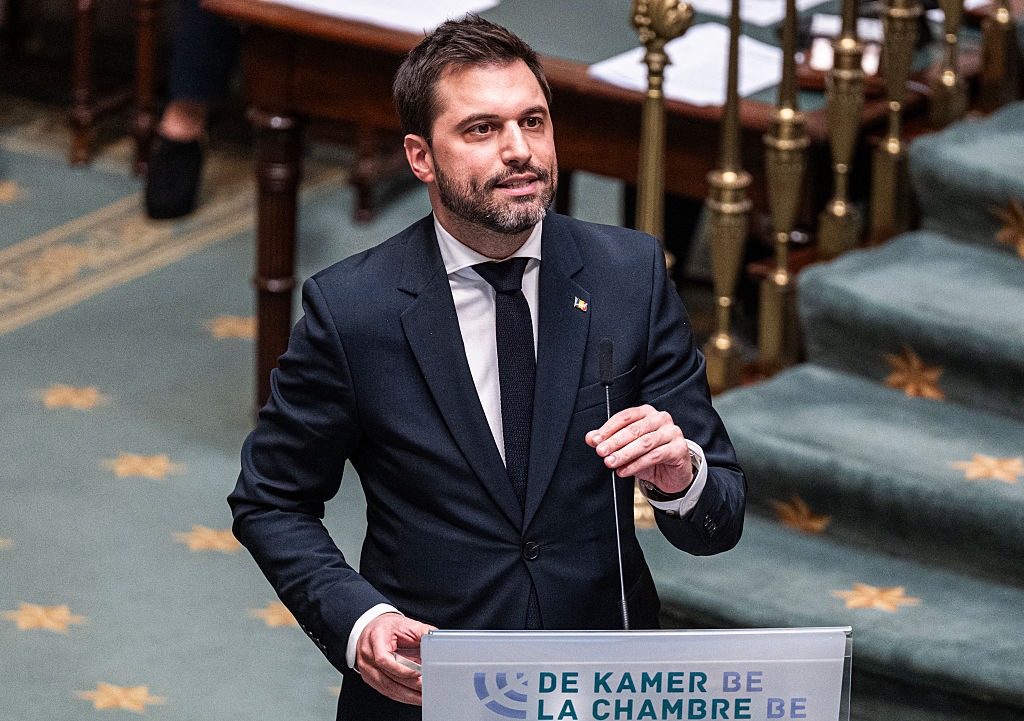
In Belgium, this kind of mobilization is rare. Yes, there are people of integrity, but they remain the exception. In the political sphere, the most notable example is Georges-Louis Bouchez, president of the Mouvement Réformateur (“Reformist Movement,” a center-right party), who regularly speaks out against antisemitism and defends pro-Israel positions.
Of the twelve Belgian political parties, eight have embraced what is currently the central antisemitic theme: falsely accusing Israel of “genocide” in Gaza. Three of the five parties are in the governing coalition — the foreign minister himself speaks that way.
At its core, there seems to be a historic, ancient hatred that changes its vocabulary according to the era. Two thousand years ago, Jews were accused of “deicide”; today, of “genocide.” Antisemitism, like a virus, adapts to its environment. In Western societies, where religion is less important, the accusation is recast in the dominant language of the moment — that of human rights.
In addition, there seems to be a linguistic drift: Israel means Zionist means Jew. By conflation, what begins as criticism of a state gradually turns into targeting people — a “domino effect” — in France and Belgium and other places as well.
Canlorbe: Unless I am mistaken, your family on both sides, had to flee countries where there was antisemitic persecution. Morocco joined the Abraham Accords. In Russia, Federal Law No. 128-FZ of May 5, 2014 criminalizes Holocaust denial and the approval of Nazi crimes. In your view, are Morocco and Russia fallback options for Jews?
Joël Rubinfeld: Yes, the last three generations of my father’s family had to flee antisemitic persecution, first from Russian pogroms, then from Poland, then, in 1939, from Austria, after which, they found refuge in Belgium.
On my mother’s side, the story is different. She was born in Morocco and had to leave her country in 1960 amid a growing climate of insecurity for Jews. Further back, her family descends from Jews expelled from Spain at the time of the Inquisition — under Isabella the Catholic and Torquemada — who found refuge in Morocco in 1492. Life there was not always idyllic, but my mother’s family were able to remain on the same land for nearly five centuries.
Today, as his ancestors did before him, the King of Morocco protects the Jews, but very few remain. When my mother was born in 1943, there were nearly 300,000 Jews in Morocco; today, the number is estimated at 2,000 to 3,000. Despite this, I feel a bond with the country. I do not feel a bond with Austria. I feel somewhat at home in Morocco. In fact, I feel safer walking around in Morocco than in many neighborhoods in Brussels.
I know Russian Jews living in Moscow, and they seem to live there normally. However, Russia does not really seem like a fallback option, not least because of local practices when it comes to democracy and freedom of expression.
Canlorbe: Trump is probably the most pro-Israel president America has ever had. Do you have any concerns that the MAGA movement, despite Trump’s support for Israel, could become a springboard for a new generation of right-wing antisemites?
Rubinfeld: Antisemitic tendencies can be found in every camp. On the radical fringe of the MAGA movement and the American far right, influencers such as Tucker Carlson, Candace Owens, and Nick Fuentes are injecting the antisemitic poison into the minds of millions of young people online. It is a real problem that needs to be confronted with the utmost determination.
On the Republican side, this type of discourse is relatively recent and has mainly developed around purveyors of hate active on social media. But over the past twenty years, it is above all within the Democratic camp that antisemitism has gained ground through its radical wing, such as the “Squad.”
One must fully grasp the significance of certain political signals, such as the election of Zohran Mamdani as mayor of New York. His election may herald a national trend, in two, six, or ten years. This is all the more striking given that New York is, outside Israel, the city with the world’s largest Jewish population.
Antisemitism is universal. It can be found on the left and on the right. Herbert Pagani in Plea for My Land (Plaidoyer pour ma terre) summed it up: the left-wing antisemite blames the Jews for being capitalists, while the right-wing antisemite blames them for being revolutionaries.
Canlorbe: In Belgium and France, where socialism and anti-Zionism have risen simultaneously, do you see any connection?
Joël Rubinfeld: Antisemitism fits nicely with the views of the far left. Some authors regarded as foundational have made explicitly antisemitic statements. Karl Marx, for instance, in On the Jewish Question (1843), evidently innocent of the psychological device known as projection –attributing to others aspects of yourself of which you feel ashamed — “What is the secular basis of Judaism? Practical need, self-interest. What is the secular cult of the Jew? Huckstering. What is his secular God? Money. Very well then! In emancipating itself from huckstering and money, and thus from real and practical Judaism, our age would emancipate itself.”
This passage contains a line of thinking still present in certain minds: the idea that “the Jew” embodies money, calculation, enslavement, and that, in order to be “free”, one must “emancipate oneself” from Jews. This twisted rhetoric culminated in the industrial-scale mass-extermination of Jews carried out by Nazi Germany.
Pierre-Joseph Proudhon also expresses a rather raw antisemitism: “The Jew is the enemy of the human race. This race must be sent back to Asia, or exterminated.” “Rothschild, Crémieux, Marx, Fould — malicious, bilious, envious, acrid beings (…) The Jew must disappear: by iron, by fire, or by expulsion.”
Proudhon even includes Marx, although he was not, strictly speaking, Jewish: his grandfathers were indeed rabbis, but his parents had converted to Protestantism, and Marx was baptized at the age of six. Yet beyond personal rivalries and sectarian quarrels, the central idea remains: the Jew — or the presumed Jew — is portrayed as the incarnation of evil.
The same interpretive lens is at work today among certain frameworks: whether one calls it wokism, intersectionality, or Islamo-leftism, one often finds a Marxist worldview divided between oppressors and oppressed. The designated enemy is “the white person,” and even more so “the white male”; within a Marxian or Proudhonian logic, “the Jew” ends up being portrayed as a kind of “super-white” — the ultimate enemy.
Antisemitism: it reaches levels of verbal and physical violence rarely seen in other forms of hatred, because it does not merely target an individual or a group; it constructs a totalizing myth — that of a supposedly omnipresent, corrupting force responsible for all evils.
Grégoire Canlorbe: Although Bart De Wever condemned the October 7 attack, he refused to support Israel in the war in Gaza; moreover, he conditionally recognized the Palestinian state. Is that really a policy worthy of someone claiming to support Israel?
Joël Rubinfeld: The reality is more complex.
Within the coalition, there are five parties, three of which follow an anti-Israel line: the Flemish Christian Democrats, the Flemish socialists, and the French-speaking centrists. On the other side are the government’s two heavyweight parties: the Flemish nationalists — De Wever’s party — and the French-speaking center-right party led by Georges-Louis Bouchez.
Bart De Wever is neither an outspoken critic of Israel nor an unwavering supporter; yet if most likely, if left to his own judgment, he would stand on Israel’s side rather than oppose it.
The problem is that he has to hold the coalition together. The three anti-Israel parties are smaller, but each could bring down the majority by leaving the government. And for those parties, the Palestinian cause has become a central electoral issue — in a sense, a matter of political survival. So De Wever is not hostile to Israel; he is above all constrained by the internal balance of his coalition.
On the question of recognizing Palestine, Bart De Wever accepted a conditional formula: the anti-Israel parties wanted immediate recognition, as Ireland, Spain, Slovenia, and others did — and as France later put on the agenda. De Wever and Bouchez did not want to go that far.
In the end, it is a “Belgian compromise”: no one is happy, but no one is entirely losing either.
Canlorbe: What hopes do you place in conservative [in French: libéral] politician Georges-Louis Bouchez?
Rubinfeld: He represents the main political shield for Belgium’s Jews. And I do mean the man, more than the party: if he were replaced tomorrow by someone more lukewarm, it is not unthinkable that the Reformist Movement, too, could end up on the wrong side of history.
What makes the difference is his personality. Bouchez is a straight-talker, someone who is neither impressed nor intimidated. In a context where media, activist, and electoral pressure push many politicians into making concessions, this ability to stand firm makes all the difference. Georges-Louis Bouchez may not have Winston Churchill’s composure, but he does have his resolve.
 Nowy Sącz. Chasydzi pielgrzymują do grobu cadyka Chaima Halberstama (Fot. Marek Podmokły / Agencja Wyborcza.pl)
 Specjalne samoloty z chasydami wylądują na lotnisku w Radomiu. Bo Okęcie się zapchało
 Czerwiec 2026 był rekordowy dla lotniska w Radomiu Fot. Port Lotniczy Warszawa Radom
 Czerwiec 2026 był rekordowy dla lotniska w Radomiu Fot. Port Lotniczy Warszawa Radom