Bassam Tawil
- Instead of talking about “reconciliation” with Hamas and other terrorist groups, [Palestinian Authority President Mahmoud] Abbas should be demanding that they surrender their weapons, answer for their actions, and disappear from the Palestinian arena.
- There are several problems. One is that Hamas and PIJ do not accept Abbas’s conditions. Another is that Abbas is not at all interested in requiring accountability. A third problem that should not be overlooked is: Who is requiring accountability from the Palestinian Authority (PA) itself? Abbas cannot present Fatah and the PA as the “responsible” alternative to Hamas.
- Hamas is a terrorist organization. Abbas and the PA, however, have their own deeply troubling record, including authoritarian rule, suppression of dissent, and a longstanding system of payments and benefits for Palestinian terrorists and the families of those killed while carrying out attacks on Israelis, known as “pay-for-slay.”
- US State Department and Congressional reports have confirmed that the PA continued making millions of dollars in payments to terrorists and their families during 2025 and 2026. In 2025 alone, the PA provided $156 million in payments and benefits to terrorists and their families: $126 million to convicted terrorists in Israeli prisons and those released from prison, and $30 million to the families of Palestinian terrorists who died while committing their acts of terrorism.
- According to Palestinian Authority television, the prioritization of “pay-for-slay” above all other PA budget expenses has caused the PA healthcare system to be “on the verge of collapse.” Without “pay-for-slay” salaries, one released terrorist declared on PA television, it would be impossible to recruit terrorists.
- Abbas announced the elections to the Palestinian Legislative Council to appease Western aid donors. He just wants more of their money. The elections will not improve the situation for Palestinians: the choice for them remains between two bad parties: Fatah and Hamas. The United States and the Europeans should demand that Abbas stop paying terrorists and their families. That is more important than holding elections.
- Abbas’s proposed “reconciliation” should not be presented as a choice between a supposedly “moderate” Fatah and a supposedly extremist Hamas. That Hamas is simply worse in certain aspects does not make the Palestinian Authority’s conduct acceptable.
- If Abbas’s conditions are genuine, all the terrorist groups would first have to undergo a fundamental transformation, including the Palestinian Authority itself. This change would include recognizing Israel’s right to exist and dismantling the armed wings of Hamas and all the other Palestinian terrorist groups. Only then could they operate under Abbas’s stated principle of “one state with one set of institutions and one weapons and without militias.” Meanwhile, Abbas gets to retain his multi-million-dollar “pay-for-slay” program.
- Bringing a terrorist group such as Hamas into a political arrangement, however, hardly constitutes reform. For years, Fatah and Hamas have competed for power while Palestinians have paid the price of political division, repression, corruption and armed conflict. The political contest in the PA is not about who will bring democracy and a strong economy to the Palestinians. It is still a contest over power, money and control.
- The Palestinians do not need another photograph of Fatah and Hamas officials shaking hands and hugging each other in Cairo. They need functioning institutions. They need accountability. They need freedom from political repression. They need a political system in which no faction can maintain private armies or militias.
- A Palestinian political system that incorporates Iran’s terror proxies – Hamas and PIJ – means that Palestinian leaders still view these terrorist groups as legitimate actors.
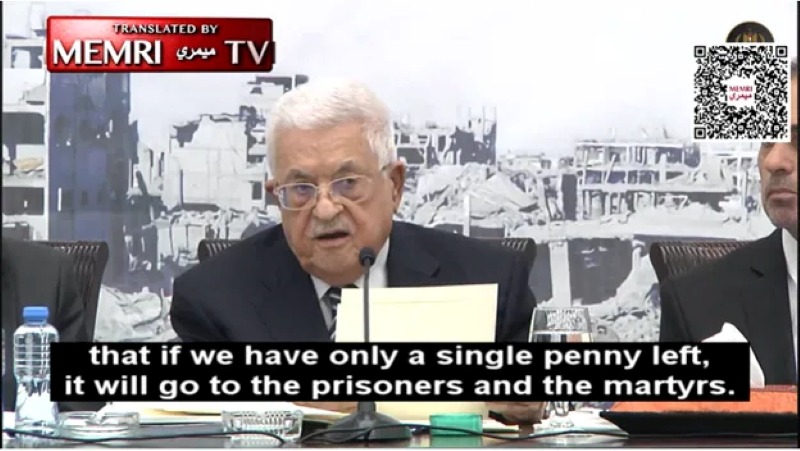 Hamas is a terrorist organization. Abbas and the Palestinian Authority, however, have their own deeply troubling record, including… a longstanding system of payments and benefits for Palestinian terrorists and the families of those killed while carrying out attacks on Israelis, known as “pay-for-slay.” “[I]f we have only a single penny left,” he said in February 2025, “it will go to the prisoners and the martyrs. I will not allow a reduction in our commitments to them.” (Image source: MEMRI)
On the eve of the third anniversary of the Hamas-led October 7, 2023 massacre in Israel, Palestinian Authority President Mahmoud Abbas is seeking “reconciliation” (musalaha) with Hamas and other Palestinian terrorist factions, including Palestinian Islamic Jihad (PIJ).
Instead of talking about “reconciliation” with Hamas and other terrorist groups, Abbas should be demanding that they surrender their weapons, answer for their actions, and disappear from the Palestinian arena.
Instead, during a recent visit to Cairo, Abbas said in an interview with Egypt’s Akhbar Al-Yom newspaper that he wanted “reconciliation” with all Palestinian factions and that a “reconciliation conference would soon be held in the Egyptian capital under the umbrella of the PLO and with Egyptian sponsorship.”
“I want reconciliation with everyone and I do not exclude anyone. Every Palestinian has the right to participate” in the upcoming legislative elections, scheduled for November 28, 2026, he added.
Abbas then added a series of conditions: the Palestinian factions must agree with the policy of the PLO, recognize what he called “international legitimacy,” and accept “one state with one set of institutions and one weapon and without militias.” He said Palestinians had already “tried” militias and that he did not want people to “die for nothing.”
There are several problems. One is that Hamas and PIJ do not accept Abbas’s conditions. Another is that Abbas is not at all interested in requiring accountability. A third problem that should not be overlooked is: Who is requiring accountability from the Palestinian Authority (PA) itself? Abbas cannot present Fatah and the PA as the “responsible” alternative to Hamas.
Hamas is a terrorist organization. Abbas and the PA, however, have their own deeply troubling record, including authoritarian rule, suppression of dissent, and a longstanding system of payments and benefits for Palestinian terrorists and the families of those killed while carrying out attacks on Israelis, known as “pay-for-slay.”
US State Department and Congressional reports have confirmed that the PA continued making millions of dollars in payments to terrorists and their families during 2025 and 2026. In 2025 alone, the PA provided $156 million in payments and benefits to terrorists and their families: $126 million to convicted terrorists in Israeli prisons and those released from prison, and $30 million to the families of Palestinian terrorists who died while committing their acts of terrorism. Payments also went to families of 5,000 “martyrs” in Lebanon.
According to Palestinian Authority television, the prioritization of “pay-for-slay” above all other PA budget expenses has caused the PA healthcare system to be “on the verge of collapse.” Without “pay-for-slay” salaries, one released terrorist declared on PA television, it would be impossible to recruit terrorists.
Abbas announced the elections to the Palestinian Legislative Council to appease Western aid donors. He just wants more of their money. The elections will not improve the situation for Palestinians: the choice for them remains between two bad parties: Fatah and Hamas. The United States and the Europeans should demand that Abbas stop paying terrorists and their families. That is more important than holding elections.
Abbas’s proposed “reconciliation” should not be presented as a choice between a supposedly “moderate” Fatah and a supposedly extremist Hamas. That Hamas is simply worse in certain aspects does not make the Palestinian Authority’s conduct acceptable.
Hamas has never accepted the Oslo Accords signed between the PLO and Israel in 1993-1995, and the Palestinian Authority has not fulfilled its binding obligations under the Accords. Both the Palestinian Islamic Jihad and Hamas do not recognize Israel’s right to exist and have continued to reject the political framework established by the Oslo process. Both do not accept the PLO’s commitment to United Nations resolutions pertaining to the Israeli Arab conflict. Most importantly, Hamas and PIJ in Gaza have consistently refused to surrender their weapons and dissolve their armed wings.
If Abbas’s conditions are genuine, all the terrorist groups would first have to undergo a fundamental transformation, including the Palestinian Authority itself. This change would include recognizing Israel’s right to exist and dismantling the armed wings of Hamas and all the other Palestinian terrorist groups. Only then could they operate under Abbas’s stated principle of “one state with one set of institutions and one weapons and without militias.” Meanwhile, Abbas gets to retain his multi-million-dollar “pay-for-slay” program.
Hamas and PIJ are not just political factions with which Fatah happens to disagree. The United States and several other countries have officially designated both Hamas and PIJ as Foreign Terrorist Organizations.
There is another striking feature of Abbas’s interview. When asked about the October 7, 2023 massacre and its repercussions, Abbas chose to focus only on the destruction in the Gaza Strip, as if the invasion of Israel by Hamas had never taken place. “After October 7, the result was the complete destruction of the Gaza Strip,” he said, referring to the destruction of infrastructure, roads, and buildings. “What happened brought nothing but destruction and ruin.”
There is no mention of the murders, kidnapping and torture of thousands of Israeli and foreign nationals that caused the “destruction” he is lamenting.
If Abbas or any other Palestinian leader wants to convince Israelis and the international community that the Palestinian leadership represents a different political path from Hamas and PIJ, all they have to do is say plainly — and then actually do it. He must declare that attacking Israeli civilians deliberately and taking hostages will no longer be accepted, that Hamas and all the terrorist organizations must surrender their weapons, and that no Palestinian political future will be built on terrorists or terrorism.
Abbas also appears to have forgotten — or at least set aside — what happened between his Fatah faction and Hamas in 2007. Hamas members violently seized control of the Gaza Strip, forcibly took over the government from the Palestinian Authority. After days of deadly fighting and extrajudicial executions — including Hamas throwing Fatah members off tall buildings to their deaths — other Fatah members fled to Israel.
According to Human Rights Watch:
“For eight days, the fighting was intense, and both sides engaged in serious violations of international humanitarian law, such as torturing and summarily executing captured and incapacitated fighters, including those inside hospitals, unnecessarily endangering civilians by fighting from populated areas, and blocking medical access to the injured. Hamas security forces, including members of the Executive Force and the Izz al-Din al-Qassam Brigades, shot several captured Fatah security members multiple times in the legs – a practice that continued over the following months.”
Since then, Abbas has repeatedly stated that there could be no “reconciliation” talks with Hamas so long as the terrorist group continues to control the Gaza Strip. In June 2007, he also issued a presidential decree declaring the Executive Force and Hamas militias to be “outlawed” due to their armed coup against the Palestinian Authority.
The fundamental problems, however, have not disappeared. Hamas remains an Islamist terrorist group committed to the destruction of Israel through jihad (holy war), and while Abbas says that the Palestinians need one state, one government, one set of institutions, and one weapon, Hamas continues to retain its armed wing.
For years, furthermore, Abbas has faced sustained international pressure to reform his own Palestinian Authority and strengthen governance, transparency, and the rule of law.
Recently, Abbas “renewed his commitment to the national reform agenda, including improving governance and transparency, strengthening the justice and security sectors, modernizing public administration, and developing education curricula in line with UNESCO standards,” according to the PA’s official WAFA news agency.
“He further emphasized efforts to enhance social protection systems, combat corruption, and reinforce accountability and integrity, while working with international and regional partners to implement reforms within set timelines.”
Bringing a terrorist group such as Hamas into a political arrangement, however, hardly constitutes reform. For years, Fatah and Hamas have competed for power while Palestinians have paid the price of political division, repression, corruption and armed conflict. The political contest in the PA is not about who will bring democracy and a strong economy to the Palestinians. It is still a contest over power, money and control.
The Palestinians do not need another photograph of Fatah and Hamas officials shaking hands and hugging each other in Cairo. They need functioning institutions. They need accountability. They need freedom from political repression. They need a political system in which no faction can maintain private armies or militias.
Finally, Abbas’s proposal raises an even larger question: Why is Palestinian reconciliation always discussed primarily as reconciliation among Palestinian factions, while reconciliation between Palestinians and Israelis remains so distant? A Palestinian political system that incorporates Iran’s terror proxies – Hamas and PIJ – means that Palestinian leaders still view these terrorist groups as legitimate actors.
Bassam Tawil is a Muslim Arab based in the Middle East. His work is made possible through the generous donation of a couple who wish to remain anonymous. Gatestone is most grateful.
 Uciekający z obszaru walk na Ochocie mieszkańcy oraz przyglądający się nim niemieccy żołnierze – zdjęcie wykonane na terenie cegielni stojącej przy Gliniankach Szczęśliwickich (otoczenie obecnej Górki Szczęśliwickiej). Fot. ECPAD / Instytut Pileckiego
 Ponad tysiąc nieznanych zdjęć z czasów II wojny światowej trafiło do polskich zbiorów