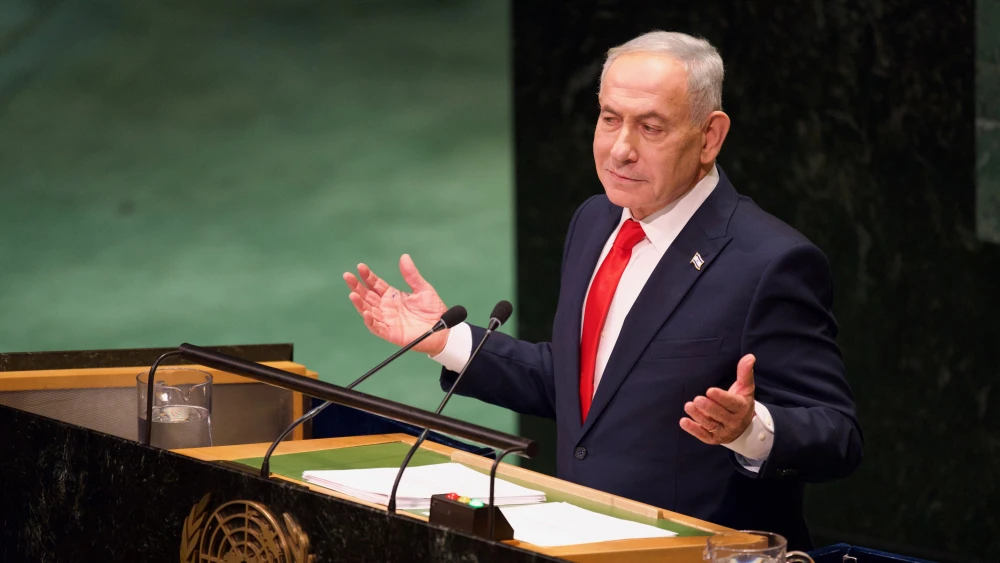
 Israeli Prime Minister Benjamin Netanyahu speaks at the U.N. General Assembly at United Nations headquarters in New York City, Sept. 24, 2026. Photo by Perry Bindelglass.
Jonathan S. Tobin
Israeli and American media have reacted to the prime minister’s strong polling with stories claiming that he was forewarned about Oct. 7. But do the voters trust them?
 Delegations walk out as Israeli Prime Minister Benjamin Netanyahu addresses the general debate of the U.N. General Assembly’s 81st session, at the U.N. headquarters in New York City, Sept. 24, 2026. Credit: Loey Felipe/UN Photo.
When Israeli Prime Minister Benjamin Netanyahu addressed the U.N. General Assembly in New York last week, his bold defense of his country and evisceration of its foes were predictably greeted by two completely different sets of responses in Israel and the United States. His supporters praised it as an eloquent and necessary rejoinder to the blood libels hurled at the Jewish state by its opponents. His Israeli and Jewish critics panned it as being out of touch with public opinion in both countries.
Those divergent responses sum up the difficulty of assessing Netanyahu’s ability to conduct public diplomacy as well as his current prospects for re-election when Israeli voters go to the polls on Oct. 27. The question isn’t so much about the value of his speech; it’s who is actually listening to him.
And by that, I’m not referring to the representatives of 75 nations who walked out of the speech, as opposed to the 118 who stayed and listened. Rather, I am taking into consideration the many Israelis and Americans who tuned him out long ago over the course of the turbulent four years since he was returned to office in the Knesset election in November 2022.
Serious accusations
The same problem faces those who are pondering the impact of the deluge of stories that have been published in the last week that allege, in one form or another, that Netanyahu has been warned about the Hamas-led Palestinian Arab terror attacks on his country but did nothing about it.
Those are serious accusations. And if they were true—and the prime minister really did ignore warnings and cover up the truth rather than act on the information that he was given—then they would be damning.
But real questions need to be asked about the reports.
It’s not just that their truth can be challenged on many details. The context of the pre-Oct. 7 world in which Israel lived, both in terms of the assumptions of the military and intelligence establishments and the political reality of the pre-war situation, is largely obscured by these articles.
And, just as important, is that the reports in Haaretz, The New York Times and The Atlantic come from publications fully committed to defeating the prime minister in the upcoming Knesset election by any means necessary. That they have arrived just in time to try and reverse a polling trend that seems to indicate an election stalemate or a Netanyahu victory also inspires skepticism.
As such, it’s hardly surprising that most of those who support Netanyahu’s Likud Party and his right-wing and religious coalition partners aren’t listening to the accusations. They not unreasonably assume that these broadsides are the Israeli equivalent of what American political observers call “October surprises”: politically motivated bombshells concocted by partisans to influence an election.
In America, the practice dates back to the 19th century. But the term was first coined when liberals seeking to derail Ronald Reagan hatched a conspiracy theory about him conspiring with Iran to ensure that the American hostages the Islamist regime had taken would not be released before the 1980 election. It was a lie, though some on the left still cling to this fiction. Nevertheless, Reagan won by a landslide.
Doubt over the reports about Netanyahu is not purely a function of support for him.
After all, six years ago the same American outlets that are now flogging charges about the Israeli leader were those who denied the truth of an October surprise that was actually true. Those who falsely claimed that the contents of Hunter Biden’s laptop—which, in addition to providing prurient details about his life, also contained evidence of his family’s corrupt activities—contained Russian disinformation forfeited our trust in their integrity.
A far-left outlet like Haaretz, which provides cover to many of the blood libels that have been spread about Israeli conduct during the post-Oct. 7 war—is similarly lacking in credibility. Israelis also know that the same sources have been telling them the prime minister is a crook and guilty of corruption. Yet the trial based on the flimsy charges made against him by a hostile legal establishment goes on endlessly, even though proof of his criminal conduct has not been produced.
Genuine intelligence or ‘noise’
Still, the accusations cannot be dismissed out of hand.
In addressing this indictment of Netanyahu, we need to start with a basic fact about judging intelligence in real time. As with all such situations in which governments must assess information, it’s very difficult to separate the truth about the intentions and actions of foes from what intelligence professionals refer to as the “noise.” By that, they mean the cacophony of other data that can be essentially true or completely false, and that might lead them to disbelieve the reports that might have led them to the correct conclusions. It is only after the fact (when we already know the outcome) that we can point to what happened prior to any conflict or incident and know which was which.
To note that doesn’t mean that it’s unfair to second-guess Netanyahu, as well as the entire military and intelligence establishment, for believing that, regardless of what some of the information they were receiving was telling them, Hamas wasn’t going to attack. Such judgments are part of the price of power.
But it is fair to point out what his critics would have said he had acted on such information. Since the plans of the Israel Defense Forces were predicated on an Oct. 7-style attack not being within the realm of the possible, would warnings have sufficed to defend the Gaza Envelope communities?
Critics want it both ways
As Israeli columnist Amit Segal has pointed out, many of the details in these reports don’t stand up to scrutiny. The Netanyahu-bashers want to have it both ways. As he wrote, “Israel’s government stands accused of, before Oct. 7, ignoring the warnings and not acting against Hamas with enough force and resolve. From Oct. 8 onward, it stands accused of acting with too much force and resolve.”
More to the point, would the same people who now call him a “traitor” have supported the prime minister if he had ordered an attack on Gaza to forestall the attacks before the slaughter on Oct. 7 based on the sources cited in these reports? Would they have backed him if he had reacted to these warnings—if indeed they were as unambiguous and authoritative as these journalists now claim them to be—and halted efforts to buy off Hamas with cash from Qatar (which was well known and largely supported by his political opponents at the time, since they, too, believed that war was unlikely) or restricted Gazans from employment in Israel?
The answer to those questions may be obscured by the righteous anger directed at everyone who has any share of the blame for the disaster—and Netanyahu is one of them.
But we all know that these left-wing outlets and the politicians hoping to benefit from these stories would have accused him of inhumanity and provoking war had he done so, even based on the best intelligence. The same smears about “genocide” and “war crimes” that have been hurled at Israel after Oct. 7 would have soon followed.
The problem is that even if the reports were accurate, what Netanyahu is truly guilty of doing is following the same policies toward Hamas-controlled Gaza that almost all of his political opponents supported before Oct. 7. Some, especially those on the left of the current “anyone-but-Bibi” coalition that has coalesced behind former IDF Gen. Gadi Eisenkot, actually want to repeat the folly of trying to appease the Palestinians now. Despite what some of those who are running against Netanyahu say now, the “conceptzia” about Hamas not attacking that paralyzed Israel’s security and political establishment prior to Oct. 7 was accepted across the Israeli political spectrum, with almost none of his opponents advocating for a tougher or more proactive stand against Hamas.
Letting Hamas off the hook
The worst aspect of the attempt to claim that Netanyahu somehow conspired to allow the attack to happen is not so much the way it seeks to undermine faith in his character and judgement. It’s that, as Segal also noted, these accounts seem to pardon the real authors of Oct. 7 of any agency or the ultimate responsibility for the worst mass slaughter of Jews since the Holocaust. The charges against Netanyahu are reminiscent of the way many of those who demonstrated against Netanyahu during the war seemed to speak at their weekly emotional rallies in Tel Aviv’s Hostages Square, as if Netanyahu had taken Israeli captives and was personally holding them prisoner. This type of argument gave a pass to the real culprits: Hamas, the Palestinians and their funders.
Shlomi Eldar and Ruthie Yuval, the authors of the new book that Haaretz and The New York Times cite as providing conclusive proof of Netanyahu’s criminal irresponsibility, appear to be claiming that Hamas senior leader Yahya Sinwar was left with no choice but to order the murder, torture, rape and kidnapping of Israelis. They further claim that he was willing to be bought off by the Israelis for more economic aid. They also argue that Sinwar was willing to release the hostages right after Oct. 7. All of this seems to stem from sources in the Palestinian Authority, who are no more trustworthy than Hamas.
Those claims are as unlikely to be true as the assumptions we’re asked to make about Netanyahu ignoring warnings. It contradicts everything we know about Hamas’s intentions and operations. It also requires us to believe that Sinwar was willing to keep the secret about his plan from his allies and sponsors in Iran and Lebanon, who could have materially aided the assault on Israel had they known of its date in advance. But at the same time, it requires us to believe he also either rushed to pass on the information to Netanyahu or let his allies elsewhere do it.
It’s also rather hard to believe and a bit too convenient for those who have come to think of Netanyahu as not merely a political opponent who is very hard to beat, but the source of all evil. Having failed to make their corruption accusations stick, accusing him of deliberately betraying his nation and his legacy as the guardian of its security is all that’s left to them.
Hypocrisy exists in both camps. It’s entirely fair to say that had one of Netanyahu’s opponents been in power on Oct. 7, those supporting the Likud-led coalition would probably be saying the same things about them. Just as those on the left dispute any “surprises” that might discomfit their candidates, conservatives in both countries do the same. And Israelis have substantial, if debatable, reasons to want a change in government that have nothing to do with the effort to smear Netanyahu.
Looming over all of this are the data points that scare Netanyahu’s opponents. The various polls of the Israeli electorate that have been published are clearly influenced by the political leanings of those who sponsor them. Israeli TV Channel 11, Channel 12 and Channel 13 all skew to the left, as do their polls. Channel 14, the one more conservative and religious alternative, skews to the right.
But none of them show Eisenkot’s coalition winning a majority in the Knesset, even if, despite his pledges not to do it, he invited the anti-Zionist Arab Ra’am Party to join his government. Meanwhile, Channel 14’s poll shows Netanyahu’s coalition gaining an even stronger majority in the Knesset. What frightens the Israeli left even more is that this same outlet’s poll correctly called the 2022 election, while its competition wrongly predicted his defeat.
Even if the left-wing polls are closer to the mark this time, at this point that would mean a stalemate, ensuring that Netanyahu continues as prime minister until a subsequent election could be organized sometime in 2027.
Under these circumstances, it’s hardly surprising that the Israeli left is pulling every possible surprise out of the closet—with likely more to come in the weeks until Oct. 27.
 Israeli Prime Minister Benjamin Netanyahu speaks at the United Nations in New York City, Sept. 24, 2026. Credit: Arie Leib Abrams/Flash90.
The voters’ verdict
This still begs the question as to whether anyone thinking of voting for one of the parties in Netanyahu’s coalition is even listening to the very serious charges the left is making.
In the internet era, in which competing sets of media outlets exist on both sides of the political aisle, it’s not just that Israelis, like Americans, no longer watch, listen or read the same news sources. In a bifurcated society, different media supply their readers, listeners and viewers with not only contradictory opinions and analyses of the issues. They also present them with often completely different sets of facts. In such an environment, it’s far from clear that all but a tiny portion of the electorate can be influenced to change their minds about who to vote for.
That battle over blame for Oct. 7 is likely to go on indefinitely since it has been a political football from the moment the war began. It’s hard to imagine either the Israeli right or left believing the findings of a commission of inquiry they don’t control. For the foreseeable future, historical works about the issue will probably be treated in the same manner.
And, for the time being, the only verdict that will matter will be the one delivered by the voters. Israelis have not only been deluged with evidence and arguments about this since Oct. 8. They have also lived through this chapter of history, experiencing the horror and sorrow of the attacks while being equally aware of the victories Israel has won over its enemies since then. Whether or not Netanyahu’s career is ended by the election results, his fate will be in the hands of the citizens of Israel—the only jury that ought to count and a far more trustworthy one than a jury composed of the editors of the Times, the Atlantic or Haaretz.
Many, if not most, of those looking on from abroad detest Netanyahu. Like U.S. President Donald Trump, they see him as a larger-than-life villain who can be blamed for anything. Even so, they need to trust the Israeli people and accept their judgment, whether they like it or not.
 Jonathan S. Tobin is editor-in-chief of the Jewish News Syndicate, a senior contributor for The Federalist, a columnist for Newsweek and a contributor to many other publications. He covers the American political scene, foreign policy, the U.S.-Israel relationship, Middle East diplomacy, the Jewish world and the arts. He hosts the JNS “Think Twice” podcast, both the weekly video program and the “Jonathan Tobin Daily” program, which are available on all major audio platforms and YouTube. Previously, he was executive editor, then senior online editor and chief political blogger, for Commentary magazine. Before that, he was editor-in-chief of The Jewish Exponent in Philadelphia and editor of the Connecticut Jewish Ledger. He has won more than 60 awards for commentary, art criticism and other writing. He appears regularly on television, commenting on politics and foreign policy. Born in New York City, he studied history at Columbia University.
 Wiadomości z wielkiego świata