 Who should speak for Israel? The case for Caroline Glick
Jonathan S. Tobin
Pearl-clutching about the veteran journalist possibly being sent to the New York consulate misses the point. The Jewish state needs bold advocates more than traditional diplomats.
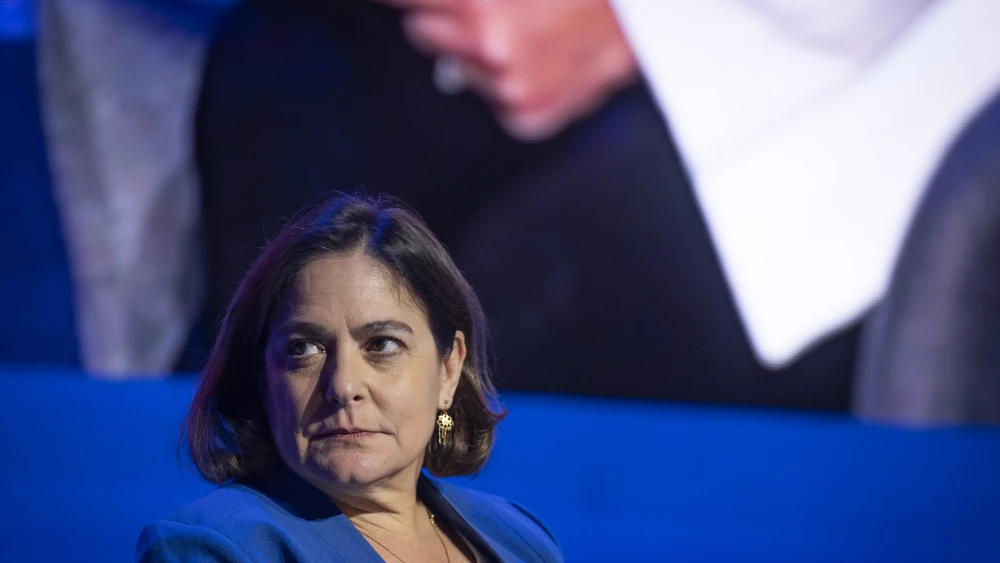 Caroline Glick, international affairs adviser to the Israeli Prime Minister Benjamin Netanyahu, attends the FOZ Ambassadors Summit in Jerusalem, Dec. 7, 2025. Photo by Yonatan Sindel/Flash90.
As far as Prime Minister Benjamin Netanyahu’s leftist critics are concerned, the last thing Israel needs is someone representing the country abroad who enthusiastically supports his policies, and is ready to do intellectual and verbal combat with the government’s opponents. If that doesn’t make sense, then welcome to Israeli politics.
That basic conundrum explains the firestorm that has greeted the floating of the idea that Netanyahu might name veteran journalist and current adviser Caroline Glick to the post of consul general in New York City. Glick was a senior contributing editor at JNS and hosted “The Caroline Glick” show on JNS TV before being named as Netanyahu’s international affairs adviser in February 2025.
In many ways, she is an ideal candidate for such a post. She was born, raised and educated (at Columbia and Harvard universities) in the United States. As a result, she speaks unaccented idiomatic American English, unlike most of Israel’s diplomats.
After making aliyah, she served in the Israel Defense Forces, where she worked as coordinator of negotiations with the Palestinian Authority during the period of the Oslo Accords. After becoming a journalist, she was embedded with the U.S. Army during the invasion of Iraq and worked as a frontline war correspondent. Since then—and outside of a brief stint running for the Knesset in 2019—she’s been covering and commenting on the issues that are at the forefront of Israeli public policy and diplomacy.
Moreover, as someone who worked with Netanyahu for a while in the 1990s and then again in the last year, she understands the prime minister’s views as well as anyone.
Unpopular with the left
So, what’s the problem with sending her to represent Israel in the city with the largest Jewish population outside of the Jewish state?
The answer, according to the scathing comments published in recent days in outlets like The Times of Israel and Haaretz, is that her views are in line with those of the government she would represent and the voters who elected it. According to both of those publications, which are bitterly opposed to that government, sending Glick to New York would offend “progressive” Jews. As far as the far-left Haaretz is concerned, Netanyahu is “spitting in American Jews’ faces” by even thinking of such an appointment.
The portrait they paint of her is of someone who hates most American Jews. The truth is quite the opposite. Glick loves both Israel and the Jewish people. But she has little patience or tolerance for those who claim to represent the Jews but have abysmally failed to defend their interests and security. Which is to say that she has been deeply critical of much of the American Jewish establishment and those elements of the community that have largely failed to live up to their responsibilities.
Since the Hamas-led Palestinian Arab terror attacks on Israel on Oct. 7, 2023, American Jewry has been faced with an unprecedented surge of antisemitism. Mobs on college campuses and in the streets of American cities have targeted Jews of all ages for intimidation and even violence, while chanting for Jewish genocide (“From the river to the sea”) and terrorism against Jews everywhere (“Globalize the intifada”). The traditional allies of liberal Jews have turned their backs on them, joining the gangs and embracing a new generation of anti-Zionist politicians who have joined in spreading blood libels about Israel being guilty of “genocide” and “apartheid.” And with the help of corporate media outlets like The New York Times, they have created a situation where Jew-hatred has become not just mainstream but even fashionable in elite circles.
Much of the American Jewish establishment has failed to respond to this crisis. Even when confronted with openly anti-Zionist figures like New York City Mayor Zohran Mamdani, whose entire career has revolved around his opposition to the existence of a Jewish state and who eggs on mobs besieging synagogues, all too many Jewish leaders have failed to confront or consistently oppose him.
Moreover, some of the so-called Jewish “progressives” whose sensibilities TOI and Haaretz are so worried about have joined with the likes of Mamdani to vilify Israel.
Diplomacy or advocacy
At such a moment in history, it’s worth asking: What is needed most? Israeli diplomats to schmooze the Jewish establishment, as so many have done in the past, and seek to avoid criticizing anti-Zionist Jews? Or does Israel, as well as the majority of New York Jews who are still supportive of the Jewish state, need someone who will pull no punches—and directly confront their country’s foes and help inspire others to do the same?
Advocacy hasn’t always been the top priority when Israel has chosen people to fill the country’s three top diplomatic posts in the United States and arguably the world: ambassador to the United States, ambassador to the United Nations and consul general in New York City. In practice, these positions are often treated more like patronage plums to be given out for political reasons as opposed to decisions directly related to public support for the Jewish state.
It’s also true that when it comes to filling such posts, governments of all stripes like to follow tradition, picking people who can look and play the role of diplomat. That means choosing a person who doesn’t offend anyone or step on any toes. That often involves dipping into the ranks of the professionals who have served in a similar capacity elsewhere, including veterans of Israel’s Foreign Ministry.
Being charming at cocktail parties can also be useful. But given the current crisis, perhaps it’s time that a new voice is represented in a major American posting by someone who goes against type. That would entail choosing an individual who could not only handle the duties of a typical diplomat but serve as an unapologetic advocate for the country and for the government he or she is representing.
In the past, some of Israel’s envoys have distinguished themselves as public advocates.
Abba Eban, the Jewish state’s first ambassador to the United Nations, who also jointly held the post of ambassador to the United States from 1950 to 1959; and U.N. Ambassadors Chaim Herzog (1975-78) and Netanyahu (1984-88) ably argued the justice of the Jewish state’s cause.
It’s no coincidence that in addition to their command of the issues—and unlike many of those who have represented Israel in the United States—all three spoke fluent and idiomatic English with, respectively, South African/English, Irish and American accents. That was a major asset; it enabled them to avoid the pitfalls of addressing the American public with awkward or non-idiomatic English, a must in a country where relatively few people speak a foreign language.
Netanyahu managed to do the same with some of his appointments.
Two former Americans he appointed as ambassadors to the United States—Michael Oren (2009-2013) and Ron Dermer (2013-2021)—were able diplomats and articulate exponents of their country’s cause.
Yechiel Leiter, the current ambassador in Washington, also American-born, is willing to eloquently and bluntly speak truth to both Washington and American Jewry. In fact, he did so earlier this month, when he aptly characterized the left-wing J Street as “a cancer within the Jewish community” for advocating for cutting off arms sales to Israel in the middle of a war in which it is fighting for its survival.
Leiter may have offended left-wing opponents of Israel, but he was only saying what most American Jews who care about Israel were already thinking.
The American Jewish disconnect
Such truth-telling can be jarring for American Jews. Too many of them get their news about Israel from The New York Times or left-wing publications like TOI and Haaretz. So, it’s no wonder that in contrast to the overwhelming majority of Israelis, they cling to outdated patent nostrums like the belief in a two-state solution the Palestinians repeatedly rejected long ago. They tend to believe that anyone who doesn’t sound like a J Street spokesperson is a rabid right-winger and opposed to peace, even if that sort of thinking is utterly disconnected from the reality of Israel, especially after Oct. 7.
With all due respect to many of the able and hard-working people who have served in this post before, what is required now is thinking outside the box. Sending another former Knesset member who needed to be “promoted” to a diplomatic post to get them out of the way in Jerusalem or a veteran diplomat who sees New York as another rung up the organizational ladder in the Ministry of Foreign Affairs would be a missed opportunity for the Jewish state.
What Israel and American Jewry need now is not someone who will try to make friends with Mamdani or be comfortable at a soirée with editors of the Times or liberal Jews who continue foolishly to look to both for leadership. An Israeli representative who will take on the intersectional left and the antisemitic right with equal boldness is what is required right now. So is someone who will fearlessly speak directly to ordinary Jews and not just to the Manhattan elites.
And that is exactly what Caroline Glick would do if given this opportunity.
In the past, Netanyahu flirted with the idea of appointing Glick to this post; in the end, he went in another direction. But he ought to take the pearl-clutching about Glick from left-wingers who oppose everything that he and most Israelis stand for as a good reason to trust his instincts and to choose her this time. While she wouldn’t be the safe choice or one that would earn him the applause of the liberal establishment in either country, she would be the right one.
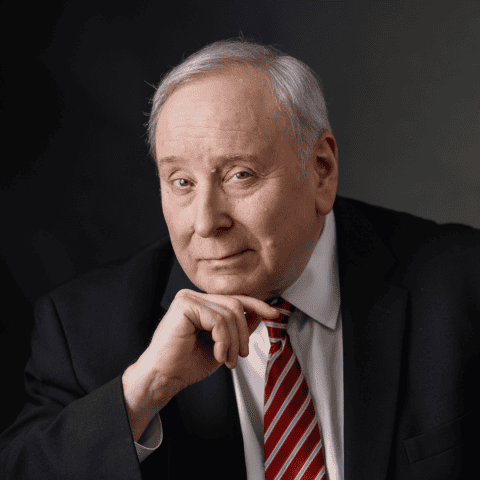 Jonathan S. Tobin is editor-in-chief of the Jewish News Syndicate, a senior contributor for The Federalist, a columnist for Newsweek and a contributor to many other publications. He covers the American political scene, foreign policy, the U.S.-Israel relationship, Middle East diplomacy, the Jewish world and the arts. He hosts the JNS “Think Twice” podcast, both the weekly video program and the “Jonathan Tobin Daily” program, which are available on all major audio platforms and YouTube. Previously, he was executive editor, then senior online editor and chief political blogger, for Commentary magazine. Before that, he was editor-in-chief of The Jewish Exponent in Philadelphia and editor of the Connecticut Jewish Ledger. He has won more than 60 awards for commentary, art criticism and other writing. He appears regularly on television, commenting on politics and foreign policy. Born in New York City, he studied history at Columbia University.
Zawartość publikowanych artykułów i materiałów nie reprezentuje poglądów ani opinii Reunion’68,
ani też webmastera Blogu Reunion’68, chyba ze jest to wyraźnie zaznaczone.
Twoje uwagi, linki, własne artykuły lub wiadomości prześlij na adres:
webmaster@reunion68.com