
Educate Americans First

Educate Americans First


Jay P. Greene


Skyrocketing foreign student enrollment at American universities is giving foreign governments power over what our universities teach while acculturating American students in third-world hatreds

.
Pro-Palestinian activists don kaffiyehs as students at the University of Pennsylvania campus in Philadelphia, on April 25, 2024
Matthew Hatcher/AFP via Getty Images

As the number of foreign students at our selective universities exceeds a third of total enrollment, it is important to remember the maxim of the 16th-century physician Paracelsus: “Sola dosis facit venenum.” The dose makes the poison.

From the end of World War II to 1977, the percentage of U.S. university enrollment from abroad never exceeded 2%. With this modest level of foreign enrollment, international students offered significant benefits. They strengthened the education of American students by contributing talent, experiences, and ideas from around the world to the learning environment.

Foreign students also added financial resources to U.S. universities because they tended to pay full tuition and sometimes brought with them large donations from wealthy foreign governments or families. In the context of the Cold War struggle between the Soviet Union and the West, foreign students who learned about the American political system and its values could bring ideas about individual liberty and representative democracy back to their home countries.

After 1977, foreign enrollment at U.S. universities crept higher, slowly at first, before it dramatically skyrocketed over the last two decades. Nationwide, the percentage of international students on college campuses has now nearly tripled since 1977. At our leading universities, the percentage of students from abroad has reached critical mass, averaging about a third but sometimes approaching half of total enrollments.

As foreign enrollments reach critical mass, the direction of the cultural exchanges taking place on campus has reversed.

Among Ivy League institutions, the foreign student population averages 27% or 39%, depending on whether students participating in Optional Practical Training (OPT) program are included. OPT allows foreigners on student visas to remain in the U.S. for as many as three years, if their university recommends that they receive additional applied training by working in their field of study, often as research assistants or instructors at the university. If OPT students are counted, Columbia University now has almost two-thirds of its total enrollment from abroad—a remarkable figure that makes it hard to imagine why U.S. taxpayers are massively supporting the educations of students who aren’t Americans. If OPT students are excluded, international students at Columbia still constitute 40% of its student body.

The University of Pennsylvania, Harvard, and Cornell each number 25% of their enrollment from abroad, not counting OPT students, and between 33% and 37% if OPT students are included. Yale, Princeton, Dartmouth, and Brown all have more than a fifth of their enrollment from abroad, excluding OPT, and between 23% and 31% if OPT is counted.

What was healthy at a low dose is turning poisonous at much higher levels. As foreign enrollments reach critical mass, the direction of the cultural exchanges taking place on campus has reversed. U.S. students are starting to take political opinions from countries like China, Saudi Arabia, Pakistan, Malaysia, and others whose governments and people are hardly known for their adherence to liberal values like democracy, free speech, legal equality of the sexes, opposition to racism and antisemitism, and other basic rules of the road in Western societies. At a certain level of foreign enrollment, our leading universities stop seeing themselves as the incubators of the American elite and start seeing themselves as incubators of a global elite, which sometimes involves teaching hatred of America and its values.

In addition to direct donations from foreign countries like Qatar, which have proved to be enormous, foreign actors gain leverage over American universities by massive tuition payments that can equal half or more of a given university’s tuition revenue—while helping to make universities unaffordable for all but the wealthiest American families. Foreign actors, whether governments or quasi-official foundations, can advance their agendas both by creating and amplifying entities within universities that promote perspectives preferred by their foreign patrons and by silencing potential critics of foreign misbehavior. Foreign students have played a leading role in campus protests against U.S. backing for Israel in the Gaza war, thereby advancing the foreign policies of their home governments while driving Jewish students off campus.

Neetu Arnold at the National Association of Scholars issued a report documenting how Middle East studies centers at American universities have been “hijacked” by foreign donors. “It is no surprise that foreign governments and individuals fund these centers,” Arnold wrote. “But foreign sponsors rarely need to exercise active influence, for the faculty and staff willingly do their bidding unasked. Donors can thus take a hands-off approach, leaving almost no paper trail other than a dollar amount and a few signatures. The funding still serves their interests: continued production of biased material that promotes the political interests of the donors.”

The Chinese government helped create and fund a network of centers at American universities known as “Confucius institutes,” as a “soft power” tool to advance their interests. Those institutes were so egregious in their propaganda activities, including efforts to silence critics and facilitate espionage, that Congress took action that resulted in the closure of almost all of them.

A more general critique of the influence of foreign money on American campuses is that it has tempted administrators and faculty alike to stray from basic academic norms such as the protection of free speech and the unhindered pursuit of knowledge, free access to university facilities by all faculty and students, the need to prove one’s arguments through objective fact-based research and argument, and prohibitions on violence and intimidation as acceptable methods of argument. According to a study of over 200 universities, “Campuses receiving foreign funds exhibited approximately twice as many campaigns to silence academics as those that did not.” Students at universities receiving more foreign money also reported a greater amount of antisemitic and anti-Zionist rhetoric and activity. The leverage of foreign money has enabled foreign actors to influence the culture and research activity at American universities in significant and harmful ways.

The largest number of international students come from China, which constitutes 27% of those from abroad. Students from India—a country that can at least boast a functioning democracy and which adheres to many, if not all, values of a liberal democratic society—make up 25% of foreign students. A little more than half of these students from China and India are studying math, science, or engineering, but the remainder are spread across a diversity of fields, including those in the social sciences, humanities, and the arts.

As relations between China and the U.S. have become more hostile, there has been a sharp rise in instances where Chinese students have been engaging in espionage against the U.S. and spying on fellow Chinese students to monitor any activity that might be threatening to the communist regime. While these activities of Chinese students in the U.S. pose serious threats to American interests, they do not cause much disruption in the normal operations of universities, which therefore appear happy to let them continue, without disrupting their accustomed cash flow.

Foreign students from countries hostile to Israel, however, have contributed to massive disruptions at U.S. universities after Oct. 7. These protests have not only interfered with regular instruction and research at universities, but they have also forcefully agitated against America and capitalism almost as much as against Israel. In some cases, they have led to the closure of campus facilities and spaces to American Jewish students, and to the cancellation of in-person instruction and graduation ceremonies for all students.

There are 28 countries in the U.N. that do not have diplomatic relations with Israel. Students from those 28 countries represent about 8% of international enrollment. If we add the 11 countries that have recalled their ambassadors or severed relations subsequent to Oct. 7, there are 129,710 students from countries with explicitly hostile relations with Israel, amounting to more than 12% of international enrollment. Other than China and India, both of which have maintained relations with Israel, students from these anti-Israel countries represent the largest block of international students on American campuses.

Universities with a critical mass of international students have hosted many more anti-Israel protests than universities where foreign enrollment is more moderate. A group of researchers at Harvard’s Crowd Counting Consortium tracks protests all over the country. If we focus on the few weeks following Oct. 7 and the last few weeks of the spring 2024 semester, the two periods with the most protest activity, and consider universities with at least 1,000 foreign students, we see a strong connection between the frequency of those protests and schools with high percentages of international students.

We can divide universities into quintiles—five groups, each with the same number of schools. In the three quintiles with fewer than 13% of enrollments from abroad, we see no trend between foreign enrollments and the number of protests. But when the dose is increased so that international students constitute more than 13% of enrollments, the number of protests more than doubles.

Calculations by Jay Greene and Tommy Huska based on data from IPEDS Data Center and OpenDoors and Harvard’s Crowd Counting Consortium

Of course, we cannot prove that high concentrations of international students caused the higher number of anti-Israel protests. Universities with more international students also tend to be institutions with wealthier and more liberal students, factors that other researchers have linked to anti-Israel activity. It is also important to note that the vast majority of international students, like all university students, have nothing to do with protests and just want to focus on their studies. But at higher doses, even a small percentage of international students seeking political agitation can constitute a critical mass to foment significant disruption.

We cannot demonstrate that international students are a large portion of those directly engaged in protests, in part because protesters have gone to extraordinary lengths to conceal their identities, and most reporters and universities have acquiesced to their desire for anonymity. International students have good reason to fear being identified in protests. If those protests violate laws or campus policies, resulting in suspensions, international students risk revocation of their visas and deportation.

Yet it is telling that universities have been visibly complicit in assisting international students in seeking to avoid consequences. For example, MIT publicly announced its reluctance to discipline rule-breaking foreign student protesters for fear that their suspension might cause them to be deported. Most other universities have been very reluctant to call in the police to shut down rule-breaking protests in part out of fear that arrests of foreign students could result in deportations.

Because of these efforts to conceal the role of foreign students in campus protests, we cannot quantify their participation, but we have plenty of anecdotes of their pivotal involvement. For example, Al Jazeera profiled Mahmoud Khalil, a Palestinian raised in Syria who is enrolled at Columbia University. According to that report, Khalil avoided joining the encampment for fear of suspension and deportation and instead took a role behind the scenes as “lead negotiator for Columbia University Apartheid Divest.” Despite his effort to assist the protests without directly participating in them, Khalil was suspended, but that suspension was quickly rescinded. According to Al Jazeera, Khalil “even received a call from the Columbia University president’s office, apologizing for the mistake.” Like MIT, Columbia officials were eager to avoid punishments for international students that might result in deportations.

The USC Annenberg Media similarly profiled Yousef Khafaja, a Palestinian raised in Germany, who was active in the UCLA encampment. According to that report, “the fear of the consequences he could potentially face as an international student participating in protests has never stopped him from doing so,” then it quoted Khafaja as saying, “Whatever happens to me is not going to be as important as the cause.” But the story acknowledges this sentiment as exceptional, noting “the general fear among pro-Palestinian protesters, who are covering their faces to hide their identity” with concerns about their visa status.

The Washington Post described the experience of two Cornell University international students, Momodou Taal and Bianca Waked, who both served as negotiators for protesters. Despite their efforts to avoid breaking rules by directly participating in protest actions, both nevertheless received suspensions. As they told the Post, they were “only in the encampment area the night before receiving the suspension letter to negotiate with the administration.” Like the claim that there is a distinction between the political and military wings of Hamas, university officials may not believe that negotiators are different from protesters.

Even if the involvement of international students in the protests cannot be fully documented, it is still clear that many foreign students were key contributors to those protests. As the Post put it, “The Post could not verify how many international students participated in the ongoing campus protests. Students at various universities, however, told The Post international students had been playing significant roles as speakers, teachers and general supporters, while avoiding encampments and other areas where the risk of arrest or suspension was high.”

International students have also played a longer-term indirect role in contributing to the wave of anti-Israel protests because many foreign students holding bigoted views imported from their home cultures eventually become professors at American universities where they further normalize hateful doctrines foreign to American culture. For example, Joseph Massad, a Columbia professor who was lambasted during congressional hearings as contributing to the antisemitic culture at the university, had previously been an international doctoral student at Columbia. A critical mass of anti-Israel international students eventually leads to a critical mass of anti-Israel faculty, who in turn recruit U.S. students to their cause. According to a 2019 report by George Mason University’s Institute for Immigration Research, 22% of university faculty are foreign-born, of whom over half remain foreign citizens.

Universities have shown little sensitivity to the potential problem of excess foreign influence. The amount of money they receive directly from foreign students and indirectly from foreign gifts, grants, and satellite campuses is too attractive for them to restrain themselves. And as they become globalized institutions, they feel even less obligation to attend to whether the education they offer serves American rather than foreign interests.

Yet despite all the money America universities receive from abroad, they receive even more from American taxpayers. If U.S. universities prove unable to distinguish between healthy and poisonous doses of foreign influence, policymakers may have to. Certainly, if universities wish to continue receiving large public subsidies, they will eventually be forced to ensure that they are serving American purposes by educating American students in American values and limiting foreign influence over the nature and content of the educations they are providing to foreign- and native-born students alike.


Jay P. Greene is a senior fellow at Do No Harm and a senior research fellow in the Center for Education Policy at the Heritage Foundation.


Zawartość publikowanych artykułów i materiałów nie reprezentuje poglądów ani opinii Reunion’68,
ani też webmastera Blogu Reunion’68, chyba ze jest to wyraźnie zaznaczone.
Twoje uwagi, linki, własne artykuły lub wiadomości prześlij na adres:
webmaster@reunion68.com


Israeli Singer Eden Golan to Perform at UN ‘October Rain’ Song About Hamas Attack Rejected by Eurovision

Israeli Singer Eden Golan to Perform at UN ‘October Rain’ Song About Hamas Attack Rejected by Eurovision

Shiryn Ghermezian


Eden Golan performing “Hurricane” for Israel at the second semi-final for the 2024 Eurovision Song Contest at Malmo Arena on May 9, 2024. Photo: Corinne Cumming/EBU

Eden Golan, Israel’s representative in this year’s Eurovision Song Contest, will perform her original song “October Rain” at the United Nations to mark the one-year anniversary of the deadly Oct. 7 Hamas terrorist attacks in southern Israel.

Golan will perform the track at a ceremony on Oct. 7 that will be hosted by Israel’s Foreign Ministry, according to ILTV News. Families of hostages currently being held by Hamas in the Gaza Strip are expected to attend the event along with Israel’s Foreign Minister Israel Katz, US Ambassador to the UN Linda Thomas-Greenfield, and diplomats from other countries, the news outlet reported.

The lyrics of “October Rain” reference the Oct. 7 massacre, and in the chorus, Golan sings: “Dancing in the storm/We got nothing to hide/Take me home/And leave the world behind/And I promise you that never again/I’m still wet from this October rain.”

Golan had originally planned to perform “October Rain” at this year’s Eurovision Song Contest in Sweden, but the European Broadcasting Union (EBU), which organizes the contest, rejected the song, deeming it too political. Golan instead competed in the Eurovision with a reworded version of the song that was retitled “Hurricane.”

Golan finished in fifth place in the 2024 Eurovision Song Contest. She made it to the top five after being booed on stage by anti-Israel protesters, experiencing death threats, and having one of the competition’s jury members refuse to give her points because of his personal opposition to Israel. Golan later revealed that she was forced to wear a disguise outside her hotel during the song competition in Malmo, Sweden, because of the threats she faced by those who opposed Israel’s involvement in the contest.

Shortly after the conclusion of the competition, Golan performed “October Rain” at a rally in Tel Aviv in support of the hostages taken by Hamas on Oct. 7.


Zawartość publikowanych artykułów i materiałów nie reprezentuje poglądów ani opinii Reunion’68,
ani też webmastera Blogu Reunion’68, chyba ze jest to wyraźnie zaznaczone.
Twoje uwagi, linki, własne artykuły lub wiadomości prześlij na adres:
webmaster@reunion68.com


Rezolucja parowóz dziejów, chwała jej maszynistom

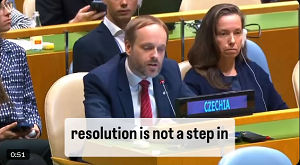
Ambasador Czech wyjaśnia dlaczego jego kraj nie może poprzeć rezolucji Zgromadzenia Ogólnego ONZ. (Zrzut z ekranu)


Rezolucja parowóz dziejów, chwała jej maszynistom

Andrzej Koraszewski


Zgromadzenie Ogólne ONZ podjęło w środę 11 września rezolucję, którą (jeśli wierzyć Google), zauważyła w naszym kraju tylko strona internetowa Kresy.pl. Ta strona informuje, że Oxford Internet Institute uznał ją za należącą do pierwszej piątki najbardziej rzetelnych w Polsce  i faktycznie w tym doniesieniu rzetelnie informuje, co postanowiono. Zgromadzenie 124 głosami za, przy 14 przeciw i 42 wstrzymujących się uznało, że Izrael ma w ciągu roku zakończyć okupację i  wycofać nielegalnych osadników z terenów palestyńskich.

Kresy.pl donoszą, iż rezolucja traktuje o „bezprawnej okupacji” (trwającej od 1967 roku), o „nielegalnych osadnikach”, o tym, że „większość państw uznaje żydowskie osady za nielegalne”.

Jest to poprawne streszczenie tekstu rezolucji. Redakcja nie przypomina, że te sformułowania i ten język znajdujemy w mediach radzieckich i rosyjskich od wielu dziesięcioleci.

Polska heroicznie wstrzymała się od głosu, nie wiemy jednak, czym się kierowała. Doprawdy trudno się domyślić, czym mógł się kierować minister Radek Sikorski, instruując swojego pracownika na stanowisku ambasadora RP, iżby się wstrzymał. Może minister nie chciał łamać tradycji, (w końcu Polska uznała „państwo Palestyna” jeszcze przed upadkiem komunizmu), może tak mu doradziła żona, a może tylko nie chciał urazić hiszpańskiego komunisty Borrella, który jest nie tylko komisarzem politycznym Unii Europejskiej, ale pochodzi z kraju, który współsponsorował tę rezolucję.

Międzynarodowe media, które donosiły o tej rezolucji Zgromadzenia Ogólnego ONZ, nie rozwodziły się nad motywacją krajów, które się jej sprzeciwiły. Było ich zaledwie 14 na 180 biorących udział w głosowaniu. Sprzeciwiły się Stany Zjednoczone, ale media z jakiegoś powodu nie napisały, czym się pani ambasador kierowała. Długo musiałem szukać, żeby się dowiedzieć, czym kierowali się nasi sąsiedzi Czesi, którzy podobnie jak USA odmówili poparcia tej haniebnej rezolucji.

Przed głosowaniem ambasador Jakub Kulhanek mówił, że ta rezolucja po raz kolejny wzmacnia konflikty, nie wspomina o zagrożeniach Izraela, o porwanych zakładnikach, o używaniu przez Hamas palestyńskich cywilów jako żywych tarcz.

Na swoim koncie X ambasador Kulhanek pisał:

„Dzisiaj przedstawiono projekt rezolucji Zgromadzenia Ogólnego w oparciu o opinię doradczą Międzynarodowego Trybunału Sprawiedliwości. Głosowaliśmy przeciw. W pełni szanujemy niezależność MTS. Jednak pytania sformułowane przez Zgromadzenie Ogólne w rezolucji 247 z 2022 r. nie pozwoliły Trybunałowi ocenić sytuacji jako całości. Trybunał nie mógł poświęcić wystarczającej uwagi uzasadnionym interesom bezpieczeństwa Izraela i jego prawu do samoobrony.”

Nie trudno zgadnąć, że najrzetelniejsze sprawozdania z tego posiedzenia Zgromadzenia Ogólnego ONZ i najwięcej opinii na temat tej rezolucji znajdujemy w mediach izraelskich.

Jak pisała, „Jerusalem Post”, Antonio Guterres poparł tę rezolucję jeszcze przed głosowaniem, nie zauważając faktu, iż nie wspomina ona o Hamasie, Hezbollahu, Islamskiej Republice Iranu, ani o wspieraniu terroryzmu przez Autonomię Palestyńską. Rezolucja nie tylko wzywa do zakończenia „okupacji” i zlikwidowania „nielegalnych” osiedli, ale zwraca się również do wszystkich narodów świata, żeby nie sprzedawały Izraelowi broni i nie kupowały u Żyda.   

Rezolucja Zgromadzenia Ogólnego nie jest wiążąca, ale podobnie jak sponsorowana przez ZSRR rezolucja z 1975 roku zrównująca syjonizm z rasizmem była pierwszym krokiem do konferencji w Durbanie i wykorzystania ONZ dla nakręcania ogólnoświatowej orgii antysemityzmu, tak mamy powody, by sądzić, że ta rezolucja będzie miała silny wpływ psychologiczny i jeszcze bardziej wzmocni antysemityzm światowych mediów oraz polityków. Świat nie chce walczyć z zagrażającym demokracji wojującym islamem i jego terroryzmem, zdecydowanie woli walkę z Izraelem, bo to apeluje do właściwych uczuć ideologicznych i religijnych.   

Jak czytamy w tym doniesieniu „Jerusalem Post” ambasadorka Nowej Zelandii, Carolyn Schwalger, (która poparła rezolucję), dała do zrozumienia, że to tylko cyrk i z poważną miną mówiła:

„Wskazany w rezolucji 12-miesięczny okres na wycofanie się Izraela z okupowanego terytorium palestyńskiego jest szczerze mówiąc nierealny. Rozwiązanie w postaci dwóch państw musi być wynikiem negocjacji. Aspiracje muszą być łagodzone przez realizm, biorąc pod uwagę złożoność, którą należy rozwiązać.

Oczekujemy jednak, że w ciągu najbliższych 12 miesięcy Izrael podejmie znaczące kroki w kierunku przestrzegania prawa międzynarodowego, w szczególności poprzez wycofanie się z okupowanych terytoriów palestyńskich.”

Biorąc pod uwagę, że  ta ambasadorka nie oczekuje niczego od tych, którzy deklarują zamiar zniszczenia Izraela i wymordowania jego ludności, reszty jej motywacji skłaniającej do poparcia tej rezolucji możemy się domyślać.   

Ambasador Kanady zauważył nawet, że „w rezolucji nie ma żadnej wzmianki o konieczności położenia kresu terroryzmowi, co do którego Izrael ma poważne i uzasadnione obawy dotyczące bezpieczeństwa” i uznał za rzecz moralną nie przeszkadzanie w jej uchwaleniu i wstrzymanie się od głosu.

Urodzony w Kanadzie polityk izraelski Dan Illouz pisząc o tej rezolucji na swoim koncie X stwierdził:

„W tym teatrze absurdu ONZ ośmiela się oskarżać Izrael o łamanie prawa międzynarodowego – gdy Izrael jest jedynym krajem w regionie, który je przestrzega i egzekwuje, nawet w czasie wojny. Izrael jest moralną busolą, krajem broniącym swojego narodu, który jednocześnie przestrzega najwyższych standardów prawa i sprawiedliwości.

Nie łudźcie się: to nie jest tylko wojna Izraela. To wojna o prawo całego wolnego świata do obrony przed terrorem i złem. Nie dajcie się zwieść – Izrael może być na pierwszej linii frontu, ale wy wszyscy jesteście na celowniku. Ta walka toczy się o przetrwanie wolności, przyzwoitości i samego życia”

Jeśli ktoś sądzi, że ta rezolucja jest bez znaczenia i że media słusznie ją zignorowały, to prawdopodobnie jest w poważnym błędzie. Tego rodzaju rezolucje wracają w dyskursie latami i powołują się na nie nie tylko tacy „mężowie stanu” jak Mahmoud Abbas, Putin, czy Erdogan, ale politycy uznawani za demokratów i przedstawicieli wolnego świata.

W 1975 roku przed głosowaniem nad rezolucją zrównującą syjonizm z rasizmem, ambasador Stanów Zjednoczonych przy ONZ, Daniel Patrick Moynihan ostrzegł, że „Narody Zjednoczone wkrótce uczynią antysemityzm prawem międzynarodowym”. Powiedział również, że „Stany Zjednoczone nie uznają, nie będą przestrzegać i nigdy nie pogodzą się z tą haniebną rezolucją”.

Po upadku ZSRR tamta rezolucja została unieważniona, nic jednak nie mogło naprawić jej tragicznych skutków.

Młode pokolenie na szczęście nie musi się uczyć słynnego wiersza Władysława Broniewskiego „Słowo o Stalinie”:

“Rewolucja – parowóz dziejów”…
Chwała jej maszynistom!
Cóż, że wrogie wiatry powieją?
Chwała płonącym iskrom!
Chwała tym, co wśród ognia i mrozu
jak złom granitowy trwali,
jak wcielona wola i rozum,
jak Stalin.

W środę 11 września Zgromadzenie Ogólne ONZ weszło ponownie w stare koleiny. 49 lat temu Polska głosowała za uchwaleniem haniebnej rezolucji, prawie pół wieku później, wstrzymała się od głosu. To niebywały postęp moralny.


Zawartość publikowanych artykułów i materiałów nie reprezentuje poglądów ani opinii Reunion’68,
ani też webmastera Blogu Reunion’68, chyba ze jest to wyraźnie zaznaczone.
Twoje uwagi, linki, własne artykuły lub wiadomości prześlij na adres:
webmaster@reunion68.com


Why the reactions to Israel’s strikes on Hezbollah matter

Why the reactions to Israel’s strikes on Hezbollah matter

Jonathan S. Tobin


The criticism of the tactics and the fact that it inspired some laughter from besieged Israelis speak volumes about the moral sickness afflicting many Western liberals.

.
Israeli soldiers evacuate wounded people who was severely injured when a missile fired from Lebanon hit the Ramim Cliff area, near the Israeli border with Lebanon, on Sept. 19, 2024. Photo by Ayal Margolin/Flash90.

It was the covert operation that inspired thousands of Internet memes. The simultaneous explosion of thousands of pagers in the possession of Hezbollah operatives followed a day later by a similar mass explosion of terrorist walkie-talkies was the top story across the world this week.

The strikes on Hezbollah leadership that occurred a few days later might have been just as important in seeking to cripple the terrorists’ ability to continue its ongoing missile strikes on northern Israel and possible threats of a possible land attack on the Jewish state. Nevertheless, the attack on members of the organization (and its associated sponsors and string-pullers, like the Iranian ambassador to Lebanon who reportedly also had a Hezbollah beeper and lost an eye when it blew up) carrying around those relics of 1980s technology triggered both the imagination and the indignation of international opinion.

We can’t know for sure just how much damage Israel has done to Hezbollah’s morale, let alone its capabilities to inflict terror and pain on Israelis as well as Lebanese citizens. There may be some truth to what the doomsayers among New York Times analysts and Israeli left-wingers who claimed that any harm would be superficial and transitory.

More important was the angry reaction inspired among many Western liberals who denounced the attacks because they don’t believe in Israel’s right to defend itself against terrorists and because they no longer believe that any Western nation has the right to fight even the most just wars.

Not an ‘escalation’

The claim that this was an Israeli “escalation” is entirely untrue since it is Hezbollah that initiated the current round of strife. No matter how many terrorists were killed, maimed or wounded in the strikes, the Iranian proxy shows no sign of halting its firing on not just northern Israel but now other areas since Hamas’s Oct. 7 massacre by Hamas in the south. Hezbollah’s rockets have essentially depopulated Israeli communities along the country’s northern border, turning tens of thousands of its citizens into evacuees holing up in hotels in the center of the country alongside those who were similarly affected by the assault on southern Israel.

No spy caper—no matter how ingenious or expertly targeted to harm as few innocents as possible—means much if it doesn’t contribute to Israel’s strategic goal: pushing Hezbollah forces away from its border and ensuring safety to the north. It may be, as Israeli Defense Minister Yoav Gallant has recently hinted, that this objective may only be achieved by a cross-border offensive involving the use of land forces.

But there is no avoiding the fact that the enormous attention devoted to what analyst Michael Doran satirically called “Operation Grim Beeper” told us not only about the role that Jews and Israel still play in the Western imagination but also about what a great many people in the West now think about armed conflict.

‘Magical’ Jews

One side of this reaction is not entirely bad. As much as the still-powerful myth about Jewish power is at the heart of antisemitism, the belief in what might be termed the “magical Jew” who is smarter and more resourceful than other people sometimes works to benefit Jews.

Britain’s 1917 decision to issue the Balfour Declaration in favor of the creation of a Jewish National Home, which gave Zionism a crucial boost at a critical time, is often ascribed to the philo-Semitsm as well as the belief of several British statesmen, including Prime Minister David Lloyd George’s in the authority of the Bible, which has a thing or two to say about to whom the land of Israel belongs. More important was their misplaced belief in the unchecked power of the Jews (whom they were persuaded would be won over to the Allied cause by the declaration) to ensure that the United States stayed close to British objectives and to keep Russia an active participant in World War I, something that was far beyond the capabilities of either Jewish community.

Yet the heart of the deterrent power of Israel’s defense and intelligence forces is the fact that many of the Jewish state’s enemies see it as a mighty power that can’t be beaten.

This reputation has been honestly earned by Israel’s many military victories and intelligence coups over the decades. The latter, in which technology masterminds working inside Israel’s Mossad has dispatched with ingenious methods a long list of those working to harm Jews—Arab terrorists, German scientists working in Arab countries to produce weapons of mass destruction, those involved in the 1972 Munich Olympic massacre, and, in recent years, Iranians working on building the Islamist regime’s nuclear program—are already well-documented.

This sense of their own invincibility has sometimes also worked against Israelis. The tragic errors made by its intelligence establishment before Oct. 7 showed the price of such hubris. The same geniuses that helped pull off the exploding beepers this week were members of the organization that failed so badly to prevent the largest mass slaughter of Jews since World War II and the Holocaust.

The exploding pagers and walkie-talkies (employed only because Hezbollah was already convinced that modern means of communication involving cell phones and the Internet were inevitably going to be compromised by the Israelis) will join that list. But as with every Israeli achievement, including the innumerable technological and medical innovations produced by that tiny country’s scientists, tech specialists and engineers that have inspired great praise (and made Jews everywhere proud of what their people have done), it will also inspire more harmful conspiracy theories that contribute to hatred for Jews. This proves again that although times and circumstances changed, the Jews remain the primary boogeymen of Western thought.

Along with those more traditional tropes of antisemitism, the reactions to what we all must presume (though Hezbollah and Iran have many enemies, such as the United States, which currently lacks the will to strike them and many others who don’t have the capability) was an Israeli operation, the moral disdain it aroused among some needs to be understood and put in context.

The attack provoked condemnation from among supposedly high-minded people who labeled the scheme a “terrorist” attack or claimed that it violated international law—as did Human Rights Watch, a group that has time and again been exposed for its bias against Israel and antisemitism. As predictably negative articles published by NPR and The Intercept noted, so-called experts from the United Nations agreed. Other entities irredeemably committed to undermining Israel’s right to exist and defend itself decried that the exploding devices were evidence of a massive “war crime.”

An Israeli tank during military training in the Golan Heights on April 19, 2024. Photo by Michael Giladi/Flash90.

Is it acceptable to laugh at the situation?

Even more insufferable was the moral opprobrium directed at the many Israelis and people everywhere, Jew and non-Jew alike, who found humor in the misfortune of the terrorists, as was made clear in a tsunami of jokes and memes about their stupidity as well as the grievous injuries suffered by many of them.

Let’s specify that many of these jibes were not in the best of taste. Maybe all of them were tasteless. The notion that we should in some ways recognize the common humanity we share with members of Hezbollah or that we are obligated by our own faiths to grieve with our enemies, even as we resist them, is well grounded in Jewish as well as Christian traditions.

After all, one of the highlights of a Passover seder is the ritual of removing drops of wine from our cups at the mention of each of the plagues sent by God to punish the Egyptians for their enslavement of the Jews. Moses’ own sister, Miriam, was punished for celebrating the deaths of the Egyptians who drowned when the Red Sea reconstituted itself after letting the escaped slaves pass.

But dipping our fingers in a wine cup is easy enough when trying to atavistically recall an event that happened more than 3,000 years ago. Israelis have been living with the trauma of Oct. 7 for the past year and decades of terrorism before that. Jews elsewhere are facing a surge in antisemitism the likes of which have not been experienced in the living memory of most people. We are all only human and are entitled to take some satisfaction when those dedicated to murdering Israelis, Americans and other Diaspora Jewish communities encounter some misfortune.

This is not dissimilar to reactions to the deaths of Nazis in the past, even though as many as a million or more German civilians were killed in both Allied bombings and the invasions of Germany needed to overthrow Adolf Hitler’s regime. When human beings engage in mass murder, as members of Hezbollah have repeatedly done, they forfeit the right to sympathy when reaping the whirlwind they have sown. Anyone who disagrees with that has lost their moral compass.

Although the deaths of any innocent civilian is a tragedy, there is no other example that I am aware of such a mass-targeted killing of terrorists that was so clearly crafted to avoid such casualties. In the past year, Israel has often been falsely accused of making no effort to spare civilians, even though they do more than any nation in that respect. But when it does something that is so transparently directed only at terrorists—who else would have a Hezbollah pager?—it is still attacked with the same unfairness charge. As in so many other ways, this proves again that Israel is assaulted verbally, legally and physically not so much for what it does but for what it is.

Israel can do nothing right

At the root of this the same belief in Israel’s illegitimacy as a “settler/colonialist” and “apartheid” state that motivates the mobs who have marched in the streets of American cities and on college campuses in support of Hamas’s efforts to purge Jews “from the river to the sea.”

To such people, there is nothing that Israelis could do to defend itself under any circumstance that would be justified. And, as they have also shown, there is nothing that those who wish to eradicate Israeli—even the genocidal Islamists of Hamas who perpetrated an orgy of mass murder, rape, torture, kidnapping and wanton destruction on Oct. 7—can do that can’t be characterized as an act of justified “resistance” against “settlers” and “white” oppressors.

Just as important as that is the way the attack on Israel’s efforts to stop Hezbollah tells us about the way many in the West have lost any belief that there is such a thing as a just war.

The immediate reaction to the terrorist attacks on Sept. 11, 2001, reminded the overwhelming majority of Americans that there were times when you had to fight to defend yourself and your country. That was a matter of consensus among the generation that fought in World War II but had gone out of fashion in the Vietnam War era. Amid the quagmires in Iraq and Afghanistan that followed 9/11, it is once again being attacked by the left.

Some wars are just

That sense that there is nothing worth fighting or dying for has been compounded by the success of the left’s long march through our institutions in recent years as a generation of American students were indoctrinated in the toxic neo-Marxist myths about critical race theory and intersectionality. This is not just a war against America and its history but against Western civilization itself. By this means, many Americans have been intellectually disarmed against threats to their values and their nation. Along with it comes a belief that “white” Westerners are, like Israelis, inherently illegitimate and should not resist those who label themselves (as does Hezbollah) as members of a class of victims who seek to do them harm and topple their civilization.

In the aftermath of Vietnam, one liberal intellectual who had protested America’s involvement in that conflict sought to map out a way to think about war that would be free of mindless pacifism, in addition to chauvinism and war fever. His 1977 book, Just and Unjust Wars, is a classic that has withstood the test of time and bears revisiting. It teaches that while unnecessary and aggressive wars are unjust, those waged to defend against murderous regimes and those who seek to victimize the powerless are just. Most of all, a war waged to defend a nation’s existence is fully defensible and should be supported by anyone with a set of moral values.

But many contemporary Western liberals have either forgotten that or have embraced anti-Western and Marxist ideology that would render even the most obviously moral wars, such as those waged against Hitler’s regime and the perpetrators of Oct. 7, as somehow immoral. In this way, they are prepared to condemn Israel’s exploding beepers that are clearly aimed at killing only terrorists as much as they do anything to prevent Hamas, Hezbollah, the Houthis in Yemen and their Iranian paymasters from continuing to inflict suffering on Israel and the West. In their worldview, the terrorists should be protected from attack, and their Israeli and Western victims deserve none.

The issue this week isn’t so much whether it’s OK to laugh at the predicament of terrorists who have had the tables turned on them. It’s whether it’s ever right for Israelis or any citizen of a Western country to defend themselves against murderers with blood on their hands, and who wish to create more mayhem and death. Ethical people understand that there is only one answer to that question. The anger directed at Israel is because they have once again shown that they are prepared to try to make the killers pay for their crimes.


Jonathan S. Tobin is editor-in-chief of JNS.org. Follow him @jonathans_tobin.


Zawartość publikowanych artykułów i materiałów nie reprezentuje poglądów ani opinii Reunion’68,
ani też webmastera Blogu Reunion’68, chyba ze jest to wyraźnie zaznaczone.
Twoje uwagi, linki, własne artykuły lub wiadomości prześlij na adres:
webmaster@reunion68.com


Anti-Israel Protesters Storm Screening of Israeli Film at Toronto Festival

Anti-Israel Protesters Storm Screening of Israeli Film at Toronto Festival

Shiryn Ghermezian


A scene from “Bliss (Hemda).” Photo: TIFF

Anti-Israel protesters interrupted a screening of an Israeli film at the Toronto International Film Festival (TIFF) on Wednesday by demonstrating on stage before the show began and also chanting against the Jewish state outside the theater where the screening took place.

The film “Bliss (Hemda)” made its international premiere at the film festival. Before its screening began inside the TIFF Lightbox Cinema, a small group of approximately four protesters jumped on stage and shouted slogans against Israel, including “Free Palestine” as well as “From the river to the sea, Palestine will be free,” which is widely interpreted as a call for the destruction of Israel, which is located between the Jordan River and the Mediterranean Sea.

The protesters told the audience “Shame on all of you,” shouted multiple false claims, and held banners about Israel committing “genocide” against Palestinians, according to a video from the scene obtained by Israel’s N12. Another demonstrator introduced the group as “a coalition of Jewish people, filmmakers [and] artists and we say no to genocide.” They continued to protest while being escorted off the stage and out of the theater by security personnel.

As the protesters were led out of the theater, the audience began chanting “Bring them home,” calling for Hamas to release the 101 hostages that remain in captivity in Gaza since the Oct. 7 terrorist attacks in Israel. The screening then proceeded as planned.

Outside the TIFF Lightbox Cinema, protesters chanted “Free Palestine,” against falsely accused Israel of genocide, held Palestinian flags, and raised anti-Israel posters, including one that said “Boycott Israel.” Another sign said “Turtle Island to Palestine, colonization is a crime,” and a separate poster read: “Bliss normalizes Israel apartheid.”

“Bliss” is a drama about an older married couple — played by Sasson Gabay, from “Shtisel” fame, and Asi Levi – confronting a number of challenges in their marriage, which is now intensified by the presence of two young men, who introduce new threats to their already fragile marriage. A synopsis of the film provided by TIFF stated that “Bliss” was written and shot before the ongoing Israel-Hamas war, but “certain scenes touch lightly on interactions between Jewish and Arab culture and language in Israel.”

The Hebrew and Arabic language film is directed by Shemi Zarhin, who was born in Tiberias and is now based in Tel Aviv. The director, who is also a screenwriter and novelist, has had previous films screened at TIFF. He told The Hollywood Reporter that “Bliss” was shot in locations across northern Israel that were later bombed and destroyed by Hezbollah missiles fired from southern Lebanon during the current Israel-Hamas war. A community center with a swimming pool that was a central location in the film was completely destroyed.

TIFF runs through Sept. 15, and “Bliss” had a second screening at the film festival on Thursday.

Watch a trailer for the film below.


Zawartość publikowanych artykułów i materiałów nie reprezentuje poglądów ani opinii Reunion’68,
ani też webmastera Blogu Reunion’68, chyba ze jest to wyraźnie zaznaczone.
Twoje uwagi, linki, własne artykuły lub wiadomości prześlij na adres:
webmaster@reunion68.com