
Archive | 2016/06/26

Za kulisami niechętnego ślubu Turcji z Izraelem

Za kulisami niechętnego ślubu Turcji z Izraelem

Burak Bekdil
tłumaczenie: Małgorzata Koraszewska
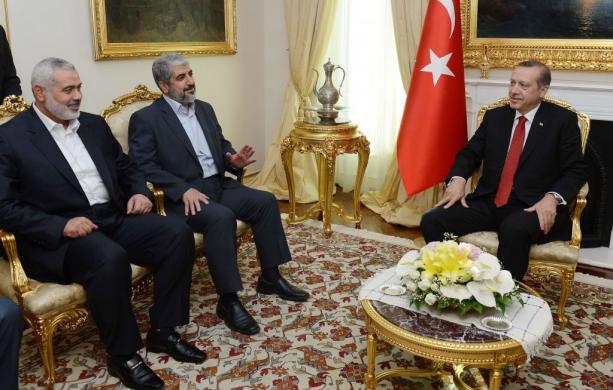

Prezydent Turecji (wówczas premier) Recep Tayyip Erdogan, po prawej, na spotkaniu z przywódcami Hamasu Chaledem Maszaalem (pośrodku) i Ismailem Haniją, 18 czerwca 2013 r. w Ankarze w Turcji. (Zdjęcie: Biuro prasowe premiera Turcji)Prezydent Turecji (wówczas premier) Recep Tayyip Erdogan, po prawej, na spotkaniu z przywódcami Hamasu Chaledem Maszaalem (pośrodku) i Ismailem Haniją, 18 czerwca 2013 r. w Ankarze w Turcji. (Zdjęcie: Biuro prasowe premiera Turcji)

Wszystkie oznaki wskazują na to, że Turcja i Izrael nie są daleko od powrotu do normalizacji swoich burzliwych stosunków dyplomatycznych. Według tureckiego ministra spraw zagranicznych, Mevluta Cavusoglu, ci byli sojusznicy są o “jedno lub dwa spotkania” oddaleni od normalizacji.

Jeśli jednak po sześciu latach zimnej wojny Ankara i Jerozolima uścisną sobie ręce, będzie to dlatego, że Turcja czuje się coraz bardziej izolowana na arenie międzynarodowej, nie zaś dlatego, że ma jakieś autentycznie przyjazne uczucia wobec narodu żydowskiego.

Najprawdopodobniej “pokój” między Turcją a Izraelem będzie wyglądał tak jak definicja pokoju w The Devil’s Dictionary Ambrose Bierce’a: “W kontaktach międzynarodowych, okres oszukiwania między dwoma okresami walk”.

Tymczasem 29 maja po raz pierwszy od 41 lat w historycznej synagodze w północno zachodniej prowincji Edirne odbyła się żydowska ceremonia ślubna. Kilka miesięcy wcześniej, w grudniu 2015 roku, żydowski rok 5776 przeszedł do historii jako pierwszy, być może, raz, kiedy w muzułmańskiej Turcji odprawiono oficjalną chanukową ceremonię zapalania świec jako wydarzenie sponsorowane przez państwo. Wszystko to jest bardzo miłe – ale może być mylące.

Są dwa wielkie problemy, które prawdopodobnie zablokują prawdziwą normalizację. Jednym jest Hamas, a drugim głęboki i jak się wydaje nieodwracalny, antysemityzm, który trawi większość Turków.`

Niedawno Jonathan Schanzer w ważnym artykule przypomniał, że chociaż Saleh Arouri, wysoki rangą przywódca wojskowy Hamasu, został wydalony ze swej bezpiecznej bazy w Stambule, “… wielu innych wysokich rangą funkcjonariuszy Hamasu nadal tam pozostaje. A ich wydalenie z Turcji wydają się należeć do stanowczych żądań Izraela, kiedy rozmowy o zbliżeniu dobiegają końca”.

Schanzer pisze, że są dziesiątki funkcjonariuszy Hamasu, którzy obecnie cieszą się schronieniem w Turcji, i podaje nazwiska sześciu z nich, w tym Mahmouda Attouna, winnego porwania i zamordowania 29-letniego Izraelczyka. Również członkowie brygad Izzedine al-Kassam znaleźli bezpieczne schronienie w Turcji. Schanzer dodaje:

“Jest ich więcej i z łatwością można ich zidentyfikować przez doniesienia w prasie arabskiej i tureckiej, a niemal wszyscy mają również profile na Facebooku i Twitterze, gdzie regularnie zamieszczają aktualności o swoim życiu w Turcji”.

Turecki prezydent, Recep Tayyip Erdogan, twierdził wiele razy, że Hamas nie jest organizacją terrorystyczną, ale legalną partią polityczną. Spotykał się nieskończoną ilość razy z wysokimi funkcjonariuszami Hamasu, włącznie z Chaledem Maszaalem, szefem biura politycznego Hamasu. Ponadto Erdogan przedstawił pomysł ogłoszenia syjonizmu “zbrodnią przeciwko ludzkości”.

Jak wspomniałem, drugim problemem jest antysemityzm. Erdogan umyślnie podsycał antysemityzm w i tak juz bardzo ksenofobicznym społeczeństwie, aż wreszcie postanowił zamilknąć (nie całkiem), kiedy zrozumiał niedawno, że nie da się utrzymać zimnej wojny Turcji z Izraelem. Nie znaczy to jednak, że zmieniły się poglądy jego lub społeczeństwa tureckiego w sprawie Żydów.

Na przykład, na początku roku jeden z głównych doradców Erdogana atakował rywali politycznych na łamach prorządowych mediów za “wychowywanie żołnierzy dla Żydów”. Te antysemickie sentymenty nie ograniczają się oczywiście do sfer rządowych.

Pierwszy od 41 lat żydowski ślub w synagodze w Edirne był bez wątpienia radosnym wydarzeniem, zarówno dla tej pary Żydów tureckich, jak też z politycznego punktu widzenia. Była tu jednak i druga, bardziej paskudna strona medalu. W odróżnieniu od normalnego ślubu tureckiego (lub, powiedzmy, żydowskiego ślubu w USA) zastosowano niezwykle ostre środki bezpieczeństwa w całej dzielnicy, włącznie z zamknięciem ulic prowadzących do synagogi i sprawdzaniem gości weselnych. Wchodząc do synagogi goście musieli przechodzić przez wykrywacz metalu. Zamknięte ulice i wykrywacz metalu przy wejściu ślub?!

A jest tu jednak więcej spraw, o których warto opowiedzieć. Turcy swobodnie wyrażali swoje uczucia w mediach społecznościowych, przy okazji żydowskiego ślubu. “Jednym z moich największych marzeń jest zabić Żyda” – napisał jeden z użytkowników Twittera.”Hitler nie zrobił tego na próżno” – napisał inny. Serię z Hitlerem kontynuowano: „On był wielkim człowiekiem”, „Gdzie jesteś, Hitlerze?” i „Wszyscy jesteśmy Hitlerem”.

Takie są kulisy sceny politycznej w kraju, gdzie para żydowska, po raz pierwszy od 41 lat, szczęśliwie pobrała się w synagodze – w kraju, który podobno “normalizuje” swoje stosunki z Izraelem.


Burak Bekdil

Popularny publicysta wychodzącej w języku angielskim gazety tureckiej “Hurriyet Daily News”.


twoje uwagi, linki, wlasne artykuly, lub wiadomosci przeslij do: webmaster@reunion68.com



Why Are Some Feminists So Preoccupied with Israel?

Middle East ForumWhy Are Some Feminists So Preoccupied with Israel?

Phyllis Chesler

(Originally published under the title “Feminist Totally Occupied by Palestine.”)


This month, a British feminist historian, Dr. Catherine Hall, refused a half-million dollars because the money is connected to an Israel-based foundation.

The Dan David Foundation had absolutely no trouble finding two other European feminist historians (Drs. Arlette Farge and Dr. Inga Clendinnen) and awarding them the distinguished prize.

The matter is a curious one. First, because Hall herself not only declined the prize; her supporters, the British Committee for the Universities of Palestine, released the news of her rejection, which it described as “a significant endorsement of the campaign to end ties with Israeli institutions.” Hall and her supporters/handlers clearly want credit for her “politically correct” sacrifice. Perhaps a pro-Islamic or a British anti-Zionist foundation will soon find a way to reward her. Perhaps others will then follow suit.

The matter is also curious because the Committee posted a press release on May 10th—and Ha’aretz did not report this until May 22nd. Ha’aretz states that Hall declined this prize “after many discussions with those who are deeply involved with the politics of Israel-Palestine.”

The Dan David Prize was founded in 2000 with an endowment of $100 million; awards were given for the first time in 2002. It seems to be an end-of-career or a later-in-one’s-career kind of award. Scientists, novelists, musicians, thinkers, and academics, mainly historians, have been recipients of this largesse. Many undeniably great historians have received this prize, such as Sir Martin Gilbert and Robert Conquest, who shared the prize in 2012.

Hall’s work is obsessed with the crimes of colonialism and Caucasian racism.
However, what makes Hall’s rejection really curious is the extent to which the Dan David Prize has also been awarded to many “politically correct” thinkers. In 2008, Amos Oz and Al Gore (!) won; in 2009 Tony Blair won.

The judges have been very creative, awarding the city of Jerusalem, the city of Istanbul, and the Warburg Library in London prizes. The filmmaker Frederick Wiseman, theatrical talents such as Tom Stoppard and Peter Brook, novelists Margaret Atwood and Amitav Ghosh, Muslim moderate Goenawan Mohammad, and Leon Wieseltier have also received this award. If anything, the judges “lean a bit left.”

Thus, they chose Hall, an admirer of Edward Said. Hall attended a one day conference at Columbia University to celebrate the 25th anniversary edition of Edward Said’s “path-breaking book,” Orientalism. Hall writes:

It was a very special occasion. Edward Said was there all day, sitting on the front row of the hall with his wife Mariam, asking questions, engaging in debate, a constant and generous presence. At the end of the day he spoke, to a completely packed auditorium, full of colleagues, students, and friends. We hung on his words. It was a truly memorable occasion.

I would suggest that Hall read the work by Ibn Warraq Defending the West: A Critique of Edward Said’s Orientalism.

Nevertheless, Hall’s work is genuinely feminist work. However, it is a feminism that is obsessed with the crimes of colonialism and with Caucasian racism.

According to her biography listed at the University College London, Hall’s research “focuses on re-thinking the relations between Britain and its empire in the nineteenth and twentieth centuries….how English identities, both masculine and feminine, were constituted in relation to the multiple ‘others’ of the empire. (Her book), Civilizing Subjects, looks at the process of mutual constitution, both of colonizer and colonized.”

The visionary and radical feminism I once knew has become a wholly-owned subsidiary of ‘Palestine.’

As a feminist, she is and has, admirably, been concerned with women of color and with slavery.

Less admirably, she seems unaware that many Jews, including many Israelis, are also women of color.

As a “politically correct” scholar who has studied Britain’s colonized “Others,” Hall chooses not to understand that after the Ottoman Empire, Britain also colonized the indigenous Jewish people in Palestine. Britain refused Jewish survivors entry to their colony upon their pitiful return from the death camps of Europe and from the Far East.

My pen pal, Larry Shapiro, has written a letter to Hall from which I would like to quote.

Your interest in British colonial history will include the British Mandate to rule Palestine to provide governance to an area once controlled by the Ottoman Empire. The relationship between Great Britain and Jewish Palestinians, as well as the reluctance by Great Britain to allow Jews fleeing the Nazi horrors to enter Palestine is, to quote President Franklin D. Roosevelt, acts that ‘will live in infamy’. You will also discover that in 1947, Great Britain, upon preparing to leave Palestine in preparation for the establishment of the State of Israel left strategic positions in the hands of the Arabs that the UK knew had refused to accept the UN offer for a country of their own, and were bent upon aborting the new Jewish state. If there is a country that ought to suffer boycotts, divestments and sanctions it is Great Britain.

Your refusal to acknowledge the existence of Israel, indeed your decision to support the destruction of Israel, aside from being a rancid, racist revolt against decency, is in character with the acts perpetrated on Jews and the Jewish state by the British people that came before you.

And, as I have written hundreds of time before: The visionary and radical feminism that I once knew and still represent, seems to have become a wholly-owned subsidiary of “Palestine.”

Phyllis Chesler, a Shillman-Ginsburg fellow at the Middle East Forum, is an emerita professor of psychology and women’s studies and the author of sixteen books.


twoje uwagi, linki, wlasne artykuly, lub wiadomosci przeslij do: webmaster@reunion68.com


Jak w Izraelu działają antyizraelskie organizacje “pokojowe”

Jak w Izraelu działają antyizraelskie organizacje “pokojowe”

Malgorzata Koraszewska


Izraelska organizacja Ad Kan infiltrowała radykalne grupy lewicowe organizujące prowokacje w celu przejęcia państwowej ziemi. Udokumentowano metody działania tych grup. Wcześniej członek takiej grupy, Ezra Nawi, wydawał władzom palestyńskim Palestyńczyków gotowych legalnie sprzedać ziemię Izraelczykom. Ci Palestyńczycy byli często zabijani przez palestyńska bezpiekę.


twoje uwagi, linki, wlasne artykuly, lub wiadomosci przeslij do: webmaster@reunion68.com