Archives

Israel returns to normal – This Week in 60s

Israel returns to normal – This Week in 60s

TV7 Israel News


Zawartość publikowanych artykułów i materiałów nie reprezentuje poglądów ani opinii Reunion’68,
ani też webmastera Blogu Reunion’68, chyba ze jest to wyraźnie zaznaczone.
Twoje uwagi, linki, własne artykuły lub wiadomości prześlij na adres:
webmaster@reunion68.com


Why No One Can Explain the Drop in Coronavirus Cases in Israel

Why No One Can Explain the Drop in Coronavirus Cases in Israel

Meirav Arlosoroff


Policy decisions were based on contagion models developed by physicists and mathematicians ‒ not epidemiologists, and no one predicted the number of new coronavirus cases would in fact fall once the lockdown was lifted

Coronavirus mask left on the beach in Tel AvivCredit: Oded Balilty,AP

The number of new confirmed coronavirus cases in Israel ranged between 10 and 20 a day last week. That tiny number comes even though the lockdown measures began to be gradually eased a month ago and have virtually ended over the past two weeks. Israelis can now go to the beach, attend concerts and were even allowed to go out in public without their masks during last week’s heat wave.

Amid continuing suspicions that Prime Minister Benjamin Netanyahu cynically exploited the coronavirus to create hysteria and lure Benny Gantz into a national unity government, the politicians haven’t emerged from the crisis looking good. The same applies to the scientists, none of whose models predicted that the number of daily cases would fall once the lockdown was lifted.

LISTEN: Bibi’s slash-and-burn strategy puts Israel on trial

Based on their models, the health and finance ministries engaged in a titanic battle over whether the lockdown would have to be reimposed if the number of daily cases rose to 100 or 300. With the reality being just a tiny fraction of those estimates, the debate is wholly irrelevant.

How could it be that all the models were mistaken? That question has divided the Israeli scientific community and has created enmity between the physicists and mathematicians on the one side and the epidemiologists on the other as to why the first group led management of the crisis instead of the second.

The physicists have ruled since early March when the Gertner Institute, a research arm of the Health Ministry, issued a distressing forecast that became the basis for ministry policy that between 8,600 and 21,600 Israelis would die from the coronavirus. The physicists and mathematicians warned us that Israel’s health care system would be overwhelmed and so we needed to flatten the curve to avert disaster. The problem is that their expertise is on the movement of particles and the arcana of numbers theory not the science of epidemics or public health.

All their models were based on mathematical assumptions on the rate of contagion that in the end proved wrong. To their immense disappointment, it turns out the coronvirus is a biological phenomenon that doesn’t fit the rules of mathematics. The bastard killer didn’t study math at an advanced level and to the shock of those doing the calculations tended to change its behavior over time. Why? Maybe because of the change in temperature, maybe because of genetic diversity. The bottom line is all the models predicted a rise in cases with the end of the lockdown and yet the opposite has occurred.

This has become a signal for the epidemiologists – the ones who are the experts on epidemics and public health who were ignored throughout the crisis – to protest.

  • First Signs if a COVID-19 Vaccine Works Possible in Autumn, Says GAVI
  • Coronavirus Live: Sharp Uptick in New Cases After Israel Reopens Bars, Restaurants
  • Israel’s Biggest Challenge in Preparing for a Second Wave of Coronavirus

“They took models from physics, based on faulty assumptions, because of that they created a panic,” said Prof. Hagai Levine, chairman of the Israel Association of Public Health Physicians and one of the strongest critics of the Health Ministry’s coronavirus strategy.

“The models looked at anchored cruise ships or at Italy but forgot that Israel is different from these two cases by an infinite number of parameters. You can, you must, be helped by models, but you need to remember that a model is just one tool among many and is a less valuable one than monitoring disease rates in real time,” he said.

Levine speaks out of frustration. He saw how the ministry’s director general, Moshe Bar siman Tov, and his top aides managed the crisis without the advice of experts on how epidemics progress. In fact, Prof. Sigal Sadetzki, who is in change of public health services, is an epidemiologist by training, but she was the only more or less at the center of the decision-making process.

Absurdly, nearly all the other epidemiological experts in Israel were left out, including those working at the ministry. All but 15% of the staff of its Center for Disease Control was put on unpaid leave; the ministry’s emergency unit, which only had an acting head when the endemic erupted, was never put into operation.

The result was an overreliance on physicists and decision-making based on hysteria and exaggerated forecasts even though it was known at the time that the models had limited utility.

“Of course, our assumptions based on the mathematical movement of particles is problematic,” admits Dr. Michael Assaf of The Hebrew University’s Racach Institute of Physics, which built the model for the virus’ spread. “Not only did we treat the virus as a mathematical particle with fixed behavior, but we made the same assumptions about humans. So necessarily the models presented the worst-case scenario and should be regarded that way.”

Gertner’s projection was also based on faulty assumption that led to needless panic.

“Gertner’s scenario assumed that Israel is attacked on four fronts at the same time by surprise with no army to defend it. That was an unreasonable assumption because it was clear that when the pandemic arrived we would defend against it both through the health care system and through changes in the public’s behavior,” said Levine.

recomended by: Eva Rozenbaum Yerushalmi
In retrospect, epidemiologist say the models should have taken a back seat to a policy of constant and widespread testing and identification and quarantining of coronavirus carriers.

“Epidemiology is a scene of facts, not of models,” says Levine, You need to constantly check outbreaks on a geographical basis, if there is evidence of conagion from surfaces, if crowds at beaches are as dangerous as in a gym. It’s a world where the variables are constantly being created and changing. Only on the basis of these variables can you make decisions,” said Levine.

According to public health officials if officials had systematically investigated all those who came down with the illness, they would have realized that before they took the decision March 19 to begin imposing a lockdown that the incidence o f coronavirus had begun to fall, except in areas with concentrations of Haredim. Later, they would have found that a week before the most severe lockdown was imposed on the eve of Passover that the overall rate of contagion was falling.

If they were investigating the situation comprehensively today, say public health experts, decision makers would realize that Israel is easing its social-distancing rules faster than anywhere else in the world and that they are probably acting too quickly and dangerously.

They don’t know whether the virus is in temporary retreat because of the summer or gone forever. The SARS virus is from the same family as the coronavirus, and it disappeared after eight months with the onset of the summer and never returned. In contrast, the flu, which has been with us for centuries, disappears every summer only to return in the winter. No one can explain why.

The fact that science can’t explain the flu’s recurrence is hardly encouraging vis a vis the coronavirus. Scientists know a lot less than the public thinks. This calls for modesty, which epidemiologists are the first to admit is needed.

“We don’t know what are the best ways to fight the epidemic. There are signs that a minimum of distancing is enough to cope with it,” said Levine. “This isn’t like the Holocaust. It appears that moderate policies based on the constant monitoring of infection is the best way of handling it.”

The epidemiologists’ voice of moderation wasn’t heard at all during the coronavirus crisis. It’s not being heard today as the National Security Council sets up a team, with representatives from the army, the police and the Shin Bet, to prepare for a possible second wave of the virus. Again the experts in epidemiology and public health are shunted to the side as if we’ve learned nothing.

In response, the Health Ministry said the Center for Disease Control took a “significant part” in controlling the pandemic. “The center monitors the coronavirus contagion the same way it monitors the spread of the flu each winter.” Regarding the emergency center, it said its activities were done in accordance with directives issued by the Supreme Hospitalization Authority.

The ward for coronavirus patients at Hasharon hospital in Petah Tikva, April 13, 2020 / Credit: Eyal Toueg


Zawartość publikowanych artykułów i materiałów nie reprezentuje poglądów ani opinii Reunion’68,
ani też webmastera Blogu Reunion’68, chyba ze jest to wyraźnie zaznaczone.
Twoje uwagi, linki, własne artykuły lub wiadomości prześlij na adres:
webmaster@reunion68.com


Maimonides on Jewish humiliation under Islamic rule

Maimonides on Jewish humiliation under Islamic rule

ELI KAVON


The myth that historians have propagated is that Jewish life under the Muslims was safer and more successful than the life of Jews in Christendom.

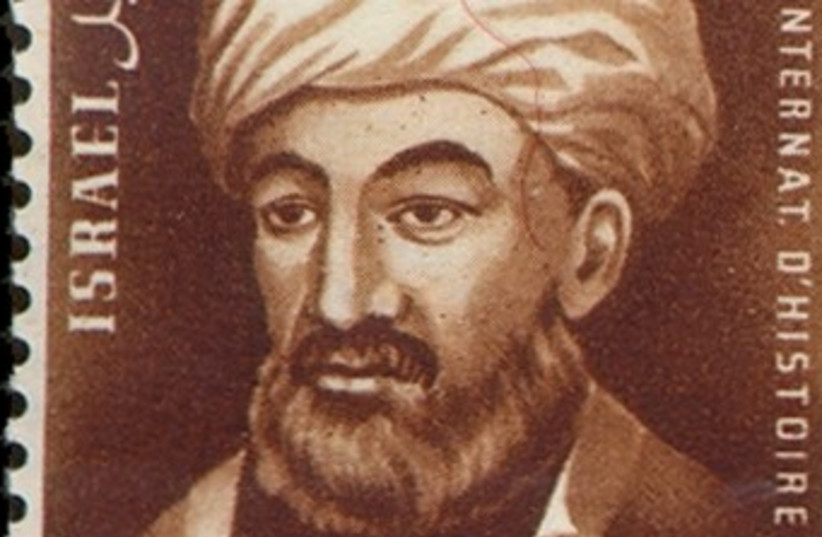
The Rambam / (photo credit: Wikimedia Commons)

In the words of Maimonides, who is seen as the most successful synthesizer of medieval Judaism and the Islamic world, “God has entangled us with this people, the nation of Ishmael, who treat us so prejudicially and who legislate our harm and hatred…. No nation has ever arisen more harmful than they, nor has anyone done more to humiliate us, degrade us, and consolidate hatred against us.”

The myth that historians have propagated is that Jewish life under the Muslims was safer and more successful than the life of Jews in Christendom. Perhaps there is a kernel of truth in this proposition; “Golden Ages” in Baghdad, Andalusia, and the Ottoman Empire highlight periods of tolerance and the powerful status of court Jews.

Maimonides was a court physician under the Fatimids and Saladin’s Ayyubids in Old Cairo and was not the subject of persecution in this period of his life. But he would never forget the Berber Almohades and their invasion of southern Spain in 1145. Maimonides, then a boy, faced death under the Almohades if he did not embrace Islam. Not long after the invasion of the fanatics, the great philosopher and legal mind settled in North Africa. But it was controlled by the same Almohades Muslims, and it is likely that his family was forced to convert to Islam but practiced Judaism in secret.

This offers insights into Maimonides’s later responsa in which he was sympathetic to Jews forced to convert to Islam to rejoin the Jewish community. This was despite the rejection of rabbis in Fez who refused to take back into the Jewish fold those Jews who converted.

Maimonides had more to say about Jewish life under Islamic rule: “We bear the inhumane burden of their humiliation, lies and absurdities, being as the prophet said, ‘like a deaf man who does not hear or a dumb man who does not open his mouth’…. Our sages disciplined us to bear Ishmael’s lies and absurdities, listening in silence, and we have trained ourselves, old and young, to endure their humiliation, as Isaiah said, ‘I have given my back to the smiters, and my cheek to the beard pullers.’”

The institutional humiliation of Jews under Islam was enshrined in the Pact of Umar, dating back to the ninth century. The Muslims forbade Jews converting Muslims to Judaism, building new synagogues, making a display of their rituals, living in houses higher than those of Muslims, carrying weapons, and they were forbidden to ride horses. Jews under these dhimmi rules had to wear distinctive clothing and pay a substantial poll tax and a land tax.

While these restrictions were not always enforced – Samuel Hanagid, the Jewish Prime Minister of Berber Granada in the 11th century, obviously did not lead his Muslim troops into battle riding a donkey – the dhimmi rules of a dependent people were enforced for both Jew and Christian. Massacres of Jews were a reality in Muhammad’s lifetime, and the Arabs and Berbers carried out a pogrom against the Jewish Quarter of Granada in December 1066.

Treatment of Jews under Islam depended on the agenda of a particular caliph or sultan. Most of the time, the dhimmi rules were in full force. There were some exceptions. But we should not idealize Jewish life under the Muslims which, in some cases, was just as bad as life in Christian lands.
Maimonides’ harsh criticisms of Islamn quoted above are to be found in The Epistle to Yemen (1172).

The Muslims in Yemen forced the Jews to convert to Islam. This was compounded by a Jewish messianic pretender who arose, providing the Jewish community with false hope. In the words of Maimonides biographer Joel L. Kraemer: “The acerbity of Maimonides’ condemnation is startling, and historians have been puzzled by its bitterness. We have seen him living among Muslims, within the embrace of Islamic civilization, assimilating its cultural legacy.” However, the situation of forced conversion in Yemen must have brought back memories of the Almohades forced conversion in Muslim Spain that Maimonides had to endure.

There is no need to expunge from the historical record the cooperation between Muslims and Jews. The Golden Age of Andalusia was a reality and Jewish life was good. But apologists for Islam focus on the positive, and negate much that was negative for Jews living under Muslim authority. The dhimmi humiliation was in force most of the time and the Muslims despised Judaism as a false faith.

Once Jews sought independence and sovereignty in the Land of Israel in the modern period, a dependent people became an independent people. That was the end of Jewish life in Muslim lands. Maimonides’s harsh censure of Islam should come as no surprise for those who have studied the history of Jews under Islam since the epoch of Muhammad.


The writer is rabbi of Congregation Anshei Sholom in West Palm Beach, Florida.


Zawartość publikowanych artykułów i materiałów nie reprezentuje poglądów ani opinii Reunion’68,
ani też webmastera Blogu Reunion’68, chyba ze jest to wyraźnie zaznaczone.
Twoje uwagi, linki, własne artykuły lub wiadomości prześlij na adres:
webmaster@reunion68.com


Iran calls for Israel’s annihilation; Islamic Jihad for Jerusalem – TV7 Israel News

Iran calls for Israel’s annihilation; Islamic Jihad for Jerusalem – TV7 Israel News

  TV7 Israel News


1) Iran’s Supreme Leader Ayatollah Ali Khamenei called on the Muslim world to united for the purpose of annihilating the Jewish State.

2) Israeli Prime Minister Benjamin Netanyahu voices claims of a deep state conspiracy which has been relentlessly seeking to shift the power-balance within the Jewish State; as the Israeli leader’s trial over charges of fraud, bribery and breach of trust commences.

3) France reveals an anticipated European response to Israel’s probable move to assert its sovereignty over parts of the West Bank.


Zawartość publikowanych artykułów i materiałów nie reprezentuje poglądów ani opinii Reunion’68,
ani też webmastera Blogu Reunion’68, chyba ze jest to wyraźnie zaznaczone.
Twoje uwagi, linki, własne artykuły lub wiadomości prześlij na adres:
webmaster@reunion68.com


Netanyahu’s historic trial is finally here

Netanyahu’s historic trial is finally here

YAAKOV KATZ


Editor’s Notes: There are many problems with having someone on trial while at the same time serving as prime minister.

THE STAIRS Prime Minister Benjamin Netanyahu will climb on Sunday inside the Jerusalem District Court on his way to his trial. / (photo credit: MARC ISRAEL SELLEM/THE JERUSALEM POST)

It is one of those historic events that you’ve known is coming, but until it starts, it’s hard to believe that we are actually here.

The “event” in this case is the criminal trial that will open on Sunday against Prime Minister Benjamin Netanyahu, marking a historic low for Israel: a sitting prime minister standing trial on charges of bribery, fraud and breach of trust.

Throughout the years of the Netanyahu investigations, there were countless predictions that Israel would never reach this point. “The coalition won’t let him stay in power,” some analysts predicted; others said that the top Likud ministers would eventually send him home.
But the investigation carried on.

First the police recommended he be indicted, and then came the indictment; only one Likudnik challenged him outright, and he lost; and even as some in the media and the Knesset called on Netanyahu to step down, he was defiant.
Not only did the prime minister stay in power; he maneuvered his rival – Blue and White leader Benny Gantz – to agree to sit under him in a coalition as his defense minister.

There are many problems with having someone on trial while at the same time serving as prime minister, the most visible political representative of every country. There is, for example, the impact it will have on the country’s moral fabric: is this the political role model to look up to for the younger generation – or any generation? An indicted leader who will now need to sling mud to survive? Is there no shame anymore? Does political survival come before anything else?

Another problem: it will be impossible to know anymore what is sincere and what isn’t. Let’s say there is another Tehran cyberattack against Israel – there appeared to be one on Thursday, and a possible earlier attack two weeks ago – and Netanyahu decides to retaliate with an all-out aerial assault against Iran’s nuclear facilities. Will Israel strike because that is genuinely what is needed, or because the prime minister wants to divert attention away from his trial?

What about the coronavirus? If and when the much-expected “second wave” of the coronavirus arrives, and Netanyahu decides to impose tough draconian restrictions on civilian life including the closure of courts – is he doing it because that is what’s needed? Or because it helps his case to delay it? These scenarios are not hypothetical. They can happen as early as Sunday afternoon, just after his first appearance in the Jerusalem courtroom.

Every decision will be suspect, every move will be suspicious. The division in this country will only grow between the camp that trusts Netanyahu and the sincerity of his decisions, and the camp that does not. Little good will come of this.

And then there is the third problem: the war he and the Likud are waging against the judicial system that has the potential to forever alter the rule of law here. This does not mean that Netanyahu will soon raze the courts – but that is only because he doesn’t have to. Not every revolution happens in a single day. In some cases, it is a slow but systematic process that focuses first on changing public opinion.

For example: just a few weeks ago, former Knesset speaker Yuli Edelstein blatantly ignored a High Court ruling. Did the people rise up? No. The reason is because Netanyahu and the Right’s campaign against the Supreme Court has been effective in getting the public to lose trust in the country’s most important judges. According to one recent poll, only about half the country trusts the courts.

When all they hear from the Likud is the “Court is drunk on power” (Gideon Sa’ar), “I won’t let the court intervene” (Yariv Levin), or “Not every ruling needs to be obeyed” (Amir Ohana), there will be a lasting effect.
Add to this the direct attacks on the attorney-general, the police and the prosecution, and you get the picture: a targeted campaign to delegitimize the judicial system by portraying the case against Netanyahu as personal and unjustified.

When Netanyahu’s attorneys filed a request on Tuesday that the prime minister be exempt from attending the opening hearing on Sunday, they claimed that bringing him to court would incur exorbitant costs for security. Basically, the lawyers argued, the prime minister is only trying to save money for the taxpayer.

The problem was that not only was the argument ridiculous – the prime minister goes almost anywhere he wants including crowded places like open marketplaces and malls – but also cynical. It came just two days after Netanyahu swore in his new government of 34 ministers – some for made-up ministries – and 16 deputy ministers. This cost the country hundreds of millions of shekels – and suddenly he cares about the security costs for his court appearance?

The request was really only submitted so that when it was rejected, the lawyers could issue their response: “There is no alternative but to conclude that the prosecution’s decision is a continuation of the ‘Just not Bibi’ campaign,” his lawyers said.

In other words, this decision, as well as the entire legal process against Netanyahu, is nothing more than a ploy by the deep state and the media to overthrow the prime minister. That is the message that will continue echoing over the next few years of this legal process. It will have nothing to do with the legal arguments being brought before the court or the charges against him; everything will be about delegitimizing the court, in front of the only court that really matters to Netanyahu: public opinion.
All of this has the potential to cause Israel irreparable damage. When the courts are systematically undermined and the rule of law disintegrates, who will be there to stop it? Who will prevent anarchy from breaking out? This revolution won’t happen in one day. It has the potential to creep up on us, but when we finally see it, it might be too late.

This does not mean that the courts are perfect. Far from it. They make mistakes, they intervene in cases that they shouldn’t. But a suspect in a crime, indicted and standing trial, cannot oversee judicial reforms at the same time as he is fighting to prove his innocence. Is there no greater conflict of interest?

***

FIFTY-THREE YEARS AGO today, the IDF liberated Jerusalem. It was the third day of the Six Day War, a war that ended with Israel also in possession of the West Bank/Judea and Samaria, the Gaza Strip, the Golan Heights and the Sinai Peninsula.

Earlier this week, I looked back at The Jerusalem Post’s coverage of the war. It is always interesting to see how this paper was laid out back then, what stories were highlighted on the front page. On the third day of the war, June 7, the headline read: “Scopus Road Opened, Old City Encircled.” IDF paratroopers would reach the Western Wall later that day, and Israelis would hear the famous words: “Har Habayit Beyadeinu,” the Temple Mount is in our hands.
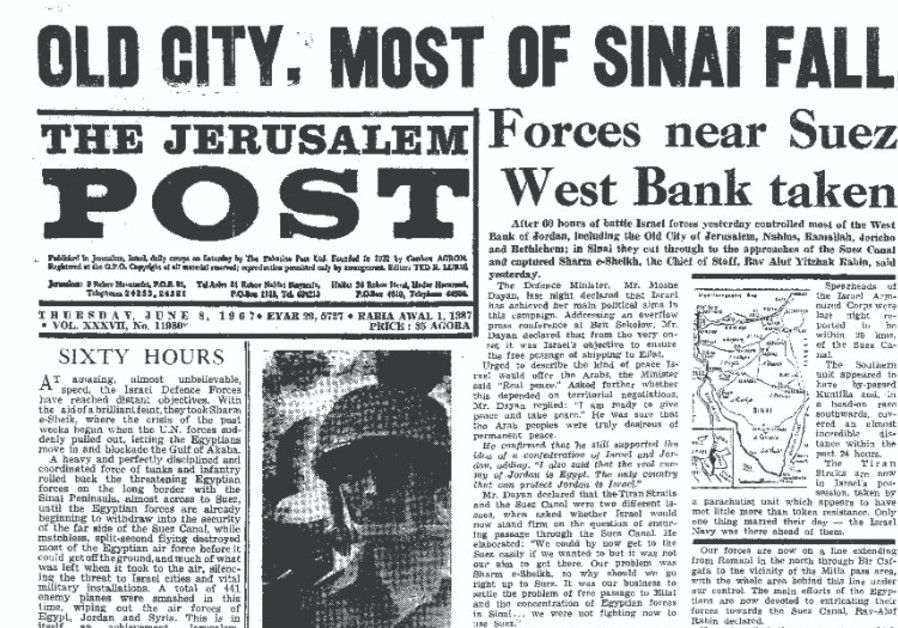
The Jerusalem Post’s coverage of the Six Day War.

What struck me about the page though was a 2” x 2” ad that appeared at the bottom, placed there by Moshe Dayan, the defense minister in the midst of becoming an Israeli war hero. “I would like to thank all of those who have expressed their good wishes on my appointment as Minister of Defence,” Dayan wrote, adding: “I would ask my friends to forgive me for not being able to reply to each one personally in view of the needs of the hour.”

Think about that: Israel was in the middle of a historic war that would change the country and the Jewish people forever – and the defense minister puts an ad in the paper apologizing to his friends that he cannot reply to their good wishes? Amazing.

As I moved on to June 8, the next day’s paper that reported on the liberation of Jerusalem, I saw a beautiful column headlined “Sixty Hours” appearing on the front page. It did not have a byline, and served as that day’s editorial.

“Let no one think that Zahal’s [the IDF’s] fantastic array of simultaneous victories is due to luck or chance, the poor training and morale of the Egyptians or even the profound consciousness of every soldier that he is fighting quite literally for his own survival and for that of his family and people.

Their training and planning started with the watchmen of the “Shomer” – one of whose earliest theorists was Mr. Ben-Gurion – and it was continued in the difficult underground days of the Haganah, when defence against Arab hostility had to be prepared in secret for fear that British policemen would confiscate the small store of precious weapons.

“The result is an army with all of the best qualities of the civilians of whom it is made up, fortified by devotion, loyalty and unity. They have proved victorious every time against armies whose officers were trained at some of the best European and American academies. The army was born out of need, not pride, and shaped by adversity, not privilege. Its face is the face of Israel, and the success of its youthful legions has marked the nation in gratitude, pride and a deep affection.”

Yom Yerushalyim Sameach! Happy Jerusalem Day!


Zawartość publikowanych artykułów i materiałów nie reprezentuje poglądów ani opinii Reunion’68,
ani też webmastera Blogu Reunion’68, chyba ze jest to wyraźnie zaznaczone.
Twoje uwagi, linki, własne artykuły lub wiadomości prześlij na adres:
webmaster@reunion68.com