Archives

Weekly Review – May 22, 2020

Weekly Review – May 22, 2020

   ILTV Israel News


Zawartość publikowanych artykułów i materiałów nie reprezentuje poglądów ani opinii Reunion’68,
ani też webmastera Blogu Reunion’68, chyba ze jest to wyraźnie zaznaczone.
Twoje uwagi, linki, własne artykuły lub wiadomości prześlij na adres:
webmaster@reunion68.com


Israelis and Palestinians work together against coronavirus

Israelis and Palestinians work together against coronavirus

JASON GREENBLATT, BISHARA A. BAHBAH


Perhaps President Reuven Rivlin expressed it properly when he called PA President Mahmoud Abbas and declared that “[t]he world is dealing with a crisis that does not distinguish between people.”

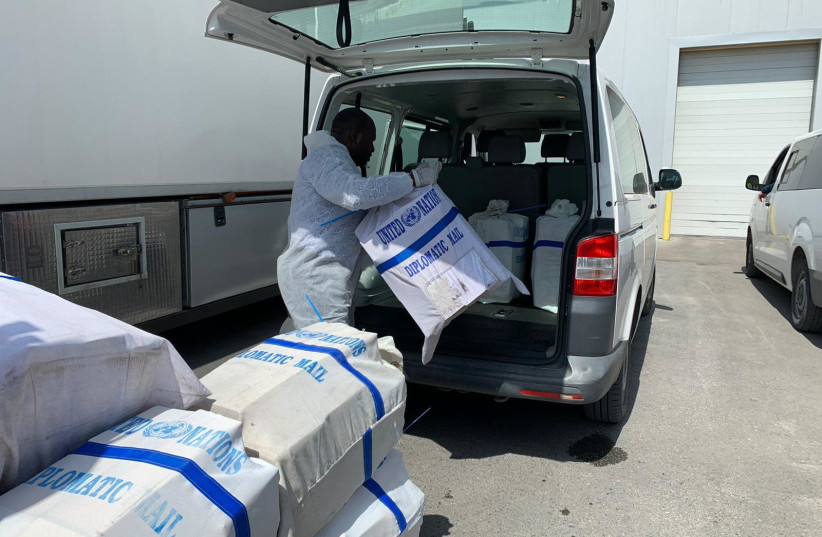
COGAT coordinates WHO delivery of coronavirus detection kits and protective masks to Palestinian Authority / (photo credit: COGAT SPOKESPERSON’S OFFICE)

Israelis and Palestinians share a trench in their fight against a common enemy – the spread of the coronavirus. Other than a few ugly exceptions, each society understands that this deadly, silent enemy must be confronted together, without politics or propaganda.

The pandemic reminds Palestinians and Israelis how intertwined their fate is. The border between Israel and what some call the West Bank and others call Judea and Samaria is porous, with tens of thousands of people crossing daily from one side to the other. The dangers posed to Israelis are the same dangers posed to Palestinians in the West Bank and Gaza. If they are not vigilant, and if they do not fight this virus diligently together, they will both suffer.

The response to the pandemic by both Israel and the Palestinian Authority is an indication that Israelis and Palestinians are capable of overcoming some of the seemingly insurmountable impasses that have characterized their relationship over the past decades. We are mindful that much of this cooperation is due to the recognition that their collective health, economic well-being and security could be undermined without such cooperation. Nevertheless, this cooperation is a good start and should not be taken lightly or ignored.

Perhaps President Reuven Rivlin expressed it properly when he called PA President Mahmoud Abbas and declared that “[t]he world is dealing with a crisis that does not distinguish between people or where they live” and when he emphasized that “cooperation between us is vital to ensure the health of both Israelis and Palestinians.” In return, Abbas offered his full cooperation in the fight against this deadly disease.

The Palestinian taboo of dealing with Israelis was lifted (other than with some exceptions from a few Palestinian so-called leaders and influencers) and Palestinian and Israeli officials coordinated activities to confront the pandemic. Both sides have been working productively side by side. According to Yotam Shefer, the head of the international department of Israel’s Civil Administration of Judea and Samaria, coordination between Israel and the Palestinians is “very tight and very strong.”

Among other things, Israel has provided training to Palestinian healthcare professionals in Israeli hospitals and has sponsored joint workshops. Israeli labs have analyzed Palestinian COVID-19 diagnostic tests, doctors on both sides have exchanged and analyzed information, thousands of COVID-19 testing kits were given to the Palestinian health ministry and protective gear was given to Palestinian healthcare workers and security personnel. In a rare, but important move, Israel also permitted the entry of critical supplies and equipment into Gaza from the PA, Israel and other international donors and allowed the movement of critical personnel.

Normally, as many as 145,000 West Bank Palestinians work in Israel daily. Their income is vital to the Palestinian West Bank economy. Palestinian workers are provided with appropriate housing and proper sanitary conditions while working in Israel. In an unprecedented move, the Israeli government has allowed 45,000 Palestinian workers to work and sleep in Israel for at least one or two months during this crisis. These workers are generally not allowed to go back and forth to minimize the possibility of transmitting the virus. The movement of laborers is coordinated by both the Israeli and Palestinian governments to reduce the transfer of the virus from one area to the other.

The pandemic highlights how interconnected the Israeli and Palestinian economies are. This crisis validates the theory that it is more realistic and economical for Israel to use Palestinian labor than to import labor from the Far East or Eastern Europe. Ultimately, it would be beneficial for Palestinians to work with Israel in the hi-tech sector as well. Instead of significant portions of the Israeli hi-tech sector being offshored to parts of Eastern Europe and elsewhere, Palestinians can be trained up to work in the Israeli tech scene and continue to grow the Palestinian nascent hi-tech sector.

Out of the COVID-19 pandemic springs the hope that Palestinians and Israelis can cooperate and work together and set aside politics as usual, at least for the duration of this crisis, and hopefully well beyond it. Thus far, other than with some notable exceptions, both sides have shown that with goodwill and honorable intentions, they can indeed work together. Whether this newfound cooperation leads to good-faith negotiations of a comprehensive peace agreement remains to be seen. We are not suggesting that this cooperation is the key to resolve the significant issues that must be resolved to achieve a peace agreement that works for both sides. No one can predict what will happen when life returns to whatever the new normal will be when the immediate danger of the pandemic passes, or what happens if (most would say when) there is a recurrence of some sort. But the two societies have been separate and distrustful of one another for far too long. Breaking this cycle can only help in any peace effort.

It is our hope that the lessons learned from this pandemic and the spirit of respect and cooperation will continue, so that movement toward a peace agreement can be built on similar goodwill, respect and cooperation. It is time for a new Israeli-Palestinian dynamic. It is time for a new future for Israelis and Palestinians and the region around them.

God bless all of humanity.


Jason D. Greenblatt is a former assistant to the president and special representative for international negotiations in US President Donald Trump’s administration. He is now a partner at OurCrowd, the world’s largest equity crowdfunding platform. Follow him on Twitter at @GreenblattJD.
Bishara A. Bahbah is a former member of the Palestinian delegation to the multilateral peace talks. He taught at Harvard University and was associate director of its Middle East Institute.


Zawartość publikowanych artykułów i materiałów nie reprezentuje poglądów ani opinii Reunion’68,
ani też webmastera Blogu Reunion’68, chyba ze jest to wyraźnie zaznaczone.
Twoje uwagi, linki, własne artykuły lub wiadomości prześlij na adres:
webmaster@reunion68.com


Meet the Israeli startup making water drinkable again

Meet the Israeli startup making water drinkable again

Naama Barak


BlueGreen Water Technologies battles algal blooms that are devastating bodies of water around the globe in a cost-effective, planet-friendly way.

Water in South Africa’s Roodeplaat Dam Reservoir turns clear following treatment with BlueGreen Water Technologies’ solution. Photo: courtesy

You’d think that bacteria would be hard to see with the naked eye, and even harder to spot from outer space. But when it comes to toxic algal blooms, even satellites orbiting Earth can’t miss it.

Blue-green algal blooms are toxic bacteria scientifically known as cyanobacterial blooms. These occur when a water ecosystem becomes unhinged as a result of internal or external contamination. The photosynthesizing algae proliferate and take over all the resources in the lakes or reservoirs and ruin their ecosystem, sometimes even turning them into dead aquatic zones.

This isn’t bad news only for the body of water and its plant and animal inhabitants, but also for the people who live around it and rely on it for their drinking water, livelihood and recreation. Drinking the water becomes out of the question, as does eating the fish that lived there. Consuming vegetables that were grown using the water is also not advisable, and neither is bathing in it – it literally stinks.

Algal blooms take over all the resources in bodies of waters and can render them dead aquatic zones. A red algal bloom in Sarsota, Florida, summer 2018. Photo by Shutterstock.com

This is where Israeli startup BlueGreen Water Technologies steps in. Founded in 2014, the company started as one of the cofounders’ doctoral dissertation on cyanobacteria. It turns existing forms of algal blooms treatments into a more efficient, planet-friendly and easy-to-use solution.

You’d think that bacteria would be hard to see with the naked eye, and even harder to spot from outer space. But when it comes to toxic algal blooms, even satellites orbiting Earth can’t miss it.

Blue-green algal blooms are toxic bacteria scientifically known as cyanobacterial blooms. These occur when a water ecosystem becomes unhinged as a result of internal or external contamination. The photosynthesizing algae proliferate and take over all the resources in the lakes or reservoirs and ruin their ecosystem, sometimes even turning them into dead aquatic zones.

This isn’t bad news only for the body of water and its plant and animal inhabitants, but also for the people who live around it and rely on it for their drinking water, livelihood and recreation. Drinking the water becomes out of the question, as does eating the fish that lived there. Consuming vegetables that were grown using the water is also not advisable, and neither is bathing in it – it literally stinks.

Algal blooms take over all the resources in bodies of waters and can render them dead aquatic zones. A red algal bloom in Sarsota, Florida, summer 2018. Photo by Shutterstock.com

This is where Israeli startup BlueGreen Water Technologies steps in. Founded in 2014, the company started as one of the cofounders’ doctoral dissertation on cyanobacteria. It turns existing forms of algal blooms treatments into a more efficient, planet-friendly and easy-to-use solution.

“For years, it was common practice to work with algicides, specifically copper,” explains BlueGreen’s CEO and co-founder Eyal Harel. “It’s excellent material, it works great.”

“But it’s a heavy metal that sticks around – it mounts up and in the end it’s a chemical,” he says. “In the past 25 years a new algicide based on hydrogen peroxide was introduced. It also does a great job, but it’s hydrogen peroxide. The way it’s being used today requires a very, very great deal of it.”

Using copious amounts of these substances is not great for the environment and not always efficient in treating the algal blooms. This is because the bloom resides on the surface of the water and is moved around by the currents, while the chemicals used to treat it are heavy and sink to the bottom, meaning that large amounts of the algicides go to waste.

New treatment paradigm

“We took the same chemical materials,” Harel explains, “and in a very clever procedure we gave them a nano-coating with a material that we developed using a process that we developed. It doesn’t do anything to the physical substances but it changes their physical properties.”

“We took a heavy substance that quickly sinks and disintegrates when you put it in water and we turned it into a ‘light’ substance,” he says. “The final result is that it floats atop the water and slowly releases the active material.”

BlueGreen’s Lake Guard solution comes in pellet form. Users simply throw a small amount into the body of water, and the active ingredients are released from their coating within four to six hours. According to Harel, results can be seen within 24 to 48 hours.

“It’s kind of a silver bullet,” he says. “All you need to do is to put a very small amount of the chemical on a local level and the material starts to move in the water on its own.”

“With this, we managed to change the treatment paradigm,” he says.

Lake Guard pellets are thrown into the Roodeplaat Dam Reservoir to treat toxic algal blooms. Photo: courtesy

Global problem

BlueGreen began marketing Lake Guard in 2018 and is already working with most of the water reservoirs in Israel – some 600 of them.

“Israel is our beta site,” Harel says.

“Working in Israel is very convenient,” he explains. “The variety we were exposed to was huge, and the distances between the reservoirs are nothing. That’s why it’s really great for carrying out research and development.”

BlueGreen’s potential clients range from farmers with a little lake in their back yard to municipalities and regional water authorities.

“Further down the line, the goal is to reach international cooperation regarding water that’s outside territorial waters,” Harel says, noting that algal blooms can appear anywhere around the world, the North and South poles included, and they’re becoming a greater problem with time.

“Like any bacterial infection, it keeps on growing,” he says. “The curve is very clear all around the world. From year to year the phenomenon is becoming more acute.”

In February, BlueGreen treated the 4.4-square-kilometer Roodeplaat Dam Reservoir near Pretoria, South Africa. There, the agal blooms were so bad that they could be viewed by satellite and rendered the water unsuitable for use. Within days, the situation was reversed.

“One of the places we’re going to treat in the next few weeks is in China, a place that’s been suffering from blooms for the past 25 years. They’ve tried treating it for the past 15 years and have failed time after time,” Harel says.

He adds that the coronavirus crisis hasn’t had much effect on business.

“At the end of the day, water is a must – corona or not.”


Zawartość publikowanych artykułów i materiałów nie reprezentuje poglądów ani opinii Reunion’68,
ani też webmastera Blogu Reunion’68, chyba ze jest to wyraźnie zaznaczone.
Twoje uwagi, linki, własne artykuły lub wiadomości prześlij na adres:
webmaster@reunion68.com


News From Israel- May 20, 2020

News From Israel- May 20, 2020

  ILTV Israel News


Sparking worldwide criticism and threats from the Palestinian Authority – leading Prime Minister Netanyahu sets his sits on west bank annexation. Coronavirus claims Israel’s youngest male victim as restrictions continue to ease with beaches officially opening
and relations between israel and the uae take flight with the first known emirates cargo plane landing in tel aviv.


Zawartość publikowanych artykułów i materiałów nie reprezentuje poglądów ani opinii Reunion’68,
ani też webmastera Blogu Reunion’68, chyba ze jest to wyraźnie zaznaczone.
Twoje uwagi, linki, własne artykuły lub wiadomości prześlij na adres:
webmaster@reunion68.com


Despite Coronavirus, Hezbollah Is Still a Dangerous Threat to Israel

Despite Coronavirus, Hezbollah Is Still a Dangerous Threat to Israel

Yaakov Lappin


A view of beds at a shopping mall, one of Iran’s largest, which has been turned into a center to receive patients suffering from the coronavirus disease (COVID-19), in Tehran, April 4, 2020. Photo: WANA (West Asia News Agency) / Ali Khara via Reuters.

The coronavirus pandemic has turned into a serious challenge for the Iran-backed Lebanese terror organization Hezbollah, placing the world’s most heavily armed non-state armed group under strain.

Nevertheless, recent reports indicate that these conditions have not stopped Hezbollah’s ongoing military and terrorist activity in the region.

Three locations along Israel’s security barrier on the Lebanese border were sabotaged Friday, likely by Hezbollah operatives, in what appears to have been a threat to infiltrate into Israel.

That event appears to be a direct response to a dramatic incident that took place last Wednesday in Syria. According to international media reports, an Israeli airstrike hit a jeep carrying Hezbollah operatives who may have been involved in weapons trafficking from Syria to Lebanon.

A subsequent Al-Arabiya report said one of the occupants was Mustafa Mughniyeh, the son of the late Hezbollah operations chief Imad Mughniyeh. Imad Mughniyeh was killed in a 2008 bomb attack in Damascus attributed to the Mossad and the CIA. Mustafa Mughniyeh and others in the vehicle reportedly escaped last week’s strike unharmed.

International media reports indicate that, even as the world battles the coronavirus, Hezbollah’s ongoing force build-up and weapons trafficking continue to draw preemptive Israeli airstrikes in Syria.

That doesn’t mean Hezbollah isn’t facing new challenges. The first is rooted in the distress that its patron Iran is in. The Islamic Republic suffers high infection and mortality numbers, its economy is in crisis, and its embattled regime is trying to fend off charges of covering up and mismanaging the pandemic.

Hezbollah’s mammoth arsenal, estimated by the Israel Defense Forces to be at around 130,000 surface-to-surface projectiles, is paid for by Iran and its Quds Force. Hezbollah’s arsenal is made up mostly of short-range Katyusha rockets that have a 45-kilometer (28-mile) reach, but also includes more than 3,500 projectiles that put greater Tel Aviv in range, and which carry 150 kilogram warheads. The arsenal also includes more than 200 long-range ballistic missiles that carry half-ton warheads and can strike any point in Israel.

Israel’s air defenses, made up of the Iron Dome, David’s Sling, and Arrow systems, can stop many projectile attacks, but would be flooded by the scale of Hezbollah’s arsenal in any full-scale conflict, meaning that some of Hezbollah’s attacks would invariably get through. In addition, the attacks would paralyze the Israeli home front and economy, and if symbolic or strategic sites are targeted, they could cause significant harm to critical national infrastructure. Hezbollah also has a number of anti-ship cruise missiles, and air-to-surface missile batteries.

Iran and Hezbollah had planned on establishing a domestic precision-guided missile industry in Lebanon, enabling the serial production of a large number of missiles, but appear to have frozen this project following a series of Israeli warnings to desist or face military action. The more Iran struggles to pay for such activities, the more constraints Hezbollah will face.

In addition, Iran’s newly appointed Quds Force Commander, Esmail Qaani, who replaced Qassem Soleimani following his assassination in a US drone strike in January, means that Hezbollah’s leadership is now working with a less charismatic and influential Iranian commander. While the Quds Force is expected to continue to make every effort to equip Hezbollah with a range of weapons, the dynamic between Hezbollah leader Hassan Nasrallah and Qaani is an unknown quantity that could affect future cooperation.

In Lebanon, Hezbollah’s home turf, the organization has faced accusations of importing the virus via flights from Iran. International flights out of Iran have reportedly helped spread the disease in the Arab world, placing pressure on Hezbollah in Lebanon, Brig. Gen. (ret.) Yossi Kuperwasser, former head of the research division in the IDF Military Intelligence Directorate, told the Investigative Project on Terrorism (IPT).

“Hezbollah is under pressure both because of the virus and because of its links to Iran,” he said. “Iranians continue to be active in Lebanon. Hezbollah operates in close proximity with Iranians in Syria, and in other places. The whole episode reflects badly on Hezbollah. It has led to accusations [in Lebanon] against it.”

Although Hezbollah is using its extensive civilian and military infrastructure to battle the spread of coronavirus, the program has a definitive sectarian nature, since the efforts are mainly underway in Shiite areas of Lebanon.

Meanwhile, Lebanon’s massive economic troubles, which predate the virus, have only grown more acute with the pandemic. Some in Lebanon, like former Lebanese Prime Minister Fouad Siniora, blame Hezbollah and its resistance to assistance from international financial institutions, for ensuring that there is no way out of those troubles.

According to a report in March in the Arab Weekly newspaper, Siniora said Lebanon is “sick and requires a stronger medicine than just ointments.” He added that the Lebanese are paying the price of “Hezbollah’s hegemony over the state and its refraining from implementing reforms pledged by the state,” the report said.

It also cited former Lebanese MP Fares Saeed as stating, “Hezbollah is the political decision-maker in the country and, while fighting in Syria, Iraq, and Yemen, it is trying to establish an economic-political system that matches its regional function by overthrowing the Lebanese financial system and removing the country from the international community in the interest of a resistance economy … that is to say, importing goods through illegal channels and relations with Iran and China, in addition to severing all relations with Washington and the international legitimacy.”

Lebanon’s economy was on the brink of collapse before the pandemic struck, and is in even worse shape now.

“Due to Hezbollah’s closeness to Iran, Lebanon suffers,” Kuperwasser said. At the end of March, Lebanon expressed interest in an IMF emergency loan. Hezbollah appeared to change its tune somewhat regarding the acceptance of aid, but the organization’s chief, Hassan Nasrallah, conditioned any agreement against any terms that “would make the country explode.” Lebanon’s interest mirrors Iran’s own unusual request for a $5 billion IMF loan to battle the coronavirus.

“Banks do not like connections with terror elements. This is one of the reasons why the IMF is not assisting Iran,” said Kuperwasser. “The banking systems in Iran and Lebanon are both contaminated with terror activities. Hence, the terrorism of Hezbollah, which is recognized by some of the international system, makes it difficult for Lebanon to uphold a banking system that is respectable and acceptable to the international community.”

US sanctions against several Lebanese banks accused of having with ties to Hezbollah have also exerted pressure over recent years. Now, Hezbollah has stepped up a campaign “to place its allies at the heart of Lebanon’s banking system as the US seeks to disrupt the armed group’s financial networks,” the UAE’s The National newspaper reported. Hezbollah is trying to install allies into Lebanon’s monetary authorities “to help the movement circumvent intensified US sanctions,” the report said.

The report, citing unnamed Arab financiers, warned that the outcome of such efforts in Lebanon could extend Hezbollah’s reach into the nerve center “of Lebanon’s banking sector — once the most important in the region — and could hamper any chance the country has of emerging from the worst financial crisis in its modern history.”

In addition, the role the Lebanese Armed Forces (LAF) play vis-à-vis Hezbollah continues to be a source of contention. Some observers point to increased collaboration between the two sides, such as joint patrols along the Lebanese-Israeli border. Others view the LAF as a potential counter-balance to Hezbollah. In 2018, the IPT reported that Hezbollah and the LAF are increasingly cooperating with one another, with Hezbollah personnel sometimes wearing LAF uniforms during joint patrols.

Since 2010, the United States has invested more than $1.82 billion in security assistance to the LAF. But the LAF’s unwillingness or inability to actively counter Hezbollah in any way has raised deep questions about the LAF’s role, and fueled controversy over ongoing American assistance to it.

Despite all the strain, Hezbollah does not appear to have given up on its regional armed activities. It still has about 2,300 operatives in Syria.

Reports of routine Israeli strikes against threatening activity in Syria during the coronavirus outbreak seem to indicate that “there has been no substantial change in the scope of Hezbollah’s activities in the area,” Kuperwasser said. “The Iranians continue in their efforts to bring in weapons. Some reach Hezbollah, and some go to Syria. This activity continues.”

Hezbollah also continues to face its regular challenges — Israel’s close intelligence coverage of the region, and rapid, precise Israeli strike capabilities — on top of the added coronavirus pressure.

None of that, however, has stopped Hezbollah’s military consolidation efforts in Syria. The organization has invested resources in northern Syria, and in building an armed infrastructure in the Syrian Golan Heights, near the Israeli border, Kuperwasser said. It is also maintaining its weapons smuggling routes linking Syria to Lebanon.

Evidence of this activity surfaced in recent days, when the IDF released surveillance video showing the Syrian army actively cooperating with Hezbollah in the south of the country.

“Even during the coronavirus period, the new commander of the Syrian army’s 1st Division, Lua’a Ali Ahmad Asa’ad, continues to help and allow the Hezbollah terror group establish a front on the Golan Heights,” the IDF stated.

The video footage showed Asa’ad meeting with Hezbollah’s commander of its south Syria region, Hajj Hashem.

Last year, the IDF named Hashem as the man in charge of Hezbollah’s “Golan file,” a program to build an attack base for striking Israeli civilians and soldiers from Syria.

Recent reports indicate that the shadow war between Israel and the Shi’ite axis in Syria remains active despite the virus.

“Hezbollah’s activities on this level do not appear to have been eroded,” Kuperwasser said.


Yaakov Lappin is a military and strategic affairs correspondent. He also conducts research and analysis for defense think tanks, and is the military correspondent for JNS. His book, The Virtual Caliphate, explores the online jihadist presence.

A version of this article was originally published by The Investigative Project on Terrorism.


Zawartość publikowanych artykułów i materiałów nie reprezentuje poglądów ani opinii Reunion’68,
ani też webmastera Blogu Reunion’68, chyba ze jest to wyraźnie zaznaczone.
Twoje uwagi, linki, własne artykuły lub wiadomości prześlij na adres:
webmaster@reunion68.com