Archives

Israel to force Iran out of Syria; vows to pursue peace with neighbors

Israel to force Iran out of Syria; vows to pursue peace with neighbors

  TV7 Israel News


1) The Islamic Republic of Iran is seemingly reducing the scope of its forces in Syria, a withdrawal – the outgoing Israeli Defense Minister Naftali Bennett exclaimed – needs to be completed with Israel’s help.

2) Palestinian Prime Minister Mohammad Shtayyeh warned that “the Palestinian issue might face “a hot summer” in light of Israel’s plans and measures to annex significant parts of territories the Palestinians demand for a future state.

3) EU Foreign Policy Chief Josep Borrell fails to secure unanimous support to act against Israel for its voiced plan – in line with Washington’s initiative – to annex parts of the West Bank.


Zawartość publikowanych artykułów i materiałów nie reprezentuje poglądów ani opinii Reunion’68,
ani też webmastera Blogu Reunion’68, chyba ze jest to wyraźnie zaznaczone.
Twoje uwagi, linki, własne artykuły lub wiadomości prześlij na adres:
webmaster@reunion68.com


Washington Post – Israel linked to cyberattack on Iranian port

Washington Post – Israel linked to cyberattack on Iranian port

TZVI JOFFRE


A foreign government security official said the attack was “highly accurate” and the damage to the Iranian port was more serious than described in official Iranian accounts, the Post reported.

People pose in front of a display showing the word ‘cyber’ in binary code, in this picture illustration taken in Zenica /  (photo credit: DADO RUVIC/REUTERS)

Israel is likely behind a cyberattack which halted traffic and caused “total disarray” at Iran’s Shahid Rajaei Port, located near the Strait of Hormuz, last week, according to a report by The Washington Post.

On May 11, Mohammad Rastad, Managing Director of the Ports and Maritime Organization (PMO), announced that a cyberattack managed to damage a number of private systems at the Shahid Rajaei port.

Allah-Morad Afifi-Pour, Director-General of the PMO of Hormozgan province in southern Iran, had initially denied the reports of a cyberattack, but Rastad confirmed that a cyberattack had occurred in a press conference on Sunday, according to the Iranian Fars News Agency.

Allah-Morad Afifi-Pour, Director-General of the PMO of Hormozgan province in southern Iran, initially denied the reports of a cyberattack, but Rastad confirmed that a cyberattack had occurred in a press conference on Sunday, according to the Iranian Fars News Agency.

Rastad also confirmed that the attack was carried out by a foreign entity, according to Fars News Agency.

While Rastad stressed that operations had not been disrupted by the attack, US and foreign government officials told the Washington Post that traffic in the area came to a halt and was plagued with issues for a number of days.

Intelligence and cybersecurity officials familiar with the incident told the Post that the attack was carried out by “Israeli operatives,” possibly in retaliation for an earlier cyberattack on Israel’s civilian water system. A US official with access to classified files also told the Post that Israel was believed to have been behind the attack.

Satellite photographs showing miles-long traffic jams on highways leading the Shahid Rajaee port and dozens of loaded container ships waiting just off the coast were shown to the Post as well.

The cyberattack was “highly accurate,” according to a security official with a foreign government that monitored the incident which reportedly occurred on May 9, two days before Iranian officials acknowledged it had occurred.

The Israeli Embassy in Washington did not immediately respond to a request for comment from Reuters on the Post report.

Former IDF intelligence chief and executive director of the INSS Amos Yadlin tweeted that cyberspace is “joining the ground, sea and air dimensions as a significant dimension of warfare,” pointing to incidents in which the US and Iran used cyberattacks as responses to attacks in order to prevent an escalation in the physical world.

“If Israel is the one who responded to the Iranian attack that targeted civilian infrastructure, Israel is making it clear that civilian systems should be left out of battle,” added Yadlin. “This is a significant message about the vulnerability of Iran’s financial systems to Israeli cyber abilities.”

Earlier this month, Israel’s security cabinet met to discuss an alleged Iranian cyberattack on Israeli water and sewage facilities that took place in April. The attack did not cause substantial damage except for a few issues in local water systems, according to Israeli officials, but is still seen as a substantial escalation by the Iranians, especially since the attack targeted civilian infrastructure.

“This was a very unordinary cyberattack against civilian water facilities which is against every ethic and every code even in times of war,” a senior Israeli official said to Channel 13’s Barak Ravid. “We didn’t expect this even from the Iranians. It is just not done.”

Iran reported three cyberattacks within one week back in December. At least one of the attacks was allegedly “state-sponsored.”

Minister of Communications and Information Technology Mohammad Javad Azari Jahromi claimed that two of the three attacks in December were repelled by the country’s security shield.

Jahromi claimed that the Islamic Republic’s national cybersecurity wall, known as Digital Fortress or Dezhfa, helped thwart 33 million cyberattacks against the country in 2019, according to Fars.


Reuters contributed to this report.


Zawartość publikowanych artykułów i materiałów nie reprezentuje poglądów ani opinii Reunion’68,
ani też webmastera Blogu Reunion’68, chyba ze jest to wyraźnie zaznaczone.
Twoje uwagi, linki, własne artykuły lub wiadomości prześlij na adres:
webmaster@reunion68.com


Remembering Albert Agarunov, the Jewish hero of Azerbaijan

Remembering Albert Agarunov, the Jewish hero of Azerbaijan

ARYE GUT


His life carries spiritual and emotional resonance for all people, but especially for Jews in the Muslim world.
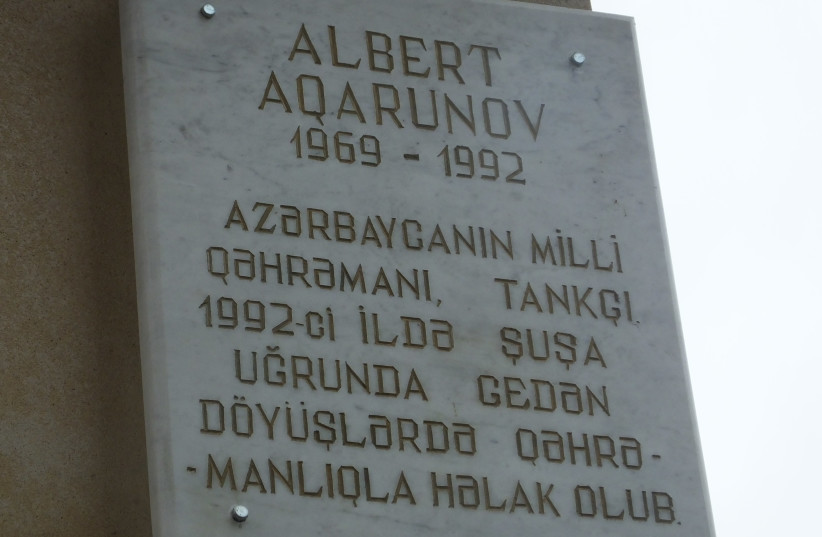
A picture of text written about Albert Agarunov in Qırmızı Qəsəbə / (photo credit: AYKHAN ZAYEDZADEH / WIKIMEDIA COMMONS)

Half a year ago, a monument to the Jewish hero of Azerbaijan was unveiled in the capital of multicultural and tolerant Azerbaijan. The day was a particularly special day for the country’s Jewish community and for Jews worldwide who know the story of decorated war hero Albert Agarunov.

On that day in Baku, an enormous statue of Agarunov was unveiled with military honors before a crowd of government and community leaders and the broader community and foreign guests who had come to celebrate one of the greatest Azerbaijani-Jewish heroes.

Some traveled from afar to attend the ceremony, including Rabbi Abraham Cooper of the Simon Wiesenthal Center; Commissioner for the United States Commission on International Religious Freedom and President of Congress of Christian Leaders Rev. Johnnie Moore; Rabbi Shlomo Amar, former chief Sephardi rabbi; and several other rabbis from Europe, the US and Latin America, as well as state senators from the western US.

Killed at age 23, Agarunov lived a short but glorious and heroic life. He is loved and honored in Azerbaijan. He is a genuine hero and a model of the courage of our people. Azerbaijanis will always honor his memory. A brave tank officer, according to his friends, Agarunov was devoted to his country and was killed pushing his courage and determination to the limit.

He was born into a Mountain Jewish family in the village of Amirjan, near Baku. His family was originally from a famous Jewish village in Azerbaijan – Qirmizi Qasaba (Red Settlement) in Quba and had moved to Amirjan in search of a better life.

Agarunov began his military career in the Soviet army, but soon found himself wanting to give back to the country he loved and knew all his life. I think that most people in the world have never heard the name of this Jewish national hero from Azerbaijan, a secular Muslim country.

This Azerbaijani-Jewish hero went to extraordinary lengths to defend his tank battalion against an onslaught of Armenian tanks. He was a good friend, a renowned sharpshooter and a proud defender of his homeland. The unique story of his life is infused with great pride and respect for his country, a nation ingrained with an unparalleled standard of interfaith engagement, which continues to honor and celebrate Agarunov’s courage and heroism.

Agarunov died fighting on his tank for the city of Shusha. Twenty-eight years have passed since the Armed Forces of Armenia invaded and occupied Azerbaijan’s Shusha region. The fall of Shusha came as the last stage of Armenia’s military occupation of the Nagorno-Karabakh region – part of Azerbaijan’s historical and internationally recognized territory.

On May 8, 1992, with full support by the Russian 336th regiment, the Armenian troops managed to overpower Shusha. As a result of the occupation, Shusha city and 30 villages of the Shusha region were destroyed, 195 innocent civilians were killed, 165 were wounded and 58 persons remain missing. More than 24,000 inhabitants of Shusha were subjected to ethnic cleansing, becoming internally displaced people.

Shusha city was one of the ancient and historical cradles of Azerbaijani culture, with its rich cultural monuments, famous artists and thinkers – Uzeyir Hajibeyov and Rashid Behbudov, Khurshidbanu Natavan and Molla Panah Vagif, Khan Shushinsky and Farhad Badalbeyli, Jabbar Garyagdy and Niazi, Bulbul and Samad bey Mehmandarov. They were born into an impregnable fortress, and, as pure mountain streams flowed through the valleys and expanses of Azerbaijan, built and created beauty. Whether in the fields of music, arts, architecture, literature or others, Shusha was a jewel of Azerbaijan, a source of pride and a cultural center.

In the framework of Armenia’s deliberate policy of destruction, plundering, desecration and embezzlement of cultural and religious heritage of Azerbaijan in the occupied lands – in Shusha alone there were more than 170 buildings with the status of architectural monument – 160 cultural and historical monuments, mosques and rare manuscripts have been destroyed.

THE NIGHT of May 8-9, 1992 was dark and cold. There was no sign of a military attack. It was past midnight when intelligence reported an offensive movement by the Armenians. However, no one was expecting a large-scale offensive. That night many valiant sons of Azerbaijan died. They died defending Shusha, the pearl of Azerbaijan and bastion of national culture. Jewish hero Agarunov, a 23-year-old tank commander, was among those who sacrificed their lives.

Agarunov was one of the Armenian army’s biggest targets. The invaders were so especially offended by his strong military skills, coupled with his identity as a Jew, that they placed a bounty of 5 million rubles on his head. Agarunov fought with all of his heart and might as he and many Jewish soldiers faced the Armenian invasion and subsequent acts of ethnic cleansing and brutality against more than 20% of Azerbaijan.

With the option to repatriate for Israel, Agarunov and his fellow Azerbaijani Jews chose to fight to defend their homeland of Azerbaijan. A truly righteous man, Agarunov lost his life when a sniper bullet caught the seemingly uncatchable hero, because Agarunov had left the security of his tank, exposed to the enemy, instructing the tank driver to avoid driving over the many murdered bodies of his Azerbaijan soldiers on the ground.

Agarunov lost his life because he was busy honoring the lives of his compatriots, unwilling to put even his own safety before the integrity of their memory.

His life carries spiritual and emotional resonance for all people, but especially for Jews in the Muslim world. The meaning and depth of his identity was only realized because he was born and raised in a place where interreligious harmony became an expected component of life. Agarunov fought for his homeland Azerbaijan, because for thousands of years and all the right reasons, his homeland fought for him.

Albert Agarunov was a war hero, an icon of Jewish life and commitment who was not only accepted in a majority-Muslim nation, but also widely cherished by all faiths. When taking in the story of Agarunov’s life, like any historic event, one can easily see that the beginning is as meaningful as the end. Shusha never forgot its own Azerbaijani heritage and the Azerbaijani people will not forget this beautiful and historical city – Shusha!


Zawartość publikowanych artykułów i materiałów nie reprezentuje poglądów ani opinii Reunion’68,
ani też webmastera Blogu Reunion’68, chyba ze jest to wyraźnie zaznaczone.
Twoje uwagi, linki, własne artykuły lub wiadomości prześlij na adres:
webmaster@reunion68.com


Israel moving toward greater economic freedom – opinion

Israel moving toward greater economic freedom – opinion

ANTHONY KIM


How does this tiny nation in one of the world’s toughest neighborhoods manage to be so innovative and entrepreneurial?

SOSA, also known as the Global Network of Tech Innovation, will be leading the effort to transform Israel into a ‘ConstrucTech Hub’ in partnership with the Economy Ministry, the Construction Ministry and the Israel Builders Association. /  (photo credit: Courtesy)

Israel has been renowned as the Start-Up Nation, punching above its weight for a country with a population of less than nine million people. Remarkably, it has become a hi-tech powerhouse over the past several decades, sprouting from a socialist economy relying upon US aid, tourism, and agricultural exports into a hotbed of entrepreneurship and innovation. The flourishing tech sector continues to expand and diversify.

How does this tiny nation in one of the world’s toughest neighborhoods manage to be so innovative and entrepreneurial?

Perhaps Israel best exemplifies what the late Julian Simon, an optimistic economist, pinpointed: “The ultimate resource is people – skilled, spirited, and hopeful people who will exert their wills and imaginations for their own benefit as well as in a spirit of faith and social concern. Inevitably they will benefit not only themselves but the rest of us as well.”

Equally notable is that despite the constant threat of war with hostile neighbors, terrorist activity and diplomatic hurdles, Israel has advanced economic freedom. Ron Dermer, Israel’s ambassador to the United States, once noted that one of the main recipes to Israel’s economic success today was moving away from the socialist system on which the nation was founded and embracing capitalism.

As a matter of fact, according to the recently released Heritage Foundation’s 2020 Index of Economic Freedom, a cross-country policy guidebook that tracks free market policies: “Israel’s economic freedom score is 74.0, making its economy the 26th freest in the 2020 Index. Its overall score has increased by 1.2 points, with the country’s overall score is well above the regional and world averages…. The Israeli economy has risen higher in the mostly free category for the third year in a row.”

That performance has been mirrored by healthy GDP growth. Benefiting from an increasingly diversified productive base and ongoing structural reforms, the economy has grown over 3% annually over the past five years.

More specifically, Israel’s openness to global commerce has been an important factor in promoting innovation and productivity growth. The relatively sound judicial framework that sustains the rule of law and provides consistent protection for property rights has also contributed to economic stability and long-term competitiveness.

The small but capable Israeli economy has charted an upward trajectory of economic freedom over the past 26 years, reaching its highest level ever in the 2020 Index. The country is striving to be a scale-up nation, and more market-based reforms will facilitate its progress toward greater economic freedom and entrepreneurial dynamism.

Vibrant entrepreneurial growth is not only vital to Israel’s resilience, but also an important element in its overall security, which has been reinforced by the long-standing trade and investment bonds between the United States and Israel.

In fact, Israel is a partner to the oldest US free trade agreement. Since the implementation of the US-Israel Free Trade Agreement on September 1, 1985, by then-president Ronald Reagan and prime minister Shimon Peres, two-way goods-and-services trade between the two free-market democracies has multiplied 10-fold to around $50 billion. The trade pact between the two like-minded nations is a pragmatic symbol of shared values of freedom, opportunity and prosperity.

The late Milton Friedman once urged Israeli policymakers to “set your people free” and liberalize the economy. Obviously, they did not discard the American economist’s advice as Israel has moved toward greater economic freedom.


The writer is editor of the Index of Economic Freedom, and research manager at the Center for International Trade and Economics (CITE) at the Heritage Foundation (heritage.org).


Zawartość publikowanych artykułów i materiałów nie reprezentuje poglądów ani opinii Reunion’68,
ani też webmastera Blogu Reunion’68, chyba ze jest to wyraźnie zaznaczone.
Twoje uwagi, linki, własne artykuły lub wiadomości prześlij na adres:
webmaster@reunion68.com


Israeli Film ‘Asia’ Wins Awards at Tribeca Film Festival

Israeli Film ‘Asia’ Wins Awards at Tribeca Film Festival

JNS.org


A still from the Israeli film “Asia.” Photo: Tribeca Film Festival.

 The Israeli movie “Asia” won three awards at the Tribeca Film Festival, including one for Israeli actress Shira Haas and the Nora Ephron Award, organizers announced on Wednesday.

“From the writing, to the directing, to the camera moves, to the direction for the acting, to the way Ms. Pribar told a story through non-speaking was just outstanding,” the jury said about Israeli director Ruthy Pribar’s first feature film, which revolves around a mother-daughter relationship.

The Nora Ephron Award was created seven years ago “to honor excellence in storytelling by a female writer or director who embodies the spirit and boldness of the late filmmaker.”

“Asia” also won Best Cinematography in an International Narrative Feature for Daniella Nowitz. The jury said, “We were impressed with how the cinematography was supporting the emotionality of the story and was allowing us to really deeply feel with the characters.”

Haas, who now stars in the Netflix series “Unorthodox,” won Best Actress in the international category for the film.

“Her face is a never-ending landscape in which even the tiniest expression is heartbreaking; she’s an incredibly honest and present actress who brings depth to everything she does,” the jury said about her performance.

While the coronavirus pandemic forced the festival to reschedule, jury members were still able to view the films and vote on winners.


Zawartość publikowanych artykułów i materiałów nie reprezentuje poglądów ani opinii Reunion’68,
ani też webmastera Blogu Reunion’68, chyba ze jest to wyraźnie zaznaczone.
Twoje uwagi, linki, własne artykuły lub wiadomości prześlij na adres:
webmaster@reunion68.com