 High Court green lights Netanyahu, coalition deal
YONAH JEREMY BOB
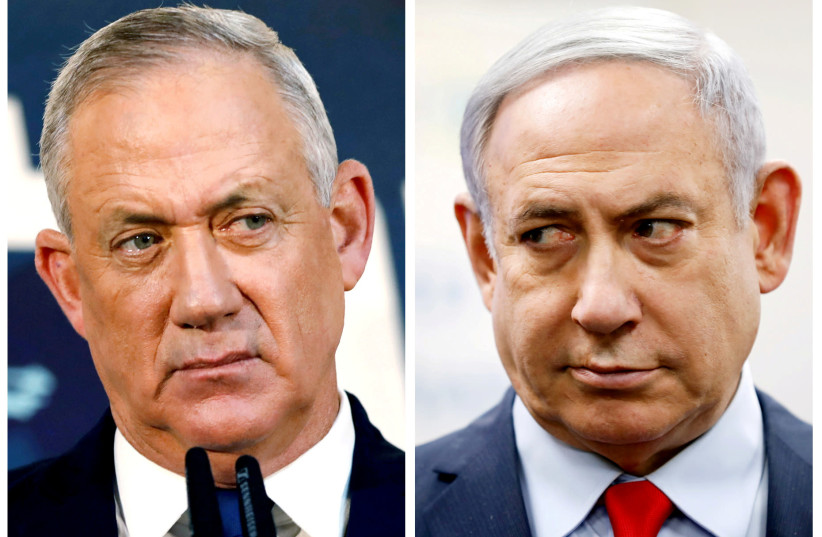
A maximum 11-judge panel of the High Court of Justice at close to midnight on Wednesday green-lighted Prime Minister Benjamin Netanyahu to form the next government as well as controversial aspects of the Blue and White-Likud coalition deal.
Despite misgivings about the “grave charges pending” in the bribery indictment against Netanyahu and aspects of the coalition deal, the justices voted unanimously that they could not intervene.
Ultimately, the justices said there was a two-part test to giving Netanyahu the green light.
First, they said he was not automatically disqualified by law since the Knesset law only automatically disqualifies a prime minister who was convicted and exhausted his appeals.
Second, they said the court could still review the discretion of any appointment.
The question then became who is appointing the prime minister.
The justices ruled that the Knesset is the body that appoints the prime minister and that they must give heavy deference to such an inherently political decision.
Further, the justices said it could be disastrous for an external body – such as the court – to intervene with this process absent a case much more extreme than the one before them.
In theory, this second step to the legal analysis preserved the judges’ role in judicial review and their theoretical ability to fire a future indicted prime minister.
In practice, the justices made it clear that they were in no mood to challenge the will of the Knesset, even for a bribery charge, which is viewed as the most severe of white collar crimes.
The signs were already there on Sunday that it would be hard for the petitioners to force out Netanyahu.
Even then, it appeared that at least a majority of six, if not more, of the justices were leaning toward green-lighting Netanyahu. The decision is expected to come before the May 7 deadline to form a government.
Movement for the Quality of Government in Israel lawyer Eliad Shraga tried on Sunday to shock the justices into ruling against Netanyahu.
He said if the High Court accepted Netanyahu as prime minister, “you will have destroyed your decades of precedent of Deri-Pinhasi,” which forces ministers to resign upon indictment.
Shraga also said Attorney-General Avichai Mandelblit’s attempts to defend Netanyahu were a “tortuous mix” of contradictory approaches to interpreting the law.
He lashed out at Blue and White leader Benny Gantz’s lawyers, who had said the High Court has the power to fire a prime minister, but not in these specific circumstances (highlighting the three elections and coronavirus crisis).
Shraga proclaimed the case against Netanyahu was “extremely grave,” saying that Mandelblit and the lawyers for the Knesset and President Reuven Rivlin were “turning bribery into normative behavior” by looking the other way so that Netanyahu could form the next government.
Lawyer Daphna Holech-Lechner, representing more than 100 hi-tech officials, said on Sunday: “We are falling into a dark black hole” that is “destroying the rule of law… We have been in this situation for months with danger and awful attacks on the rule of law.”
“What we saw until now is just a promo,” she added. “This is very dangerous.”
“I don’t think Knesset members at the time of the amendment of the Basic Law [regarding when a prime minister must resign] ever would have imagined where we are with” the public and the Knesset endorsing a man indicted for bribery to be prime minister and Netanyahu himself refuses to resign, Holech-Lechner said.
But the justices appeared unconvinced.
High Court President Esther Hayut and Vice President Hanan Melcer repeatedly said on Sunday that the petitioners were making populist arguments and ignoring the explicit words of the law, which only allow ousting a prime minister after convicting and exhausting all appeals.
When the law regarding ousting a prime minister for legal issues was passed, Melcer said, the Knesset even considered a stricter approach and rejected it to avoid non-elected legal officials from toppling the person chosen to run the country by the voters.
Hayut explicitly referred to the Knesset’s power of selecting a prime minister as being at the heart of the legislative branch’s fundamental political powers for which it had much wider discretion than a mere administrative decision.
Whereas in the case of a minister, the High Court could order the prime minister to fire them for being indicted, the justices suggested that they did not have the same obvious angle for overruling the sovereign choice of the Knesset to lead the country.
Holech-Lechner said Amnon Rubinstein, who helped lead the legislation regarding ousting a prime minister some 20 years ago, has admitted that they did not foresee a situation in which the prime minister would be viable and seek to stay in office if accused of bribery.
But Melcer’s retort was that if there was a problem with the law, the Knesset itself would need to fix it with an amendment, not the courts.
One key moment in the hearings was when the High Court appeared to be trying to limit Netanyahu’s powers as prime minister even if they green-light him.
For example, they suggested he would not be allowed to take on any additional ministerial portfolios besides being prime minister as long as he faces his trial.
Also, they suggested he should be walled off from involvement in appointing law-enforcement officials. (It is unclear how this can be enforced, given that the Likud can enforce his will whether Netanyahu is physically present at decisive meetings or not.)
Last week, Mandelblit had green-lighted Netanyahu despite significant misgivings regarding the bribery indictment pending against him.
Mandelblit had also said despite major legal problems with other controversial aspects of the Likud-Blue and White coalition deal, the High Court of Justice should let the new government form and probe specifics only later and if concrete problems present themselves.
The High Court addressed those issues on Monday.
The bottom line was that Mandelblit started to plow the way forward for the two parties to form the next government with Netanyahu as prime minister and Gantz as vice prime minister.
Effectively, he was stamping out opposition from Yesh Atid and other opposition factions, even as numerous comments in his legal brief made it clear that he had misgivings about large aspects of the coalition deal.
Mandelblit’s opinion to the High Court came after Blue and White called on the court last week to let Netanyahu remain as prime minister due to the coronavirus crisis and to avoid unprecedented fourth elections.
Likewise, Rivlin requested that the High Court reject the petitions against Netanyahu and the coalition deal and not try to drag his office into the issue since the prime minister has the support of the majority of the Knesset.
Both Mandelblit and the High Court had already rejected several petitions seeking to fire Netanyahu on a variety of grounds dating back to the indictment being issued on November 21, 2019.
Some of the several petitioning good-government groups had been slightly more hopeful of winning over the court this time.
But Mandelblit’s siding with Netanyahu, even as he was the one who issued the indictment, was a heavy blow to their efforts.
Essentially, the attorney-general said even though the law only addresses a sitting prime minister and not a transitional prime minister seeking to form a new government, the same provisions that apply to a sitting prime minister should be the lens with which an aspiring prime minister with an absolute majority of Knesset recommendations should be viewed.
Despite more than 25 years of High Court precedent forcing ministers to resign upon indictment, Mandelblit said the prime minister is qualitatively different from other ministers because toppling or blocking a candidate for prime minister throws off the entire process of government formation.
Regarding changes to the Basic Laws, Mandelblit said after the government is established, portions of the deal may need to be amended that conflict with Israel’s democratic structure.
The attorney-general voiced concern that the deal restricts the Knesset’s powers for six months to consider issues beyond the coronavirus crisis.
He also showed distaste for provisions that weakened the role of the opposition in the Knesset, such as removing them from certain committee positions as well as from the Judicial Selection Committee.
Mandelblit also objected to dividing the government into two blocs and to a deal to appoint Osnat Mark to the Judicial Selection Committee even though she will only become a member of the Knesset after various Likud ministers resign their positions.
But Mandelblit was ready to let these issues be dealt with at a later date so as not to undermine the deal as a whole and risk sending the country to fourth elections.
Rebuking one of the petitioner’s lawyers who said that the voters had no idea that this problematic new form of government would be foisted on them, Hayut said on Monday, “the voters did not vote for a specific form of government, they voted for political parties and for the Knesset.”
At the same time, the justice seemed on the warpath about some specific provisions of the deal, but the parties amended most of those provisions by Tuesday.
Hayut appeared to give the coalition a big win at the opening of the hearing, suggesting that the lawyers focus “only on issues not requiring Knesset legislation.”
The massive implication was that the High Court would not disqualify any of the changes to the Basic Laws required by the deal until after the Knesset successfully passes them into law.
This means that the government will overwhelmingly go into effect, leaving its critics to try to slice pieces off before the High Court at a later date only after the new government is a fact on the ground.
Still, several of the justices voiced opposition to the idea that the new government could give itself an unlimited corona emergency period for playing with the country’s normal legal structure.
Along those lines, Hayut pressed the deal’s defenders to explain why the corona crisis prevented them from appointing a permanent police chief.
The deal freezes most top officials in place during the six month coronavirus emergency period.
Like Mandelblit, Justice Neal Hendel showed distaste for provisions that weakened the role of the opposition in the Knesset, such as removing them from certain committee positions as well as from the Judicial Selection Committee.
At the same time, when the petitioners attacked this point, the justices suggested that however problematic it might be, there had been past rotation-unity deal eras when the opposition was given fewer roles.
The basis of this, they explained, was the idea that a unity government already represents multiple viewpoints and interests in the country – in some ways allowing even more public debate than when there is a mere disempowered opposition.
Yesh Atid lawyer Eliram Bakal warned on Monday that this vision “is very dangerous.” He said the justices must not let the unity government claim “there is no opposition” and that they represent all the interests of all groups in Israel.
Melcer also warned that the suggested number of ministers and deputy ministers at a count of 52 was close to a point where a majority of the Knesset would be part of the cabinet, ending the idea that the executive and legislative branches are separate.
The court asked for the coalition parties to clarify and fix certain legal problems which the justices had flagged within 24 hours.
Petitioner lawyer Avigdor Feldman on Monday was one of the few who attacked the broad idea of the High Court waiting to rule on proposed Knesset bills until they became law.
He said, “We went to sleep with one prime minister and woke up to two prime ministers,” adding that the High Court should not be so passive to wait for major new legal facts to be set and wedge them in from having to roll them back later.
Both Feldman and Movement for the Quality of Government in Israel lawyer Eliad Shraga said on Monday that the justices could not ignore “the elephant in the room” that none of the changes to the law were out of an ideological belief that this would improve Israel’s governmental structure.
Rather, they emphasized it was a testament to the lack of trust Blue and White had in Netanyahu and their commitment to force him out of the prime minister’s chair in October 2021.
Leading into the Monday hearing, Yesh Atid MK Karin Elharar said, “the State of Israel has known many coalition deals, but we have never seen a deal that is this bad. It is a deal which weakens the Knesset, oppresses the opposition” and treats public appointments as if they are part of “someone’s personal wallet.”
However, Netanyahu lawyer Michael Ravilo said on Monday that the deal that was reached was extremely sensitive and had taken so long to negotiate that the justices should not touch it, lest they risk going to fourth elections.
Zawartość publikowanych artykułów i materiałów nie reprezentuje poglądów ani opinii Reunion’68,
ani też webmastera Blogu Reunion’68, chyba ze jest to wyraźnie zaznaczone.
Twoje uwagi, linki, własne artykuły lub wiadomości prześlij na adres:
webmaster@reunion68.com


 TV7 Israel News
  ILTV Israel News