
Archive | March 2015

Bliźni w świadomości bliźniego

Bliźni w świadomości bliźniego

Andrzej Koraszewski
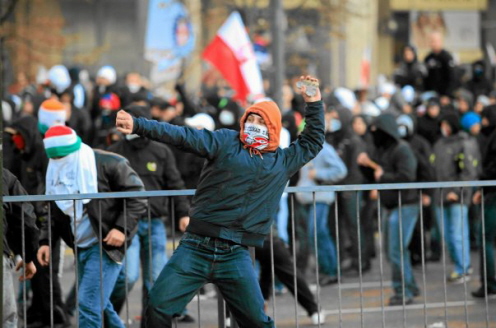

Agresja szympansów, porozbijane czaszki naszych przodków, pojedynki naszych pradziadów, cywilizujemy się na grandę i dziś zdecydowana większość Polaków ogranicza się do przynoszącej słabą satysfakcję agresji słownej.

Dzieci chwalą się jaki tatuś ma elegancki (by nie użyć słowa zajebisty) samochód, a nie ilu zabił facetów z sąsiedniej wsi. Nic w przyrodzie nie ginie i nawet jeśli wbijanie na pal wyszło z mody, a pal go sześć, to zaledwie idiomatyczny zwrot oznaczający „niech go diabli wezmą”, potrzeba dokopania bliźniemu pozostała równie pilna, jak była w przeszłości.

Jak zasadne jest pytanie kto nienawidzi? Nikt z nas nie jest bez grzechu i konia z rzędem temu, kto w życiu nie miał ochoty nikogo udusić. Trzeba zatem nienawiść dodefiniować, iżby było jaśniejsze, o której nienawiści mówimy.

Obawę przed innym mamy zakodowaną w genach. Nienawiść szympansów (głównie młodych) do szympansów z sąsiedniego terytorium nie zawsze jest jednak podyktowana obawą. Grupowa napaść i zamordowanie samotnego samca, który nie jest chroniony wewnętrznymi prawami własnego stada, wydaje się być cenioną formą dowartościowania, szczególnie dla jednostek znajdujących się nisko w hierarchii społecznej.

Podczas wojny miedzy Serbami i Chorwatami jedna z gazet brytyjskich cytowała fragmenty listu kobiety piszącej, że nigdy nie zdawała sobie sprawy z tego, ile szczęścia daje nienawiść.

Informacja, że od dziś tych, czy tamtych wolno zabijać, w każdym społeczeństwie ujawnia niezliczone rzesze morderców. Agresję mamy wbudowaną, kultura (polityka, religia) może ją hamować lub wzmacniać.

Niedawny z historycznego punktu widzenia zakaz pojedynków był ograniczeniem swobody dysponowania własnym życiem. Udział w pojedynku był nagle zagrożony karą więzienia, pobyt w więzieniu był plamą na honorze. W tej sytuacji zniewaga, która wcześniej plamiła nasz honor, przestała plamić w stopniu wystarczającym, aby zabijając plamiącego narazić się na karę pozbawienia wolności. (Wcześniej obowiązek pozostawiania broni w kruchtach kościołów nie był wymuszony przez sprzątaczki, ale niewątpliwie ułatwił im życie.)

Ciekawa sprawa, bo same pojedynki były już wymuszoną przez kulturę samokontrolą agresji. Zamiast komuś, kto pożądliwie spojrzał na naszą wybrankę, rozwalić łeb natychmiast, rzucamy rękawicę, policzkujemy lub wysyłamy bilecik z wezwaniem na śmiertelną rozprawę według ściśle ustalonych reguł (pod warunkiem iż patrzący pożądliwie miał równy mojemu status społeczny). Ustawki współczesnych kiboli pobrzmiewają echem etosu rycerskiego.

Kiedy pytamy o to, kto dziś nienawidzi, istotny jest poziom kontroli nienawiści. Od czasu do czasu (ale zawsze 11 listopada) widzimy na ulicach gromady młodych ludzi, którzy wyszli z domów z zamiarem i nadzieją na popełnienie morderstwa. Człowiek rzucający kamieniem w drugiego człowieka liczy na to, że trafi i albo zabije, albo zrani.

Możemy uważać, że ta mordercza nienawiść jest w pewnym sensie marginalna, gdyż watahy zakapturzonych młodzieńców jadących autobusami na patriotyczne uroczystości liczą się w tysiącach, a nie w dziesiątkach czy setkach tysięcy

Czytaj dalej tu: Bliźni w świadomości bliźniego


twoje uwagi, linki, wlasne artykuly, lub wiadomosci przeslij do: webmaster@reunion68.com



Watch: Senator Rubio Rips Obama’s ‘Historic Mistake’ on Israel

Watch: Senator Rubio Rips Obama’s ‘Historic Mistake’ on Israel

By Ari Yashar, Gil Ronen


Rubio gives impassioned speech revealing Obama’s ‘outrageous’ hypocrisy and enmity concerning Israel with elections fallout.

Senator Marco Rubio (R-FL) on Thursday night delivered a powerful speech against US President Barack Obama’s increasing hostility towards Israel after Prime Minister Binyamin Netanyahu’s elections victory, as the White House threatened to pull support for Israel at the UN.

Rubio began by noting “Israel is everything we want that region of the world to be,” pointing out the Jewish state’s democracy, free enterprise economy, and status as a strong American ally.

Speaking about Israel’s “unique purpose” as “the homeland for the Jewish people in the aftermath of the Second World War and of the Holocaust,” he noted his pride that America has “stood behind the Jewish state for all of these years.”

However, that support is in danger he charged, pointing that as of the time of his speech Obama had yet to call Netanyahu to congratulate him on his victory – the call came later on Thursday night, a full two days after elections.

Rubio revealed the hypocrisy of the delay, given that in 2012 Obama was among the first to call and congratulate Russia’s Vladimir Putin, President Mohammed Morsi of the Muslim Brotherhood in Egypt, as well as Chinese Communist leaders, and in 2013 he likewise rushed to call Iranian president Hassan Rouhani.

The senator provided an overview of Obama’s noted slant in bashing Israel back from his campaigning days in 2008.

At eight minutes and 25 seconds into the video, Rubio turns up the heat, focusing on the post-election fallout.

Obama accused Netanyahu of “divisive language” in the elections, noted Rubio, saying the criticism was hypocritical given that Obama “was elected at least once, probably twice, on extremely divisive language.”

Making the hypocrisy of the criticism more apparent according to Rubio is that after Iran’s “fraudulent election” of 2009, a local Green Revolution started and was violently put down – in that case, Obama refused to “interfere in the sovereignty of Iran.”

Obama has also harped on Netanyahu for saying the conditions for a two-state solution do not exist, threatening to reconsider the US’s position in the UN and possibly allow a resolution recognizing the Palestinian Authority (PA) as a state.

“Obama is making an historic mistake”

Rubio argued the conditions are not right for a peace deal. He pointed to how Israeli withdrawals from southern Lebanon and Gaza turned them into rocket launching grounds, how the PA turned down every peace offer, how 6% of the PA budget goes to jailed terrorists and their families including with foreign donor money, and gave multiple illustrations of PA incitement.

“These are the people that this president wants to put pressure on them (Israel) to cut a peace deal with,” emphasized Rubio. “I think Netanyahu is right that the conditions do not exist for a peace deal with people who teach their children that killing Jews is a glorious thing…that there’s no such thing as a Jewish people, that any methods of destroying them is valid, that pay them salaries and benefits.”

Rubio asserted “this president is making an historic mistake. Allies have differences, but allies like Israel, when you have a difference with them and you amke it public, it emboldens their enemies…to launch more terrorist attacks, to go to more international forums and delegitimize Israel’s right to exist.”

Denouncing Obama’s anti-Israel rhetoric, Rubio said “this is outrageous, it is irresponsible, it is dangerous, and it betrays the commitment this nation has made to the right of a Jewish state to exist in peace.”

“They deserve to be treated with more respect, not less, than this president is giving the supreme leader of Iran,” he added, noting Obama is wary of upsetting Iran to as not to harm the nuclear deal being formed.

“If America doesn’t stand with Israel, who would we stand with?” posed Rubio. “If they are not worthy of our unconditional support, then what ally of ours around the world can feel safe in their alliance with us?”


twoje uwagi, linki, wlasne artykuly, lub wiadomosci przeslij do: webmaster@reunion68.com



“I ciągle śni mi się Auschwitz”

“I ciągle śni mi się Auschwitz”

Sylwia Ławrynowicz


fot. http://www.zchor.org/birenbaum/museum.htm

Historia Haliny Birenbaum, pisarki i poetki, ocalonej z Holocaustu. W czasie II wojny światowej jako dziecko przebywała w niemieckich obozach koncentracyjnych na Majdanku, Auschwitz-Birkenau, Ravensbrück oraz Neustadt-Glewe, gdzie doczekała wyzwolenia w 1945. W 1947 roku wyjechała do Izraela. Założyła rodzinę i mieszka tam do dziś.

“I ciągle śni mi się Auschwitz” – rozmowa z Haliną Birenbaum, jedną z 300 żyjących obecnie osób, która przeżyła obóz. Autorka: Sylwia Ławrynowicz


twoje uwagi, linki, wlasne artykuly, lub wiadomosci przeslij do: webmaster@reunion68.com


Archiwum polskich filmow “Pociag”

Pociag

Studio Filmowe KADR


FILM PO REKONSTRUKCJI CYFROWEJ.

Reżyseria: Jerzy Kawalerowicz
Muzyka: Andrzej Dąbrowski
Rok produkcji: 1959 r.
Obsada: Lucyna Winnicka, Leon Niemczyk, Teresa Szmigielówna, Zbigniew Cybulski
Opis: Jerzy i Marta przypadkowo spotykają się w pociągu. Z powodu braku wolnych miejsc zostają zmuszeni do odbycia podróży w jednym przedziale, choć każde wolałoby tą podróż spędzić w samotności. Pomiędzy parą stopniowo nawiązuje się przyjazny kontakt. Szorstkie i niekonwencjonalne zachowanie Marty fascynuje Jerzego, który obserwując ją zapomina o swoich kłopotach…


twoje uwagi, linki, wlasne artykuly, lub wiadomosci przeslij do: webmaster@reunion68.com



A safe haven for war criminals?

balticworlds.comWriting history politically.A safe haven for war criminals?

Matthew Kott


Illustration Ragni Svensson

Published in the printed edition of Baltic Worlds pages 43-45, Vol 4:2010
Published on balticworlds.com on januari 11, 2011

The tension among politics, justice, and history lies at the heart of the recent book Purgatorium by the Swedish historian Mats Deland. Even though Sweden was formally neutral throughout World War II, it was still intimately drawn into many aspects of the conflict. A neutral state, it was also the destination of choice for many refugees both during and after the war. Among those who sought refuge in Sweden were not only the victims of various persecutions, but, indeed, also persons who had been complicit in persecuting others. Deland’s interest is in exposing how the Swedish state handled this situation.

Within the framework of a government funded “Svenaz” research program initiated by the Social Democratic Prime Minister Göran Persson, a number of projects aimed to shed new light on the relations between Sweden and Nazi Germany, and, more broadly, Sweden and Nazism. One of the research projects in the program was Deland’s investigation of Sweden as the destination for alleged Nazi war criminals in the final phases of the war and its immediate aftermath.

Due to his “Svenaz” affiliation, Deland was able to access certain classified files and documents closed to other researchers, although this did not prevent him from feeling thwarted at times by the overly bureaucratic procedures that hindered his progress. Despite this, after some years Deland managed to amass an unparalleled body of source material on war criminals in Sweden after World War II. The results were far too much to be contained in a single volume. Aside from Purgatorium, which runs to over 560 pages, Deland has also published a separate report1, magazine articles2, and appendices on his Web site3 based on this research.

In Purgatorium, Deland focuses primarily on one group of suspected Nazi war criminals who came to Sweden, the Latvians. Other groups — Germans, Estonians — are mentioned as well, but mainly to contextualize the general historical trends described. Although not the largest refugee group in postwar Sweden, nor the group with the most (in absolute terms) suspected war criminals among them, Deland lets the case of the Latvians exemplify the moral, legal, and political factors that shaped Sweden’s problematic history of dealing with war crimes since World War II.

The occupied Baltic states were the locus of some of the earliest mass atrocities of the so-called Einsatzgruppen phase of Nazi genocide. During 1941 and 1942, hundreds of thousands of Jews, as well as Romanis, Communists, Soviet POWs, and the mentally ill were executed en masse in the Baltic region by the SS men of Einsatzgruppe A and their helpers: German soldiers, German policemen, and local auxiliaries.

These tragic circumstances thus contributed to a sizeable group of perpetrators, both German and local, in the Baltic states. Sweden’s geographic proximity made it an ideal escape route for those who sought to avoid the retribution that could be expected with the collapse of German power and the return of the Soviets to the region.

The book opens with the story of a German policeman who served with an SS unit that swept through small-town Lithuania in 1941, leaving behind a trail of mass graves. This German, who fled to Sweden after the war, was later extradited to face charges relating to his complicity in wartime Nazi crimes. After serving a short sentence in a West German prison, he returned to his family in Sweden, where he remained to the end of his days. As it turns out, he was the only foreigner ever who was extradited from Sweden to a non-Nordic country.

Throughout the Cold War, Sweden never assisted other countries in prosecuting alleged war criminals who had sought refuge there, but nor did it actively pursue prosecuting these persons itself. Deland offers several explanatory factors for this, some legal, some pragmatic, some political. Most significant, however, would seem to have been the political ones.

To set the scene, Deland presents a great deal of detail regarding the situation in German-occupied Latvia during World War II, including the types of atrocities committed there, and by whom. The reader is left with few illusions about the implications that complicity in these crimes would entail.

Read more: Writing history…


twoje uwagi, linki, wlasne artykuly, lub wiadomosci przeslij do: webmaster@reunion68.com