
Archive | February 2017

RADIO MARYJA CRITICIZED IN TEL AVIV UNIVERSITY PRESENTATION

RADIO MARYJA CRITICIZED IN TEL AVIV UNIVERSITY PRESENTATION

RADIO MARYJA LINKS CRITICIZED AT TEL AVIV UNIVERSITY PRESENTATION

Members of the ‘NEVER AGAIN’ Association have participated in a series of meetings in Israel in late December and early January, including the international conference of senior educators on ‘The Shoah and Jewish identity’ held at Yad Vashem Institute (Jerusalem). Dr Rafal Pankowski, a co-founder of ‘NEVER AGAIN’, was invited to give a presentation about the current state of antisemitism and xenophobia in Poland at the Tel Aviv University Kantor Centre for the Study of Contemporary European Jewry headed by Professor Dina Porat. The presentation, followed by a lively discussion, was held at the Tel Aviv University campus on 1 January 2017.

Although the number of Jews in today’s Poland is very small, antisemitism is present in the public discourse in various settings: from the football stadium to academia and church. Antisemitism can be seen as a paradigmatic form of prejudice, a popular expression of hostility to liberal democracy in Poland and other countries in the region of Central and Eastern Europe. The linkage between antisemitism ‎and the rapid rise of other types of xenophobia was stressed during the debate. It was illustrated by the spectacular burning of an effigy of a Chasidic Jew during an anti-refugee demonstration organized by the neo-fascist National-Radical Camp (ONR) in Wroclaw in November 2015.

Radio Maryja, the nationalist-Catholic radio station run by the Redemptorist order, has been the single most powerful disseminator of antisemitic discourse for the last 25 years, as documented in numerous reports by the ‘NEVER AGAIN’ Association, the Anti-Defamation League, the Council of Europe, and other organizations. According to the US State Department report on Global Antisemitism to the Congress in 2008, ‘Radio Maryja is one of Europe’s most blatantly anti-Semitic media venues.’

Radio Maryja’s founder, Father Tadeusz Rydzyk, himself has frequently engaged in antisemitic speech on air, e.g. he routinely referred to Polish State Television as ‘TELAVision’, suggesting it was dominated by Jews. In one of his broadcasts, Rydzyk openly degraded the Jewish religion: ‘I call it ai vai shalom. It is clearly a religion of trade. It is trade, and not religion.’

Surprisingly, Rydzyk was received as a guest by the current Israeli Ambassador to Warsaw, Anna Azari, in September 2016. The publicized meeting was met with raised eyebrows among Polish civil society and an open letter of protest to the embassy was written by several highly respected figures in the Polish Jewish community, such as Konstanty Gebert, Stanislaw Krajewski, and Joanna Sobolewska-Pyz. The ‘NEVER AGAIN’ Association expressed its disappointment, too. Nevertheless, the contacts between the Israeli Embassy and Radio Maryja continued and the embassy was represented at ceremonies organized by Father Rydzyk in his powerbase, the city of Torun. Another meeting took place on 26 November 2016 in the form of a shabbat dinner attended by Father Rydzyk, Ambassador Azari, the Director of the Zionist Organization of America Morton Kleinand, and Deputy Speaker of the Knesset Yehiel Bar (Labour Party).

– ‘I believe it is a moral and political mistake to enter into such unholy alliances with Father Rydzyk’ – said Rafal Pankowski who is an Associate Professor in Sociology at Warsaw’s Collegium Civitas. – ‘It amounts to legitimizing Radio Maryja and its xenophobic ideology.’ ‎He pointed to the fact Radio Maryja continues to promote radically antisemitic views. For example, during a religious ceremony broadcast on Radio Maryja and its associated TV network on 3 September 2016, Father Rydzyk reprimanded the faithful by shouting: ‘This is not a synagogue!’ ‎On 5 October 2016, the regular Radio Maryja commentator Stanislaw Michalkiewicz read his column on air saying: ‘The Jewish circles in Poland are tasked with providing the European Commission with as many proofs as possible that democracy and the rule of law in our unhappy country is threatened by the fascist regime.’‎ On 20 October 2016, Michalkiewicz authored another lengthy antisemitic rant, saying among others: ‘Today the mischevious Jews understood what it is about and they transformed themselves into liberals.’ On 23 November 2016, Radio Maryja aired Michalkiewicz’s weekly antisemitic broadcast in which he alleged ‘the Jewish lobby in Poland demonstrates its racial solidarity with the Ukrainian oligarchs.’ In December 2016, Michalkiewicz toured Polish churches and cultural centres in the US, spreading his antisemitic conspiracy theories.

– ‘The levels of far-right activity, hate speech and hate crime in Poland have risen rapidly since the summer of 2015’ – said Rafal Pankowski. – ‘They must be condemned and confronted, not ignored or condoned.’

The ‘NEVER AGAIN’ Association is a Warsaw-based anti-racist educational and monitoring organization established in 1996.


twoje uwagi, linki, wlasne artykuly, lub wiadomosci przeslij do: webmaster@reunion68.com



At Auschwitz, a Jewish journalist confronts his anti-Polish bias

At Auschwitz, a Jewish journalist confronts his anti-Polish bias

Cnaan Liphshiz


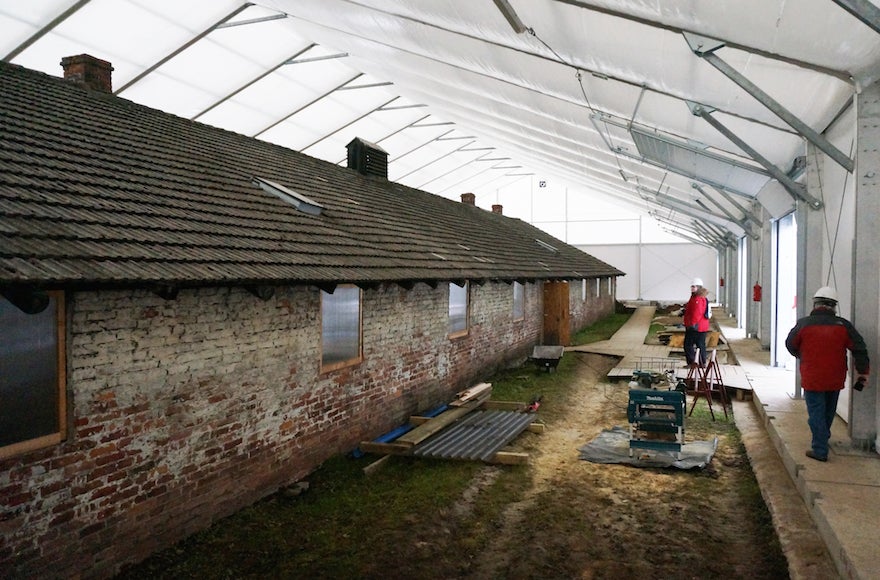
Journalists visiting a renovated barack at Auschwitz, Dec. 1, 2016. (Cnaan Liphshiz)Journalists visiting a renovated barack at Auschwitz, Dec. 1, 2016. (Cnaan Liphshiz)

OSWIECIM, Poland (JTA) — I did a shameful thing on my first visit 20 years ago to the former Nazi death camp of Auschwitz-Birkenau.

In a guestbook outside an Auschwitz museum exhibit featuring information on 70,000 Polish non-Jews who were murdered here, I downplayed the significance of their deaths by writing: “Your pain is no credential here, it’s just the shadow of my wound.”

Those words — a quote from a Leonard Cohen song that I abused as a high school student from Israel while touring the camp that my grandmother had survived — resurfaced in my consciousness last month on my latest visit to the site, this time to attend a five-day journalists’ seminar.

Like eight other colleagues from publications such as The New York Times, Agence-France Presse and Britain’s Press Association, I signed up for the seminar to finally gain a truly structured understanding, based on observation and deliberate study, of the sprawling site that I had visited at least a dozen times on brief assignments.

We got what we came for — and more. During the seminar, the first-ever designed for journalists by the museum, we saw a dozen restorers carefully polishing some of the 3,800 suitcases of Holocaust victims.

“It’s drudgery, but when the faded name once again appears on the leather, it’s like giving a headstone to a person without a grave,” Maria Swieton, a 30-year-old restorer at the lab told me. In addition to suitcases, the museum also has 110,000 shoes and 4,500 artworks.

Our tour was the first time media were allowed access to a pilot preservation program that will cost tens of millions of dollars aimed at restoring Auschwitz barracks. Implemented for the time being on just two of the some 450 structures on the museum’s grounds, the program involves encasing them in huge tents, replacing unsalvageable parts with material fashioned to match the originals, then taking apart and cataloguing the barracks furnishings before reassembling the buildings and reinforcing the foundations.

It was an inspiring demonstration of the dedication of Polish authorities and the international donors to the Auschwitz memorial fund, whose goal is to not let the world forget what happened here and educate approximately 2 million people who visit the museum each year.

Yet as the chill of the place worked its way to my bones — both metaphorically and physically, as again I had come without sufficient winter gear — my mind kept drifting back to my grandmother who survived Auschwitz, my relatives who perished here and that Cohen lyric. I wondered what made me write it — and if the ugly sentiment was connected to the aggressive attempts by Polish authorities to control public discourse about the Holocaust.

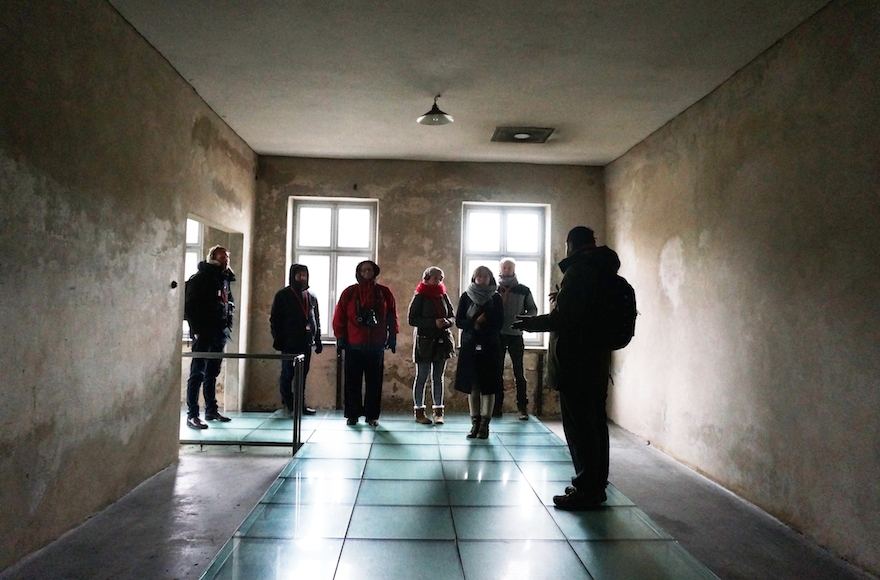
Journalists and a spokesperson of the Auschwitz museum visiting a former disinfection facility, Dec. 1, 2016. (Cnaan Liphshiz)Journalists and a spokesperson of the Auschwitz museum visiting a former disinfection facility, Dec. 1, 2016. (Cnaan Liphshiz)

I broke from the group early one night and walked a lonely half-mile through the icy paths of the Auschwitz I complex. Long after the closing hours of the now deserted museum, I shivered under the yellow lights of lamps that the Nazis had Polish slave laborers install here.

The quote came back to me as I passed the gallows of Auschwitz I — the first part of the death camp that the Germans initially built in 1940 for Polish prisoners and by 1941 used to keep also Soviet prisoners of war. Eighteen months later it became a slaughterhouse for 1.1 million Jews, 25,000 Roma and 15,000 prisoners of war.

I specifically recalled the story of Janusz Pogonowski, a fighter for the Home Army underground, who in 1943 stood with 11 other non-Jews at those gallows while camp commander Rudolf Hoss read out the sham verdict for plotting to escape. Instead of waiting to be executed, Pogonowski kicked the stool from under his own feet as a last act of resistance.

In addition to killing 3 million Polish Jews, the Nazis also killed 3 million Polish non-Jews, mostly civilians. I saw hundreds of their portraits – haunting mugshots of men and boys with extinguished eyes and striped uniforms — alongside photos of Jewish inmates on the walls of Blocks
5 and 6.

What could have possessed me, then, to write that callous and disrespectful sentence 20 years ago?

With hindsight, I was able to see that my competitive attitude to grief was an unwanted inheritance from my grandparents and parents, all of them Polish speakers. More than a teenager’s outburst, the gesture was rooted in a troubled, bloody legacy of shared grief, grudges, nuances and caveats that continue to bedevil Polish-Jewish relations to this day.

Like many Polish leaders before him, President Andrzej Duda says the Holocaust and World War II were tragedies that underscore the shared destiny of Jews and Poles. He also likes to highlight the actions of more than 6,500 Poles who saved Jews during the Holocaust — the highest number of any country in the world.

In line with this view — that Poles and Jews are united by the devastation caused by the Nazis — Duda’s right-wing government last year passed a bill that criminalizes terms like “Polish death camps” instead of “Nazi death camps.” And the Auschwitz-Birkenau Memorial and Museum insists that journalists use the term “German-occupied Poland” when referring to the country during the Holocaust.

But my Poland-born grandmother did not think of Polish non-Jews as fellow victims as she was marched by retreating Nazis from Auschwitz into Germany. Severely emaciated and exhausted, she also feared being caught by Pogonowski’s Home Army. Its fighters, in addition to recruiting and helping to save some Jews, also participated in anti-Jewish pogroms that made some Jews fear the partisans more than the Nazis.

During the Nazi occupation, thousands of Jews were murdered by Poles in at least 20 towns and cities, including Jedwabne, where hundreds were butchered in 1941 without German interference.

Ironically, my grandmother and her dying friend decided they would escape the march only in Germany, where a German farmer and a soldier – perhaps a defector – saved her friend’s life and saved my grandmother’s badly infected arm from amputation. After the war and living in Lodz, her husband, my grandfather, taught my father how to fight children who called him a “dirty Jew.” Then they were let out of the country, but stripped of the Polish nationality, in 1957 during a period of relative liberalization following the death of Joseph Stalin.

Like countless other Jews of Polish descent, such stories formed the background of my understanding of Poland and colored it with a bias.

I know I’m not the only one.

Last year Rabbi Zev Friedman, dean of Rambam Mesivta High School in New York, rallied with his pupils outside the Polish consulate to protest Warsaw’s curbing of free speech. They complained about the opening last year of a criminal probe in Poland against a Jewish historian who said Poles killed more Jews during World War II than Poles killed Germans. The historian was suspected of “insulting the honor of the Polish nation,” which is an offense according to the country’s penal code.

Historians agree that collaboration in Poland was immensely less prevalent than in nearly all the countries in Eastern Europe, including Ukraine, Lithuania, Romania and Hungary. Poles are responsible only for a tiny fraction of the victims of the Holocaust.

Yet Friedman also wrote in a statement about the rally that Poland is trying “to rewrite history and deny the significant role that Polish citizens had in perpetrating the Holocaust.” He added: “I’ve heard many survivors speak of the glee that their Polish neighbors had when Jews were being mercilessly persecuted.”

Michael Schudrich, the chief rabbi of Poland, has heard those claims, too. And while he acknowledges that some Poles perpetrated atrocities against Jews during the Holocaust, he called testimonies saying this was prevalent “not historical accounts but reflections of the horror experienced by people who survived the Holocaust in Poland.”

I got a window seat on the plane bound for my home in the Netherlands — a country which, unlike Poland, had during World II a quisling Nazi proclaimed as its leader by Adolf Hitler. The sun was setting on the homes of ordinary and honest people who, 75 years after the Nazis turned their land into a cemetery for Jews and other undesirables, are still struggling to come to terms with their nation’s tormented legacy.


twoje uwagi, linki, wlasne artykuly, lub wiadomosci przeslij do: webmaster@reunion68.com


Jerusalem, Israel: Jewish Quarter and New City

Jerusalem, Israel: Jewish Quarter and New City

Rick Steves


More info about travel to Jerusalem: https://www.ricksteves.com/watch-read… In Jerusalem’s New City, we appreciate this culture’s fascinating mix of east and west, secular and sacred, modern and traditional. While it’s not convenient or economical to live in the medieval tangle of the Jewish Quarter in Jerusalem, Israel, devout Jews find great joy in living and raising their families so close to the Western Wall.

At http://www.ricksteves.com, you’ll find money-saving travel tips, small-group tours, guidebooks, TV shows, radio programs, podcasts, and more on this destination.


twoje uwagi, linki, wlasne artykuly, lub wiadomosci przeslij do: webmaster@reunion68.com


Francja: plac w Paryżu nazwany imieniem Marka Edelmana

Francja: plac w Paryżu nazwany imieniem Marka Edelmana

PAP


Plac w XI dzielnicy Paryża został nazwany imieniem Marka Edelmana, ostatniego przywódcy powstania w getcie warszawskim. O taki sposób uczczenia Edelmana wystąpili do Rady Paryża przedstawiciele żydowskiego ośrodka kulturalnego im. Włodzimierza Medema w Paryżu.

Marek Edelman

– Jestem zachwycony i zadziwiony – powiedział dziś wiceprezes ośrodka Emile Papiernik. – Zachwycony, bo ośrodek im. Medema jest spadkobiercą idei Bundu (żydowski ruch socjaldemokratyczny; Medem był jego czołowym przywódcą), któremu Edelman był do końca wierny.

– A zadziwiony, bo Rada Paryża nie powiadomiła nas o swej decyzji, choć to nasze stowarzyszenie wystąpiło po śmierci tego bohatera powstania w getcie warszawskim, o uczczenie go w nazwie ulicy lub paryskiego placu – tłumaczył Papiernik, dodając: “sztandar Bundu, w który owinięto trumnę doktora Edelmana, przysłaliśmy z Paryża”.

Pierwsza propozycja nazwania któregoś z placów stolicy Francji imieniem Edelmana padła w 2009 r. Rada Paryża oficjalnie podjęła ją w październiku 2013 r. i teraz sfinalizowała.

Mer Paryża Anne Hidalgo oceniła, że Edelman, “uznany za bohatera, jest jedną z najważniejszych postaci żydowskiego ruchu robotniczego i jednym z najwspanialszych przykładów żydowskiego oporu przeciw nazizmowi”. Przypomniała, że “jest to jeden z historycznych przywódców powstania w getcie warszawskim” oraz że “był aktywnym działaczem Solidarności”. Wśród odznaczeń Edelmana, który był także uczestnikiem powstania warszawskiego, wymieniła zarówno Order Orła Białego, jak i francuską Legię Honorową.

– To pewnie pierwszy plac na świecie noszący imię mego ojca – powiedział dziś mieszkający w Paryżu syn Marka Edelmana, Aleksander.

Miejsce to położone jest na skrzyżowaniu ulic du Moulin Joly i de la Fontaine au Roi. Przy placu stoi m.in. kościół pod wezwaniem Matki Boskiej Odkupicielki oraz hostel młodzieżowy. Na niewielkim placu nie ma jeszcze tabliczek z nową nazwą.


twoje uwagi, linki, wlasne artykuly, lub wiadomosci przeslij do: webmaster@reunion68.com



Moving the US Embassy to Jerusalem May Save the Temple Mount

Moving the US Embassy to Jerusalem May Save the Temple Mount

  Pini Dunner


The Temple Mount in Jerusalem. Photo: Wikipedia.The Temple Mount in Jerusalem. Photo: Wikipedia.

This past Monday, I arrived in Israel to begin a whirlwind tour with 30 millennial Evangelical pastors from across the United States. All but two of them were on their first trip to Israel. The experience was both breathtaking and heartwarming. None of the pastors on the mission was a seasoned “Christian Zionist,” but all had a passion for the Bible, for the land of the Bible and for the People of the Book that puts our own religious feelings about Israel to shame. We have a lot to learn from our Christian brethren.

There were many highlights of the trip — too many to fit into this short dispatch. Instead, I would like to use the limited space to focus on Jerusalem, and particularly our visit to the Temple Mount. I would also like to reflect on the ongoing debate and discussion in diplomatic circles and the media about moving the United States Embassy from Tel Aviv to Jerusalem.

You can hardly swing a cat in Jerusalem without hitting a holy shrine or an archaeological dig that is deeply meaningful to one religion or another — or, indeed, to all of them. We visited many such holy sites, and must have certainly passed many others unknowingly — seemingly meaningless piles of collapsed masonry covered in moss.

There was only one site that we visited that made us all angry. On Wednesday morning, we patiently waited in line at the security booth next to the Western Wall, and after a few minutes walked up the temporary wooden walkway onto the Temple Mount. Our hour-long visit was an exercise in frustration and disillusionment. We were all immediately struck by the shabby condition of this ancient site. Wherever you look it is dirty and grubby, and all the buildings are in an absolutely dreadful condition — including, shockingly, the two mosques, which are ostensibly the third holiest prayer shrines of the Islamic faith.

I have seen the Temple Mount from afar thousands of times, but this was my first-ever visit, and it was the first time that I was able to take a closer look at the holiest geographic location of Judaism. What a disappointment it turned out to be.

I must admit: I had always imagined the Temple Mount to be an awesome and impressive place. Over the years, I have had the privilege to visit many well-known national heritage sites all over the world — in countries such as Italy, France, Greece, China and of course countless sites in Israel — all of them revered and cherished, protected and lovingly treated by their national or religious patrons, who clearly see their own collective dignity and beauty reflected in the way their precious monuments appear to visitors and outsiders.

Like you, I have seen pictures of Mecca and Medina, the two holiest shrines of Islam. In Mecca, the Masjid al-Haram — the “Great Mosque of Mecca” — has gone through numerous facelifts, and is purported to be one of the most beautiful and well-maintained religious shrines in the world. In Medina, the Al-Masjid an-Nabawi — the “Prophet’s Mosque” — although more modest than its Mecca counterpart, is a wonderful prayer space, visited by most of the annual Hajj pilgrims after their time in Mecca.

Considering that the Al-Aqsa Mosque on Temple Mount is the third holiest shrine on the Muslim holy shrine shortlist, one would imagine that its treatment and appearance would reflect the care and attention devoted to the two primary mosques of Islam. I expected the same of the Mosque of Omar, or the “Dome of the Rock”, whose copper cupola dominates the Jerusalem skyline. How shocking it was, therefore, that these two ancient shrines are so dilapidated, and the plaza on which they stand is so badly maintained. As one of the pastors put it to me, how hard would it be to pressure-wash the flagstone floor of the Temple Mount plaza once a week so that it looked clean and fresh? And why are there discarded chairs and sun umbrella stands standing abandoned in a Muslim holy site?

The Western Wall may represent the sad remnant of our destructed Temple, but the depth of spirituality and dignity of this diminished spot far outshines the atmosphere on the Temple Mount. Spiritually the place seems dead. No joy. No love. No warmth. Everywhere else, Jerusalem is a bustling city, full of spiritual yearning and religious longing. The Temple Mount is the opposite — stagnant and negative.

For me, it hammered home the point of how important it is for the world to recognize Jerusalem as the capital of Israel, and for the US Embassy to move there as soon as possible. This is not and has never been about Islamic claims on Temple Mount. This is all about the forces of evil trying to thwart God’s plan for humanity under the fraudulent guise of religious respect.

So as not to end on such a sour note, let me conclude by saying that since I have been to the Temple Mount and seen it so decrepit, and so devoid of God’s presence, actually I feel elated and happy rather. This is just like Rabbi Akiva, who the Talmud records told his friends after they had all observed the desolation of the Temple Mount, that he felt joyous knowing that the prophecies of destruction had come to pass, and that consequently, so too would the prophecies of salvation, liberation, redemption and resurrection become reality.


twoje uwagi, linki, wlasne artykuly, lub wiadomosci przeslij do: webmaster@reunion68.com
