
Archive | 2017/05/28

Poparcie dla uwięzionych terrorystów ze strony prezydenta Abbasa

Pochwały i poparcie dla uwięzionych terrorystów ze strony prezydenta Autonomii Palestyńskiej, ‚Abbasa i przedstawicieli Autonomii Palestyńskiej

Memri


Prezydent Autonomii Palestyńskiej (AP), Mahmoud ‚Abbas, w ostatnich tygodniach wyraził w wielu wypowiedziach pochwały i poparcie dla więźniów palestyńskich w więzieniach izraelskich, którzy prowadzą strajk głodowy; część spośród tych więźniów przeprowadziła najgorsze zamachy terrorystyczne, jakich zaznał Izrael. ‚Abbas nazwał tych więźniów “naszymi symbolami i bohaterami”, deklarując wielokrotnie, że ich sprawa jest najwyższym priorytetem AP. Gościł także delegację rodzin męczenników i więźniów u siebie w Ramallah. Premier AP, Rami Hamdallah, mówił o przywódcy strajku głodowego, Marwanie Al-Barghoutim, który odsiaduje pięć wyroków dożywocia plus cztery lata za udział w planowaniu zamachów, w których zginęły dziesiątki Izraelczyków, jako o “bojowniku”, a funkcjonariusze Fatahu odwiedzili matki męczenników i więźniów. Także, w frontowym artykule z 12 maja 2017 r., gazeta AP, “Al-Hayat Al-Jadida”, nazwała więźniów „bohaterami wolności i honoru”.

Poniżej podajemy przykłady niedawnych wypowiedzi Abbasa i funkcjonariuszy Fatahu w poparciu dla więźniów.

‚Abbas na przyjęciu dla rodzin męczenników i więźniów: “Mówię do więźniów: ‘Cierpliwości, wasze zwycięstwo nadejdzie, jesteście naszymi symbolami i naszymi bohaterami’”
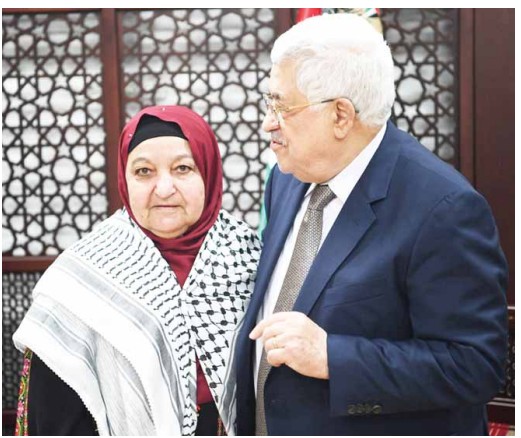
Spotkanie ‚Abbasa z Latifah Abu Hamid. Źródło: Al-Hayat Al-Jadida, AP, 29 kwietnia 2017.

2 maja 2017 r. w USA podczas spotkania z przedstawicielami palestyńskiej emigracji, Abbas powiedział: “Mówię do więźniów: ‘Cierpliwości, wasze zwycięstwo nadejdzie, jesteście naszymi symbolami i naszymi bohaterami’”[1].

28 kwietnia ‚Abbas przyjął w swojej głównej siedzibie w Ramallah delegację rodzin męczenników i więźniów, którzy prowadzą strajk głodowy, wśród nich Latifah Abu Hamid, matkę męczennika i czterech więźniów.
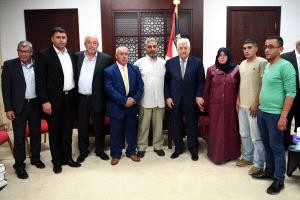
 

Spotkanie ‚Abbasa w Ramallah z delegacją rodzin męczenników i więźniów. Źródło: Wafa.ps, 28 kwietnia 2017.

Podczas przyjęcia ‚Abbas powiedział, że „kwestia więźniów jest najwyższym priorytetem kierownictwa palestyńskiego”. Wzywając wszystkich do poparcia strajkujących więźniów powiedział: “Kierownictwo palestyńskie jest w kontakcie z kręgami międzynarodowymi w celu naciskania na rząd izraelski by odpowiedział na żądania więźniów”.

W przyjęciu udział wzięli: sekretarz OWP, Saeb Erekat, zastępca przewodniczącego Fatahu Mahmoud Al-‚Aloul, sekretarz generalny prezydentury, Al-Tajjeb ‚Abd Al-Rahim, przewodniczący Urzędu ds. Więźniów, ‚Issa Karake’, członek Komitetu Centralnego Fatahu, ‚Azzam Al-Ahmad i szef wywiadu AP, Madżed Faradż.[2]

Premier AP: Jesteśmy dumni ze strajku prowadzonego przez “bojownika” Marwana Al-Barghoutiego

Premier AP, Rami Hamdallah, także dołączył do gloryfikacji więźniów. W wypowiedzi z 16 kwietnia w Dzień Więźniów Palestyńskich, powiedział: „Czujemy dumę i honor w świetle niezłomności ruchu więźniów i ich poświęcenia. My, kierownictwo oraz naród, jesteśmy złączeni w poparciu dla nich i dumni z walki o wolność, jaką prowadzą pod przywództwem wojownika, Marwana Al-Barghoutiego.[3]

Zastępca przewodniczącego Fatahu, Mahmoud Al-‚Aloul: Fatah wyraża dumę z kierownictwa i wojowników

16 kwietnia 2017 r. w oświadczeniu w Dzień Więźniów Palestyńskich Fatah chwalił “determinację walki i niezłomność oraz wytrwałość okazywaną przez więźniów palestyńskich przez najwspanialsze z poświęceń. [Fatah] wyraża dumę z kierownictwa i wojowników, i ze zdolności naszych braci w rewolucji i w ojczyźnie do ustanowienia metody walki bezprecedensowej w historii ruchu wyzwolenia narodowego, mimo ograniczeń i opresji izraelskich katów”. Ruch podkreślił: „Narodowa zgoda w sprawie strajku [głodowego] dowodzonego przez Marwana Al-Barghoutiego, przywódcę, więźnia i członka komitetu centralnego ruchu, a wraz z nim przywódców ruchu, jest godnym modelem mentalności, jaką muszą przyjąć wojownicy w celu osiągnięcia zwycięstwa dla narodu palestyńskiego i dla zrealizowania narodowych celów i zasad”[4].

24 kwietnia delegacja obejmująca zastępcę przewodniczącego Fatahu, Mahmouda Al-‚Aloula i członka komitetu centralnego Fatahu, Dżamala Al-Moheisena, odwiedziła dom Umm Nasser Hamid, matki męczennika i czterech więźniów biorących udział w strajku głodowym, który prowadzi także ona sama w solidarności ze swoimi uwięzionymi synami. Al-‚Aloul obiecał: „Fatah będzie kontynuował walkę aż do uwolnienia wszystkich naszych więźniów”[5].
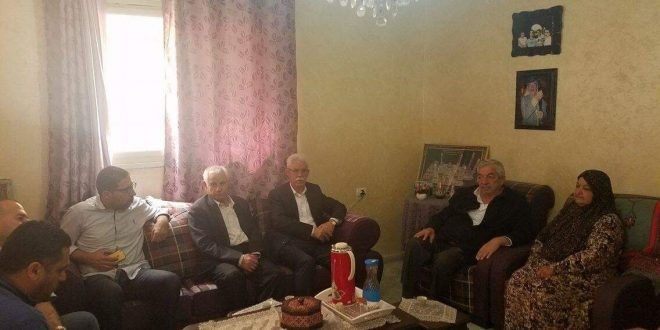
Delegacja Fatahu odwiedza dom Umm Nasser Hamid. Źródło: Pnn.ps/news, 24 kwietnia 2017.


[1] Al-Hayat Al-Jadida (Palestinian Authority), May 3, 2017.
[2] Wafa.ps, April 28, 2017 the heb says may 
[3] Wafa.ps, April 16, 2017.
[4] Wafa.ps, April 16, 2017.
[5] Palsawa.com, April 25, 2017.


twoje uwagi, linki, wlasne artykuly, lub wiadomosci przeslij do: webmaster@reunion68.com



ESTONIA CELEBRATES 10 YEARS OF FIRST JEWISH COMMUNITY CENTER SINCE WWII

ESTONIA CELEBRATES 10 YEARS OF FIRST JEWISH COMMUNITY CENTER SINCE WWII

TAMARA ZIEVE


Members of the tiny community believe it will survive, despite its low numbers.

Estonian President Kersti Kaljulaid (center) pictured with other dignataries in the celebration of the 10th Anniversary for the establishment of the first Jewish community center built in Estonia since the Holocaust, May 25 2017.. (photo credit:ELENA RUDI)

TALLINN – “We will be here forever,” a veteran member of the Estonian capital’s tiny Jewish community tells The Jerusalem Post during a celebration of the community center’s tenth anniversary on Thursday.

Estonia was the first country to be declared Juden-Frei (Free from Jews) at the Wannsee Conference 75 years ago.

Though thousands returned after the Holocaust, Jewish life was stifled by the Soviet regime and saw another drastic decline in its community after the fall of Communism in 1989, when many Jews emigrated.

“In the Soviet Union we had a corner, a little synagogue, half hidden,” recalls Peisah Kozlovski, 65. He says life before the establishment of Tallinn’s new synagogue, was “gloomy.”
“Life started after Estonia became free, and especially with this synagogue,” he remarked. “The community has changed a lot with the arrival of our [chief] rabbi [Shmuel Kot], who united all of us and made this life very interesting. We have a lot of friends, we come together – it’s a point of meeting. We go to shul and then to a cafe next door,” he smiles.

The community currently numbers some 2,000 –natives alongside Israelis and other immigrants — but its members are confident in its continuity. “The numbers don’t matter,” says Kozlovski.

“We have a lot of children, it will grow. It will not be big but still we are forever, like Israel.”

“Estonia is a good place for the Jewish people,” agrees Eric Kachkovsky, 30. “We don’t feel any antisemitism and we feel very warmly treated.”

Aaron Raihshtein recalls the synagogue’s early days when it was only possible to convene a minyan once a week. Now they have one every day. He describes Jewish life in the city is “blooming,” and his fiancee Ester Volskii discusses her plans to open the first kosher grocery store there.

Given the size of Estonia’s population (1.3 million), it’s natural that its minorities are small, and Foreign Minister Sven Mikser says “we are so few that everyone counts.”

“I think the Jewish community is one of most active both politically and culturally,” he told the Post, saying that he doesn’t see any reason it won’t survive.

Though he was not able to attend the celebration due to its coincidence with the NATO summit, other Estonian and European officials did, including Estonia’s president Kersti Kaljulaid, who delivered a speech inside the beautiful, modern synagogue.

“The story of the Synagogue of Tallinn tells us about the fate of the Jewish community,” she told the audience.

“Estonia is proud of the fact that the country today has a flourishing and happy Jewish life. The history of the local community as the history of the country itself has experienced tragedies and revivals. From the years of the Holocaust which tell us the tragedy and the difficulty of occupation, to the flourishing recent years of free, democratic and independent Estonia. Today the synagogue is a beautiful and clear indication of the importance of freedom.”

Estonia granted the Jews cultural autonomy in 1926. It was liquidated in 1940, and restored in 1993 after Estonia regained independence and again passed a law granting minorities the right to preserve their national identities.

“Our two nations shared both the joyous and difficult times in which we lived together and on which we have to speak more clearly. Both nations have had to fight for their existence. I must recall with gratitude those 178 Jewish women and men who participated in the Estonian War of Independence. Both of our nations know what does it mean to keep your identity and freedom even under the pressure of foreign powers, and we can be proud of their achievements,” the president stated.

Other VIPs at the event included Speaker of Estonian Parliament Eiki Nestor, Vice President of the European Commission Andrus Ansip, Speaker of Estonian Parliament Eiki Nestor, and Vice President of the European Commission Andrus Ansip.

Among those who flew in from Israel for the occasion were Minister of Social Equality Gila Gamliel and Chief Rabbi of Israel David Lau.

In addition to the synagogue, the center includes a school, a Kosher restaurant and a Jewish museum. The building was named Beit Bella, after Jewish businessman and philanthropist Alexander Bronstein, who funded the community center.

Chairman of the Board of the Jewish Community Boris Oks recalled how the local architects had never seen a synagogue before, so they sent them to Israel to get a feel for Jewish houses of prayer.

The VIP guests toured all parts of the center, and watched a show put on for them by the schoolchildren.

In honor of Jerusalem Day, the youngsters sang Hebrew songs about Jerusalem with an impressive command of the language, and enacted a play about the city.

Jewish Community Chairman Alla Jakobson lauded the Israeli officials for their participation, saying that their presence gave support and strength to the children and community.

“After World War II, Tallinn was the only capital in Europe with no rabbi, and we realized we needed a synagogue,” Alla said in a speech to the attendees of the main event.

“Ten years for Jewish history is nothing — our history is long– but for our community it is life,” she said. Referencing a recent 100 anniversary celebration she attended in Helsinki, she wondered whether her community would be able to celebrate the same milestone. “I hope it will,” she said.


twoje uwagi, linki, wlasne artykuly, lub wiadomosci przeslij do: webmaster@reunion68.com



UN, Norwegian Government, Distance Themselves From Palestinian Terrorist Dalal Mughrabi

UN, Norwegian Government, Distance Themselves From Palestinian Youth Center Named for Terrorist Dalal Mughrabi

Ben Cohen


Palestinian terrorist Dala Mughrabi is widely regarded as a hero in the West Bank. Photo: PMW

The United Nations and the Norwegian government have moved swiftly to distance themselves from a Palestinian youth center named after one of the most notorious terrorists to strike at Israelis, after it emerged that the building where the center is located carries the logos of UN Women and the Norwegian Representative Office to the Palestinian Authority (PA).

The center, which opened last week in the village of Burqa in the West Bank, is named after Dalal Mughrabi, a Fatah terrorist who carried out the bloodiest terrorist attack in Israel’s history, the “Coastal Road Massacre.” On March 11 1978, Mughrabi led a group of PLO terrorists who landed on Tel Aviv beach and went on to seize a bus full of passengers which they drove north on Israel’s Coastal Highway. The operation ended with the deaths of 38 Israelis – including 12 children – with a further 71 wounded.

Palestinian Media Watch (PMW) – an Israeli monitoring organization that has tracked the scandal – said that the purpose of the center was to promote Mughrabi as a hero. Reem Hajje, a member of the Burqa village council, noted that the center “will focus especially on the history of the struggle of Martyr Dalal Mughrabi and on presenting it to the youth groups, and that it constitutes the beginning of the launch of enrichment activities regarding the history of the Palestinian struggle.”

On Friday, both the UN and the Norwegian government criticized the center, but claimed that they had cut their support for the center before it was named in Mughrabi’s honor.

“The United Nations support for this center ended last year,” said Robert Piper, UN Assistant Secretary General for Development, in a statement from Jerusalem. “The inauguration of the center took place a few weeks ago, well after the UN association with it concluded. The name chosen by the community center is wrong and unacceptable. The UN Women logo should not be associated with it and it will be removed immediately.”

While Piper did not specifically mention terrorism, the Norwegian statement was more forthright in that regard.

“The glorification of terrorist attacks is completely unacceptable, and I deplore this decision in the strongest possible terms,” said Minister of Foreign Affairs Børge Brende. “Norway will not allow itself to be associated with institutions that take the names of terrorists in this way. We will not accept the use of Norwegian aid funding for such purposes.”

Brende added that it “was not until after Norway had stopped providing funding for the centre that it became known that it was to be named after the Palestinian terrorist. This happened in connection with the opening of the centre last week. Neither the Norwegian authorities nor the UN were consulted in advance or invited to the opening ceremony.”

Norway is among several European governments providing millions of dollars each year to Palestinian NGOs whose development programs are frequently springboards for the promotion of BDS and the glorification of terrorism.


twoje uwagi, linki, wlasne artykuly, lub wiadomosci przeslij do: webmaster@reunion68.com