 Can the ADL go back to defending the Jews?
Jonathan S. Tobin
Under fire from the left for speaking up against Mamdani and resented by the right for a decade of partisanship and woke betrayal, the organization stands at a crossroads.
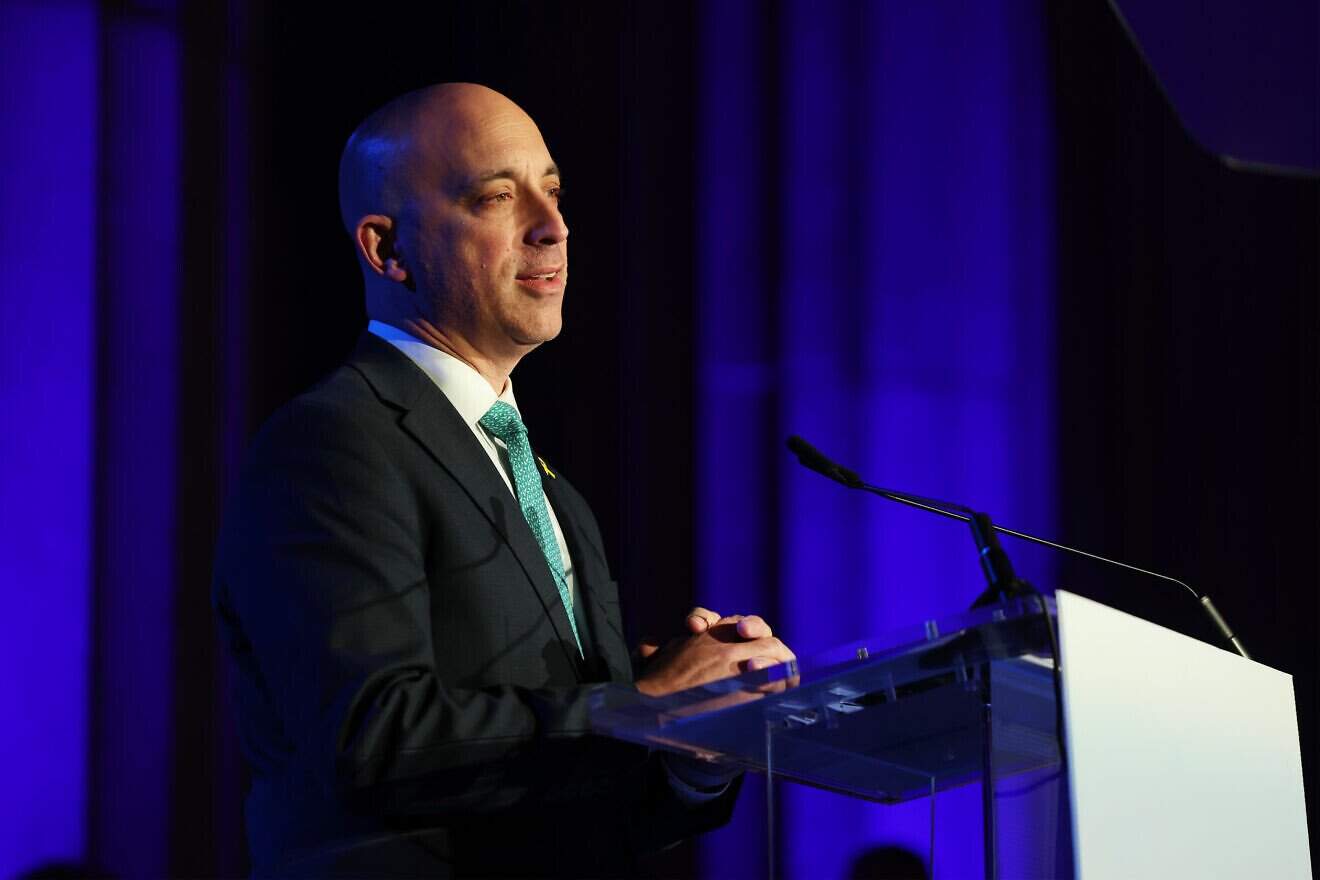 WASHINGTON, DC – NOVEMBER 10: Jonathan Greenblatt speaks onstage at the 2025 Washington DC Concert Against Hate at Andrew W. Mellon Auditorium on November 10, 2025 in Washington, DC. (Photo by Tasos Katopodis/Getty Images for ADL)
The Anti-Defamation League is being accused by The New York Times, MSNBC, left-wing Jewish organizations and the antisemitic Council of American-Islamic Relations (CAIR) of Islamophobia and unfairness to New York City Mayor-elect Zohran Mamdani. But for those who are hoping that the Jewish defense group will return to its mission of defending the Jewish people and drop its decade-long detour into woke partisanship, that’s a hopeful sign.
After years of showing every indication that it was not merely useless in the battle against antisemitism but increasingly aligned with those enabling a dangerous growth of left-wing Jew-hatred, the ADL is starting to try to do its job again. Like many liberal Jews, the organization’s leaders were not merely shocked but caught completely off guard by the reaction to the Hamas-led Palestinian-Arab attack on Israel on Oct. 7, 2023. The surge of antisemitism coming from the political left that manifested itself on the streets of American cities and on college campuses was too obvious and devastating for the ADL to ignore.
A Mamdani monitor
The election of a mayor of the city with the world’s largest Jewish population who has a history of antisemitic language and activity has placed the ADL at a crossroads. If it is to continue as a group tasked with the job of defending Jews against hate, it must stand up against Mamdani. In response to the very real possibility of his using City Hall to engage in BDS campaigns or otherwise follow the same pattern of hostility to Jewish concerns he has demonstrated throughout his life, the ADL set up a “Mamdani Monitor” webpage and tipline as a resource for the embattled Jews of New York.
That has put it in the crosshairs of the political left. The Islamists of CAIR, along with their left-wing Jewish allies—who represent the minority of New York Jews who voted for Mamdani, whether because or in spite of his anti-Israel stances—consider this to be discriminatory, if not Islamophobic.
This not only demonstrates that almost all of what is now termed “Islamophobia” is merely criticism of Muslim antisemitism. The above groups also claim the ADL isn’t being as tough on the administration of President Donald Trump as it is on the mayor-elect.
That’s something of a joke, because the ADL spent most of the last 10 years not merely bashing Trump and conservatives, but actively cooperating in efforts to oppose them.
The question is: Has the ADL been sufficiently mugged by reality to persist not merely in efforts to hold Mamdani accountable, but also to acknowledge the way Jew-hatred has become normative on the political left and recognize that the Democratic Party has been increasingly dominated by its intersectional progressive base? That will be no easy feat for a group that has done its best to alienate conservatives.
Conservative backlash
Though Jew-hatred is also a serious problem on the right, most conservatives remain overwhelmingly philosemitic and allies of the Jewish community and Israel. This is not the case on the left.
That was made obvious after the assassination of right-wing activist Charlie Kirk. During the days that followed his murder, it was revealed that the ADL had maintained a webpage labeling Turning Point USA, the organization founded by the late Christian Zionist, as an “extremist hate group.” At the same time, another webpage in the ADL database said that the left-wing Antifa domestic terror group “wasn’t normally violent.”
Both pages were soon deleted by the ADL, but as part of the backlash against its misguided partisanship, the FBI terminated its relationship with the group. Given the way the organization had aligned itself against Trump—falsely accusing him of antisemitism, while cooperating with the efforts of the Biden administration and Silicon Valley oligarchs to silence conservative speech on the Internet and de-monetize their opponents—that was both predictable and understandable.
This raises the question as to whether it will be possible for the group to salvage its reputation and do the hard work of fighting Jew-hatred wherever it is to be found. As one of the wealthiest Jewish organizations—it passed the $100 million mark in annual fundraising a few years ago—with active offices around the country, it has the resources to do the job for which it was founded. That was 1915, in the wake of the lynching of Leo Frank—a Jew falsely convicted of murder—by an antisemitic Georgia mob. Yet, the Mamdani Monitor notwithstanding, it’s far from clear that the ADL’s current leadership has the will or courage to do so.
A turn to the left
The ADL is that rarity among the many national Jewish organizations founded in the late 19th and early 20th centuries that hasn’t long since become obsolete. To the contrary, with antisemitism surging, it still has a vital mission that the Jewish community desperately needs for it—or some replacement—to perform.
The problem is that in recent years, it seemed to be abandoning its original mission in favor of becoming just another liberal NGO aimed at promoting left-wing causes and the political agenda of its Democratic Party allies. This was apparent from the moment its longtime national director, Abe Foxman, retired in 2015 and was replaced by former Clinton and Obama administration staffer Jonathan Greenblatt.
Foxman was a conventional political liberal on most issues and distrustful of conservatives. But there was never any doubt that he was solely interested in fighting antisemitism wherever it was to be found. He was also disliked by the political left for his staunch defense of Israel. But from the start of his tenure, Greenblatt reoriented the group away from its traditional work toward one that put it in sync with left-wing allies.
Unlike Foxman, Greenblatt was a relentless partisan who didn’t hesitate to stick the ADL’s nose where it didn’t belong—such as when he announced his opposition to Trump’s nomination of Justice Brett Kavanaugh to the U.S. Supreme Court moments after it was announced.
After that, it was all downhill for the ADL, as the organization imported toxic left-wing doctrines like critical race theory and intersectionality into its anti-hate education programs and hired staff who were primarily focused on pursuing liberal political causes rather than on fighting Jew-hatred.
This wasn’t merely bad judgement. It was a lapse that more or less put the group that the Jewish community depended upon to speak up for it on the side of those who were enabling and supporting a growing movement of left-wing antisemites. By endorsing the antisemitic and anti-Israel Black Lives Matter movement, as well as supporting progressive ideologies that labeled Jews as “white” oppressors, it essentially backed the stigmatizing of the Jewish community and Israel. And by joining the Biden administration’s efforts to censor conservatives in the name of suppressing hate speech, Greenblatt burned his bridges with the very people whom he should have been treating as allies in the fight against the rising tide of left-wing Jew-hatred.
The ADL’s efforts to stay in sync with liberal, left-wing and minority groups—who were once allied with Jews on the left, but who abandoned them after Oct. 7—have been a fiasco. For example, even as it sought to react to the wave of antisemitic activity on college campuses over the past two years, it failed to support Trump’s efforts to roll back the very DEI policies responsible for the problem.
Under these circumstances, there’s good reason for ADL’s critics to remain deeply skeptical of its willingness or ability to respond effectively to the challenge of 21st– century antisemitism.
Moreover, as the Manhattan Institute’s Jesse Arm writes, the focus on raising money to combat antisemitism, such as the enormous sums being donated to the ADL, is itself a waste of scarce resources and effort. He argues, as has scholar Ruth Wisse, that the traditional model of promoting Holocaust education as the standard response to Jew-hatred embraced by the group has failed to produce the intended effect.
This is a moment in history when left-wingers are falsely accusing Israelis of being Nazis, while cheering on Palestinians who actually want to commit Jewish genocide, and when right-wingers are smearing Jews (and Christians) who support Israel as “Israel Firsters” and thereby disloyal. These phenomena render the ADL’s standard responses as obsolete, if not counterproductive.
Redefining Jewish defense
Institutions where Jews once felt at home—from K-12 schools to Ivy League universities—are now hostile environments where the only way to avoid ostracism is to be a “good Jew”: to disavow Zionism and the elements of Jewish identity that the left detests. That means that ADL’s popular “no place for hate” and other programs aimed at making people be nicer to each other do little or nothing to help. Worse, they may persuade some observers that the stubborn willingness of the Jews to defend themselves is the problem, not those who hate them.
What is needed are focused political campaigns aimed at supporting allies who will stand with Jews when they are under siege. An actual self-defense effort to deter intimidation and violence against Jews may also be of more use than the standard community-relations and interfaith programs that liberals swear by but led to nothing other than disappointment. Just as important, rather than enabling legacy groups like the ADL to grandstand and issue press releases, funds might be better spent on strengthening Jewish identity with greater support for Jewish education and experiences, such as camps and trips to Israel. That will do more to prepare Jews to withstand the current surge of hate against them than anything Greenblatt can do or say.
Nevertheless, the task of monitoring and responding to antisemitism is still necessary and the ADL has the resources to perform it. Even those of us who have lamented the group’s failures and bitterly criticized its profound misjudgments are ready to cheer it on when, as with its first steps to put Mamdani on notice that the Jews aren’t afraid to stand up to him, the group shows a willingness to do its job. But if it falters under left-wing criticism, or refuses to ally with those on the right who are ready to fight Jew-hatred, its plug will have to be pulled.
 Jonathan S. Tobin is editor-in-chief of the Jewish News Syndicate, a senior contributor for The Federalist, a columnist for Newsweek and a contributor to many other publications. He covers the American political scene, foreign policy, the U.S.-Israel relationship, Middle East diplomacy, the Jewish world and the arts. He hosts the JNS “Think Twice” podcast, both the weekly video program and the “Jonathan Tobin Daily” program, which are available on all major audio platforms and YouTube. Previously, he was executive editor, then senior online editor and chief political blogger, for Commentary magazine. Before that, he was editor-in-chief of The Jewish Exponent in Philadelphia and editor of the Connecticut Jewish Ledger. He has won more than 60 awards for commentary, art criticism and other writing. He appears regularly on television, commenting on politics and foreign policy. Born in New York City, he studied history at Columbia University.
Zawartość publikowanych artykułów i materiałów nie reprezentuje poglądów ani opinii Reunion’68,
ani też webmastera Blogu Reunion’68, chyba ze jest to wyraźnie zaznaczone.
Twoje uwagi, linki, własne artykuły lub wiadomości prześlij na adres:
webmaster@reunion68.com

