 Amid Conspiracy Theories, Eurovision Proves Ordinary People Are Still Willing to Treat Israel Fairly
Micha Danzig
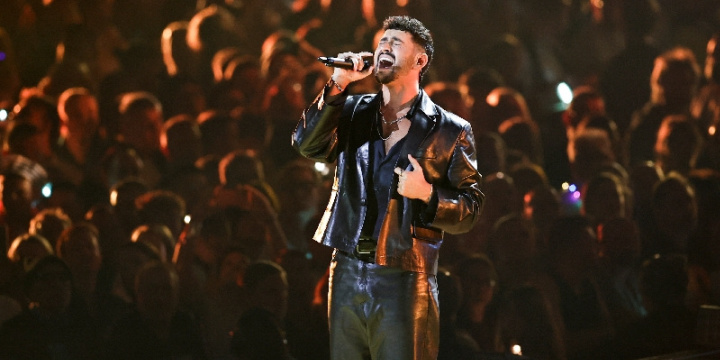 Noam Bettan, representing Israel, performs “Michelle” during the dress rehearsal 2 of the Grand Final of the 2026 Eurovision Song Contest, in Vienna, Austria, May 15, 2026. Photo: REUTERS/Lisa Leutner
For many Americans, Eurovision requires a brief explanation. It is a massive annual international music competition involving dozens of countries across Europe and nearby regions, watched by hundreds of millions of people. And because much of the Arab world boycotted Israel culturally and politically after 1948 — excluding it from most regional sporting and cultural frameworks — Israel was integrated into European competitions instead.
Much like the situation where Israeli soccer teams must qualify for the World Cup through Europe rather than through the Middle East, Israel competes in Eurovision through the European broadcasting system.
For years now, Eurovision has followed the same ritualized choreography when it comes to Israel.
There are protests outside the arena. Activists demand Israel’s exclusion. Broadcasters openly question whether Israel should even participate. Some performers posture about morality and “complicity.” Social media floods with denunciations. Major media outlets, like The New York Times, publish innuendo-filled pieces implying Israel is somehow manipulating the contest through “soft power,” aggressive promotion, or shadowy mobilization campaigns.
And then the public votes for Israel at — or near — the top anyway.
The pressure campaign against Israel exploded after October 7, 2023, but the politicization predates October 7 by years.
Israel historically performed extremely well at Eurovision, winning in 1978, 1979, 1998, and again in 2018 with Netta Barzilai’s “Toy.” For decades, Israel was treated largely as a normal — if occasionally controversial — participant.
That changed during the 2010s, alongside the rise of intersectional activist politics, the normalization of BDS rhetoric in cultural spaces, and the growing effort to frame Israel as not merely controversial, but as uniquely illegitimate.
Netta’s 2018 victory was an early warning sign. The backlash quickly escalated from criticism of the song itself to claims that Israel should not host Eurovision (as all winners do) because the contest was supposedly “laundering apartheid.”
After October 7, the situation became impossible to ignore.
Israel increasingly received weak jury scores while performing dramatically better with the public vote. Ordinary viewers and elite opinion were diverging sharply.
That pattern repeated this year with Israel’s multilingual ballad “Michelle,” performed by Noam Bettan.
Last year, Israel’s “New Day Will Rise,” performed by Yuval Raphael — herself a survivor of the Nova massacre — triggered a frenzy of insinuations about “manipulated” voting after she finished second despite ranking only 15th with the professional juries.
This year, “Michelle” briefly surged into the overall lead during the public vote reveal but ultimately finished second as Bulgaria secured the win with far stronger professional jury support.
And once again, the reaction was not: “perhaps the public genuinely liked the song.”
Instead, Israel’s success is cast as both suspect and suspicious.
Apparently, Israel promoting its Eurovision entry is now evidence of sinister “soft power” — despite Eurovision itself being essentially one giant soft-power competition.
Countries spend heavily promoting themselves through Eurovision. The contest has always been part music competition, part tourism campaign, part national branding exercise, and part geopolitical theater in sequins.
Host countries market tourism and national identity through the contest. Governments support contestants. National broadcasters campaign aggressively. Diaspora and regional voting blocs have existed for decades and are openly joked about every year.
None of this becomes scandalous unless Israel succeeds.
Because increasingly, Israel is not treated as a normal country participating in international cultural life, but as a uniquely illegitimate presence whose success must always be explained away as manipulation, coercion, propaganda, or hidden influence — an impulse that mirrors classic antisemitic patterns.
In fact, many journalists now deploy this double standard so reflexively they no longer even recognize it.
But the deeper issue here is not really the Eurovision itself. It is the widening divide between institutional opinion and public sentiment.
The Eurovision voting system makes this unusually visible. Countries award separate “professional jury” votes and public televotes. Under Eurovision rules, countries cannot televote for themselves. Meanwhile, countries like Britain, France, Ukraine, Poland, and Romania possess diaspora populations vastly larger than the global Jewish population.
Yet when Israel performs strongly with the public vote, conspiracy theories immediately emerge.
The global Jewish population is roughly 15 million people — about half living in Israel, with much of the diaspora concentrated in the United States, where Eurovision remains relatively niche in mainstream culture. The notion that diaspora Jews are secretly overpowering Europe’s vastly larger voting populations through coordinated televoting campaigns collapses under minimal scrutiny.
The problem for many activists is not Israel’s Eurovision strategy. It is that the public itself keeps refusing to behave correctly.
The public keeps voting for the Israelis anyway — likely because Israeli entries are often among the competition’s strongest. And because many ordinary viewers probably recoil from the increasingly hysterical effort to turn Israeli artists into untouchables.
That effort has increasingly backfired.
Several left-wing European broadcasters and political actors spent years trying to pressure Eurovision organizers to ban Israel entirely. When that failed, some shifted toward symbolic boycotts and public distancing campaigns.
Yet despite the protests, the media pressure, the activist intimidation, and despite professional juries that increasingly appear politically or socially pressured not to reward Israel too generously, Israel still finished second again this year — propelled overwhelmingly by ordinary viewers.
That is the real story.
This does not mean European publics are uniformly pro-Israel. They are not. But many appear to recognize that the obsession with Israel is wildly disproportionate and often reflects something deeper than policy disagreement: hostility toward Jewish national legitimacy itself.
That distinction mattered even more after October 7.
Because while large segments of the Western media rapidly attempted to reframe Israelis from massacre victims into primary villains almost immediately after the largest single-day slaughter of Jews since the Holocaust, millions of ordinary people watched what actually happened.
They saw civilians butchered in homes. Families burned alive. Young people massacred at a music festival. Women dragged into Gaza. Babies kidnapped. Holocaust survivors taken hostage.
And despite relentless efforts afterward to flatten chronology, causation, and moral categories, many people never fully accepted the demand that Israelis immediately cede to an assigned role as uniquely illegitimate global pariahs. That, for parts of Europe’s activist and media class, is the real scandal.
Micha Danzig is an attorney, former IDF soldier, and former NYPD officer. He writes widely on Israel, Zionism, antisemitism, and Jewish history. He serves on the board of Herut North America.
Zawartość publikowanych artykułów i materiałów nie reprezentuje poglądów ani opinii Reunion’68,
ani też webmastera Blogu Reunion’68, chyba ze jest to wyraźnie zaznaczone.
Twoje uwagi, linki, własne artykuły lub wiadomości prześlij na adres:
webmaster@reunion68.com