 Debating Palestinian cause on the grounds of the Lodz Ghetto
Lilka Elbaum
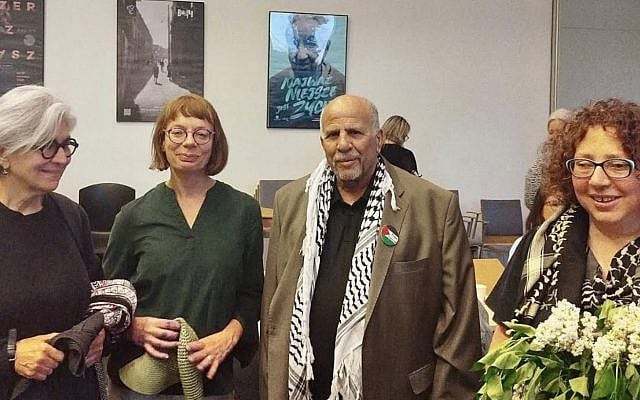 Photo Credit, Centrum Dialogue, May 10, 2026
Acts of antisemitism and anti-Israel rhetoric are especially painful when they occur in places where hundreds of thousands of Jews were murdered during the Holocaust. Lodz, Poland, is such a place. Before the Holocaust, Lodz was home to the world’s third-largest Jewish community and later became the site of the second-largest ghetto in Nazi-occupied Europe. Of a prewar Jewish population of over 230,000, only about 7,000 survived. The city itself remains almost intact, with much of its Jewish heritage still visible—Jews were instrumental in building and owning Lodz’s textile industrial base.
Today, only about 75 to 100 Jews still live in Lodz. Until the Gaza War, the community remained relatively safe, though antisemitism was always present. Jewish contributions to the city’s history, and the tragedy that befell its people, were widely commemorated. The Center for Dialogue, located in the heart of the former Jewish Ghetto and housed in a modern building financed by an Israeli entrepreneur, led, and hosted many of these commemorations. Until recently, 75% of the Center’s activities—funded by municipal and federal governments—were dedicated to preserving Jewish heritage.
That drastically changed on May 10, 2026, when the Center became the site of an event addressing the “Palestinian Question.” The event featured a dialogue between local academics and Omar Faris, the 73-year-old president of a Polish Palestinian association, and its main guest. The discussion was laced with antisemitic tropes, slandered Israel and its Prime Minister, and did not allow questions from the two Jewish community members present. All of this happened in a building constructed with Jewish donations, on the sacred ground of the former Jewish Ghetto.
In Europe’s largest Catholic country, where masses pray to a Jew, there is now little commemoration, sentiment, or compassion for the greatest tragedy to befall the Jewish people. It is not just the uninformed and the ignorant, but also the academic elites of a nation from which nearly 80% of global Jewry traces their roots, who now seek to sever this centuries-old connection, choosing instead to champion the cause of a group numbering only about 1,000–2,000 among them. Perhaps a shift driven by a need to embrace popular narratives and align with prevailing political sentiments, at the expense of historical truth and memory, they no longer regard as their own.
 Lilka Elbaum is a child of survivors from Poland. Born after the war in Lodz where she lived until 1968. She emigrated to Montreal and then United States (Boston). She works at Boston University doing Holocaust related research. In addition, she manages the World Federation of Jewish Holocaust Survivors and Descendants annual conferences.
Zawartość publikowanych artykułów i materiałów nie reprezentuje poglądów ani opinii Reunion’68,
ani też webmastera Blogu Reunion’68, chyba ze jest to wyraźnie zaznaczone.
Twoje uwagi, linki, własne artykuły lub wiadomości prześlij na adres:
webmaster@reunion68.com