Archive | 2016/04/30

70 LAT TEMU POWSTAŁ DZIENNIK „FOŁKS-SZTYME”

Cover Photo
70 LAT TEMU POWSTAŁ DZIENNIK „FOŁKS-SZTYME”

Piotr Piluk


Piotr Piluk's Profile PhotoPrasa żydowska w powojennej Polsce, wbrew dosyć powszechnym opiniom na ten temat, to niezwykle interesujące zjawisko. W latach 1945-1949 ukazywało się wiele tytułów, powiązanych z istniejącymi jeszcze w tamtym okresie żydowskimi partiami politycznymi. W okresie stalinowskim partie zostały zdelegalizowane, a tym samym znikła większość żydowskich gazet, które były wydawane w jidysz, po polsku i hebrajsku. Na tym tle swoisty fenomen stanowi „Fołks-Sztyme”. Dziennik ten powstał w 1946 roku w Łodzi, która wówczas pełniła funkcję zastępczej stolicy kraju, zanim nie zapadła decyzja o odbudowie Warszawy. Kilka lat później redakcja została jednak przeniesiona do Warszawy, natomiast w Łodzi jeszcze przez jakiś czas posiadała swój oddział. Od 1950 roku „Fołks-Sztyme” było organem prasowym Towarzystwa Społeczno-Kulturalnego Żydów w Polsce. Dziennik był drukowany w jidysz, a od lat 50. posiadał specjalny dodatek dla młodzieży – „Nasz Głos”, wydawany w języku polskim. Dodatek ten przetrwał do 1968 roku, natomiast „Fołks-Sztyme”, co ciekawe, do roku 1991. W latach 70. i 80. dwie trzecie, wtedy już tygodnika, było nadał w jidysz, a pozostała część po polsku. Po transformacji ustrojowej w 1989 roku tytuł „Fołks-Sztyme” czyli głos ludu, nie brzmiał najbardziej fortunnie i zarząd TSKŻ podjął decyzję o jego zmianie na „Słowo Żydowskie”, które zaczęło ukazywać się od stycznia 1992 roku. Najpierw, jako dwutygodnik, a obecnie jako miesięcznik. Dlatego „Słowo Żydowskie” jest bezpośrednim kontynuatorem „Fołks-Sztyme”. Prasie z okresu PRL-u zarzuca się propagandowy charakter, co jest pewnie prawdą, nie zmienia to jednak faktu, że kilka tysięcy wydań „Fołks-Sztyme” stanowi bezcenny materiał obrazujący życie żydowskie w Polsce w latach 1946-1991. Przy okazji warto także podkreślić, że w przyszłym roku jubileusz 25-lecia będzie obchodziło „Słowo Żydowskie”.

Warszawa. Roczniki „Fołks-Sztyme” w archiwum TSKŻ.

Warszawa. Winieta „Fołks-Sztyme”, wydanie z 2. połowy lat 60. XX wieku. (Warszawa sroda 1 maja 1968 r.)
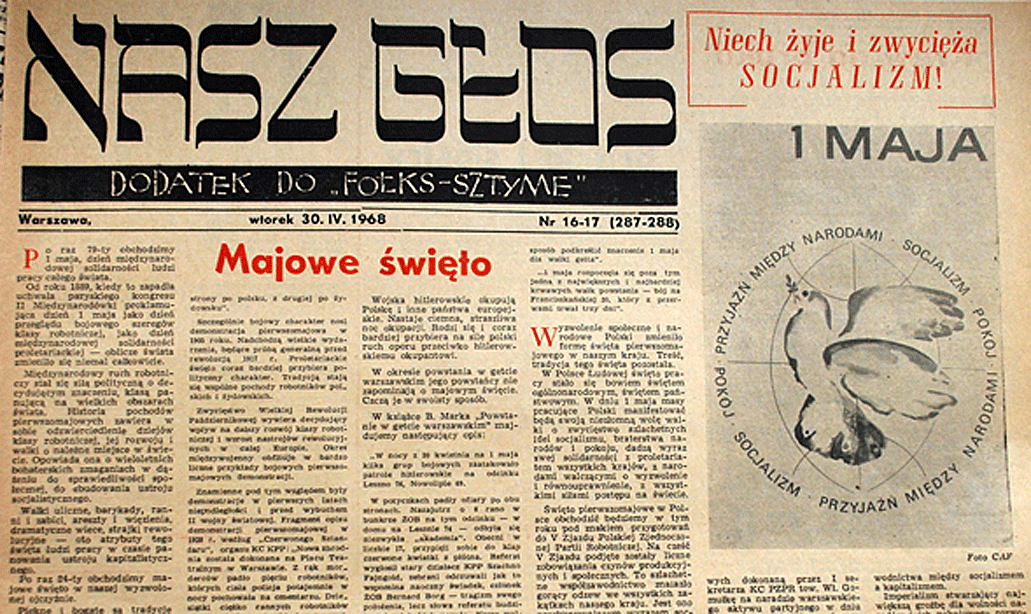

Warszawa. „Nasz Głos” – dodatek w języku polskim do „Fołks-Sztyme”, 2. poł. lat 60. XX wieku.
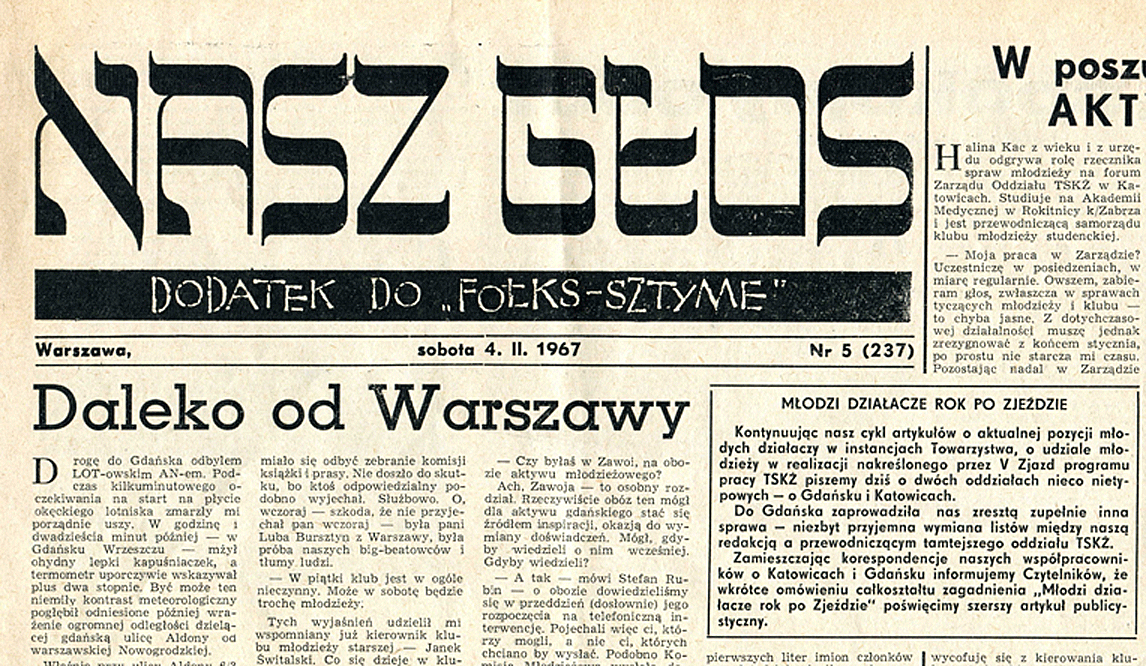

Warszawa. Wywiad w „Naszym Głosie” z Leopoldem Dombem – ówczesnym szefem wydawnictwa Jidysz Buch, działającego w strukturze TSKŻ.
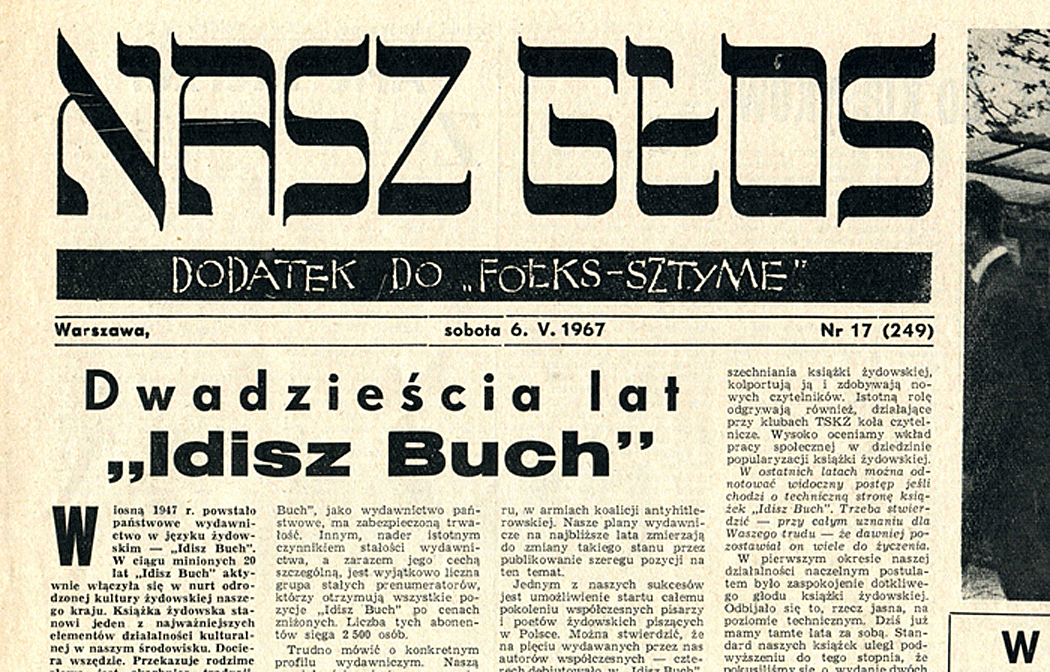

Warszawa. „Fołks-sztyme”, część w języku polskim, 1970 rok.


Warszawa. „Fołks-sztyme”, część w języku polskim, 1970 rok.


Warszawa. „Fołks-Sztyme”, część w języku jidysz, 1985 rok.
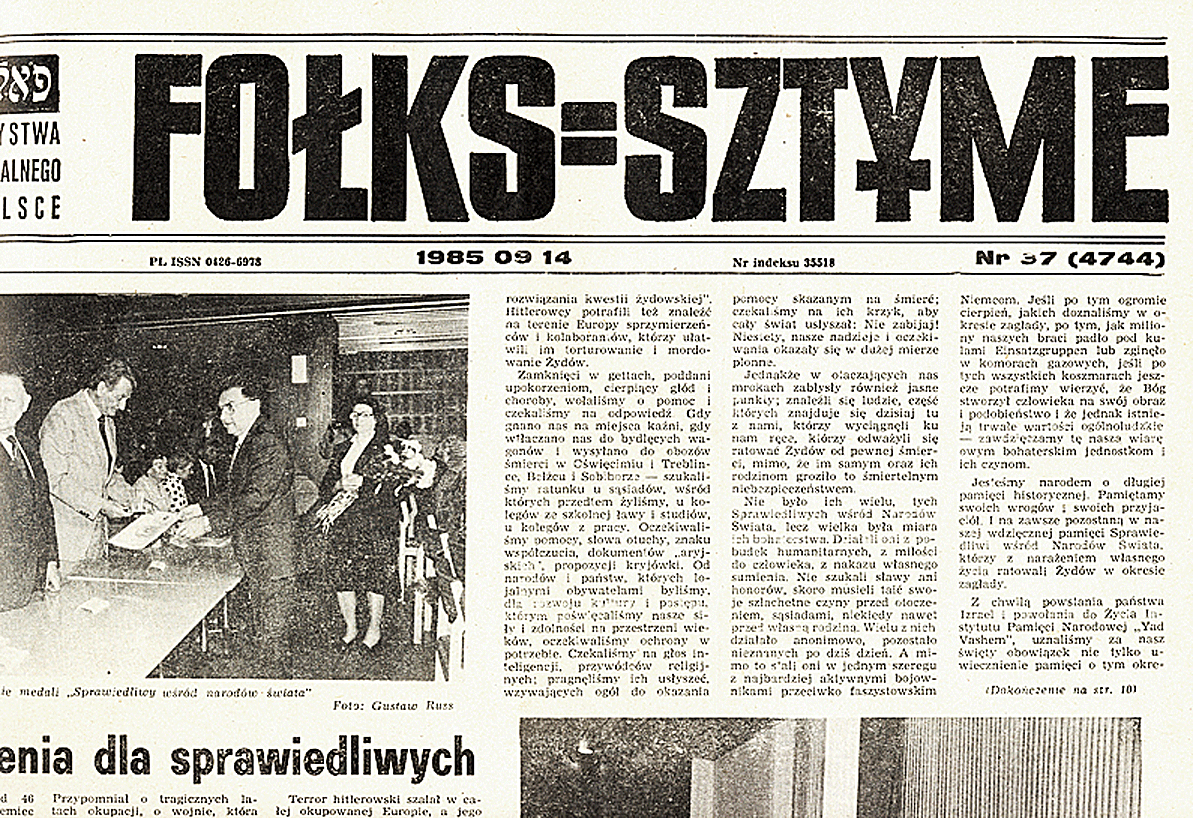

Warszawa. „Fołks-sztyme”, część w języku polskim, 1985 rok.


twoje uwagi, linki, wlasne artykuly, lub wiadomosci przeslij do: webmaster@reunion68.com



Netanyahu to battle Obama, Putin over the Golan

Netanyahu to battle Obama, Putin over the Golan


The Israeli cabinet holds its weekly session Sunday April 17, on the Golan. Prime Minister Benyamin Netanyahu will visit Moscow on Thursday, April 21 to meet with Russian President Vladimir Putin and to launch the most important battle of his political career, and one of Israel’s most decisive contests of the last 10 years: the battle over the future of the Golan Heights.

DEBKAfile’s intelligence sources and its sources in Moscow report exclusively that Israel’s top political leaders and military commanders were stunned and shocked last weekend when they found out that US President Barack Obama and Russian President Vladimir Putin have agreed to support the return of the Golan to Syria. The two presidents gave their top diplomats, Secretary of State John Kerry and Foreign Minister Sergei Lavrov, the green light to include such a clause in a proposal being drafted at the Geneva conference on ending the Syrian civil war.

Israel captured the Golan from the Syrian army 49 years ago, during the Six-Day War in 1967 after the Syrian army invaded Israel.
In 1981, during the tenure of then Prime Minister Menachem Begin, Israel passed a law defining the Golan as a territory under Israeli sovereignty. However, it did not state that the area belongs to Israel.
While Israel was preparing for a diplomatic battle over the future of Jerusalem, Judea and Samaria, Obama and Putin decided to deal a diplomatic blow to Israel and Netanyahu’s government on an unexpected issue, the Golan.

It is part of an endeavor by the two powers to use their diplomatic and military cooperation regarding Syria to impose agreements on neighboring countries, such as Israel, Turkey, Saudi Arabia and Jordan.
For example, Washington and Moscow are trying to impose an agreement regarding the granting of independence to Syrian Kurds, despite Ankara’s adamant opposition. The two presidents are also pressuring Riyadh and Amman to accept the continuation of Syrian President Bashar Assad’s rule, at least for the immediate future.

DEBKAfile’s sources report that just like the other diplomatic or military steps initiated by Obama and Putin in Syria, such as those for Assad’s eventual removal from power, the two powers see a resolution of the Golan issue as a gradual process that may take a long time, perhaps even years. But as far as they are concerned, Israel will have to withdraw from the Golan at the end of that process.

It should be noted that Prime Minister Netanyahu is not traveling to Washington to discuss the Golan issue with Obama. The frequent trips by the prime minister, senior officials and top IDF brass to Moscow in recent months show where the winds are blowing in the Middle East.
However, Moscow is not Washington, and Israel has no lobby in the Russian capital defending its interests.

It should be made very clear that the frequent trips by senior Israeli officials to Moscow have not created an Israeli policy that can influence Putin or other senior members of the Russian leadership. Putin has made occasional concessions to Israel on matters of minimal strategic importance, but on diplomatic and military steps regarding Syria and Iran he has shown little consideration of Jerusalem’s stance.
It should also be noted that there has been no basis for the enthusiasm over the Russian intervention in Syria shown by Netanyahu, Israeli ministers and senior IDF officers.

All of the calls by a number of Russia experts, mainly those of DEBKAfile, for extreme caution in ties with Putin have fallen on deaf ears among the political leadership in Jerusalem and the IDF command in Tel Aviv.

Amid these developments, three regional actors are very pleased by Washington and Moscow’s agreement to demand Israeli withdrawal from the Golan: Syrian President Assad, the Iranian leadership in Tehran and Hizballah leader Hassan Nasrallah.

Now, they do not need to risk a military confrontation with Israel over the Golan because Obama and Putin have essentially agreed to do the dirty work for them


twoje uwagi, linki, wlasne artykuly, lub wiadomosci przeslij do: webmaster@reunion68.com


11 Jewish Harvard Law students defend peer who called Livni ‘smelly’

The Jerusalem Post - Israel News
11 Jewish Harvard Law students defend peer who called Livni ‘smelly’

by: JTA


Husam El-Qoulaq’s comment at an April 14 panel event on the Israel-Palestinian conflict was condemned by Harvard Law dean Martha Minow, the Jewish Law Students Association, and others.

Former foreign minister Tzipi Livni of the Zionist Union addresses a conference in New York

Eleven Jewish students and recent alumni of the Harvard Law School have signed a letter defending the law student who asked former Israeli Foreign Minister Tzipi Livni why she is “so smelly.”

In a letter to the Harvard Law Record, the students defend “our friend and peer” Husam El-Qoulaq, whose comment at an April 14 panel event on the Israel-Palestinian conflict was condemned by Harvard Law dean Martha Minow, the Jewish Law Students Association and others, with many saying it evoked an anti-Semitic stereotype.

Qoulaq, whose identity was not made public until this week, published an apology in the Record last week saying he had not intended to be anti-Semitic and was “entirely unaware” of any stereotypes about Jews being smelly. The apology did not explain what he had intended to convey, however, nor did it acknowledge that whether anti-Semitic or not, calling a panelist “smelly” is generally considered impolite.

The incident comes at a time when speeches by Israelis on campuses throughout North America and in the United Kingdom are frequently disrupted by anti-Israel protesters. Many campus activists are calling for universities to boycott or divest from Israel. It also comes amid fierce debate as to whether anti-Zionism is inherently anti-Semitic or is merely legitimate criticism of the Jewish state.

In their letter published Monday, which had garnered 84 comments by midday Tuesday, the 11 supporters of El-Qoulaq say their friend is the “target of a vicious smear campaign,” with people on the Internet threatening “various forms of violence” against him.

“These tactics are part of a sadly well-worn playbook aimed at discrediting and defaming those who dare challenge Israel’s abuses against Palestinians,” they continue.

The letter indicates that El-Quolaq meant his remarks as an attack on Livni for her “key role” in “Operation Cast Lead, a 23-day military operation that was condemned … for the brutality it visited upon Palestinian civilians.” Israel launched that operation, which took place from Dec. 27, 2008 to Jan. 18, 2009, in response to repeated rocket fire from Hamas targeting Israeli civilians.

“Over the years, we’ve seen Husam experiment with many forms of engagement on this issue, from handing out informational fliers to asking pointed substantive questions at events,” the letter continues. “Earlier this semester he tried a different tactic, calling a male Palestinian speaker a ‘smelly liar.’”

Acknowledging that El-Qoulaq’s words could be seen as “disrespectful, reckless or inappropriate,” the students insisted “his aim was more mischief than malice.”

Further excusing him, the letter notes that El-Qoulaq “is one of a small handful of Palestinians on a campus where the prevailing sentiment is to back Israeli actions that he – along with much of the rest of the world – views as war crimes against his people.”

During the April 14 panel event involving Livni and American diplomat Dennis Ross, El-Qoulaq asked Livni, “How is it that you are so smelly?” Asked by the moderator to clarify his question, he said his question was “about the odor of Tzipi Livni, very smelly.”


twoje uwagi, linki, wlasne artykuly, lub wiadomosci przeslij do: webmaster@reunion68.com