Archive | 2017/01/02

316 mil do Aleppo. Lekcja dla Izraela

316 mil do Aleppo. Lekcja dla Izraela

David Collier Tłumaczenie: Małgorzata Koraszewska


Obrazy z Aleppo w Syrii rozdzierają serce. Można też zasadnie powiedzieć, że większość z nas na Zachodzi, mimo głośnych okrzyków, że „coś trzeba zrobić”, nie bardzo ma koncepcję, co właściwie trzeba lub można zrobić. Syria jest opowieścią o tysiącu okopów i dwóch tysiącach armii.

Pamiętam, jak podczas “Wiosny Arabskiej” 2011 r. angażowałem się w debatę wokół wydarzeń w Libii. Kiedy „interwencjoniści” mieli trudności skoordynowania poparcia międzynarodowego dla działań przeciwko Kaddafiemu, wskazywałem na Syrię, niepokojąc się, że impotencja międzynarodowa dawała Assadowi sygnał, że może działać bezkarnie. Akcja w Libii była “łatwym” wyborem.

W owym czasie większość komentarzy o „Wiośnie Arabskiej” była pozytywna. Tysiące ekspertów, większość elit liberalnych słuchało echa własnych okrzyków i oklaskiwało “powstanie” ulicy arabskiej. Ten zarys polityki z European Policy Centre omawia, jak Europa powinna “otworzyć się” na “tworzące się demokracje”. Brian Whitaker w “Guardianie” pisał 14 marca 2011, że “wiosna arabska jest jaśniejsza niż kiedykolwiek”.

Mój pesymizm w dyskusjach na ten temat był niemile widziany. Nikt nie chciał słuchać czarnowidza. Michael Hardt i Antonio Negri w “Guardianie” byli w awangardzie z nagłówkiem: “Arabowie są nowymi pionierami demokracji”. Pytali: „czego te nowe eksperymenty w dziedzinach wolności i demokracji nauczą świat przez następne dziesięciolecie?” Obecnie jest rok 2016 i jesteśmy w połowie tego „następnego dziesięciolecia”. Piszę odpowiedź na to pytanie.

Na początku

Aby to zrobić, musimy się cofnąć o 20 lat. Dokładnie o 3.30 nad ranem 18 stycznia 1991.

W tym czasie kuliłem się w “zapieczętowanym pokoju”. W rzeczywistości był to zwykły pokój specjalnie ozdobiony taśmą klejącą i plastikowymi płachtami, co miało podnieść moje szanse przeżycia ataku bronią chemiczną. Nie znałem hebrajskiego i informacje podawane przez radio były poza moim zasięgiem lingwistycznym. Jeden z moich sąsiadów trzymał swojego psa przywiązanego przed domem i często wymykałem się, by mu pozwolić przez chwilę pobiegać. Kiedy więc zawyły syreny, pobiegłem najpierw, by uwolnić Lady i podzielić się z nią moją ochroną przed atakiem chemicznym. Tak więc siedzieliśmy w zapieczętowanym pokoju, dwoje samotników, ryzykując razem.

Powodem, dla którego wspominam Irak, jest to, że reakcja arabska na wojowniczość Saddama w połączeniu z powściągliwością Izraela została uznana za to, co Szimon Peres zaczął nazywać “Nowym Bliskim Wschodem”. Niezależnie od tego jak głupio taka myśl wygląda w 2016 r., filary, leżące u podstaw działań tych “wierzących”, były też głównymi filarami globalnej strategii wobec Izraela przez ostatnie trzydzieści lat.

W trzy lata po wojnie irackiej i przy głośnym aplauzie międzynarodowym Izrael importował terrorystów z Tunisu. Zaledwie kilka miesięcy później w miastach izraelskich eksplodowały autobusy. Kiedy Icchak Rabin szukał sposobów działania przeciwko terrorowi, proszono Izrael, by działał z powściągliwością.

Aplauz międzynarodowy

Izrael często słyszy aplauz międzynarodowy, kiedy zmniejsza czujność, i jest natychmiast krytykowany, kiedy reaguje na agresję w tej nowej rzeczywistości. Na początku 1995 r., kiedy bomby w autobusach groziły usunięciem Rabina i Partii Pracy, wywierano naciski na Izrael, by poszedł na ustępstwa w celu zawarcia pokoju z Syrią. Cena – Wzgórza Golan. Minister spraw zagranicznych Wielkiej Brytanii w 1995 r. mówił, że “straci się historyczną okazję”, jeśli strony starające się o pokój będą „zbyt ostrożne”.

Wyobraźcie sobie teraz Wzgórza Golan jako część katastrofy o nazwie Syria. Zamiast pomniejszych konfrontacji granicznych między państwami Izrael byłby wplątany w globalną walkę strategiczną z Rosją, Iranem i Turcją, ciągnącymi za sznurki, kiedy tysiąc różnych frakcji zbrojnych mogłoby używać Izraelczyków za cele ćwiczebne. W 1995 r. wpychano tę umowę jako sposób *zapewnienia* długotrwałego bezpieczeństwa Izraela.

W 1999 r. wycofanie się Izraela z Libanu ogłoszono za oznakę słabości Izraela i sukces Hezbollahu. Liban Południowy stał się fortecą terrorystów i konflikt 2006 r. stał się nieunikniony. Kiedy wybuchła wojna, pokazując, że głupie pomysły rzadko umierają, Sekretarz Stanu USA, opisała ten konflikt jako “bóle porodowe nowego Bliskiego Wschodu”.

Po bardzo ostrej krytyce Izraela za jego reakcję na ataki i ogień rakietowy, koniec konfliktu przyniósł gwarancje, ustalone w rezolucji 1701 ONZ, o „rozbrojeniu wszystkich grup zbrojnych w Libanie”. Dzisiaj Hezbollah jest uważany za “najsilniejszą nie-państwową grupę zbrojną na Bliskim Wschodzie”. Jest tak mniej niż 10 lat po przysiędze społeczności międzynarodowej, że rozbroi Hezbollah jako część porozumienia z Izraelem.

Żadnych rakiet na Aszkelon

Podobna jest historia Gazy. W 2005 r., kiedy Izrael zdemontował wszystkie osiedla w Gazie i wycofał swoje wojsko, społeczność międzynarodowa przyklasnęła tej akcji. Przywódca palestyński, Mahmoud Abbas, opisał wycofanie się jako “historyczny i radosny dzień” dla jego ludu. W ciągu tygodni na Izrael znowu zaczęły spadać rakiety.

To jest prosta prawda. Od 1990 r. za każdym razem, kiedy zmusza się Izrael do uczynienia poświęceń dla pokoju, w nagrodę otrzymuje przemoc, a społeczność międzynarodowa jest politycznie niezdolna do spełnienia swoich obietnic działania i poparcia.

Za każdym razem, kiedy “pesymiści” mówili, że obiecane próby doprowadzenia do pokoju wyłącznie przyniosą więcej przemocy, wypraszano ich z towarzystwa. Icchak Rabin twierdził, że Likud boi się wyłącznie “pokoju” i obiecywał, że nie będzie żadnych rakiet z Gazy (po hebrajsku). Te porażki, uporczywe, powtarzające się porażki stanowią główne filary działania tych, którzy są zdeterminowani dowieść, że pokój jest w zasięgu ręki, niezależnie od tego jak bardzo zaprzecza im rzeczywistość.

Powód do walki

Ustępujący sekretarz generalny Ban Ki-moon przyznał, że istnieją antyizraelskie uprzedzenia w ONZ, niemniej nie wyciągnięto żadnej nauki z tej wiedzy. ONZ utrwala ten konflikt zamiast szukać rozwiązania konfliktu izraelsko/arabskiego. Czasami dla ludzi zaangażowanych w konflikt “wojna jest bezpieczniejszym wyborem“. Analityk zbrojnych konfliktów, James Schear, napisał w 1997 r.:

“Pokój, z drugiej strony, jest skokiem w nieznane. Obejmuje przetargi o ustępstwa, wymianę obietnic, które można wycofać… A przede wszystkim pokój oznacza utratę kontroli politycznej i spójności. Na ogół rozmywa klej, który łączy koalicje czasów wojny, czy to na lewicy politycznej w Salwadorze, czy wśród nie-komunistów w Kambodży lub, jak widzimy dzisiaj, wśród nacjonalistycznych Serbów w Bośni”.

A teraz spójrzmy na Izrael. Koalicja, a raczej cały przemysł zainteresowany w utrwalaniu konfliktu wokół Izraela jest olbrzymi i utrzymuje setki tysięcy ludzi. Wszyscy zależą od braku pokoju. Jaka byłaby rzeczywistość dla tych milionów, włącznie z „uchodźcami” w takich miejscach jak Liban, gdyby konflikt został rozwiązany?

Państwo palestyńskie byłoby państwem nędzarzy. Zapomniane, niewspominane, ekonomicznie i politycznie zależne i bez wielkiej idei. Dzisiaj jest na ustach wszystkich, na stołach wszystkich, jako pierwszy punkt każdego porządku dnia. Pokój przyniósłby rzeczywistość, nicość polityczną i ekonomiczną. Konflikt daje ułudę spójności, pokój obiecuje jedynie rozdarcie wewnętrzne, podział na walczące między sobą frakcje. Jaką więc ceną jest konflikt o niskiej intensywności, który pochłania tak niewiele istnień, a daje utrzymanie tak wielu?

Aleppo, Syria

To wszystko prowadzi nas z powrotem do Aleppo. W rzeczywistości brutalnego świata Aleppo jest tym, co dzieje się, kiedy społeczność międzynarodowa nie potrafi porozumieć się w kwestii reakcji na katastrofę humanitarną i kiedy mocarstwa globalne mają różne cele strategiczne. Izrael istnieje w globalnym świecie, który szybko się zmienia. Pomoc nie nadchodzi i to interes własny, a nie humanitaryzm napędza całą dyplomację. Nie można zająć się masakrami cywilów, niezależnie od tego, jak wielkimi, jeśli istnieją różnice strategiczne. Do ambasadorów nadal się strzela, ciężarówki wjeżdżają w ludzi robiących zakupy na Boże Narodzenie. Pozór kontroli jest tylko ułudą.

Propozycje pokoju są pustymi słowami wypowiadanymi z takiej czy innej okazji. Niewidoczne tsunami może już zbliżać się, kiedy wywiera się naciski na ustępstwa. Ci, którzy głupio uważają, że historię da się przewidzieć, tworzą długofalowe plany strategiczne. Dzisiejsze mocarstwa, dzisiejsi przyjaciele, nie mogą obiecać niczego na jutro.

Jest dużo bardziej logiczne, dużo bardziej podbudowane powiedzenie, że w ciągu następnych 50 lat miliony niewinnych ludzi zginą w konfliktach, a świat wzruszy ramionami, niż sugerowanie, że nadchodzi nowa era pokoju.

Dla Izraela są trzy główne nauki z ruin Aleppo:

1. Ignoruj obietnice międzynarodowe,
2. Siła jest najlepszym środkiem powstrzymującym agresję,
3. Izrael może ufać tylko sobie w sprawie swojego długoterminowego bezpieczeństwa.

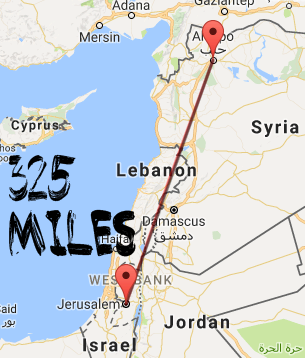
A dla tych, którzy nadal trzymają się argumentu o “nowym Bliskim Wschodzie”, dla tych, którzy twierdzili, że Izrael powinien poczynić wielkie ustępstwa, bo tak dobrze na nich wyszli wcześniej – Izraelczycy żyją zaledwie 316 mil od Aleppo w Syrii. W komforcie Londynu i Nowego Jorku łatwo jest mówić innym, że muszą zaryzykować dla pokoju.


twoje uwagi, linki, wlasne artykuly, lub wiadomosci przeslij do: webmaster@reunion68.com


Brexit vote sparks rush of British Jews seeking Portuguese passports

Brexit vote sparks rush of British Jews seeking Portuguese passports

Sam Jones


More Sephardic Jews are applying for citizenship of Portugal under law making amends for expulsion centuries ago

Lisbon. Thousands of Jews were forced from Spain and Portugal at the end of the 15th century. Photograph: Alamy Stock Photo

The UK’s decision to leave the European Union has fuelled an 80-fold increase in the number of British Sephardic Jews seeking Portuguese citizenship under a recent law intended to make amends for their ancestors’ expulsion from the Iberian peninsula more than 500 years ago.

Last year both Spain and Portugal brought in legislation to facilitate the return of the descendants of the thousands of Jews who were forced from the countries at the end of the 15th century.

The Spanish government said the offer of citizenship was intended to right the “historical wrong” that saw the country’s Jewish community exiled, forced to convert to Catholicism or burned at the stake. Portugal said that while there was no way to make up for what had been done, the offer of citizenship represented “an attribution of a right”.

In the wake of June’s Brexit vote, however, a rapidly increasing number of British Sephardic Jews have been applying for Portuguese citizenship as a way to deal with the uncertainty created by the leave victory.

According to the Jewish Community of Oporto – which, along with the Lisbon Jewish community, is certifying applicants – demand from the UK has soared since 23 June.

Dr Michael Rothwell, a delegate to the community, said it had received just five applications before Brexit compared with 400 in the two months following the vote.

“I think people are a bit nervous about this and therefore feel that having a European Union passport would be an advantage even if they are not necessarily planning to move to Portugal,” he said. “Having citizenship of an EU country has its benefits.”

Rothwell said the community had not been surprised by the rush for Portuguese passports, adding that the number of individuals applying was greater that 400 as many had applied in groups. Although there are no precise figures, the UK’s Sephardic population is estimated to be in the thousands.

Alison Rosen, executive director of the S&P Sephardi Community in London, said its archivists had also seen a rise in the number of people inquiring about their Sephardic ancestry.

“One hundred per cent, the minute Brexit happened, we definitely saw an increase in volume and I think it’s continuing,” she said. “In the past, we had a handful of people and it’s now a steady flow of people. In the past we might have got one a month and now it’s a couple a week or something.”

However, Spain’s Federation of Jewish Communities said it had not seen a similar rise in UK applications after Brexit, perhaps because the language tests required by the Spanish government are pushing would-be applicants to try the Portuguese route, which makes no linguistic demands on applicants. The UK does not feature among the Spanish government’s top 10 countries for applications, a list led by Argentina, Israel, Venezuela, the US and Canada.

Gillie Traeger, a 45-year-old teaching assistant from Greater London, is one of those now seeking Portuguese nationality. For her, the offer of citizenship is a matter of recognising both her Sephardic roots and asserting her wider European identity in the aftermath of Brexit.

“There’s kind of a sense of pride from coming from this very old Jewish family in England,” she said. “[But] historically, I don’t feel like I’m just English. I feel I’m European and would like to stay that way. Having the opportunity to do this is rather nice, actually.”

Another British descendant of Sephardic Jews, who did not want to give his name, said his decision to apply for Portuguese citizenship had been political and pragmatic.

“The moment that I heard about the decree in Portugal, I said to my wife: ‘If we leave the European Union, I’m going to apply for Portuguese citizenship,’” he said.

“I’m literally in mourning about Brexit. I’m a European, a cosmopolitan and I think all forms of nationalism are pretty hateful. If you look at the 19th and 20th century and see what nationalism does, it’s not a history to be particularly proud of.”

Particularly distasteful, he added, had been the rhetoric surrounding the debate with its familiar attacks on “the hated Johnny Foreigner”.

“My going for Portuguese citizenship is in part symbolic; it’s in part protest and in part the embracing of a particular cultural heritage. But it’s in part the practicality of being able to travel in Europe without having to produce a non-European passport.”

Yoram Zara, an Israeli lawyer representing Sephardic Jews from all over the world, said the reasons for the rise in applications were self-evident.

“They are used to being a part of the European Union and enjoying all the privileges and rights of European citizens,” he said. “Now there’s some uncertainty about what will happen in the coming years, so it’s safe to have it if you intend to live, work or study in the EU or to retire there. Having a Portuguese, EU passport certainly shouldn’t harm you and might give you things that a British passport will no longer allow you to have.”

Zara and Rothwell said that while applications to Portugal from the UK were on the increase, there was also strong interest from Turkey, which welcomed many Sephardic Jews following the expulsion from Spain and Portugal.

Five hundred years on, the dwindling community has found itself the target of terrorist atrocities, and many feel increasingly unwelcome in Turkey’s shifting political climate.

“This law came out at a time when precisely Turkish Jews are feeling under stress from the political changes that are taking place in Turkey,” said Rothwell.

“Five hundred years ago, Spain and Portugal expelled the Jews and the Sultan of the Ottoman empire received them very happily – it was a very good deal – and they have been living in those areas very happily for 500 years, but now the circle is kind of closing because the Turkish Jews are not feeling very safe where they are, and so you have the inverse.”

Zara said that Sephardic Jews in Turkey were now applying in their “hundreds and thousands”.

He added: “They are concerned – and I think the last few months have proved them right – because things are not stable in Turkey and maybe they will need to leave if things get worse.”

Despite the emollient words from Madrid and Lisbon, though, some of those whose ancestors were persecuted and chased from their homes are still left pondering the epic injustice of it all.

“To them it may be an offer of amends but to me it’s part of my cultural identity and heritage,” said Misty Kenney, who applied for Portuguese citizenship before the Brexit vote.

“I’m surprised they didn’t start doing this years ago. If it wasn’t for the inquisition maybe I would be in Portugal today.”


twoje uwagi, linki, wlasne artykuly, lub wiadomosci przeslij do: webmaster@reunion68.com


Carnegie Deli, a New York institution, closes its doors

Carnegie Deli, a New York institution, closes its doors

CATHERINE TRIOMPHE


Iconic Jewish delicatessen shuts down after 79 years in operation in Manhattan

People line up to get into the Carnegie Deli December 30, 2016 in New York. The deli will close after 79 years of service on December 30. (AFP/Catherine Triomphe)People line up to get into the Carnegie Deli December 30, 2016 in New York. The deli will close after 79 years of service on December 30. (AFP/Catherine Triomphe)

NeW YORK (AFP) — For 79 years it reigned as a New York culinary institution: the Carnegie Deli, frequented by locals and visitors for its ginormous sandwiches, and immortalized in the Woody Allen movie “Broadway Danny Rose.”

Now, it’s closed, relegated to nostalgic photos and memories — another sign, many say, that America’s biggest city is losing its old charms and succumbing to exorbitant property prices and the encroachment of ever more Manhattan hotels.

On its last day, Friday, dozens braved the cold to line up at the 7th Avenue eatery across the street from the famed Carnegie Hall, close to Central Park.

They were determined to get one last bite in the most emblematic of New York’s Jewish delicatessens, a place whose walls boast hundreds of old photos of theater stars from nearby Broadway.

Paul Zatek, a young finance executive, was representative of many now living in what is one of the world’s most expensive cities. “I’ve lived here for 10 years and had never come,” he said.

But the realization that it was the last chance to taste the deli’s enormous, $30 pastrami sandwich — called the “Woody Allen,” in honor of the director/actor who gave the place much of its cachet — prompted him to drop by and wait for a seat.

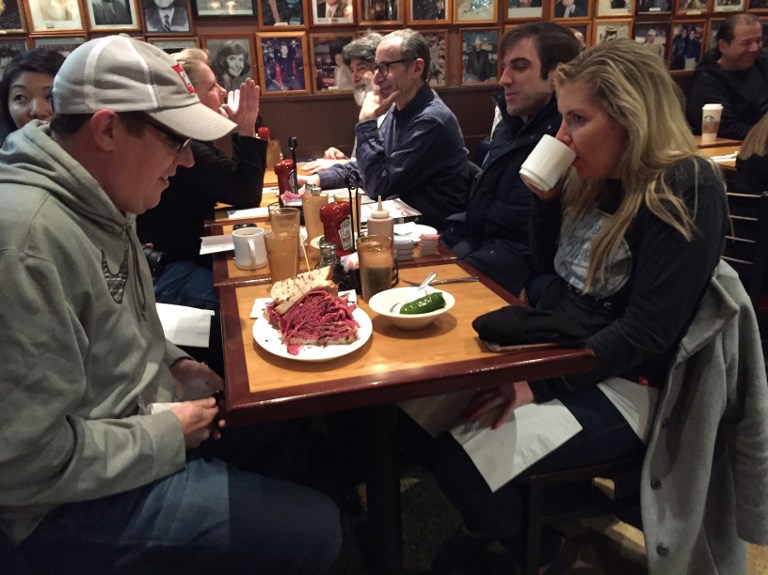
New Yorker Paul Zatek (L) waits to take his first bite of a "Woody Allen" pastrami sandwich at the Carnegie Deli December 30, 2016 in New York. The deli will close after 79 years of service on December 30. (AFP PHOTO / Catherine Triomphe)New Yorker Paul Zatek (L) waits to take his first bite of a “Woody Allen” pastrami sandwich at the Carnegie Deli December 30, 2016 in New York. The deli will close after 79 years of service on December 30. (AFP PHOTO / Catherine Triomphe)

“It’s just a New York institution — you see from the pictures on the walls how many people have come here,” said his fiancée, Jackie Fennessey, looking around at the walls.

The owner of the establishment, Marian Harper, said it had been a very difficult decision to close the deli, which she inherited from her father, who had bought it with a partner in 1976.

“I’m at that certain age where I want to enjoy my life,” Harper told public radio network NPR. “And all good things must come to an end.”

According to the New York Daily News, Harper rejected an offer from one of her former employees, a dishwasher who now owns a Mexican restaurant, to buy the restaurant for $10 million. He had hoped to preserve the address, which he considered as “much a part of New York City as the Statue of Liberty and the Empire State Building.”

But its business — and management — had gone through some rough patches, including a messy divorce for Harper, a nearly year-long closure because of a reported gas leak, and a court ordering the deli to pay workers $2.6 million in back wages.

Harper said none of those snags factored into her decision to close.

Forbes magazine portrayed the deli’s end-of-an-era as part of the greater change of New York’s makeup.

“A well-known name and nostalgic food aren’t enough to keep a place going on forever, even with tourists as a customer base. As cities change, the restaurants that reflect their character have to change, too,” it said.

For one of the waiters, Ali Tarique, it was sad to see the place he had worked in the past 14 years shut its doors.

“Every day you met new people, sometimes funny people, sometimes celebrities…very nice people,” he reminisced as he tended to the final-day rush.

At one table, two young Chinese women, students at the University of California, Santa Barbara, admitted they had never heard of Carnegie Deli until just hours earlier.

But now inside, waiting to be served, they marveled that a place so cosy could close down.

“The feeling is so good, it feels so warm,” said one of them, Ann Zheng.

But while the deli no longer exists, aficionados of its pastrami and almost-as-renowned cheesecake need not go hungry.

Harper says she intends to keep producing them in her New Jersey factory, supplying Carnegie Deli-branded eateries that are operating in Madison Square Garden, Las Vegas, and Bethlehem, Pennsylvania.


twoje uwagi, linki, wlasne artykuly, lub wiadomosci przeslij do: webmaster@reunion68.com


12 Reasons the U.S. Should Have Vetoed U.N. resolution 2334

UN Watch12 Reasons the U.S. Should Have Vetoed U.N. resolution 2334

Hillel C. Neuer


Joining the Jackals: The Case Against U.N. Resolution 2334
An open letter from UN Watch executive director Hillel Neuer to U.S. Ambassador Samantha Power

December 29, 2016

Dear Ambassador Power,

I write in response to your abstention on Friday which allowed a U.N. Security Council resolution condemning Israel, and in response to the substantial explanation of vote that you delivered. With even further U.N. measures still possible before President Obama leaves office on January 20th, I urge you and the Administration—where you play an influential role as a member of the President’s Cabinet, and as one of President Obama’s most trusted advisors—to reconsider your approach.

Your speech on Friday had much to applaud. As you have vigorously done for three years, your remarks exposed in compelling detail the U.N. double standard applied to the Jewish state, which, you rightly said, “not only hurts Israel, it undermines the legitimacy of the United Nations itself.”

As you noted last year on the 40th anniversary of the infamous Zionism is Racism resolution, at the U.N. “rarely a day goes by without some effort to delegitimize Israel.” On that occasion, you called for everyone to “relentlessly fight back” against this “ignorance and hatred.”

Your vote on Friday, however, makes a dramatic break with all of this. While it is perfectly legitimate to disagree with Israel about settlements, allowing Resolution 2334 to pass was morally wrong and strategically damaging. As set forth below, we believe the U.S. decision to acquiesce in the adoption of this lopsided resolution reverses decades of past practice, sets back the cause of peace, and harms the interests of Israelis, Palestinians, and Americans.

Leader’s of Israel’s Left-Wing Opposition Reject U.N. Resolution

Immediate and compelling evidence demonstrates that the Administration has failed to achieve its objective, which you articulated as promoting the two-state solution.

Secretary Kerry’s speech yesterday failed to acknowledge the telling fact that Israel’s mainstream society, including leading supporters of the two-state solution, have sharply rejected the U.N. resolution, and criticized the U.S. role in its advancement and adoption.

Consider:

  • Isaac Herzog, leader of the opposition and chairman of the Labor Party—whom you recently recognized for being “so principled on behalf of peace”—called for Resolution 2334 to be annulled, saying it caused “severe damage.”
  • Similarly, his colleague, former foreign minister Tzipi Livni, who led efforts to achieve a two-state solution at the Annapolis Conference, and who welcomed the 2008 Security Council resolution endorsing that summit, said by contrast that Friday’s U.S.-backed resolution “harms the interests of Israel,” “harms Jerusalem,” and threatens to haul Israeli officers to the International Criminal Court.
  • Yair Lapid, chair of the Yesh Atid opposition party, who has endorsed the Saudi-Arab Peace Initiative as a basis for peace talks, and who opposes the proposed Knesset bill to legalize outposts which you cited on Friday, called the U.N. resolution “dangerous”, “unfair, and “an act of hypocrisy.”
  • Ehud Barak, who as prime minister went to Camp David in 2000 and extended an unprecedented and far-reaching peace offer to the Palestinians, called this resolution a “humiliating blow to Israel.” Amos Yadlin, head of Tel Aviv University’s Institute for National Security Studies, the country’s most influential think tank, and another prominent supporter of the two-state solution, said that the resolution was “extremely problematic for Israel and the peace process alike,” and he accused President Obama of committing “a severe anti-Israeli move” which “harmed the United States’ staunchest ally in the Middle East.”

To be sure, all of these left-leaning figures faulted or admonished Prime Minister Netanyahu for failing to head off the blow. Yet neither President Obama, Secretary Kerry or anyone else in your Administration has yet addressed the astonishing fact that their closest Israeli political allies and interlocutors in promoting the peace process have uniformly denounced an action which you claim will advance their position.

Hamas & Islamic Jihad Terrorists Cheer Resolution: “Now Israel Can Be Isolated, Boycotted, Prosecuted”

By contrast, are you not troubled that among the first to endorse the resolution were the terrorist groups Hamas and Islamic Jihad? “Hamas commends the countries that voiced their opposition to the Israeli occupation’s aggressive settlement policy aimed against the Palestinian people,” said Hamas spokesman Fawzi Barhoum. Hamas praised “the important about-face in the international position in favor of the Palestinian people.” Iran-backed Islamic Jihad welcomed the U.S.-backed resolution, saying, “It’s plain to see the world opinion is against Israel and its policies,” and “now Israel can be isolated and boycotted, as well as prosecuted in the international arena for all its crimes.”

12 Reasons Why the U.S. Should Have Vetoed U.N. Resolution 2334

To understand why, by contrast, so many supporters of Israeli-Palestinian peace oppose what you did on Friday, I urge you and the Administration to consider the following 12 points:

1. Resolution 2334 Encourages Palestinian Rejectionism, Undermines Negotiations
The resolution dangerously disincentivizes Palestinians to come to the negotiating table. Instead, Resolution 2334 will for the foreseeable future encourage them to await being handed the same or more by international fiat. This will feed into the Palestinian strategy of preferring to deal with international institutions over bilateral talks with Israel. Contrary to its stated objective, therefore, the resolution will only push negotiations further away.

In this regard, we recall that in 2011, your predecessor Susan Rice vetoed a similar resolution on the grounds that it risked “hardening the positions of both sides,” and “could encourage the parties to stay out of negotiations.” She said it was “unwise for this Council to attempt to resolve the core issues that divide Israelis and Palestinians.”

Though your speech claims that circumstances have now changed, many will see the only meaningful difference as the fact that the current transition period allows a president to make unpopular decisions at no political cost.

2. Resolution Fuels Palestinian Targeting of Israelis with BDS & International Prosecutions
Secretary of State John Kerry pledged this month to oppose any “biased, unfair resolution calculated to delegitimize Israel.” And though he likewise said on Friday after the vote that he is proud of “defending Israel against any efforts to undermine its security or legitimacy in international fora,” and “steadfastly opposing boycotts, divestment campaigns and sanctions targeting the State of Israel,” the fact is that these are precisely the efforts empowered by Resolution 2334.

Friday’s text not only provides the first Security Council endorsement of the scandalous 2004 ICJ advisory opinion, which denied Israel’s right to defend itself from Gaza rockets, but it implicitly encourages the International Criminal Court (ICC) to move forward in its preliminary examination of whether Israeli officials have engaged in the “war crime” of settlement building, and provides the same impetus to prosecutions in national courts that claim universal jurisdiction. If Tzipi Livni was already being served with UK arrest warrants before, Resolution 2334 will only aggravate anti-Israel lawfare. The U.S. should never have lent its hand to a campaign designed to delegitimize Israeli civil and military leaders as criminals.

Moreover, the resolution’s appeal to all states to take action, in paragraph 5, is a clear call to escalate campaigns seeking to boycott Israeli products, companies and citizens. Certainly the UN Human Rights Council will feel empowered to continue preparing its blacklist of Israeli companies that do business over the green line, due in March. Meanwhile, the resolution’s mandated reports by the Secretary-General every three months will ensure constant activity.

3. Contrary to U.S. Claims, Resolution Fails to Condemn Palestinian Incitement
You said after the vote that the U.S. “would not have let this resolution pass had it not also addressed counterproductive actions by the Palestinians such as terrorism and incitement to violence.” Yet that is exactly what happened: the resolution that was adopted mentions terrorism and incitement only in the abstract; nowhere are these crimes attributed to Palestinians. Whereas Israel is named and shamed throughout the text, the Palestinians get a free pass. The U.S. reversed decades of past practice by allowing the adoption of such an unbalanced text.

The failure of this resolution to truly confront Palestinian incitement is not inconsistent with your failure to speak out against the routine incitement to antisemitism and terrorism by Palestinian school principals and teachers at UNRWA, to which your Administration gave $380 million last year. We sent you petition after petition, supported by thousands worldwide, yet your only statements on UNRWA have been to defend or promote the organization, not to hold it accountable. I hope you will change your approach when we soon reveal the latest trove of UNRWA’s online incitement.

4. Blames Israel as “Major Obstacle” to Peace, Yet Palestinians Evade Responsibility
Despite the fact that the Palestinians refuse to negotiate without preconditions, refused to negotiate even during Israel’s 2009-2010 settlement freeze, rejected the Kerry framework principles, and are inciting to terrorism at the highest levels, they are spared in the resolution from any blame. Instead, the resolution accuses Israel alone of creating, with the settlements, “a major obstacle” to just, lasting and comprehensive peace.

5. Failure to Distinguish Settlements Loses Israeli Mainstream
By ignoring the 2000 Clinton Parameters, the Obama Administration unwisely managed to alienate itself from the vast majority of the Israeli population and political parties, who regard the Jewish Quarter, the Western Wall, and Jewish neighborhoods in eastern Jerusalem such as Ramot and Gilo as an integral part of Israel—all of which are defined in the resolution as “occupied Palestinian territory”—and likewise, the Israeli Jewish communities in the large settlement blocs such as Gush Etzion have for years been considered part of the Israeli consensus. The U.S. failure to distinguish between these and isolated, remote settlements is what doomed the U.N. resolution to complete rejection by Israeli society as a whole.

6. Offensive to Call Jerusalem’s Jewish Holy Sites “Occupied Palestinian Territory”
The resolution is offensive to Jews worldwide by absurdly defining the Jewish Quarter of Jerusalem, and the holiest Jewish sites of the Temple Mount and Western Wall, as “occupied Palestinian territory.” In describing your commitment to Israel as both personal and profound, you have on several occasions noted before Jewish and Israeli audiences that your son is a descendant, from his father’s side, of Rabbi Elijah, the 18th-century Lithuanian Jewish sage known as the Vilna Gaon, considered the greatest Talmudic scholar of his time.

Given that the Gaon’s vision of return to the Land of Israel was a decisive factor in the rebuilding of the Jewish Quarter, by inspiring hundreds of his disciples to immigrate to Jerusalem in the early 19th century, and given that we are about to mark the 100th anniversary of the Balfour Declaration, which recognized the ancient, indigenous Jewish rights to the Holy Land—formalized internationally in the League of Nations Mandate on Palestine, which stated that the British Administration “shall encourage… close settlement by Jews, on the land”—I hope you will reconsider the logic of now criminalizing Jewish residents of the Jewish Quarter.

7. Seeks to Relitigate & Rewrite Cornerstone Resolution 242
By injecting new language enshrining “the 4 June 1967 lines,” the resolution seeks to relitigate and rewrite U.N. Security Council Resolution 242 of November 1967, the cornerstone of Arab-Israeli peace negotiations over the past half-century—endorsed by the Palestinians at Oslo—which calls for the right of every state to live in peace within “secure and recognized boundaries” and for Israel to withdraw “from territories occupied.”

Your predecessor Arthur Goldberg, former Supreme Court Justice and U.S. ambassador to the U.N. when 242 was enacted, made clear that the text’s “notable omissions in language” on withdrawal are the words “the,” “all,” and the “June 5, 1967, lines.” The choice of language was clear, he explained: “there is lacking a declaration requiring Israel to withdraw from the (or all the) territories occupied by it on and after June 5, 1967.”

Instead, the resolution “stipulates withdrawal from occupied territories without defining the extent of withdrawal.” And it “can be inferred from the incorporation of the words secure and recognized boundaries that the territorial adjustments to be made by the parties in their peace settlements could encompass less than a complete withdrawal of Israeli forces from occupied territories.” Goldberg likewise told King Hussein in the lead-up to 242 that there was a “need for some territorial adjustment.”

8. Explanation of Vote Misstates Longstanding U.S. Policy
Your speech on Friday opened with a 1982 quote from President Ronald Reagan opposing settlements, and you argued that “our vote today is fully in line with the bipartisan history” of how American presidents have approached the issue. In fact, your speech was selective, excluding material statements by U.S. leaders rejecting the notion of return to the 1949 armistice lines, what Israeli statesman Abba Eban once called “Auschwitz borders.”

  • For example, you failed to quote the rest of President Reagan’s statement, in which he said: “I have personally followed and supported Israel’s heroic struggle for survival, ever since the founding of the State of Israel 34 years ago. In the pre-1967 borders Israel was barely 10 miles wide at its narrowest point. The bulk of Israel’s population lived within artillery range of hostile Arab armies. I am not about to ask Israel to live that way again.”
  • Nor did you quote President Lyndon Johnson who said: “We are not the ones to say where other nations should draw lines between them that will assure each the greatest security. It is clear, however, that a return to the situation of June 4, 1967, will not bring peace. There must be secure, and there must be recognized, borders.”
  • Likewise, you omitted Secretary of State Schultz’s 1988 statement: “The territorial issue needs to be addressed realistically. Israel will never negotiate from or return to the lines of partition or to the 1967 borders.”
  • The Clinton parameters of December 2000, which contemplates Israeli annexation of large settlement blocs, are also ignored by the resolution.

9. U.S. Position Reneges on Commitments in 2004 Bush-Sharon Letters
By allowing the resolution’s new language enshrining “the 4 June 1967 lines,” which are the 1949 armistice lines, the U.S. position reneges on the 2004 exchange of letters negotiated between Prime Minister Ariel Sharon and President George W. Bush. The Bush letter stated: “In light of new realities on the ground, including already existing major Israeli populations centers, it is unrealistic to expect that the outcome of final status negotiations will be a full and complete return to the armistice lines of 1949, and all previous efforts to negotiate a two-state solution have reached the same conclusion.”

Prime Minister Sharon relied on the Bush commitments as part of negotiated package deal, being the consideration Israel received and relied upon in exchange for its total withdrawal from Gaza. When the U.S. ignores written commitments to allies, its international credibility is dangerously diminished. Moreover, the Bush letter severely undermines your claim that the U.S. vote on Friday was “fully in line” with prior history.

10. Resolution Lacks Legitimacy in U.S. Opinion
The resolution has been firmly rejected by the broad mainstream of American society, including by congressional leaders of President Obama’s own party:

  • Incoming Senate Minority Leader Charles Schumer (D-N.Y.) called the U.S. vote “frustrating, disappointing and confounding” and said it will move the Middle East farther from peace.\
  • Sen. Ron Wyden (D-Ore.) was “deeply disappointed” that the administration “set aside longstanding U.S. policy to allow such a one-sided resolution to pass.”
  • The U.S. abstention on “such a flagrantly one-sided resolution,” said Sen. Richard Blumenthal (D-Vt.), “is unconscionable.”
    Sen. Mark Warner (D-Va.) said he was “dismayed that the Administration departed from decades of U.S. policy by not vetoing the U.N. resolution.”
  • Even President Obama’s former Special Envoy for Middle East Peace opposed the decision. “President Obama would have been wise to veto this resolution,” said George Mitchell, a former Senate majority leader, “because of the timing and the circumstance that it leads to with respect to trying to get the parties together.”
  • The Washington Post called the U.S. decision a “dangerous parting shot at Israel,” likely to do more harm than good.

11. Reverses Decades of U.S. Practice
There has not been a resolution like this in a generation, not since the Carter years in 1979 and 1980, and even those resolutions did not take place during a time of extreme anti-Israeli BDS campaigns and in the context of global anti-Israeli lawfare prosecutions sought in the ICC and elsewhere. This reverses decades of practice by both Democratic and Republican presidents. Moreover, unlike with the few other U.S-backed resolutions in history that criticized Israel from time to time, the nature of the coordination and the careful timing of this maneuver against a close ally make it seem particularly deliberate and hostile.

12. Joining with Venezuela & Malaysia to Condemn Israel
Whom you align with at the U.N. matters. I cannot think of another time in modern history when the U.S. endorsed a U.N. Security Council resolution co-sponsored by countries such as Venezuela, whose Maduro regime has thrown its opposition leaders in jail while causing mass starvation, and Malaysia, a hotbed of antisemitism.

Speaking of Venezuela, whose political prisoners we have championed, I have to note that while Secretary Kerry said repeatedly yesterday that the U.S. “cannot, in good conscience, do nothing, and say nothing” in regard to Israeli settlements, your Administration has said nothing every year when we have appealed to you to oppose the election of tyrannies such as Venezuela to the U.N. Human Rights Council. You said nothing to stop the Maduro regime being elected last year; you said nothing to stop Saudi Arabia, China, and Cuba from getting elected this year; and you said nothing to stop Russia getting elected in 2013. Your Administration’s policy of speaking out when good conscience requires it ought to be less selective.

Conclusion: The Obama Administration Joined the Jackals

In conclusion, I ask you to consider what one of your predecessors and role models, the late great Daniel Patrick Moynihan, might have thought about what the U.S. did on Friday.

You cited Moynihan during your confirmation hearing as an iconic American who “stood up for what was right.” And as an example of how to bring the U.N. to live up to its ideals, you have invoked the moral clarity that Moynihan eloquently expressed in his formidable speeches as U.S. ambassador to the U.N. in 1975.

We certainly know what Moynihan thought about the Carter Administration’s similar votes against Israel in 1979 and 1980. In his iconic 1981 Commentary essay, “Joining the Jackals,” Moynihan diagnosed the confused ideas which led U.S. delegates and officials to abandon Israel to what the Washington Post editorial board had identified as the pack at the U.N. which hounds Israel shamelessly. Carter, the Post had said, had decided to “join the jackals.”

I believe Moynihan’s observations of 36 years ago are no less apt to the resolution which you just allowed last week:

  • “[F]or the United States to abstain on a Security Council resolution concerning Israel is the equivalent of acquiescing.”
  • “As a direct result of American policy, the Security Council was allowed to degenerate to the condition of the General Assembly.”
  • On a 1979 resolution which used the language “Arab territories… including Jerusalem,” Moynihan said, “Jerusalem is the capital of Israel. How could its capital be in the territory of others?”
  • Invoking against Israel the 1949 Fourth Geneva Convention on the Protection of Civilians in Time of War, one of a series of treaties designed to codify the behavior of Nazi Germany and make such behavior criminal under international law, “played perfectly into the Soviet propaganda position that ‘Zionism is present-day fascism.” Needless to say, Friday’s Resolution 2334 invokes the same convention and uses language meant to describe Israel’s building of homes in the West Bank, or Judea and Samaria as the U.N. 1947 partition plan called the areas, as war crimes.

Were Moynihan alive today, do you have any doubt that he would have said that on Friday the U.S.—after 36 years—once again joined the jackals?

What we don’t know yet is the degree to which the U.S., directly or indirectly, may have actually orchestrated the maneuver. If that proves to be the case—and based on my knowledge and experience of U.N. diplomacy, your Mission had to have played a key role in influencing the language, as well as the timing, of this infamous resolution—would not Moynihan say that the U.S. this time didn’t just join the jackals, but became leader of the pack?

Thank you for your consideration.

Sincerely,

Hillel C. Neuer
Executive Director
UN Watch
Geneva, Switzerland


twoje uwagi, linki, wlasne artykuly, lub wiadomosci przeslij do: webmaster@reunion68.com


The NYTimes does it again!

he NYTimes does it again!

Prof. Phyllis Chesler,


The NYTimes buried the Holocaust on its back pages during WWII. Today, its front section criticizes Israel in article after article.

New York Times buildingNew York Times building / Israel News Photo

The New York Times has done it again! Just when I think they couldn’t possibly be any worse—they have the power to surprise and disgust me anew.

Six days ago, 14 nations on the UN Security Council (with America’s abstention), voted in Resolution 2334–and we know that Obama was behind this resolution, just stay tuned for “iron clad” evidence

Yesterday, Obama’s Secretary of State, John Kerry, delivered his shameless lecture in which, as Israel’s “friend,” he demanded that it commit suicide by appeasing terrorism even further in the pointless, fruitless process known as the “two state solution.”

And today—the New York Times devotes five articles—yes, five separate articles, to further buttress and defend Kerry’s vision.

Under a bold headline: Kerry Says Israel Keeps Sabotaging Peace Prospects, we find two articles; both are front page right hand “lead” articles. David E. Sanger (Kerry Rebukes Israel, Calling Settlements a Threat to Peace) spends 1,612 words “voicing frustration at Netanyahu.”

Right next to him, Peter Baker (In John Kerry’s Mideast Speech, a Clash of Policies and Personalities), spends 1,320 words claiming that the “two state solution nears the end of its shelf life.” Both articles continue on page A10 and take up the entire page. The pull quotes read: “A bluntness rarely heard from U.S. diplomat about a close ally,” and “Kerry plays for history, while Netanyahu and Trump play for time.”

This is not straight news reporting. This is an editorial. Really, it is rank propaganda.

On page A11, opposite, there is another article by Jonathan Martin (Kerry’s Blunt Words for Israel Denounced by Lawmakers in Both Parties). The pull quote here reads: “A speech is greeted warmly in Europe but with a shrug in the Arab world.” This article is 872 words in length.

Not to be trumped by their own journalists, the NYT editors spend their entire editorial on: “Is Israel Abandoning a Two-State Solution?” The word count here is 1,228 words.

Of course, Thomas Friedman, whose column appears opposite the editorial, spends 901 words in an article titled: Bibi Netanyahu Makes Trump His Chump.

This coverage, which is entirely one-sided and based on falsehoods, distortions, and false moral equivalencies, amounts to almost 6,000 words (5,933 words to be exact).

So in Thursday’s Paper of Record we have a thousands of words highly critical of Israel and only of Israel. The consistent Palestinian refusal to recognize the Jewish state, to cease their terrorism against it, their refusal of offers of more than 95% of disputed territories—that is both underplayed and never viewed as the main reason that the “peace process” has failed.

Most people do not read or study entire articles. They are guided by the headlines, the pull quotes, and perhaps by the opening paragraphs. If a presumably distinguished newspaper spends that many words on the same day featuring a single country—then this must be major breaking news. Yes?

The first and only mention of Islamic terrorism in today’s paper appears on pg A 12 (Tunisian Detained as Possible Accomplice in Berlin Attack) and concerns a possible accomplice in the Tunisian truck attack in Berlin. We learn nothing about Syria, Iraq, Sudan or Iran. We are not kept apprised of the region’s continual melt-down into barbaric chaos, the vast flood of refugees—especially the horrifyingly under-valued Christian refugees in the region.

I have said this before and I’ll say it again: The New York Times is guilty of the filthiest propaganda when it comes to Israel, Judaism, and Islam. It alone has indoctrinated and brainwashed all those who read it, day after day, and who swear it is their “Bible.”

May I strongly suggest that everyone read Daniel Pipes in the current issue of Commentary? He has written a clear and concise analysis of how Israel itself will be able to make peace. It is titled: “A New Strategy for Israeli Victory.”


Phyllis Chesler, a Shillman-Ginsburg Fellow at the Middle East Forum and recipient of the 2013 National Jewish Book Award, is the author of sixteen books, including The New Anti-Semitism and Living History: On The Front Lines for Israel and the Jews.


twoje uwagi, linki, wlasne artykuly, lub wiadomosci przeslij do: webmaster@reunion68.com