
Archive | 2025/09/14

Sondaże nie są dowodami ludobójstwa


Sondaże nie są dowodami ludobójstwa

Andrzej Koraszewski


Jak informuje nas kierownik działu zagranicznego dziennika Rzeczpospolita  Jerzy Haszczyński:
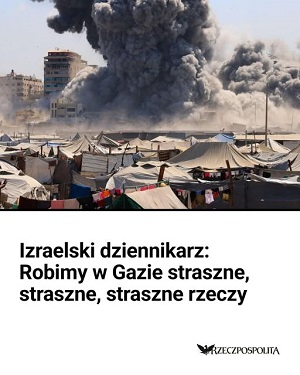
„70 proc. Polaków uważa, że Izrael dopuszcza się w Strefie Gazy ludobójstwa. Jakie znaczenie dla izraelskiego rządu mają takie sondaże? Używa ich jak papieru toaletowego do podcierania tyłków.” To zaledwie początek artykułu pod tytułem „Izraelski dziennikarz: Robimy w Gazie straszne, straszne, straszne rzeczy”. Tym dziennikarzem izraelskim jest oczywiście dziennikarz gazety Haaretz, wściekle lewicowy Josi Melman, który zaczyna swoją opowieść tak: „Rząd Izraela się nie przejmuje, co myślą Polacy, Francuzi, Hiszpanie, reszta świata. Podobnie ze zdaniem połowy Izraelczyków, którzy uważają, że to, co się dzieje w Gazie, jest okropne.”

Nie trzeba długo szukać, żeby dowiedzieć się, że izraelski dziennikarz świadomie wprowadza w błąd na temat rozkładu opinii izraelskiego społeczeństwa. Takie sprawdzenie izraelskich sondaży powinno być łatwe nawet dla absolwenta Wydziału Filozofii w Warszawie (jakim jest p. Haszczyński).

Głosy czytelników w komentarzach pod tym artykułem nie pozostawiają wątpliwości co do tego, jakie jest źródło opinii tych 70 procent Polaków i dlaczego tak wielu dało się przekonać do propagandy Hamasu, masowo powielanej na różnych szacownych łamach.

Porzućmy jednak „Rzeczpospolitą”. Być może masowe postawy i opinie mniej zależą od faktów, a bardziej od tego, gdzie kto szuka informacji.

Dziesiątego września gazeta Washington Post opublikowała artykuł Johna Spencera, wykładowcy West Point, uważanego za jednego z najlepszych specjalistów na świecie w kwestii wojen prowadzonych na terenach miejskich.

John Spencer pisze:

Izrael wezwał do masowej ewakuacji ludności cywilnej z miasta Gaza, co stanowi zapowiedź najbardziej decydującej bitwy tej wojny. W miniony weekend prezydent Donald Trump wydał – jak to ujął na platformie Truth Social – swoje „ostatnie ostrzeżenie” dla Hamasu, ogłaszając, że Izrael zaakceptował warunki rozejmu i że nadszedł czas, aby Hamas uczynił to samo – w przeciwnym razie poniesie konsekwencje. We wtorek Izrael przeprowadził precyzyjne uderzenie na przywódców Hamasu w Dosze.

Zbieg tych wydarzeń podkreśla podstawową prawdę: ostateczna bitwa o Gazę jest nieunikniona.

W miarę jak Izrael przygotowuje się do wejścia do miasta, kampania dezinformacyjna będzie się nasilać. Pojawi się coraz więcej błędnych interpretacji prawa wojennego. Wzrośnie liczba oskarżeń, że oblężenia są nielegalne lub niemoralne. Takie oskarżenia są bezpodstawne.

Amerykański ekspert zwraca uwagę na fakt, że prawa konfliktów zbrojnych dopuszczają oblężenie jako izolację sił przeciwnika w celu odcięcia go od zaopatrzenia, posiłków i możliwości manewru – zwykle w celu zmuszenia do kapitulacji lub umożliwienia decydującego ataku. Prawo zastrzega konieczność podjęcia środków ostrożności mających na celu minimalizację szkód wśród ludności cywilnej. „Oblężenie nie tylko jest zgodne z prawem – może być też najlepszym sposobem na ograniczenie liczby ofiar cywilnych”.

„Podobna taktyka nie jest unikalna dla Gazy. W niemal każdej większej operacji miejskiej ostatnich dekad Stany Zjednoczone i ich sojusznicy otaczali miasta, wzywali cywilów do ewakuacji – a następnie przystępowali do starannie zaplanowanego ataku.

W drugiej bitwie o Faludżę w 2004 roku siły amerykańskie i irackie zastosowały właśnie takie podejście, zanim rozpoczęły największy atak całej wojny w Iraku.

W Tall Afar w 2005 roku wojska USA zbudowały wysoki na trzy metry wał ziemny wokół miasta, ograniczając możliwość wchodzenia i wychodzenia. Mieszkańcom zapewniono bezpieczne drogi ewakuacji, a każda osoba opuszczająca miasto była kontrolowana, by odróżnić cywilów od bojowników Al-Kaidy. Było to tzw. oblężenie „porowate”: cywile mogli odejść, terroryści – nie. Bitwa ta stała się wzorem dla operacji izolowania i oczyszczania miast opanowanych przez ekstremistów.

Bitwa o Mosul w latach 2016–2017 to najbliższy analogiczny przypadek do planowanej operacji izraelskiej. Miasto liczące ponad milion mieszkańców przez dwa lata znajdowało się pod kontrolą Państwa Islamskiego. Początkowo cywilom nakazano pozostać na miejscu, co uczyniło z nich żywe tarcze. W połowie walk polityka się zmieniła i setki tysięcy osób uciekły – mimo że bojownicy próbowali ich powstrzymać. Pomoc humanitarna była dostarczana poza strefą walk, ponieważ wszystko, co trafiłoby do miasta, zostałoby przejęte przez terrorystów. Oczyszczenie Mosulu z sił Państwa Islamskiego zajęło dziewięć miesięcy.”

Spencer zwraca uwagę na fakt, iż mimo że Hamas jest dziś znacznie osłabiony, a armia izraelska jest i lepiej wyszkolona, i lepiej uzbrojona niż armia iracka, miasto Gaza jest twierdzą z podziemnymi tunelami, Hamas nadal korzysta z żywych tarcz i grozi cywilom karami za opuszczanie miasta, co jest oczywistą zbrodnią wojenną.

„Izrael, przeciwnie, przez całą wojnę stosował pełen katalog środków ostrożności przewidzianych przez prawo międzynarodowe: rozdawał ulotki i wykonywał połączenia telefoniczne z ostrzeżeniami, wyznaczał trasy ewakuacyjne, ogłaszał przerwy humanitarne – zarówno po to, by umożliwić cywilom ucieczkę do bezpiecznych stref, jak i by pomoc mogła dotrzeć poza strefy walk.”

W ocenie tej wojny, podobnie jak każdej innej, istotne są pytania, czy jest to agresja, czy działanie obronne? Czy to działanie jest legalne, czy nielegalne, moralne, czy niemoralne, a wreszcie, czy z punktu widzenia bezpieczeństwa państwa jest konieczne?

„Biorąc pod uwagę dotychczasowe działania Izraela, atak na Gazę będzie legalny, moralny i konieczny. IDF działa tak, jak każda nowoczesna armia walcząca z wrogiem zakorzenionym w gęsto zabudowanych miastach.

Zakończenie wojny zależy od tego, czy Hamas uwolni zakładników i zrezygnuje z kontroli nad Gazą. Żadne państwo nie może pozwolić, by organizacja terrorystyczna miała bezpieczną przystań w gęsto zaludnionym mieście, przetrzymując zakładników i wystrzeliwując dziesiątki tysięcy rakiet. Jeśli bojownicy Hamasu odmówią, Izrael ma pełne prawo dokończyć oblężenie i przeprowadzić atak do momentu ich pokonania” – konkluduje John Spencer.

Powróćmy do naszej „Rzeczpospolitej”, która po raz kolejny buduje postawy i opinie świadomie oraz z premedytacją, przekazując narrację Hamasu, na domiar złego zamaskowaną głosem izraelskiego „dziennikarza”. „Rzeczpospolita” nie poinformowała, że Międzynarodowy Trybunał Sprawiedliwości nie orzekł, iż Izrael popełnił ludobójstwo – orzekł, że oskarżenie wniesione przez RPA może mieć jakieś podstawy, a Izrael może (w jakiejś przyszłości) popełnić ludobójstwo. Mętne orzeczenia MTS pozwoliły na kształtowanie opinii publicznej i powoływanie się potem na sondaże przez działających w złej woli dziennikarzy światowej (w tym polskiej) prasy.

Oczywiście dziennikarze tacy jak Jerzy Haszczyński nie odpowiadają na proste pytania o przykład działania polskiej, brytyjskiej, francuskiej, amerykańskiej lub innej armii, która dokonałaby takich wysiłków oszczędzania ofiar cywilnych, jakich dokonuje armia izraelska w Gazie. Izrael nie używa głodu jako broni, ale ani dziennikarz „Rzeczpospolitej”, ani izraelski „dziennikarz” nie podaje i nie może podać żadnego przykładu zaopatrywania ludności wroga w żywność i medykamenty w takich ilościach, jak to robi Izrael w Gazie.
Izraelscy żołnierze nie strzelają do dzieci – chyba że są to uzbrojone dzieci, nastoletni żołnierze, których wykorzystywanie w walkach jest kolejną zbrodnią wojenną Hamasu.

„Rzeczpospolita” została założona przed wojną przez Stanisława Strońskiego (profesora romanistyki pochodzenia żydowskiego), gorącego zwolennika Mussoliniego i włoskiego faszyzmu. Nie ma jednak obowiązku, by aż tak wiernie trzymać się tradycji.


Webmaster: Nie wszyscy wiedza ze wlasciciel Haaretz mieszka w Londynie, a ta uznawana ze “najlepsza Izraelska Gazete” ma tylko troche ponad 4% czytelnikow w samym Izraelu. Tak wiec gdyby nie Arabowie, Antysemici, faszysci i swiatowi “globalisci-komunisci” ktorzy lapczywie wchlaniaja gazete, Haaretz by nie przezyl jako zwykla Izraelska gazeta.  


Zawartość publikowanych artykułów i materiałów nie reprezentuje poglądów ani opinii Reunion’68,
ani też webmastera Blogu Reunion’68, chyba ze jest to wyraźnie zaznaczone.
Twoje uwagi, linki, własne artykuły lub wiadomości prześlij na adres:
webmaster@reunion68.com


America’s unreliable Middle East ‘ally’ is Qatar, not Israel


America’s unreliable Middle East ‘ally’ is Qatar, not Israel

Jonathan S. Tobin


The foreign-policy establishment’s outrage about the strike on Hamas leaders is sheer hypocrisy. What needs to change is Washington’s reliance on the Islamists in Doha.

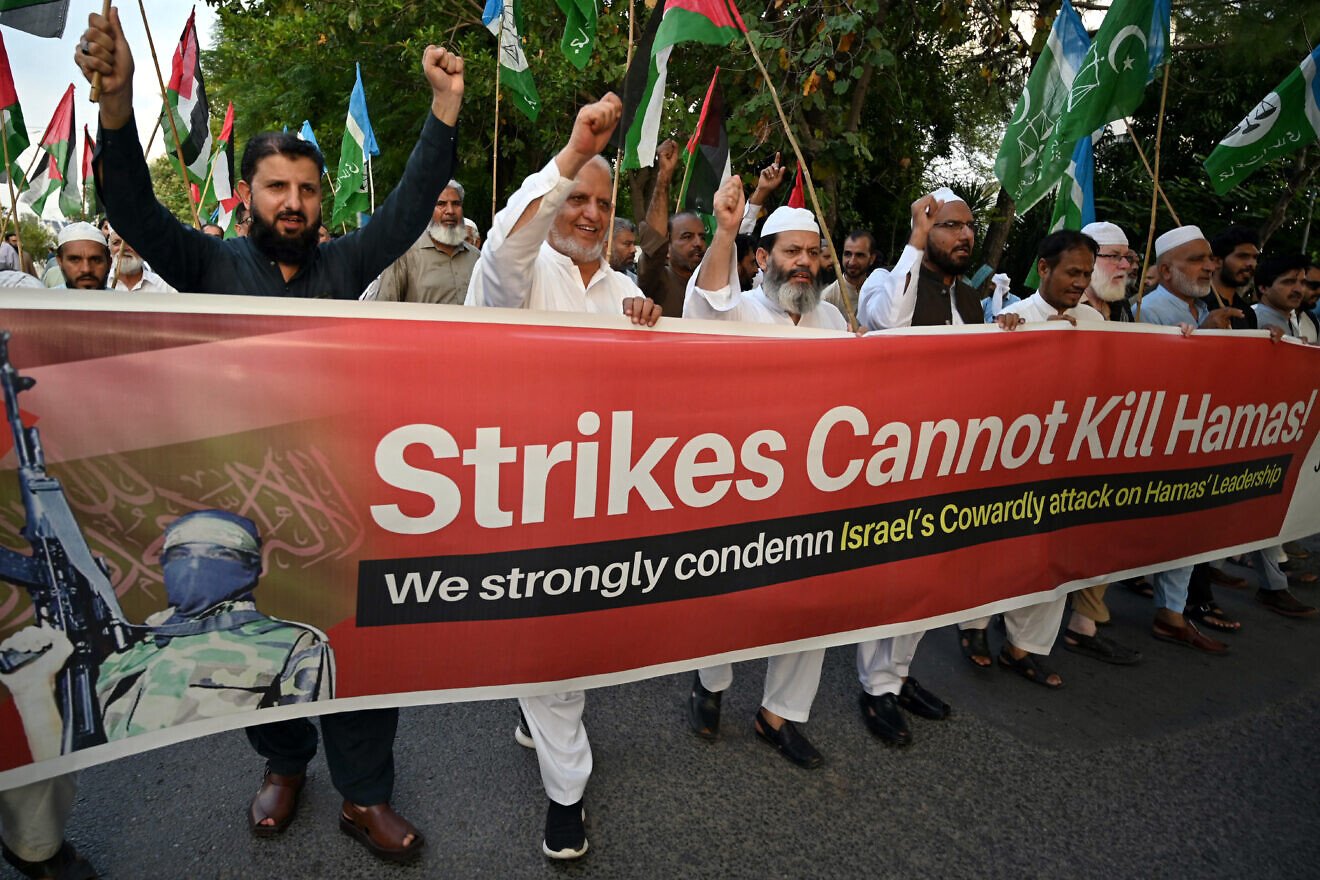
Protesters associated with Pakistan’s Jamaat-e-Islami (JI) Party in Islamabad hold a banner against Israel’s airstrikes targeting Hamas leaders in Qatar, Sept. 10, 2025. Photo by Farooq Naeem/AFP via Getty Images.

The anger from the international community, as well as the Muslim and Arab world, about Israel’s airstrike on members of the Hamas leadership in Doha, Qatar, was matched only by the outrage coming from the American foreign-policy establishment. At the heart of their complaints was not just their chagrin at the skill of the Israel Defense Forces and the Jewish state’s intelligence operatives, in addition to Prime Minister Benjamin Netanyahu’s willingness to flout world opinion.

They were also at pains to depict the strike as the actions of a rogue state, which exploits its ties with the United States rather than behaves like a good ally.

The narrative about the incident is the claim that Netanyahu tricked and/or betrayed President Donald Trump about the airstrike, and so, we were told, he was left with egg on his face.

The most important fact about what happened in Doha was something conspicuously ignored in almost all media coverage. The real scandal was that the men who direct Hamas operations and represent it to the world have been allowed to live openly in peace and apparent security in the Gulf state.

No different than bin Laden

Amid all the huffing and puffing about Israel’s chutzpah for violating the sovereignty of the Gulf emirate, what was lost was that the Hamas operatives and their various functionaries, bodyguards and family members put in harm’s way by the Israelis are among the most vicious criminals on the planet—the moral equivalent of Al-Qaeda mastermind Osama bin Laden.

The real issue isn’t Israel’s violating international norms by attempting to administer the same summary justice to the people who were as much the architects of the terrorist attacks in Israel on Oct. 7, 2023, as bin Laden was of the 9/11 attacks on the World Trade Center and the Pentagon. It’s that a country America continues to treat as a trusted ally is playing host to the authors of the worst mass slaughter of Jews since the Holocaust. That country also funds Islamist terror and supports Islamist indoctrination around the world while acting as a key supporter of Iran. It’s the Qataris who are the rogue state, not the Israelis.

Once that information is acknowledged, then the question is not what the Israelis were doing to disturb the peace of a wealthy enclave in Doha. The question is why the Trump administration seems to be following in the footsteps of its hapless predecessors by treating the Qataris as allies rather than, at best, frenemies who should never be trusted. If anyone has been duping Trump, it’s the Qataris, not the Israelis. Anyone reading or watching news accounts of the attack missed all of this.

Headlines in the liberal mainstream media outlets all screamed their dismay at the Jewish state’s decision to take out some of the terrorist group’s leaders in what they thought was the safe haven of an exclusive neighborhood filled with embassies and luxury residential buildings.

CNN led with a quote from Qatari Prime Minister Sheikh Mohammed bin Abdulrahman al-Thani calling the attack “state terrorism.” A Washington Post story focused on the allegation that Jerusalem was acting like a rogue state: “Israel says it’s bombing its way to peace. The region fears more chaos.”

The New York Times headline on its story betrayed a somewhat more subtle agenda: “Once Again, Israel Leaves Trump in the Dark as It Conducts a Military Attack.” The goal was to highlight not just an apparent rift between Israel and the United States over the incident. The point was to drive home the more sinister notion that Netanyahu is deceiving his erstwhile strategic partner, as well as leading the U.S. president around by the nose and undermining American interests to advance his own dark goals of military conquest and unending war.

A day later, the Times followed up with an even more tendentious story advocating for the Gulf States to take action against Israel while claiming that the attack threatened Qatar’s ability to conduct international trade. But what does granting mass murderers safe haven have to do with the ability of the Gulf emirates to engage in commerce?

In doing so, such media were voicing a sentiment that was repeated throughout the corporate press coverage of the event. The Times and other outlets rounded up the usual suspects of “experts” from Middle East studies departments at major universities—many of which are funded by Qatar—to echo the notion that Israel is the tail wagging the American dog, much to the detriment of the cause of peace and good relations between the United States and the Muslim Arab world.

Veterans of the Obama and Biden administrations who still nurse grudges against Netanyahu and the Israelis for not obeying their orders not to defend their country against terrorists or to make suicidal concessions to them were also trotted out to denounce the strike. They asserted that the Israeli goal was to sabotage ceasefire negotiations with Hamas, for which Qatar serves as the intermediary, as well as to undermine the U.S. relationship with Doha.

More importantly, they sought to play on Trump’s vanity and trumpet the conclusion that the self-styled master of the “art of the deal” was being played for a fool by the Israeli leader.

A picture taken from a distance shows the damaged building (left) in the compound housing members of Hamas’s political bureau, targeted the previous day by an Israeli airstrike in Qatar’s capital of Doha, Sept. 10, 2025. Photo by AFP via Getty Images.

A false friend

Many in the foreign-policy establishment speak of the relationship with Qatar as a good deal for the United States. The Qataris are said to be doing a huge favor to Washington by allowing it to use the Al Udeid Air Base as the headquarters for the U.S. Central Command (CENTCOM) and a listening post from which the Americans can keep an eye on Iran and other malign actors in the Middle East.

Moreover, the Qataris have also managed to insert themselves into negotiations between Israel, the United States and Hamas, thereby making them indispensable to the diplomatic process by which Washington hopes to broker yet another ceasefire-hostage release deal with the terrorists.

This narrative about the U.S.-Qatari relationship, however, has it all backwards.

Qatar isn’t doing the Americans any favors by posing as the go-between with Hamas. This is, like the hosting of the military airbase, part of the emirate’s information operation in which it has sought to buy influence in the United States and advance the Islamist agenda that it supports.

Hamas’s presence in Qatar is no accident. It is the headquarters of the Muslim Brotherhood, the Islamist group that gave birth to Hamas. The Brotherhood is also one of the principal engines of a jihadist movement whose aim is the destruction of Israel and a war on the West.

Buying influence

The oil-rich emirate spends money like water in America. It is the largest foreign donor to U.S. institutions of higher education, giving some of its wealth to colleges and universities to maintain Middle East studies departments that are bastions of anti-Western hate and antisemitism, as well as apologists for Islamist threats to America.

And it’s also the Washington lobbying industry’s best friend, buying influence in Congress and the business community. As Middle East analyst Michael Pregent told me, there are a lot of lobbyists and other figures in Washington, D.C., who “couldn’t pay their mortgages” without the money they get either directly or indirectly from Qatar. The emirate’s role in bailing out Trump envoy Steve Witkoff in a real estate deal not only casts doubt on his judgment but has essentially compromised the Trump foreign-policy team’s ability to objectively evaluate Doha’s role in the Middle East.

Another small example of Qatar’s profligate spending in the United States is the way it has funded the film career of the mother of Zohran Mamdani, the Socialist who is the Democratic Party’s candidate in the race for mayor of New York City. The tens of millions it has spent propping up the career of arthouse filmmaker and documentarian Mira Nair, Mamdani’s Israel-bashing mother, is small change compared to the reported hundreds of millions it invested in helping Witkoff. But like the money it spends on installing those who hate Israel and America in tenured positions at colleges and universities, it does all add up.

And that’s not even counting the enormous influence it wields via its Al Jazeera news channel—the most-watched media outlet in the Muslim world—that churns out Muslim Brotherhood-style propaganda masquerading as reporting seven days a week.

It’s true that the Al Udeid Air Base is more important than ever to the United States after former President Joe Biden’s shameful abandonment of the Bagram Air Base in Afghanistan to the Taliban in 2021. While moving it elsewhere would be highly inconvenient, the idea that it couldn’t be transferred to another Gulf emirate isn’t credible. Its presence in Qatar not only confers legitimacy on the dubious notion that Doha is an ally. It also undermines America’s credibility in the struggle against Islamist terror—a point not lost on groups like Hamas and its Muslim Brotherhood mentors, who are funded by the Qataris. Though its apologists will never admit it, Qatar needs the United States a lot more than America needs Qatar.

Simply put, Qatar plays both ends against the middle when it comes to America and Islamic terrorists who wish to destroy it. Unlike Pakistan, which often does the same thing while posing as a U.S. ally, Qatar’s ability to maintain this untenable position is based on its buying influence and not a nuclear weapon.

Has the strike in Qatar endangered Israel’s relationship with Trump? That’s what Israel-bashers are counting on. But they shouldn’t. 

Even as Trump expressed his displeasure about the Israelis acting independently of his control in this manner, he still expressed views that are more in line with those of the pro-Israel community, saying in a Truth Social post that “eliminating Hamas, who have profited off of the misery of those living in Gaza, is a worthy goal.” That is a far cry from the condemnations of the operation.

Trump went on to note that the strike could help prod the Qataris and Hamas to stop stalling in the negotiations and to bend to his most recent ultimatum to the terrorists, demanding that they accept his terms, which involve the release of all the hostages they are still holding and surrender their arms.

An elaborate grift

That goes back to another basic truth ignored in the hubbub about Israel’s actions: the belief that Hamas—and its Qatari funders and enablers—are in any way reasonable actors or part of a credible diplomatic process is a myth. The negotiations approved by Trump, into which Witkoff has helped mire the United States, are nothing more than an elaborate grift on the part of the Qataris and their clients.

They are no more interested in a peaceful settlement to the war in Gaza today than they were in the aftermath of Oct. 7. What they intend to do is to keep stringing out the talks to allow Hamas to survive the war and emerge as its victor, albeit after destroying the coastal enclave and sacrificing thousands of Palestinian Arab lives on the altar of a century-old war to destroy the State of Israel.

The only way to deal with Hamas is to hunt down every last member of its leadership and cadres, and handle them the same way the United States administered justice to bin Laden and a host of other Al-Qaeda terrorists. Doing so does nothing to undermine the cause of peace or efforts to ransom hostages that Hamas has no intention of releasing.

Netanyahu is right to make it clear—even to a good friend of the Jewish state like Trump—that Israel won’t accept any deal that compromises its security or enables a genocidal group like Hamas to remain in a position to repeat its crimes.

Whether the West realizes it or not, the Qatar strike didn’t just bolster Israel’s security but dealt a blow to the forces that also threaten America and Europe. Qatar is an unreliable ally. Israel is a reliable one. Much as Trump may prefer to believe that Doha’s influence-peddling aligns with his own transactional ideas about alliances, the sooner he wises up to the way the Qataris are playing him on behalf of the Oct. 7 murderers, the more rational America’s Middle East policy will become.


Jonathan S. Tobin is editor-in-chief of the Jewish News Syndicate, a senior contributor for The Federalist, a columnist for Newsweek and a contributor to many other publications. He covers the American political scene, foreign policy, the U.S.-Israel relationship, Middle East diplomacy, the Jewish world and the arts. He hosts the JNS “Think Twice” podcast, both the weekly video program and the “Jonathan Tobin Daily” program, which are available on all major audio platforms and YouTube. Previously, he was executive editor, then senior online editor and chief political blogger, for Commentary magazine. Before that, he was editor-in-chief of The Jewish Exponent in Philadelphia and editor of the Connecticut Jewish Ledger. He has won more than 60 awards for commentary, art criticism and other writing. He appears regularly on television, commenting on politics and foreign policy. Born in New York City, he studied history at Columbia University.

A picture taken from a distance shows the damaged building (left) in the compound housing members of Hamas’s political bureau, targeted the previous day by an Israeli airstrike in Qatar’s capital of Doha, Sept. 10, 2025. Photo by AFP via Getty Images.


Zawartość publikowanych artykułów i materiałów nie reprezentuje poglądów ani opinii Reunion’68,
ani też webmastera Blogu Reunion’68, chyba ze jest to wyraźnie zaznaczone.
Twoje uwagi, linki, własne artykuły lub wiadomości prześlij na adres:
webmaster@reunion68.com


In Memory of My Personal Friend, Charlie Kirk


In Memory of My Personal Friend, Charlie Kirk

Pinchas Allouche


A memorial is held for Charlie Kirk, who was shot and killed in Utah, at the Turning Point USA headquarters in Phoenix, Arizona, US, Sept. 10, 2025. Photo: REUTERS/Caitlin O’Hara

Words cannot express the depth of our grief at the tragic murder of my dear friend, Charlie Kirk, at the hands of an evil gunman. Charlie was not only a national leader; he was also my neighbor here in Scottsdale, Arizona, with whom I shared a special bond.

We often spoke about G-d, whom he loved; our Judeo-Christian values, which he championed; America, which he adored; Israel and the Jewish people, whom he deeply cherished; and the state of our youth, for whom he cared so profoundly.

Beyond Charlie’s profound wisdom and unquenchable curiosity, he had an uncanny ability to engage in every exchange — even when disagreements grew heated — with respect, humility, and grace, along with an unrelenting desire to find common ground. A few months ago, he proudly shared with me that he too “observes the Sabbath.” From then on, we would often wish each other “Shabbat Shalom” every Friday.

Unlike many in positions of power, Charlie never felt threatened by the success of others. He lifted people up, opened doors, and rejoiced in their growth. Over a year ago, he encouraged me to join our mutual friend Seth Leibsohn on the radio, where I now appear regularly every Friday on 960AM The Patriot. Charlie often introduced me to his many friends and influencers, always eager to connect people and help them thrive.

Charlie loved his family fiercely. His beloved wife, Erika, and their children were his crown jewels. He hugged them tightly every day, and often reminded me to do the same with mine. Their well-being was always on his mind; his family was both his source of joy and his greatest mission. Just recently, while I was praying at the Western Wall in Jerusalem, Charlie asked me to “pray for my family, my wife Erika, and our children, Genevieve and MacArthur.”

Charlie was also a true believer in the United States of America, in the Constitution, and in the Divine principles upon which this country was founded. He worked tirelessly to reach everyone — particularly students on campuses across America — engaging them in dialogue and reminding them of our sacred values.

He was a stalwart supporter of Israel and of the Jewish people. Just a few weeks ago, I wrote in the Times of Israel that “Charlie is one of the most stalwart and consistent fighters in this war for truth, faith, and moral clarity… one of the shiniest ambassadors of G-d in our world.” Indeed, he lived with courage, with clarity, and with uncompromising faith.

Charlie’s sudden passing is not only a colossal loss for his friends; it is also a profound loss for America, for the nation of Israel, for all people of faith, and for the world.

To his amazing wife, Erika, to his precious children, Genevieve and MacArthur, and to all of Charlie’s loved ones: We send our deepest love, our fervent prayers, and our endless blessings. Know that we are with you today, tomorrow, and always.

And to all of us, I beg you: In Charlie’s memory, please consider the following:

  • Hug your spouse and children tighter today and every day, as Charlie did.

  • Embrace G-d and His values uncompromisingly, as Charlie did.

  • Add more and more good deeds to your everyday life, as Charlie did.

  • Debate ideas but never demean people, as Charlie did. As the seal of our great nation proclaims: E Pluribus Unum — out of many, one. May we live by it.

May Charlie’s light continue to guide us and illuminate our world. And may we soon see the day in which “G-d will swallow up death forever … and wipe away the tears from all faces” (Isaiah 25:8). Amen.


Rabbi Pinchas Allouche is the founding Rabbi of Congregation Beth Tefillah and the founding Dean of Nishmat Adin Hihh School in Scottsdale, Arizona.


Zawartość publikowanych artykułów i materiałów nie reprezentuje poglądów ani opinii Reunion’68,
ani też webmastera Blogu Reunion’68, chyba ze jest to wyraźnie zaznaczone.
Twoje uwagi, linki, własne artykuły lub wiadomości prześlij na adres:
webmaster@reunion68.com
