
Archive | 2026/04/10

Iran powinien był wystrzelić więcej rakiet na Izrael podczas wojny 7 października – skarży się Autonomia Palestyńska


Iran powinien był wystrzelić więcej rakiet na Izrael podczas wojny 7 października – skarży się Autonomia Palestyńska

Nan Jacques Zilberdik


Autonomia Palestyńska, na łamach swojego oficjalnego dziennika, wyraziła niezadowolenie, że Iran nie wystrzelił większej liczby rakiet przeciwko Izraelowi podczas wojny z 7 października, pozostawiając osamotniony Hamas do walki:

„Niektórzy zastanawiają się dziś, ze zdziwieniem lub bez, gdzie były te rakiety podczas wojny syjonistycznego i religijnego Izraela przeciwko Strefie Gazy.” 

[Oficjalny dziennik AP, artykuł redakcyjny, „Al-Hayat Al-Jadida”, 26 marca 2026]

Autonomia Palestyńska argumentowała, że gdyby Iran troszczył się o Palestyńczyków i nie „porzucił Hamasu”, wynik wojny z 7 października mógłby być inny:

„Gdyby w tamtym czasie Iran wystrzelił jedną czwartą rakiet, które wystrzelił na Jordanię i państwa Zatoki Arabskiej, przebieg tej wojny by się zmienił, a być może zakończyłaby się ona już w pierwszym miesiącu.”

[Oficjalny dziennik AP „Al-Hayat Al-Jadida”, 26 marca 2026]

Podczas wojny z 7 października Palestinian Media Watch ujawniło zmieniające się nastawienie Autonomii Palestyńskiej wobec Iranu. We wcześniejszych biuletynach PMW odnotowało, że gdy irański program nuklearny był niszczony, Autonomia zaczęła się od niego odwracać. Wcześniej zbrojne skrzydło Fatahu świętowało irańskie rakiety i ich cel „wyeliminowania Izraela ze świata”. Ostatnio Autonomia Palestyńska zaczęła kpić z Iranu, sugerując, że Palestyńczycy skuteczniej zabijają Izraelczyków niż irańskie rakiety. Ponadto AP stwierdziła, że Hamas „sprowadził piekło na naród palestyński”, działając na rzecz swoich irańskich „panów”.

W obecnej wojnie PMW udokumentowało, że Autonomia Palestyńska milczała na temat amerykańsko-izraelskiego ataku na Iran i potępiła jedynie irańskie rakiety wymierzone w państwa arabskie. Palestyńskie organizacje terrorystyczne otwarcie opłakiwały Chameneiego, podczas gdy AP nie zajęła stanowiska. Największą obawą Autonomii jest to, że wojna z Iranem „wymaże” kwestię palestyńską z codziennych wiadomości.

Poniżej dłuższy fragment artykułu redakcyjnego AP:

„W obecnej wojnie Iran ujawnił, że dysponuje niezliczoną liczbą rakiet balistycznych. Niektórzy zastanawiają się dziś, ze zdziwieniem lub bez, gdzie były te rakiety podczas wojny syjonistycznego i religijnego Izraela przeciwko Strefie Gazy (tj. izraelskiej odpowiedzi na Hamas), jako kluczowej strony w ‘osi oporu’, której [Iran] przewodził…

Gdzie były te rakiety, gdy ta wojna zbierała żniwo wśród niewinnych ludzi w Strefie Gazy, pod pretekstem odpowiedzi na ‘Potop [Al-Aksy]’ Hamasu (nazwa ataku nadana przez Hamas – przyp. red.), o którym Iran mówił, że krew [dowódcy sił Al-Kuds IRGC, Kasema] Sulejmaniego jest tym potopem? … Ale pozostawił Hamas samego w tym potopie i powiedział, że nic o nim nie wiedział i nie miał z nim żadnego związku!

Gdyby w tamtym czasie Iran wystrzelił jedną czwartą rakiet, które wystrzelił na Jordanię i państwa Zatoki Arabskiej, przebieg tej wojny by się zmienił, a być może zakończyłaby się ona już w pierwszym miesiącu.”

[Oficjalny dziennik AP „Al-Hayat Al-Jadida”, 26 marca 2026]

Amerykańsko-izraelska wojna przeciwko Iranowi 2026 (Operacja „Ryczący Lew” Izraela, Operacja „Epic Fury” USA) – wspólna operacja wojskowa Stanów Zjednoczonych i Izraela przeciwko reżimowi irańskiemu, rozpoczęta 28 lutego 2026 roku. Najwyższy Przywódca Iranu ajatollah Ali Chamenei oraz inni wysocy przywódcy zostali zabici w początkowych uderzeniach operacji, której celem było sparaliżowanie zdolności militarnych Iranu i obalenie reżimu. Iran odpowiedział wystrzeleniem rakiet i dronów na Izrael oraz na państwa arabskie, w tym Arabię Saudyjską, Oman, ZEA, Jordanię, Kuwejt, Katar, Bahrajn i Irak — wiele z nich gości bazy wojskowe USA lub brało udział w mediacjach amerykańsko-irańskich. Po kilku dniach do wojny dołączyła wspierana przez Iran organizacja Hezbollah w Libanie, wielokrotnie atakując Izrael rakietami i dronami. Wojna nastąpiła po miesiącach antyrządowych protestów w Iranie pod koniec 2025 roku, podczas których reżim miał zabić ponad 30 000 własnych obywateli. Była też następstwem wcześniejszej wojny amerykańsko-izraelskiej z Iranem w czerwcu 2025 roku, będącej odpowiedzią na bezpośrednie ataki Iranu i działania jego pełnomocników (Hamasu i Hezbollahu).

Wojna Hamasu przeciwko Izraelowi z 7 października – ponad 1200 Izraelczyków, w tym ponad 800 cywilów, zostało zamordowanych, a ponad 5000 rannych; 251 osób zostało uprowadzonych do Strefy Gazy (w tym 154 później uwolnionych lub odbitych — wśród nich 37, których ciała odzyskano — oraz co najmniej 41 osób zabitych 7 października, których ciała również uprowadzono). Atak rozpoczął się, gdy około 3000 terrorystów Hamasu i tysiące cywilów ze Strefy Gazy sforsowało izraelskie ogrodzenie bezpieczeństwa i przeprowadziło niespodziewany atak, zajmując kilka izraelskich miejscowości oraz atakując festiwal muzyczny w święto Simchat Tora przypadające w szabat. Podczas masakry terroryści torturowali, gwałcili, strzelali, dekapitowali i palili ofiary żywcem, mordując całe rodziny i pozostawiając 21 dzieci bez rodziców. Hamas wystrzelił również co najmniej 5000 rakiet na izraelskie obszary cywilne. W odpowiedzi Izrael rozpoczął operację „Żelazne Miecze”. Hezbollah w Libanie dołączył do działań następnego dnia, atakując z północy. Walki trwały, obejmując ostrzały rakietowe, ataki dronów i starcia zbrojne.

Link do oryginału: https://palwatch.org/page/42057

Palestinian Media Watch, 6 kwietnia 2026


Zawartość publikowanych artykułów i materiałów nie reprezentuje poglądów ani opinii Reunion’68,
ani też webmastera Blogu Reunion’68, chyba ze jest to wyraźnie zaznaczone.
Twoje uwagi, linki, własne artykuły lub wiadomości prześlij na adres:
webmaster@reunion68.com

Hamas Signals No Retreat: The US Fantasy of Disarmament and Peace


Hamas Signals No Retreat: The US Fantasy of Disarmament and Peace

Khaled Abu Toameh


  • Hamas remains fully committed to jihad (holy war) and rejects disarmament.
  • The “Board of Peace” is therefore confronting a harsh reality: Hamas, like Iran, is not motivated by deadlines, incentives, or promises of reconstruction. It is motivated by ideology and by war.
  • In Hamas’s worldview, the war is not about the Gaza Strip. It is about reshaping the Middle East — and beyond — in its own image.
  • Any policy based on the assumption that Hamas can be persuaded to disarm is simply detached from reality.
  • The danger is that this rhetoric is designed to inflame public opinion in Arab and Islamic countries against their own governments, potentially destabilizing countries such as the United Arab Emirates and Bahrain that have chosen a path of pragmatism, normalization, and cooperation with Israel and the West.
  • Hamas remains a partner of Iran’s regional war machine, a committed enemy of peace, and a direct threat to the stability of the Middle East.
  • The question is whether the US is ready to listen.

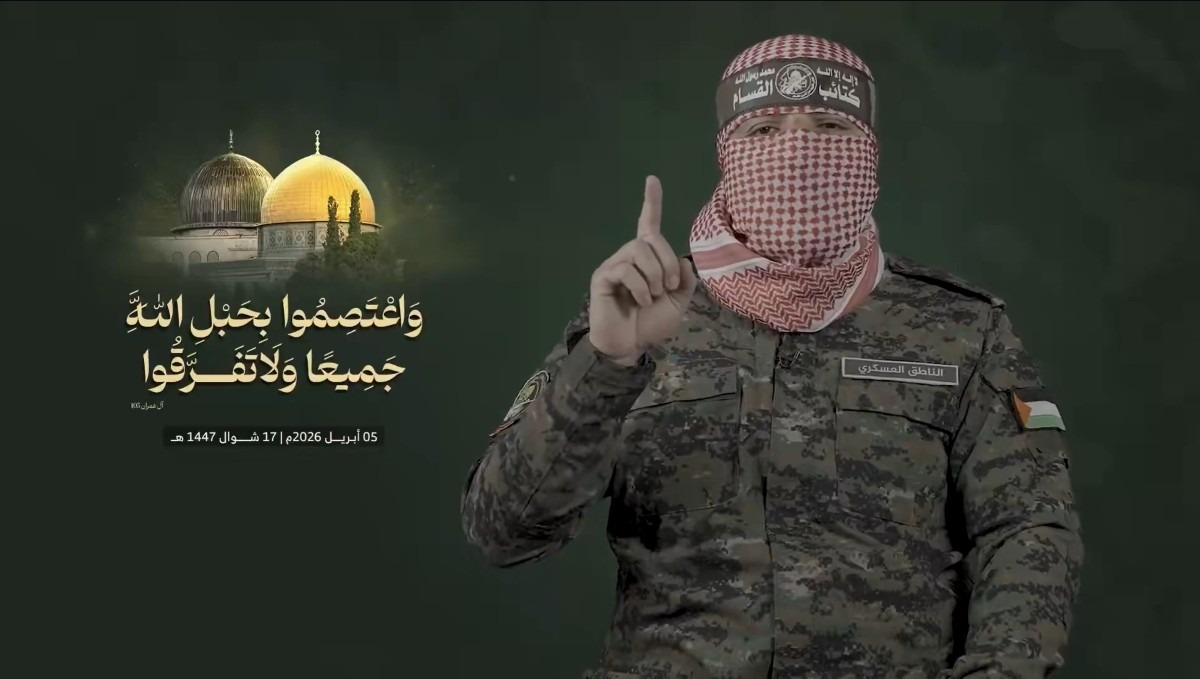
An April 5 speech by Hamas military spokesman Abu Obaida (pictured) leaves no doubt: Hamas remains fully committed to jihad (holy war) and rejects disarmament. Hamas remains a partner of Iran’s regional war machine, a committed enemy of peace, and a direct threat to the stability of the Middle East. (Image source: Hamas via X)

An April 5 speech by Hamas military spokesman Abu Obaida leaves no doubt: Hamas remains fully committed to jihad (holy war) and rejects disarmament.

Meanwhile, US President Donald J. Trump’s “Board of Peace,” an initiative to stabilize and rebuild the Gaza Strip, seems to be increasing pressure on Hamas. According to a report published in The New York Times, the board has set a deadline for the terror group to agree to a disarmament framework in the Gaza Strip by the end of the coming week.

Abu Obaida’s speech, unfortunately, is an emphatic warning that Hamas has no intention of complying:

“What the enemy is trying to push through today against the Palestinian resistance, via our brotherly mediators [Egypt, Qatar, and Turkey], is extremely dangerous. Raising the issue of weapons in this blunt manner is nothing but an overt attempt to continue the genocide against our people, something we will not accept under any circumstances. What the enemy failed to take from us through tanks and war, it will not be able to take through politics or at the negotiating table.”

Far from preparing to disarm, Hamas is publicly declaring its commitment to continued jihad, praising the Iranian regime and its proxies, and inciting Palestinians to escalate attacks against Israel.

The “Board of Peace” is therefore confronting a harsh reality: Hamas, like Iran, is not motivated by deadlines, incentives, or promises of reconstruction. It is motivated by ideology and by war.

The speech, in fact, is a manifesto of defiance.

From the outset, Abu Obaida frames the conflict in explicitly religious terms. Portraying the war not as a territorial dispute, but as a religious obligation, he calls on Muslims to “unite their ranks in confronting the disbelievers.”

He goes further by describing the current war as a “decisive phase in the history of this Ummah [Islamic nation],” a turning point meant to restore Islamic dominance and reverse what he calls the humiliation of Muslim lands:

“For even if the balance of power is disturbed, our truth is stronger than their falsehood, and our Ummah is one, its enemy is one.”

In Hamas’s worldview, the war is not about the Gaza Strip. It is about reshaping the Middle East – and beyond. It is a call for jihad.

Equally revealing is the Hamas spokesman’s repeated reference to the “Zionist-American assault” on Iran. By fusing Israel and the US into a single enemy, Hamas is openly declaring that the jihad is not directed only at Israel, but also at Washington. This is a direct message to American policymakers: Hamas does not distinguish between Israel and the US. It sees both as legitimate targets.

The implications are worse than they might at first look.

For Israel, the speech confirms that Hamas, like Iran, has not changed ideologically, despite the heavy military blows it has suffered since its October 7, 2023 invasion of Israel. On the contrary, the terror group remains as committed as ever to Israel’s destruction. Abu Obaida’s praise for Iran, Hezbollah, and Yemen’s Houthis underscores Hamas’s integration into a broader Iran-led war effort. Israel is not facing an isolated terrorist organization in the Gaza Strip, but a coordinated regional “Axis of Resistance.”

For the US, the message is equally clear. Hamas is rejecting any notion of compromise or disarmament. Despite repeated calls from Trump to lay down its arms, Hamas is doubling down on its strategy of armed struggle. The speech makes clear that Hamas views American pressure not as a reason to moderate, but as a further justification for jihad:

“The [US-Israeli] aggression will not achieve its results. The illusion of normalization they seek is doomed to failure. Those who hope to impose foreign ideologies from across the seas on our nation do not know the heritage, civilization, and power that the nation possesses.”

Any policy based on the assumption that Hamas can be persuaded to disarm is simply detached from reality.

The speech also contains an unmistakable warning to pro-Western Arab states, particularly in the Gulf. By accusing unnamed actors of seeking to “alter the concepts of the Islamic religion” and impose foreign systems of governance, Hamas is effectively attacking Arab regimes aligned with the US. These countries are portrayed not as partners, but as part of the problem – complicit in what Hamas describes as a campaign to subjugate the Islamic world.

The danger is that this rhetoric is designed to inflame public opinion in Arab and Islamic countries against their own governments, potentially destabilizing countries such as the United Arab Emirates and Bahrain that have chosen a path of pragmatism, normalization, and cooperation with Israel and the West.

At the same time, Hamas continues to incite violence on the ground. Abu Obaida’s call for unity and confrontation, regrettably, is not “just talk.” It is a direct appeal to Palestinians in the West Bank and Jerusalem to escalate their confrontation with Israel into deadly terrorist attacks. The speech’s portrayal of the war as a global crisis – claiming that Israel is plunging “the region, and indeed the world, into its furnace,” is, in addition, part of a broader propaganda effort by Hamas to shift blame for regional instability onto Israel and the US.

Stripped of its religious and ideological language, the message is simple: Hamas has no intention of ending the war. It is preparing for more.

The speech by Abu Obaida is a loud wake-up call. Hamas is planning escalation.

For Israel, the US, and pro-Western states, any strategy that assumes Hamas can be integrated, moderated, or coaxed into abandoning its weapons is not only unrealistic; it is naïve and dangerous.

Hamas at least is being honest. Hamas is not negotiating. Hamas is not moderating. Hamas is not preparing for peace. October 7, 2023, was not an isolated attack. It was part of an ongoing jihad: “The strikes [against Israel] by the fighters of Iran, Lebanon, and Yemen are an extension of the Al-Aqsa Flood [Hamas’s October 7 massacre].”

Israel, the US, and the Arab states aligned with the West might recognize the simple truth: Hamas remains a partner of Iran’s regional war machine, a committed enemy of peace, and a direct threat to the stability of the Middle East.

The question is whether the US is ready to listen.


Khaled Abu Toameh is an award-winning journalist based in Jerusalem.


Zawartość publikowanych artykułów i materiałów nie reprezentuje poglądów ani opinii Reunion’68,
ani też webmastera Blogu Reunion’68, chyba ze jest to wyraźnie zaznaczone.
Twoje uwagi, linki, własne artykuły lub wiadomości prześlij na adres:
webmaster@reunion68.com


London Jewish Community Feels ‘Anxious’ but ‘Resilient’ as It Prepares for Potential Future Attacks


London Jewish Community Feels ‘Anxious’ but ‘Resilient’ as It Prepares for Potential Future Attacks

Shiryn Ghermezian


A person holds a sign near the scene where four ambulances belonging to Hatzola, a Jewish community organization, were set on fire in an incident that the police say is being treated as an antisemitic hate crime, in northwest London, Britain, March 23, 2026. Photo: REUTERS/Isabel Infantes

The Jewish community in London is feeling “very anxious” while trying to stay vigilant and prepared for potential incidents in the future after four Hatzalah emergency vehicles were destroyed in an antisemitic arson attack last week, the president of the UK’s main Jewish umbrella organization said on Sunday.

“We’ve had two-and-a half-years of very high levels of antisemitism, obviously, the deadly attack at Heaton Park Synagogue in Manchester just in October, and now this incident, an arson attack in the heart of London’s Jewish community in Golders Green,” Phil Rosenberg of the Board of Deputies of British Jews said during an appearance on “BBC London Politics.”

“It is nonetheless a very resilient and proud community, and we are looking at how we push back and build back stronger,” Rosenberg added.

Roughly 150,000 Jewish people live in London.

Rosenberg, a deputy at a north London synagogue and former Labour councillor in Camden, was also asked about the British government’s response to the arson attack. He said that, with help from the government, the Jewish community in London is now equipped with specialist kits designed to help during future attacks, including equipment that could help with chemical exposure. The equipment was provided through a £28.4 million government grant to the Community Security Trust (CST), a Jewish charity that safeguards the safety and security of Jews across the UK.

“On the way here, I was looking at my WhatsApps. I saw one come in from my synagogue, and it was talking not about the great services we put on, the outreach to local communities, the wonderful art and charity that we do, but about a series of kits we’ve just received that will help the community if there’s an attack to stem the flow of blood, or if there’s a chemical attack. That is the situation we’re facing,” Rosenberg explained.

“It’s sad that it’s needed, though,” he added. “Because what we need to do is prevent this and create a situation where those things are not the things we’re talking about, and those are not the things we need. We want to be celebrating the Jewish community, and all communities in this city, and not [be] in fear of those sorts of attacks happening.”

Last year, there were over 1,800 antisemitic incidents in London, according to data compiled by CST. When asked if the Jewish community believes the government is doing enough to tackle the issue of antisemitism, Rosenberg said the response is “mixed.” He noted the speed at which the British government provided replacements vehicles for the Hatzalah ambulances destroyed last week and other moves by the government, like proscribing the pro-Hamas group Palestine Action.

“The government still needs to go further,” Rosenberg added, before calling for British leaders to proscribe Iran’s Islamic Revolutionary Guard Corps and to take more action to combat hatred flourishing on social media, among other issues.

“We’ve seen in our society a growth of extremism … and we are very concerned that we are seeing society being pulled apart,” he said. “We need to come together, among all communities, to push back against hatred in all its forms, including antisemitism, and marginalize those extremists.”


Zawartość publikowanych artykułów i materiałów nie reprezentuje poglądów ani opinii Reunion’68,
ani też webmastera Blogu Reunion’68, chyba ze jest to wyraźnie zaznaczone.
Twoje uwagi, linki, własne artykuły lub wiadomości prześlij na adres:
webmaster@reunion68.com