
Archive | 2026/04/24

Papież Leon odwiedza muzułmański pomnik dżihadystów – upamiętniający zabójców chrześcijan


Papież Leon odwiedza muzułmański pomnik dżihadystów – upamiętniający zabójców chrześcijan

Daniel Greenfield
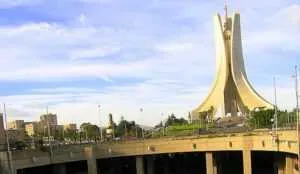

Pomnik Męczenników, Algier — autor: Bachounda, Creative Commons Attribution-Share Alike 3.0

Wyobraźmy sobie, że Hamas wygrałby 7 października, a ofiarami byliby chrześcijanie. Tak właśnie stało się w Algierii. Islamscy i marksistowscy Postowscy terroryści podczas wojny algierskiej prowadzili bezwzględną kampanię przeciwko ludności niemuzułmańskiej. W tym także Żydom.

Okrucieństwa muzułmańskich terrorystów obejmowały podcinanie gardeł kobietom oraz mordowanie niemowląt przez roztrzaskiwanie ich głów o ściany. Masakry osiągnęły kulminację w rzezi w Oranie, podczas której skorumpowany reżim de Gaulle’a odmówił ochrony chrześcijan i Żydów przed muzułmańskim tłumem.

Kościół katolicki praktycznie zniknął w Algierii po islamskim przejęciu władzy. Wśród zabitych byli także zamordowani członkowie Kościoła.

Pamięć o przemocy podczas algierskiego konfliktu w latach 90. stanowi centralny element tożsamości Kościoła katolickiego w tym kraju. W tym okresie zginęło wielu duchownych oraz osób zakonnych – kobiet i mężczyzn – w tym mnisi zamordowani podczas masakry w opactwie Tibhirine w 1996 roku oraz biskup Oranu Pierre Claverie. Katolicki mnich Jean-Pierre Schumacher pozostał, by opowiedzieć o niesławnej masakrze z 1996 roku w algierskim klasztorze Tibhirine, w której siedmiu jego współbraci zostało brutalnie zabitych.

Stanowisko Kościoła wobec tych masakr bywało surrealistyczne — jednocześnie oddające cześć ofiarom i ich zabójcom.

Biskup Pierre Claverie oraz jego 18 towarzyszy, którzy ponieśli męczeńską śmierć w Algierii z rąk islamistów w latach 1994–1996, zostali w sobotę beatyfikowani podczas mszy w Oranie.

Arcybiskup Algieru Paul Desfarges wspomniał o „tysiącach ofiar algierskiej wojny domowej”, nazywając je anonimowymi bohaterami.

„Nie chcieliśmy beatyfikacji tylko wśród chrześcijan, ponieważ ci bracia i siostry zginęli wśród dziesiątek i dziesiątek tysięcy algierskich muzułmanów” – stwierdził.

Populacja Algierii jest niemal w całości muzułmańska.

… ponieważ chrześcijanie zostali zabici lub wypędzeni.

Krewni beatyfikowanych zostali przyjęci przez muzułmańskich dostojników w Wielkim Meczecie Ibn Badisa, gdzie imam Mostapha Jaber powiedział: „My, muzułmanie, łączymy to wydarzenie z wielką radością.”

Papież Leon, pomiędzy krytykowaniem prezydenta Trumpa za przeciwstawianie się islamskiemu terroryzmowi, oddał hołd zabójcom.

.
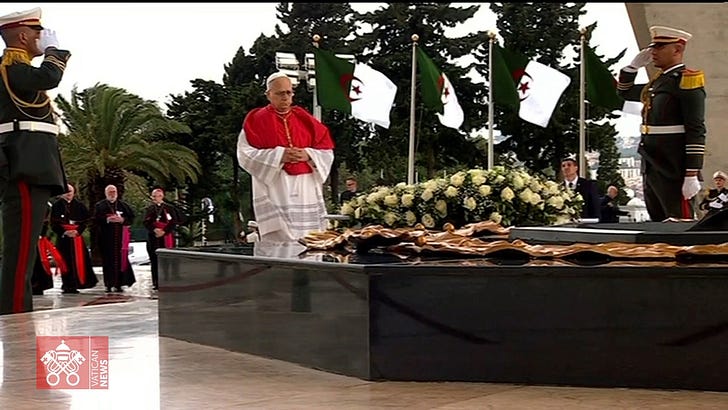
Podczas swojego pierwszego publicznego wystąpienia w Algierii papież Leon XIV odwiedził Pomnik Męczenników „Maqam Echahid”, który upamiętnia tych, którzy stracili życie w wojnie o niepodległość Algierii w latach 1954–1962.

Wizyta przy pomniku jest momentem oddania hołdu historii Algierii oraz duchowi tych, którzy walczyli o niepodległość, godność i suwerenność.

Papież Leon podkreślił, że osoby upamiętnione na pomniku „już udzieliły swojej odpowiedzi. Straciły życie, ale czyniąc to, oddały je z miłości do własnego narodu.”

Ich narodu, czyli… arabskich muzułmanów. Istotnie kochali swój naród i nienawidzili narodu papieża Leona. Papież Leon nienawidzi własnego narodu i kocha ich muzułmańskich zabójców.

Warto zauważyć, że Pomnik Męczenników nie upamiętnia tych, którzy „stracili życie” w wojnie. Upamiętnia terrorystów i zabójców.

Pod „Pomnikiem” znajduje się Muzeum El Mujahid. To oznacza dżihadystów. To jest złowrogie szaleństwo. Ale podobnie wyglądało traktowanie własnych obywateli przez Francję w Algierii, działania rządu brytyjskiego wobec dziewcząt gwałconych przez pakistańskie muzułmańskie gangi groomingowe oraz traktowanie Amerykanów sprzeciwiających się islamskiemu terroryzmowi po 11 września.

Największą sztuczką zła jest udawanie, że stoi po stronie pokoju, nawet gdy wzmacnia potwory i zabójców.


Link do oryginału: https://jihadwatch.org/2026/04/pope-leo-visits-muslim-jihadist-memorial-to-killers-of-christians

Jihad Watch, 15 kwietnia 2026


Zawartość publikowanych artykułów i materiałów nie reprezentuje poglądów ani opinii Reunion’68,
ani też webmastera Blogu Reunion’68, chyba ze jest to wyraźnie zaznaczone.
Twoje uwagi, linki, własne artykuły lub wiadomości prześlij na adres:
webmaster@reunion68.com


Isaac Accords, Wave of IRGC Terror Designations Signal Deepening Israel–Latin America Ties


Isaac Accords, Wave of IRGC Terror Designations Signal Deepening Israel–Latin America Ties

Ailin Vilches Arguello


Argentina’s President Javier Milei receives Presidential Medal of Honor from Israel’s President Isaac Herzog in Jerusalem, April 20, 2026. Photo: REUTERS/Amir Cohen

As Israel deepens its diplomatic outreach across Latin America, a quiet but notable convergence is taking shape, with regional governments tightening security cooperation and increasingly aligning efforts to counter Iranian-linked terrorism and illicit networks operating across the hemisphere.

During a state visit to Israel on Sunday, Argentine President Javier Milei and Israeli Prime Minister Benjamin Netanyahu formally signed the Isaac Accords, a new framework aimed at deepening ties between Israel and Latin American governments while jointly addressing antisemitism and terrorism.

According to Toby Dershowitz, senior adviser at the Foundation for Defense of Democracies (FDD), a Washington, DC–based think tank, this initiative builds on rising regional momentum for closer cooperation with the Jewish state and sets in place a framework for intelligence-sharing and coordinated law enforcement efforts aimed at countering Iranian proxy networks operating across the hemisphere.

Latin America has long been regarded as a hub for Iran-backed Hezbollah’s illicit drug trafficking and other criminal activities, which have been used to finance its broader terrorist operations worldwide.

“While just formally signed in recent days, there is already momentum behind some of the Isaac Accords’ goals,” Dershowitz told The Algemeiner. “Several countries have taken steps – including terrorism designations – to counter the Islamic Republic’s threat.” 

“The Western Hemisphere has been plagued by Iran-backed terrorism for decades and countries are increasingly leveraging support from allies in the region to address the threat,” she continued.

Modeled after the Abraham Accords — a series of historic, US-brokered normalization agreements between Israel and several Arab countries — this new initiative aims to strengthen political, economic, and cultural cooperation between the Jewish state and Latin American governments. 

During the signing ceremony, Milei described the launch of the accords as “a historic moment for our nations,” saying they are intended to advance peace through efforts to strengthen long-term regional stability, security, and economic prosperity.

The Isaac Accords “will not only strengthen the relationship between Argentina and Israel, united by shared values, but also mark a step toward a freer and more prosperous hemisphere,” the Argentine leader said.

According to a joint statement between the two leaders, the new initiative will focus on technology, security, and economic development, with an emphasis on deepening cooperation in innovation, commerce, and cultural exchange. 

It will also seek to encourage partner countries to relocate their embassies to Jerusalem, formally designate Hamas and Hezbollah as terrorist organizations, and shift longstanding voting patterns on Israel at the United Nations.

Dershowitz explained that the push to formally designate Iran’s Islamic Revolutionary Guard Corps (IRGC) and its proxy groups as terrorist organizations — an approach already adopted by several Latin American countries — is central to strengthening states’ ability to investigate and prosecute terrorism networks.

She also noted that such designations facilitate cooperation with global financial intelligence units, expanding the legal tools available to track and disrupt illicit financing.

“Iran has a concerning footprint in Latin America. Some countries in the region face major Hezbollah-linked drug trafficking challenges and, as a result, exposure to illicit financial flows,” Dershowitz said. “It is no doubt part of the calculus that led to these designations.”

Since the start of the war in Gaza, and even more so amid the broader confrontation with Iran, Latin American countries have increasingly sought to align their domestic legislation with international sanctions frameworks targeting Hezbollah, Hamas, and the IRGC — all of which are designated by the United States, the United Kingdom, and the European Union.

Ecuador, Costa Rica, and Paraguay are among some of the countries that have designated Hamas, Hezbollah, and the IRGC as terrorist organizations.

More recently, Costa Rica and Trinidad and Tobago have also followed suit, proscribing all three Iranian and Iran-backed entities.

Once a formal designation is in place, authorities can immediately freeze a wide range of assets belonging to designated entities without the need for a prior criminal conviction. 

The designation also makes it a criminal offense to provide such entities with material support — such as funding, transportation, housing, or false documentation — while giving authorities additional tools to track and map a group’s logistical and financial networks.

Last month, Argentina also designated the IRGC as a terrorist organization, after previously designating the Palestinian group Hamas in 2024 and the Lebanese group Hezbollah in 2019.

After Iran accused Buenos Aires of “siding with the aggressors” and violating international law with its latest designation, the Argentine government declared Iranian chargé d’affaires Mohsen Tehrani “persona non grata” and gave him 48 hours to leave the country.


Zawartość publikowanych artykułów i materiałów nie reprezentuje poglądów ani opinii Reunion’68,
ani też webmastera Blogu Reunion’68, chyba ze jest to wyraźnie zaznaczone.
Twoje uwagi, linki, własne artykuły lub wiadomości prześlij na adres:
webmaster@reunion68.com


Erdogan’s Turkey Weaponizes Judicial Mechanisms Against Israel


Erdogan’s Turkey Weaponizes Judicial Mechanisms Against Israel

Ioannis E. Kotoulas


Turkish President Tayyip Erdogan is welcomed by Qatar’s Emir Sheikh Tamim bin Hamad al-Thani in Doha, Qatar, Oct. 22, 2025. Photo: Murat Kula/Turkish Presidential Press Office/Handout via REUTERS

As the US and Israel are attempting to eradicate the nuclear threat of Iran’s Islamist regime with Operation Epic Fury and Operation Roaring Lion, usual suspect Turkey — a nominal NATO ally of the US — undermines their efforts. Turkey has been a close ally of the Iranian Islamist regime and Hamas’ most vocal supporter on an international level. Ever since Hamas launched a horrific attack on Israeli civilians on October 7, 2023, Turkey has been opposing Israel. Now Turkey resorts to renewed threats against Israel by weaponizing its judicial mechanisms.

On Apr. 10, the regime-affiliated Istanbul Chief Public Prosecutor’s Office filed indictments against 35 top Israeli officials, including Prime Minister Benjamin Netanyahu, Defense Minister Israel Katz, National Security Minister Itamar Ben Gvir, and IDF Chief of Staff Lt. Gen. Eyal Zamir. seeking a total of more than 4,500 years in prison.

The indictments relate to Israel’s Oct. 1, 2025, interception of the Global Sumud Flotilla that was trying to breach the Israeli blockade of Islamist Hamas in Gaza. The indictment seeks aggravated life sentences as well as prison terms ranging from 1,102 years and 9 months to 4,596 years for each suspect on charges, including “crimes against humanity,” “genocide,” “deprivation of liberty,” “torture,” “damage to property,” “qualified looting,” and “obstructing, hijacking or detaining transportation vehicles.”

The supposed investigation is said to unfold within the framework of the United Nations Convention on the Law of the Sea (UNCLOS), which Turkey itself has not signed.

Israeli Premier Benjamin Netanyahu did not hold back in his response, accusing Erdogan of massacring Kurds in his own country. “Israel under my leadership will continue to fight Iran’s terror regime and its proxies, unlike Erdogan who accommodates them and massacred his own Kurdish citizens,” he wrote on X. The persecution of the Kurdish population, both inside Turkey and in neighboring countries — Syria and Iraq — by Turkish authorities, has been going on for decades. Turkey’s Foreign Ministry repeated well-known tropes of anti-Israeli propaganda, calling the Israeli premier “the Hitler of our time.”

Israeli Defense Minister Israel Katz, a vocal critic of Turkey’s aggression, also lashed out at Erdogan on X, calling him a “paper tiger.” “Erdogan, who did not respond to missile fire from Iran into Turkish territory and has proven to be a paper tiger, is now fleeing into the realm of antisemitism and calling for show trials in Turkey against Israel’s political and military leadership,” he said. “What an absurdity. A man of the Muslim Brotherhood, who massacred the Kurds, accuses Israel — defending itself against his Hamas allies — of genocide,” Katz added. “Israel will continue to defend itself with strength and determination — and he would do well to remain silent.”

Israel has established a trilateral cooperation on security, defense, and energy with Greece and Cyprus, two European states that function as Israel’s necessary strategic depth in its greater Islamic neighborhood. In an interview with state-affiliated Anadolu news agency on Apr. 13, Turkish Foreign Minister Hakan Fidan criticized Greece and Cyprus over their cooperation with Israel, warning it could heighten regional tensions. The Turkish official also claimed that Israel “may seek to characterize Turkey as a new adversary after Iran, as it cannot survive without an enemy.” Greece’s Foreign Ministry replied promptly that it owes no explanations to Turkey over its long-standing alliance with Israel.

Turkish aggressive rhetoric against Israel, Greece, and Cyprus have recurred time after time.

Turkish President Recep Tayyip Erdogan has repeatedly threatened to use military force against all three states. In this context, Israel’s growing cooperation with Greece and Cyprus is essential in lifting Israel out of its Arab surroundings and engaging with a greater Mediterranean and pro-Western security environment.

“Turkey’s latest wave of anti-Israeli rhetoric following the Israel–Greece–Cyprus cooperation mechanisms reflect a familiar pattern rather than a sudden shift. Ankara views the deepening cooperation among these three states as a direct challenge to its regional influence in the Eastern Mediterranean. Israel’s growing strategic relationship with Greece and Cyprus in the Eastern Mediterranean gives Israel an alternative regional anchor that is not dependent on Arab consensus, and it opens pathways for security cooperation that can survive diplomatic storms in the Middle East. For Turkey in particular, the Israel–Greece–Cyprus triangle is a constant reminder that Israel has options, and that attempts to corner Israel politically can push it deeper into partnerships that Turkey cannot easily penetrate,” US national security lawyer, geopolitical analyst, and fellow at the Jerusalem Center for Public Affairs Irina Tsukerman, told the Investigative Project on Terrorism (IPT).

The relations of Turkey and Hamas have run deep for decades, and have been thoroughly documented by IPT in various analyses (here and here). Erdogan’s Turkey has an ambiguous relationship with extremist Islamist ideology, having supported the Islamic State and other terrorist Islamist organizations in Syria and Libya. The Turkish government supports the notorious Muslim Brotherhood, designated by the US as a foreign terrorist organization. Erdogan himself has repeatedly met with the leadership of Hamas in Turkey.

According to Israel’s Shin Bet, Hamas has established a command post in Turkey which it uses to recruit operatives and oversee operations in the Middle East and specifically in the West Bank against Israel. In September 2023, just weeks before the October 7 assault, Israeli customs authorities seized 16 tons of explosive material sent from Turkey to Gaza, hidden behind packages of construction supplies.

In many instances after the October 7 attack, Turkish Erdogan has lauded Hamas as “a liberation group, ‘mujahideen’ waging a battle to protect its lands and people.” Just weeks after the horrific attack, Erdogan cancelled a planned visit to Israel. Turkey suspended its trade with Israel, closed its airspace to Israeli planes, and issued arrest warrants for 37 Israeli officials, including Netanyahu.

Erdogan has treated Hamas as a sort of bulwark for Turkish interests, claiming in various instances that if the Islamist organization were to be eradicated, then Israel would come for Turkey next. Meanwhile, state-affiliated Turkish media continue to portray Israel as a “number one threat” for Turkey, while they always describe Hamas as a “Palestinian resistance movement.” Even after the October 7 attacks, the Turkish leadership called for an Islamic alliance against Israel, effectively a call to jihad.


IPT Senior Fellow Ioannis E. Kotoulas (Ph.D. in History, Ph.D. in Geopolitics) is Adjunct Lecturer in Geopolitics at the University of Athens, Greece. A version of this article was originally published by IPT.


Zawartość publikowanych artykułów i materiałów nie reprezentuje poglądów ani opinii Reunion’68,
ani też webmastera Blogu Reunion’68, chyba ze jest to wyraźnie zaznaczone.
Twoje uwagi, linki, własne artykuły lub wiadomości prześlij na adres:
webmaster@reunion68.com