
Archive | 2026/04/26

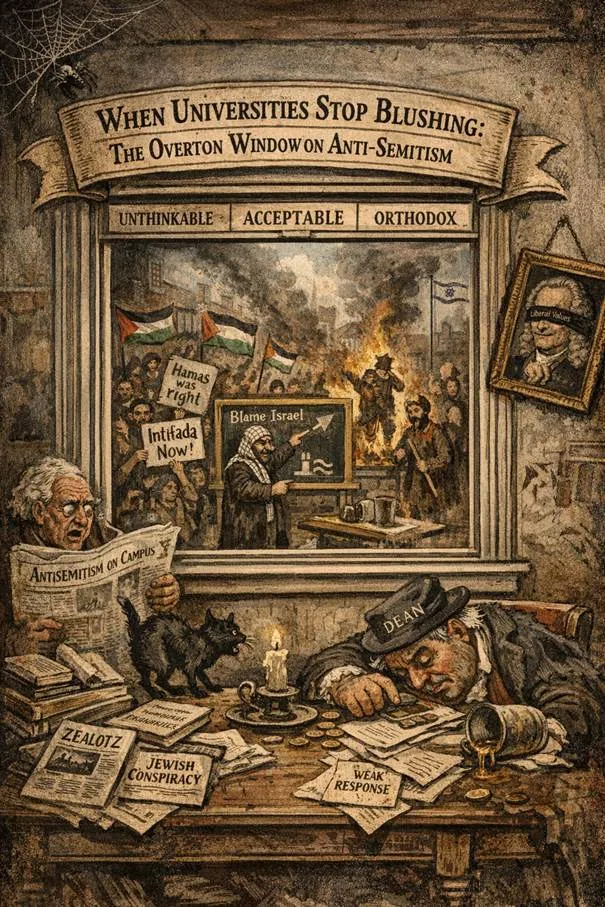
Kiedy uniwersytety przestają się rumienić


Kiedy uniwersytety przestają się rumienić

Paul Finlayson


Istnieje w dyskursie politycznym pojęcie — beznamiętnie określane mianem Okna Podtekstów — które opisuje zakres idei uznawanych przez społeczeństwo za dopuszczalne do wyrażania. Można o nim myśleć prościej jako o niewidzialnej granicy między tym, co można powiedzieć bez konsekwencji, a tym, czego powiedzieć nie można. Poza oknem leży to, co nie do pomyślenia; wewnątrz — to, co jedynie kontrowersyjne; a w jego centrum — to, co wygodnie ortodoksyjne.

Rzadziej zauważa się natomiast, w jaki sposób to okno się przesuwa. Nie otwiera się z hukiem. Przesuwa się. To, czego nie dało się powiedzieć, staje się możliwe do wypowiedzenia. To, co można było powiedzieć, staje się możliwe do obrony. A to, co jest bronione, z czasem często staje się zupełnie niebudzące zdziwienia.

Jedną z bardziej dezorientujących cech naszej chwili jest to, że ten ruch przestał być subtelny. W istocie zaszedł tak daleko, że satyra — niegdyś niezawodne narzędzie obnażania absurdów — staje się coraz bardziej zbędna. Nie dlatego, że rzeczywistość się poprawiła, lecz dlatego, że tak wyraźnie się pogorszyła. Dziś spotyka się twierdzenia — wygłaszane z pełną powagą — które kiedyś wymagałyby parodii, by w ogóle zostały rozważone. Pojawiają się nie jako żarty, lecz jako argumenty; nie jako prowokacje, lecz jako wnioski.

Weźmy na przykład tezę — dziś ani rzadką, ani szeptaną — że masakra około 1200 Izraelczyków dokonana przez Hamas 7 października była w istocie winą Izraela. Nie w znanym języku krzywd czy przyczynowości, lecz w znacznie bardziej pomysłowej sugestii, że Izrael w pewien sposób sam zaaranżował rzeź własnych obywateli. Na tym etapie polemika staje się ozdobnikiem. Nie sposób rozumować z poglądem, który wyemancypował się od potrzeby spójności.

To, czego jesteśmy świadkami, to nie tylko błąd, lecz odwrócenie porządku. Celowe zabijanie cywilów — niegdyś uznawane za najbardziej oczywistą granicę moralną — jest dziś w pewnych kręgach czymś, co się usprawiedliwia, kontekstualizuje, a czasem nawet oklaskuje.

A gdy ta granica zostaje przekroczona, nie układa się ona uprzejmie gdzie indziej. Jeśli można świętować zabijanie Żydów w jednym miejscu, zasada została już przyjęta. Geografia nie daje schronienia moralnego. Odległość między „tam” a „tu” nie mierzy się w milach, lecz w zasadach — a gdy te zostają porzucone, dystans się zapada.

Nie jest to już zjawisko ograniczone do marginesu. Na Uniwersytecie Guelph-Humber wielu członków kadry publicznie reagowało na wydarzenia z 7 października w sposób usprawiedliwiający lub wręcz celebrujący — i to nie prywatnie, lecz w formach utrwalonych. Jedno z porównań zestawiało Hamas z Ukraińcami broniącymi swojego państwa — ujęcie, które niegdyś natychmiast wywołałoby krytyczną reakcję.

Najbardziej wymowne nie jest jednak samo to, że takie wypowiedzi padają, lecz jak są formułowane: otwarcie, bez wahania i bez widocznej obawy przed konsekwencjami. Gdy jeden z wykładowców został publicznie skrytykowany za długą historię antyżydowskich komentarzy, odpowiedzią nie był odwrót, doprecyzowanie ani nawet taktyczne milczenie. Była nią kontynuacja. Wpisy nie ustały; trwały nadal.

Nie jest to zachowanie człowieka nierozważnego. To zachowanie kogoś, kto dokonał oceny — i z jego perspektywy racjonalnej — środowiska, w którym funkcjonuje. Sugeruje to przekonanie, że jakakolwiek zewnętrzna krytyka się pojawi, nie przełoży się na realne konsekwencje instytucjonalne.

I to jest punkt poważniejszy. Instytucje rzadko ogłaszają swoje stanowiska moralne wprost. Ujawniają je poprzez tolerancję, poprzez bezczynność, poprzez ciche zapewnienie, że pewne granice można przekraczać bez kosztów. Nie trzeba dowodzić formalnego poparcia, by dostrzec faktyczne przyzwolenie.

Skutki nie są abstrakcyjne. Są doświadczane. Jedna ze studentek Guelph-Humber opisuje, że niechętnie nosi na kampusie kurtkę reprezentacyjną z Igrzysk Maccabiah — zwykły wyraz tożsamości, który dla bezpieczeństwa należało do ukryć. Inna relacjonuje, że po rozwinięciu palestyńskiej flagi podczas ceremonii ukończenia studiów — przy uśmiechach i oklaskach — poczuła dyskomfort nawet wobec samego uczestnictwa w swojej własnej uroczystości. Ceremonia mająca celebrować osiągnięcie stała się, w jej odczuciu, czymś, do czego należy podchodzić z ostrożnością.

Inni mówią o wrogich hasłach wykrzykiwanych otwarcie na korytarzach, po czym skargi spotykają się nie z działaniem, lecz z lekceważeniem. Nie trzeba rozstrzygać każdego zarzutu, by dostrzec wzorzec, jaki opisują te relacje: środowisko, w którym część studentów zaczyna dozować swoją widoczność, ważyć swój udział, decydować, kiedy bezpieczniej jest nie zabierać głosu.

W tym miejscu zaczyna się rozchodzić to, co oficjalne, z tym, co faktyczne. Z jednej strony instytucje nadal publikują swoje rytualne oświadczenia — wygładzone, wyważone i całkowicie zapominane — odnotowujące żydowskie święta językiem inkluzywności tak starannie wycyzelowanym, że grozi on utratą jakiegokolwiek znaczenia. Z drugiej strony codzienne doświadczenia opisywane przez niektórych studentów sugerują coś znacznie mniej uspokajającego.

Jest w tym pewna niezamierzona szczerość. Oświadczenia mówią o wartościach; milczenie ujawnia priorytety.

I nie jest to percepcja ograniczona do jednej instytucji. Podobne obawy pojawiają się na różnych kampusach — na Uniwersytecie w Toronto, na York University, w Langara College i na McGill University. Różne przypadki, różne fakty — lecz powracające oskarżenie, że granica między tym, co potępiane w zasadzie, a tym, co dopuszczane w praktyce, się poszerza.

Tymczasem Okno Podtekstów się przesuwa. Nie dramatycznie, nie przez deklaracje, lecz przez kumulację. To, czego nie dało się powiedzieć, staje się możliwe do wypowiedzenia. To, co można było powiedzieć, staje się możliwe do obrony. A to, co można obronić, z czasem staje się rutyną.

Często słyszy się w tym miejscu, by nie przesadzać. By nie spekulować. By nie sugerować, że dzisiejsze tolerancje mogą stać się jutrzejszymi normami. „Nie mów, że to mogłoby się wydarzyć” — pada odpowiedź, zwykle z nutą uprzejmego niedowierzania.

Właśnie o to jednak chodzi.

Pięć czy dziesięć lat temu zasugerowanie, że w renomowanych instytucjach można ponosić zawodowe ryzyko za potępienie uznanej organizacji terrorystycznej, podczas gdy wrogość wobec Żydów może być wyrażana bez widocznych konsekwencji, uznano by za niedorzeczne — jeśli nie złośliwe. Przypomniano by zapewne, nie bez zniecierpliwienia, że uniwersytety kierują się standardami, że takie asymetrie nie mogą istnieć.

A jednak spójrzmy na to, co dziś uchodzi bez natychmiastowej reakcji instytucjonalnej. Na Uniwersytecie w Toronto dziekan stomatologii użył w prezentacji dydaktycznej średniowiecznej karykatury Żyda — otoczonego pieniędzmi — jako obrazu zgnilizny i rozkładu. Nie był to ulotny komentarz ani zasłyszana uwaga, lecz przygotowany materiał wizualny w formalnym kontekście akademickim. Instytucja nie zareagowała z własnej inicjatywy. Dopiero sprzeciw studentów sprawił, że sprawa w ogóle ujrzała światło dzienne.

Prosi się nas teraz, by przyjąć jako wyjaśnienie, że takie obrazy — niemal dosłownie zaczerpnięte z najbardziej rozpoznawalnej ikonografii antysemickiej lat 30. — zostały użyte bez świadomości ich znaczenia. Mówi się, że nie była to złośliwość, lecz ignorancja. Każdy może sam ocenić, co jest bardziej uspokajające.

Tymczasem schemat stał się niemal podręcznikowy. Wydawane jest oświadczenie — wyważone, inkluzywne i całkowicie pozbawione konsekwencji. Deklaracja, że instytucja „tego nie popiera”, połączona z ogólnikową życzliwością wobec wszystkich. Rodzaj moralnej dymnej zasłony: starannie uformowanej, bez smaku i zaprojektowanej przede wszystkim tak, by nikogo nie urazić, nie spełniając przy tym żadnego standardu. Prawdziwym celem nie jest korekta, lecz zarządzanie kryzysem — uprzejmie sformułowana prośba, by pozostawić sprawę samą sobie, aż zniknie z pola uwagi publicznej.

I znika. Zawsze znika. Wraca cisza. Czas robi swoje. A jak zaobserwowano w innych instytucjach, osoba, której sprawa dotyczyła, po cichu wraca do swoich obowiązków, być może poprzedzone to zostaje stosownie nijakimi przeprosinami.

Teza, która kiedyś brzmiała jak satyra — że takie asymetrie mogą istnieć — dziś nie wymaga już żadnej przesady.

A jednak znajdujemy się w sytuacji, w której debatujemy właśnie o takiej asymetrii.

Tak działa rozpęd. Nie ogłasza się jako rozpęd. Na każdym etapie jawi się jako wyjątek, niuans, szczególny przypadek. To, co kiedyś szokowało, staje się dyskutowalne. To, co dyskutowalne, staje się tolerowane. A to, co tolerowane, z czasem staje się rutyną.

Nie trzeba przewidywać, że uniwersytety w określonym dniu zaczną wprost wykluczać studentów żydowskich. Można szczerze mieć nadzieję, że do tego nigdy nie dojdzie. Nieroztropne jest jednak twierdzenie, że jest to nie do pomyślenia. Odległość między tym, co uznaje się za niemożliwe, a tym, co później akceptuje się jako nieuniknione, okazała się w ostatnich latach zaskakująco krótka.

Można zapytać, dlaczego miałoby to mieć znaczenie poza zamkniętym światem akademii. Odpowiedź jest prosta. Uniwersytety nie tylko odzwierciedlają społeczeństwo; one je wyprzedzają. Kształtują założenia, odruchy i słownik moralny tych, którzy z czasem zasilą inne instytucje. Dzisiejszy student to jutrzejszy profesjonalista. To, co zostaje znormalizowane w sali seminaryjnej, nie pozostaje w niej.

Zawsze było tak, że uniwersytety skłaniają się ku lewicy w społeczeństwach, które je utrzymują. Samo w sobie nie jest to niczym niezwykłym. Niezwykła jest natomiast skala, w jakiej pewne skrajności zdają się korzystać ze szczególnej immunizacji — milczącego, lecz silnego przeświadczenia, że nie będą poważnie kwestionowane.

A więc linia się przesuwa. Cicho. Uporczywie. Niemal uprzejmie. 

Aż pewnego dnia przestaje być w ogóle widoczna. Wtedy satyra staje się zbędna.

Nie ma już nic do wyolbrzymiania.


Link do oryginału:

Freedom to Offend
When Universities Stop Blushing: The Overton Window on Anti-Semitism
There exists a concept in political discourse—bloodlessly termed the Overton window—which describes the range of ideas a society considers acceptable to express. One might think of it more simply as the invisible boundary between what can be said without consequence and what cannot. Outside the window lies the unthinkable; inside it, the merely controve…

Zawartość publikowanych artykułów i materiałów nie reprezentuje poglądów ani opinii Reunion’68,
ani też webmastera Blogu Reunion’68, chyba ze jest to wyraźnie zaznaczone.
Twoje uwagi, linki, własne artykuły lub wiadomości prześlij na adres:
webmaster@reunion68.com



In Solidarity, I Wear a Kippah Every Day


In Solidarity, I Wear a Kippah Every Day


Steve Siporin


A head covering isn’t solely for the observant. Now, more than ever, it’s a way to signal Jewish pride.

TOBIAS SCHWARZ/AFP via Getty Images

It was the late 1960s. I was in my early 20s, with thick, dark brown hair and a thick head to go with it. But there was no space for a kippah on that head because there was no place for a kippah in my image of myself as a free, unfettered soul, my hair blowing in the wind.

The headgear of belief faced unfavorable odds opposite the headgear of boyhood vanity. I understood from the American culture in which I was raised that any type of head covering other than a cowboy hat, baseball cap, football helmet, or military headgear signaled weakness. A black kippah—the only kind I knew other than the white ones reserved for Yom Kippur—was fine for weak, skinny boys with glasses. But not me. I wanted to be Tarzan. Even the word yarmulke sounded weak to me, and so did Yiddish, for that matter. I had imbibed a stereotype of the traditional, bookish Jew who always wore a kippah.

I must have started feeling uncomfortable with the kippah not long after my bar mitzvah. It was about that time that I announced to my family—at our Passover Seder, no less—that I didn’t believe in God. Just after I had spoken the fateful words, my bubbe entered the dining room, carrying large serving plates laden with sliced turkey and roasted potatoes, one plate in each mighty hand. My proclamation had been followed by horrified silence. Bubbe looked around and asked what was going on.

“Charles says he doesn’t believe in God,” an indignant aunt explained.

“Don’t be silly. Even presidents and kings believe in God.” With that, Bubbe dismissed my words as something no one could take seriously.

If wearing a kippah ‘just wasn’t me,’ I could change. And if someone mistook me for an Orthodox Jew, was that really so bad?

Nevertheless, during my early teenage years, my arrogance grew. I considered myself smarter and more sophisticated than the clueless adults who, I thought, filled the synagogue “like sheep.” I considered religion irrational, a crutch for those unable to reason or face reality. Still, I continued to self-identify as a Jew; my Jewish bonds with home, family, and the holidays were strong.

In 1971, when I was in my early 20s, I went to live on an Israeli kibbutz. The experience was unexpectedly positive and liberating. I discovered that one could be completely Jewish without being observant—and without wearing a kippah. The masculine, sunlit, kibbutznik culture suited my Midwestern American upbringing and values. I was finally comfortable in my Jewish body. I lost any residual guilt I had felt for not wearing my kippah.

At the same time, when I visited Jerusalem, I saw men wearing kippot in a wide variety of colors, fabrics, styles, and sizes. That was OK, too, I thought; just not me.

I returned to the United States and eventually found a position at a university in the rural West, far away from Jewish population centers. When I traveled, especially to the East Coast, I would sometimes see men on the street wearing kippahs, and I would feel a yearning for Jewish life. Despite my disbelief, something bothered me. Something was missing.

In my 40s, I wrote down a story that my mother had told me about her earlier years. It was the late 1930s, and she was riding a bus in New York City. A man sat down next to her and struck up a conversation, which eventually led to his rant against Jews, including how glad he was that Hitler was “finally giving them what they deserve.” While he was speaking, my mother gently drew out the silver Magen David that she wore around her neck, inside her blouse. She didn’t look at the man but rather at the pendant, turning it over in her hands, as if examining it. The fellow looked into her eyes to observe her reaction to his words. Then his gaze followed her gaze to her hands. He fell silent and soon left his seat.

At the beginning of the Second Intifada in 2000, like many other Jews, I became aware of the Jew hatred that had been unleashed and encouraged in the United States, including increasingly biased media coverage of Israel. I decided to wear a kippah in public in protest. I thought that would be a way to encourage other Jews and supporters and to say to the haters, “You may not like us, but we’re here, and we won’t be intimidated.”

I lasted one day.

During that day, I experienced two negative internal reactions: The first was that wearing a kippah felt inauthentic. The second was that in wearing a kippah, I was misleading people. I was signaling that I was observant, had an unambivalent belief in God, and was devout.

Still, I was uncomfortable without it. Where had my commitment gone? Had it just been bravado?

As the Second Intifada continued, my English department colleagues showed themselves to be antagonistic toward Israel. Or maybe it was that I became more aware of their attitudes. They were indifferent, at best, when Israeli academics were discriminated against as a group, barred from certain academic associations, editorial staffs, and boards of journals. Academic freedom—which I had naively thought my colleagues held sacred—had been directly violated. No one blinked. No one protested. No one even agreed to sign a letter of protest. After 30 years, I no longer felt part of the English department.

In July 2014, Hamas rocket attacks against Israel triggered another war in Gaza. Meanwhile, I read about the increase in antisemitic acts in Europe, recalled the recent murder of Jews in a kosher supermarket in Paris, and learned how Malmö, Sweden, had become a “no-go zone” for Jews. Something changed again. I became aware that, besides fulfilling a commandment, wearing a kippah in public meant what it always had meant: a willingness to claim one’s Judaism and Jewish identity while at the risk of being a target. My colleagues soon saw me wearing my kippah every day.

This time, I was able to cross the line I had wanted to cross before but couldn’t. I recognized that my youthful desire to be completely free had been misplaced. To have unlimited freedom was not to be free at all, but to be adrift, with no basis for choices and commitments. The question was not how to be unfettered; the question was which “fetters” to wear.

My earlier objections to the kippah faded. If wearing a kippah “just wasn’t me,” I could change. And if someone mistook me for an Orthodox Jew, was that really so bad? If that someone was another Jew, we could talk, and both of us would learn something. And if my interlocutor was not Jewish but curious, I could tell them that I was acting in solidarity with visibly recognizable Jews who had always accepted being vulnerable targets on the front lines, so to speak. Since I’ve returned to wearing my kippah, both kinds of encounters, with Jews and gentiles, have happened. But neither would have taken place had I not been wearing my kippah.

On Oct. 7, the stakes of being Jewish in public increased exponentially. Today’s conditions were unforeseeable to most of us a few years ago, although my kippah chronicle suggests a steady escalation that led to the present situation. It has been suggested that we no longer wear our kippot and Magen Davids in public. It has also been recommended that we make a point of wearing them. I chose the latter course.

When I first started wearing my kippah again, my goal was to teach others what I thought they should know. There was still an echo of my youthful arrogance in that attitude. As time passed, my kippah taught me what I should know; it deepened my understanding of my behavior and its significance. Wearing my kippah in public, I now represent the Jewish people and Judaism in a way I didn’t before. How I act may affect other people’s perceptions of Jews. Will I be courteous or thoughtless, generous or selfish, supportive or sullen, helpful or too busy to help? Wearing my small, blue, flower-embroidered kippah on the street reminds me that everything I do matters. And that I’m part of a bigger, stronger tribe.


Steve Siporin is a professor emeritus in English and folklore at Utah State University. He is the author of The Befana is Returning: The Story of a Tuscan Festival.


Zawartość publikowanych artykułów i materiałów nie reprezentuje poglądów ani opinii Reunion’68,
ani też webmastera Blogu Reunion’68, chyba ze jest to wyraźnie zaznaczone.
Twoje uwagi, linki, własne artykuły lub wiadomości prześlij na adres:
webmaster@reunion68.com


Israel Votes in Favor of Iran Joining International Cheer Union: ‘The Iranian People Are Not Enemies’


Israel Votes in Favor of Iran Joining International Cheer Union: ‘The Iranian People Are Not Enemies’

Shiryn Ghermezian


Ludmila Yasinska, far right, posing with members of the Israeli Cheer Union competing at the 2026 ICU World Cheerleading Championships in Orlando, Florida. Photo: Provided

Israel’s representative at the International Cheer Union (ICU) General Meeting in Orlando, Florida, this week voted in favor of Iran becoming a member nation of the organization.

Ludmila Yasinska, president of the Israeli Cheer Union, attended the annual meeting in-person and voted for Iran joining the ICU, the official world governing body for cheerleading.

The decision was approved, and a total of five applicant countries have newly joined the organization: Iran, Sint Maarten, Iceland, Ethiopia, and Sierra Leone. The ICU now has 126 national federation members across all continents, and each receives one vote for all General Meeting voting processes.

“The vote in favor of Iran’s participation in international competitions expresses a clear distinction between the Iranian people and the terrorist regime,” Yasinska told The Algemeiner. “It is a values-based position that sees the Iranian people not as enemies, but as human beings who seek to take part in the international arena, to compete, and to be partners in an open and fair world. It is also a statement of hope — that despite the complex reality, there is room to distinguish between citizens and leadership, and to extend a hand toward a different future.”

“May the day come when we can stand side by side and cheer together,” she added.

According to experts, the vast majority of the Iranian people oppose the authoritarian, Islamist regime that has ruled the country since 1979. In January, the regime’s security forces killed and imprisoned tens of thousands of civilians to crush anti-government protests that erupted across Iran.

The ICU General Meeting took place before the start of the 2026 ICU World Cheerleading Championships. This year, Israel competed in the international competition for the first time ever. The championships started on Wednesday and concluded on Friday.

“It was an amazing feeling and a great source of pride to represent Israel on the world stage,” Yasinska told The Algemeiner. “Despite all the difficult times and the situation in Israel before the championship, we never stopped believing or working toward this moment.”

The competition occurred amid a ceasefire pausing the US-Israeli military campaign against Iran, whose leaders regularly call for Israel’s destruction. Before the temporary truce went into effect, Israelis spent weeks running to bomb shelters as the Iranian regime launched barrages of ballistic missiles at the Jewish state. Iran’s chief terrorist proxy, Hezbollah, also fired rockets at northern Israel from Lebanon.

“There were times when we had to train on Zoom because we could not leave our homes. We also had one intensive week where some of our girls from the north stayed in our homes, just so we could have the opportunity to train together as one team,” Yasinska explained. “After all of this hard preparation, sacrifice, and determination, to finally represent our country was incredibly emotional and meaningful. It is a huge honor for us, and it was very important to show the world that Israel is on the international map of this sport — standing strong, competing proudly, and doing the very best we can.”

In 2021, the ICU was granted full recognition by the International Olympic Committee.


Zawartość publikowanych artykułów i materiałów nie reprezentuje poglądów ani opinii Reunion’68,
ani też webmastera Blogu Reunion’68, chyba ze jest to wyraźnie zaznaczone.
Twoje uwagi, linki, własne artykuły lub wiadomości prześlij na adres:
webmaster@reunion68.com