Jonathan S. Tobin
The California governor’s waffling on the “apartheid” slur reflects the dilemma faced by “moderates,” as well as their apologists as the party’s base embraces antisemitism.
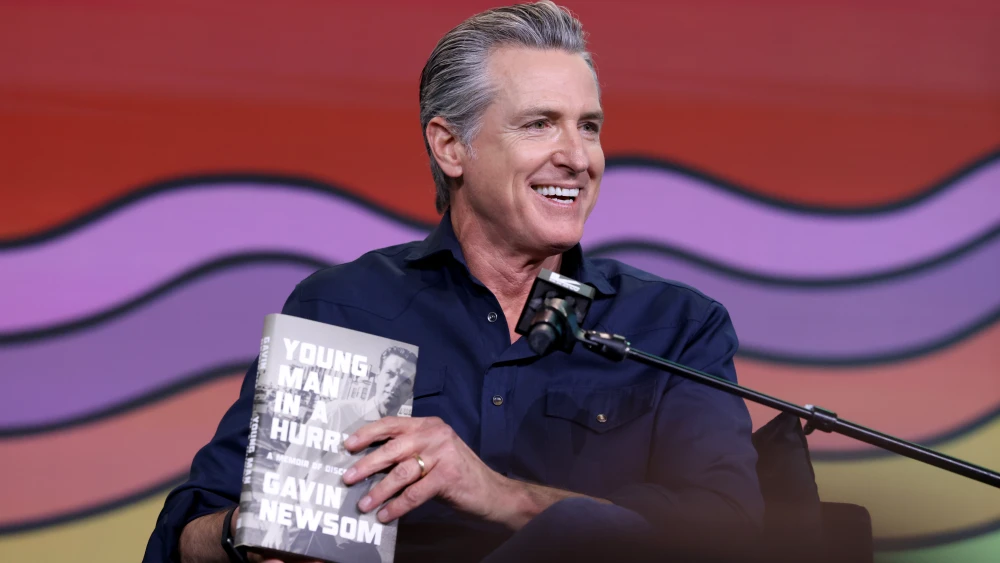 Democratic Gov. Gavin Newsom of California speaks at the Networth and Chill podcast at the Vox Media Podcast Stage at SXSW in Austin, Texas, on March 15, 2026. Photo by Rick Kern/Getty Images for Vox Media.
For Democrats who are already immersed in the run-up to the 2028 presidential election, Israel isn’t so much a country in the Middle East as it is a landmine. California Gov. Gavin Newsom provided a classic example earlier this month of how hard it is to navigate the issue for politicians who want the support of both pro- and anti-Israel voters.
Newsom set off something of an explosion when, while promoting his autobiography Young Man in a Hurry: A Memoir of Discovery, written to promote his presidential prospects. At a Los Angeles event, he told the hosts of the Pod Save America left-wing podcast that those who are smearing Israel as an apartheid state are doing so “appropriately.” In the same interview, he spoke of considering supporting a ban on military aid to the Jewish state, even in the midst of war, and implied that he thought that Israel was pushing the United States into a war with Iran in which it had no stake.
When faced with strong and immediate pushback from pro-Israel Democrats over his seeming willingness to join the growing ranks of anti-Zionists who help fuel antisemitism with blood libels about Israel, Newsom predictably backed down.
Pro-Israel, but anti-Netanyahu?
In a fawning interview with the liberal Politico website, Newsom said that he regretted the statement. What he really meant was that he agreed with New York Times columnist and inveterate Israel-basher Thomas L. Friedman, whom, he said, has written that Israel is heading toward apartheid under Israeli Prime Minister Benjamin Netanyahu, and his right-wing and religious supporters who oppose a two-state solution. While refusing to label himself as a “Zionist”—a word that has become a term of abuse on the political left—Newsom still claimed to “revere” Israel and decreed that he was “proud” to support it.
That pleased some on the left, such as Forward columnist Rob Eshman, who claimed that this meant that the governor wasn’t waffling on Israel but was actually voicing “sensible ideas” about the Middle East. Among the dwindling ranks of so-called “liberal Zionists” who join in the demonizing of the government (elected by Israeli citizens) but wish to distinguish themselves from those treating support for even the idea of a Jewish state, that’s good enough.
Newsom’s walk-back of his statement regarding the “apartheid” slur angered many others on the left, who felt that the politician was betraying them. Far-left actor/anti-Israel activist Mark Ruffalo claimed to know that the governor had “said what you meant” in the first place. “I don’t know what billionaire got in your ear, but it’s not working for you. This is not how you are going to win. It’s apartheid, and it’s a genocide!”
The question is: Who does Newsom think has a better idea of where Democratic voters are these days—those donors who likely did get in his ear about calling Israel an “apartheid” state or people like Ruffalo who want to see it destroyed?
According to the annual Gallup poll on the subject, published last month, the overwhelming majority of those identifying as Democrats oppose the Jewish state. Under those circumstances, positioning oneself as an unabashed supporter of Israel seems like a political death wish. But going all the way over to the other side and joining those who slander it and support its destruction is also problematic.
Will Democrats tilt farther to the left?
That’s especially true for those who seek to run in what is left of the “moderate” lane in 2028 that was occupied by Hillary Clinton in 2016, and by Joe Biden 2020 and 2024 (before he was deposed because of his mental incapacity). 2028 might be the year when the left wing of the party, led in the past by Sen. Bernie Sanders (I-Vt.), finally takes control.
But despite the way those who share their views on both Israel and other issues seem to dominate the liberal media and popular culture, a lot of Democrats who matter still fear nominating someone in the mold of Sanders, though someone much younger—for example, Rep. Alexandria Ocasio-Cortez (D-N.Y.). They believe that would lead to electoral disaster. That’s why those who are perceived as less extreme, like Newsom, are still broadly favored by most officeholders and the donor class. And among the latter are a great many large Democratic Party donors who still remain supportive of Israel—or at least opposed to the anti-Zionist and antisemitic left.
The 2028 Democratic presidential primaries are two full years from now, so guessing which issues and stands will appeal to voters is a somewhat hazardous task. Nevertheless, the maneuvering of leading Democrats right now with respect to Israel is part of a process that has been building for years. Part of it is rooted in the way toxic left-wing ideas like critical race theory, intersectionality and settler-colonialism, that among other things falsely labels Israelis and Jews as “white” oppressors, have become a new orthodoxy among Democrats. Mixed in with it is the way hatred for President Donald Trump and opposition to virtually everything he does has become a litmus test for party loyalty.
Anti-Trump means anti-Israel
In this way, rather than Trump’s historic support for Israel being something on which the majority of Americans could agree, it has instead become just one more example of something Democrats respond to on a knee-jerk basis.
Pro-Israel Democrats were clearly uncomfortable when Trump accomplished measures during his first term that they would have cheered had a president of their party done them, such as moving the U.S. embassy from Tel Aviv to Jerusalem in 2018 or brokering the 2020 Abraham Accords. Still, they didn’t actively oppose them. In his second term, many of their opinion leaders and voters have embraced the blood libels about the Jewish state committing “genocide” in Gaza, being an “apartheid” state, and now, the claim that Israel has dragged America into a war with Iran.
At this point, backing for the Jewish state among Democrats has become, as Newsom demonstrated, a theoretical exercise. They’re ready to support an Israel in sync with liberal Democratic policy priorities—meaning, support for a Palestinian state and making deals with Iran. That’s an Israel, however, that doesn’t really exist.
After the once-popular Oslo Accords exploded into the terrorist war of attrition known as the Second Intifada (2000-05), then the disengagement from Gaza, and then the Hamas-led atrocities on Oct. 7, 2023, support for a Palestinian state among Israelis is limited to a small percentage of die-hard leftists. Even fewer Jewish Israelis oppose the current war in Iran, with 93% backing it—a total that reflects an overwhelming majority of even those who will vote against Netanyahu in the next election.
Simply put, there is a broad consensus within Israel that stretches from left to right on these issues. That consensus views a Palestinian state, such as the one that existed in Gaza prior to Oct. 7 in all but name, as an invitation to future slaughter and perpetual war. It also understands that the only option available to them with respect to Iran, as long as it is governed by fanatical Islamist theocrats, is conflict.
Seen from that perspective, it makes even those Democrats who claim to be supporters of Israel, though bitterly opposed to its government, like Newsom or even Pennsylvania Gov. Josh Shapiro, not merely out of touch with the realities of Israeli politics but also with their own voters. Such candidates may try to finesse the issue, as Newsom and Shapiro are trying to do, by declaring their support for Israel while avowing perpetual opposition to Netanyahu and Trump. But even if you take Netanyahu out of the equation, there is no conceivable government that could emerge from the next Israeli election that would have policies on two states or Iran that any conceivable Democrat could support. And as far as the left-wing base of the Democratic Party is concerned, all Israelis and their American supporters—be they Jewish or Christian evangelicals—are backers of the mythical “genocide” and “apartheid.”
And that is why Israel is a land mine that Democratic presidential contenders understand can blow up their ability to reach their party’s activists who are the key to winning primaries and the nomination.
The two parties move in different directions
It’s true that there is also a vocal anti-Israel and increasingly antisemitic faction on the right that is unhappy with Trump’s pro-Israel policies. But it is clearly a minority with most Republicans, including the MAGA base. Most are enthusiastic supporters of Israel and of Trump’s stands, including the current war on Iran. And that has also placed Vice President JD Vance, the putative champion of the Tucker Carlson anti-Israel wing of the party, in a very uncomfortable position. He and his staff are reduced to leaking their unhappiness with Netanyahu, as well as their hopes about brokering a deal with Iran, to left-wing publications like Axios.
The anti-Israel right may think that it can reverse the GOP’s pro-Israel stance if Vance wins the presidency in 2028. But their problem is that unlike the situation on the other side of the aisle, the Veep’s coolness to Israel and the conflict with Iran is making that prospect far less of an inevitable occurrence than it seemed just a few months ago.
But for Democrats, the trend is moving in the opposite direction.
The best that supporters of Israel can hope for from a Democratic presidential candidate going forward is exactly the sort of dodge Newsom has just demonstrated—by talking out of both sides of his mouth. He signaled acquiescence to the “apartheid” and “genocide” blood libels while saying he supports a mythical Israel that has, like the few remaining liberal Zionists, learned nothing from Oslo, the events of Oct. 7, or Iran’s role in fomenting terror and war. Some “moderate” Democrats may think that trying to thread the needle in this way will allow them to be acceptable to both left-wingers and Jewish donors. Unfortunately, that is a sham that increasingly fewer opponents or supporters of Israel will accept.
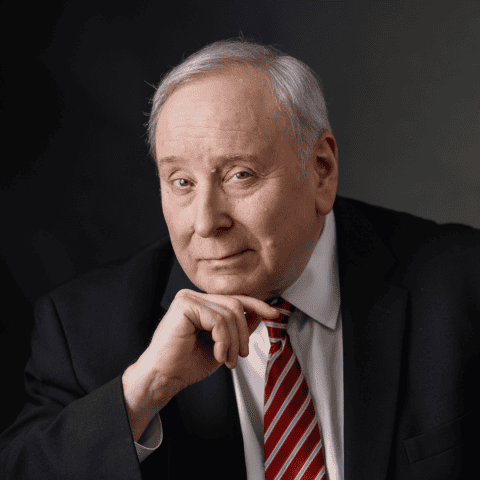 Jonathan S. Tobin is editor-in-chief of the Jewish News Syndicate, a senior contributor for The Federalist, a columnist for Newsweek and a contributor to many other publications. He covers the American political scene, foreign policy, the U.S.-Israel relationship, Middle East diplomacy, the Jewish world and the arts. He hosts the JNS “Think Twice” podcast, both the weekly video program and the “Jonathan Tobin Daily” program, which are available on all major audio platforms and YouTube. Previously, he was executive editor, then senior online editor and chief political blogger, for Commentary magazine. Before that, he was editor-in-chief of The Jewish Exponent in Philadelphia and editor of the Connecticut Jewish Ledger. He has won more than 60 awards for commentary, art criticism and other writing. He appears regularly on television, commenting on politics and foreign policy. Born in New York City, he studied history at Columbia University.
 Pole uprawne, a w tle plantacja bananów w kibucu Sa’ar. Zdjęcie Oren Pele, Wikimedia Commons.
 Oni są granicą