Archive | 2026/04/23

Izrael kontra Turcja: niebezpieczna rywalizacja regionalnych gigantów [DIE WELT]

Premier Izraela Benjamin Netanjahu podczas konferencji prasowej w Jerozolimie, 19 marca 2026 r., w trakcie konfliktu amerykańsko-izraelskiego z Iranem. (Fot. REUTERS/Ronen Zvulun)


Izrael kontra Turcja: niebezpieczna rywalizacja regionalnych gigantów [DIE WELT]

Carolina Drüten


Kryzys na Bliskim Wschodzie uwypuklił rywalizację między Ankarą a Jerozolimą. Oba państwa walczą o pozycję najważniejszej siły w regionie i postrzegają się nawzajem jako zagrożenie. Obawy przed ewentualnym starciem zbrojnym rosną.

embed

Mieszkańcy Turcji są całkiem zadowoleni ze sposobu, w jaki ich rząd radzi sobie z kryzysem wokół wojny w Iranie. Jak wynika z sondażu przeprowadzonego przez instytut Metropoll, w ciągu ostatnich dwunastu lat poparcie dla tureckiej polityki wobec Bliskiego i Środkowego Wschodu nigdy nie było tak wysokie jak obecnie. Prawie połowa respondentów oceniła kurs Ankary jako słuszny. W poprzednich sondażach liczba zwolenników oscylowała zwykle wokół 37 proc.

Minister spraw zagranicznych Hakan Fidan był zaangażowany w przygotowania amerykańsko-irańskich rozmów w Islamabadzie. Pod koniec marca wziął udział w konferencji z udziałem przedstawicieli Pakistanu, Egiptu i Arabii Saudyjskiej, którego celem było zainicjowanie bezpośredniego dialogu między Waszyngtonem a Teheranem. Ponadto Turcja jest w grupie państw, które przekazują wiadomości między Waszyngtonem a Teheranem.

Z drugiej strony rząd Erdogana ostro krytykuje trzecią stronę w wojnie z Iranem: Izrael. Jak ostry jest obecnie ton, pokazuje wymiana ciosów między obydwoma rządami w zeszłym tygodniu.

11 kwietnia prokuratura generalna w Stambule oskarżyła 35 osób – w tym izraelskiego premiera Benjamina Netanjahu – w związku z izraelską operacją wojskową przeciwko międzynarodowemu konwojowi statków, który miał dostarczyć pomoc humanitarną do Strefy Gazy.

W odpowiedzi Netanjahu publicznie zaatakował Erdogana, zarzucając mu „pomoc reżimowi terrorystycznemu w Iranie” oraz represjonowanie własnej ludności kurdyjskiej.

Tureckie MSZ zareagowało z kolei oświadczeniem, w którym nazwało Netanjahu „Hitlerem naszych czasów”.

Izrael chce obalić lub osłabić reżim w Iranie, Turcja nie ma w tym interesu

Ta mieszanka dyplomacji i retorycznych ataków nie jest niczym nowym. Radzenie sobie z niejednoznacznościami i wykorzystywanie ich w polityce to jedne z kluczowych kompetencji Erdogana. Jednak strukturalna rywalizacja między Turcją a Izraelem utrwaliła się w ostatnich latach. Wojna z Iranem tylko ją uwypukla. Obecnie oba kraje postrzegają się jako zagrożenie dla własnego bezpieczeństwa.

Przykład Iranu: rząd izraelski pod przewodnictwem Netanjahu dąży do scenariusza, w którym reżim w Teheranie zostanie albo obalony, albo tak osłabiony, że nie będzie już stanowił egzystencjalnego zagrożenia dla Izraela. Netanjahu akceptuje próżnię władzy i chaos, który niemal nieuchronnie by nastąpił, gdyby ten cel został zrealizowany. Jego zdaniem słaby, chaotyczny Iran jest łatwiejszy do opanowania niż stabilny reżim, który jest coraz bliżej zbudowania własnej broni jądrowej.

Turcja natomiast chce zapobiec scenariuszowi pogrążenia się Iranu w chaosie. Nie dlatego, że postrzega Teheran jako sojusznika – na przykład w Syrii oba kraje mają sprzeczne interesy – ale dlatego, że irański reżim jest dla niej mniejszym złem. Gdyby upadł, powstałaby przestrzeń dla Kurdów, którzy mogliby dzięki temu uzyskać więcej autonomii. Ankara postrzega te dążenia jako zagrożenie dla bezpieczeństwa.

Kolejnym aspektem jest napływ uchodźców, oczywista konsekwencja kryzysu w Iranie. Kraj liczy około 90 milionów mieszkańców – cztery razy więcej niż Syria przed rozpoczęciem wojny domowej. W Syrii w wyniku walk za granicę uciekło ponad sześć milionów ludzi, wywołując tym samym największy kryzys uchodźczy ostatnich dziesięcioleci. Konsekwencje tego kryzysu są odczuwalne w Turcji do dziś.

Nie tylko spojrzenie na Iran dzieli Netanjahu i Erdogana

Również w Syrii Ankara i Jerozolima dążyły w ostatnich latach do sprzecznych celów. Turcja jest jednym z najważniejszych zwolenników nowego przywódcy Ahmeda asz-Szara i stawia na jak najbardziej stabilne, centralnie zarządzane państwo.

Kryją się za tym podobne motywy jak w przypadku Iranu: Ankara chce zapobiec umocnieniu się kurdyjskich obszarów autonomicznych, a jednocześnie powstrzymać nowe fale uchodźców.

Dyplomacyjnego w Antalyi, Turcja, 17 kwietnia 2026 r. Fot. REUTERS/Turkish Presidential Press Office

Izrael natomiast nie ufa nowym władzom w Damaszku i zarzuca im, że kierują się niebezpieczną islamistyczną ideologią. Z tego punktu widzenia łatwiej byłoby utrzymać w ryzach zdecentralizowaną Syrię ze słabymi władzami.

Te sprzeczności nie są odosobnionym przypadkiem. Wskazują one na zasadniczą różnicę w tym, jak oba państwa rozumieją bezpieczeństwo i porządek w regionie – oraz swoją własną rolę w tej strukturze.

Z punktu widzenia Ankary Izrael uzasadnia niemal każde poszerzenie swojego pola manewru militarnego własnym bezpieczeństwem – nawet jeśli odbywa się to kosztem integralności terytorialnej innych państw. Izrael utworzył na przykład strefy buforowe w Libanie, w Syrii i w Strefie Gazy; na palestyńskim Zachodnim Brzegu znacznie rozszerzono działalność osadniczą.

Turcja stanie się nowym wrogiem Izraela?

W połowie marca turecki minister spraw zagranicznych Fidan powiedział w wywiadzie dla agencji informacyjnej Anadolu, że po wojnie z Iranem Izrael „nie będzie mógł żyć bez wroga”. Według tureckiej interpretacji następna w kolejności jest Ankara. Izrael ma próbować teraz ogłosić Turcję nowym wrogiem.

Również Erdogan powiedział w 2024 r., że po zwycięstwie nad Hamasem Izrael „nie ograniczy się do Strefy Gazy”, ale prędzej czy później weźmie na celownik również Turcję.

Narracja ta znajduje oddźwięk wśród tureckiej ludności. Sondaże od lat pokazują skrajnie negatywny wizerunek Izraela. Według badania przeprowadzonego przez Pew Research Center w czerwcu ubiegłego roku 93 procent respondentów w Turcji ma negatywny stosunek do państwa żydowskiego. Ponad jedna trzecia Turków postrzega Izrael jako największe zagrożenie dla własnego kraju.

Wzajemna nieufność

Ta nieufność ma charakter wzajemny. „Jerusalem Post” cytował niedawno izraelskiego analityka Yoniego Ben Menachema, który stwierdził: „Turcja to nowy Iran”. Za tym stoi przekonanie, że po ewentualnym osłabieniu Teheranu Ankara może próbować przejąć wiodącą rolę w regionie.

Upadek osi szyickiej ma spowodować bowiem powstanie próżni, którą Turcja wraz z Arabią Saudyjską, Egiptem i Pakistanem chce wypełnić, tworząc „sunnicki blok władzy” – cytuje się Menachema.

Nie jest to przejściowa różnica zdań wyłaniająca się między Turcją a Izraelem. To raczej trwała rywalizacja dwóch regionalnych mocarstw, które coraz bardziej postrzegają siebie nawzajem jako strategicznych przeciwników. Im bardziej obie strony będą chciały przeforsować swoje interesy, tym większe będzie ryzyko, że rywalizacja w pewnym momencie przerodzi się w jakąś formę konfrontacji.


Tłumaczył Bartosz T. Wieliński

tytuł oraz śródtytuły są od polskiej redakcji


Zawartość publikowanych artykułów i materiałów nie reprezentuje poglądów ani opinii Reunion’68,
ani też webmastera Blogu Reunion’68, chyba ze jest to wyraźnie zaznaczone.
Twoje uwagi, linki, własne artykuły lub wiadomości prześlij na adres:
webmaster@reunion68.com

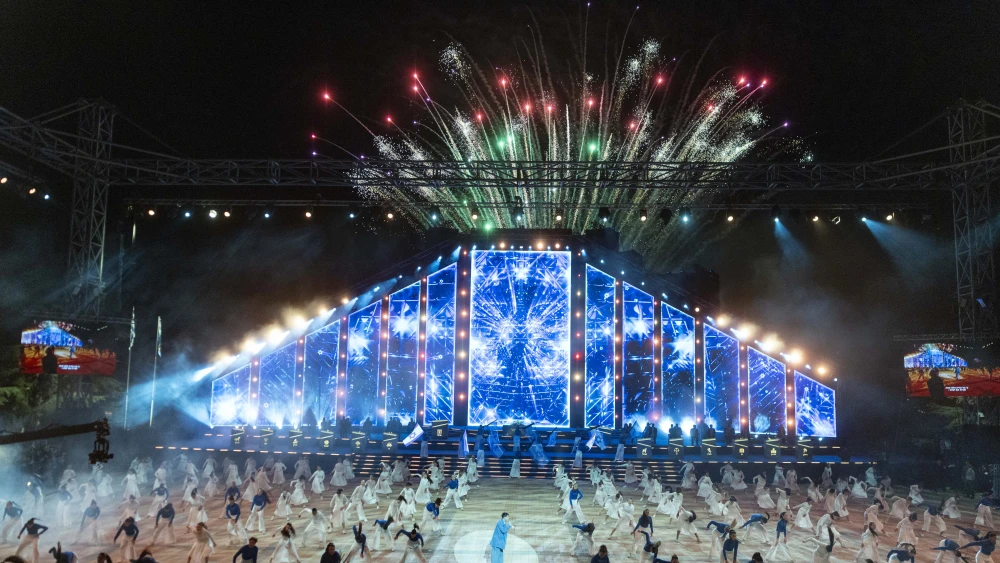
Under the stars on Mount Herzl, Israel marks 78 years of independence


Under the stars on Mount Herzl, Israel marks 78 years of independence

Tania Shalom Michaelian


Argentina’s president participates in a colorful ceremony held amid ongoing regional tensions, under the theme “Strengths of Renewal.”

The 78th anniversary Independence Day ceremony held at Mount Herzl, Jerusalem, on April 21, 2026. Photo by Chaim Goldberg/Flash90.

Nobody was entirely sure the ceremony would take place.

Organizers had quietly filmed a full dress rehearsal days earlier in case renewed fighting with Iran made a live public event impossible. A fragile ceasefire with Iran and Lebanon was holding—barely.

Last year’s ceremony was canceled due to wildfires in the Jerusalem hills. This year, thousands arrived from across the country, determined not to miss the event.

What followed was one of the most emotionally charged Independence Day ceremonies in recent memory—a sweeping, two-hour program centered on the theme “Strengths of Renewal,” moving between grief and defiance, prayer and celebration, loss and victory.

‘This is what victory looks like’

Knesset Speaker Amir Ohana opened the formal proceedings by framing the evening’s emotional stakes. Drawing on language from the Book of Esther—“and it was reversed”—he cited developments from the past year as signs of national resilience.

“When in the past year, in the midst of war, 20,000 Jews chose to make aliyah—that is what victory looks like. When in the past year 177,000 babies were born in Israel—that is what victory looks like,” Ohana said.

Israeli Prime Minister Benjamin Netanyahu, who attended with his wife, Sara, delivered remarks via pre-recorded video, citing security concerns, saying Israel had “risen like a lion and fought like one” and had “struck hard at the regime of terror in Iran.”

Netanyahu said Israel is “stronger than ever,” praising what he described as major military achievements and the country’s alliance with the United States.

“Israel is stronger than ever, and together with the United States, we are leading the fight against the forces of evil in the world,” Netanyahu said, describing the current period as a “generation of revival” in which Israel is confronting longstanding threats to its existence.

He said Israel had delivered significant blows to what he called the Iranian “axis of evil,” which he accused of seeking to destroy the Jewish state. Referring to ongoing regional hostilities, he said Israel had taken decisive action to remove what he described as existential threats, including dangers posed by Iran’s nuclear and ballistic missile programs.

“In the War of Revival, in Operation Rising Lion and Operation Roaring Lion, we made major achievements,” Netanyahu said, crediting Israel’s security forces, citizens and leadership decisions with strengthening the country’s regional standing.

He highlighted new partnerships and diplomatic opportunities that he said had expanded Israel’s strategic position. “In every generation, enemies rise up to destroy us,” Netanyahu said, adding that Israel continues to confront those threats with unity and determination.

Twelve torches, twelve stories

At the heart of the ceremony were the 12 torch-lighters chosen to represent Israeli society. This year’s group included figures from the military, medicine, technology, culture and public service.

The ceremony opened with two IDF officers whose identities were partially concealed for security reasons. Lt. Col. M., a former squadron commander involved in operations against Iran, dedicated his torch to the thousands of sorties flown in defense of Israel and to the personnel supporting those missions.

Maj. N., a combat intelligence officer wounded on Oct. 7 who returned to duty before being seriously wounded again, dedicated her torch to wounded soldiers “hurt in body and soul” and to those continuing what she called “another battle on the front of rehabilitation.”

Venture capitalist Gili Ra’anan honored Israel’s hi-tech and cybersecurity sectors while remembering his daughter Adi, who was killed in the 2018 Nahal Tzafit flash flood.

“She reminds me how precious life is, and how great is our responsibility to build a better future here,” he said.

Prof. Dina Ben-Yehuda, head of hematology at Hadassah Medical Center, dedicated her torch to Israel’s medical community and to her nephew Itamar, a Golani combat medic who fell on Oct. 7.

“To the compassion and humanity that are the most important medicine of all,” she said.

Tamir Atallah, a Druze IDF officer who coordinated emergency relief efforts for Druze communities affected by violence in Syria, emphasized the partnership between Israel’s Jewish and Druze citizens.

“A covenant of partnership, loyalty and shared fate—a bond we are obligated to guard with all our strength,” he said.

Ora Hatan of Moshav Shetula, who remained in the northern border community throughout Hezbollah attacks while preparing meals for soldiers, dedicated her torch to residents determined to remain in the north.

“It is forbidden for us to ever lose the north,” she said. “And to our children—the generation of tomorrow who dream that the Galilee will bloom again. And it will.”

Chef Asaf Granit honored Jerusalem and Israel’s culinary sector, which has continued operating despite years of conflict and economic strain.

Roni Insaz, born in Tehran and brought to Israel after secretly assisting Jewish prisoners within Iran’s judicial system, addressed the Iranian people directly.

“The vast majority love the Jewish people and dream of freedom,” he said. “May we merit seeing the dark regime fall.”

One of the most emotional moments came when Talik Gvili lit a torch in memory of her son, Staff Sgt. Ran Gvili, whose remains were returned from Gaza. She was joined by Brig. Gen. (res.) Gal Hirsch, who served as coordinator for captives and missing persons.

“Know this—we are here, and we will remain here forever,” she said.

Filmmaker Moshe Adri dedicated his torch to Israel’s cultural creators and to young people in the country’s geographic and social periphery.

“Believe in yourselves, because there is no force stronger than determination, faith and the passion to turn imagination into reality,” he said.

Rabbi Avraham Zariv, a rabbinical judge and reservist armored bulldozer operator in Gaza, dedicated his torch to the privilege of serving both through Torah scholarship and military duty.

Fighter Ari Shpitz, who lost both legs and an arm when a booby-trapped structure exploded in Gaza, dedicated his torch to wounded soldiers.

“This is another war,” he said, “and in it too, we have no choice but to win.”

.
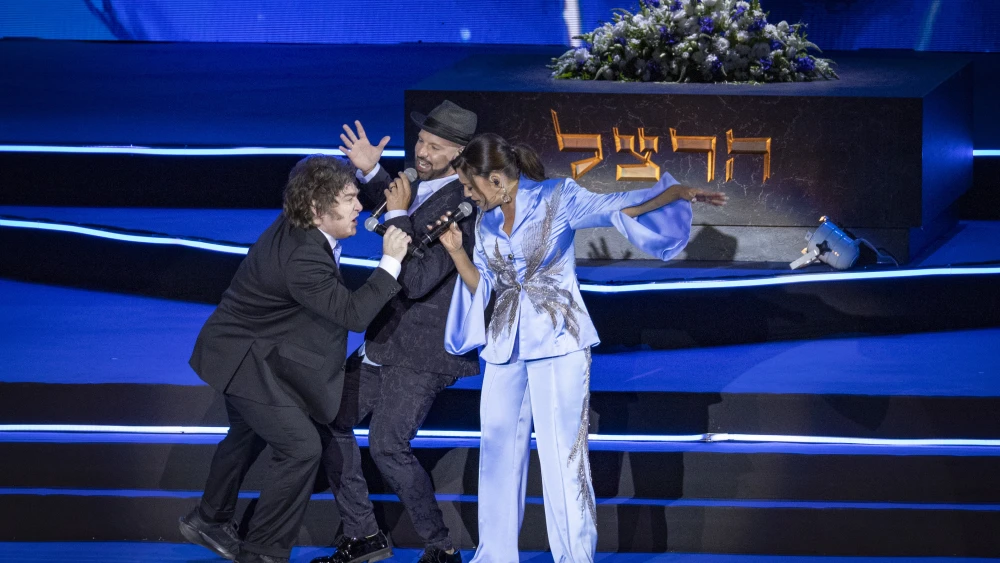
Argentina’s President Javier Milei sings at the 78th anniversary Independence Day ceremony, held at Mount Herzl, Jerusalem, on April 21, 2026. Photo by Chaim Goldberg/Flash90.Chaim Goldberg/Flash90

Special guest appearance

The ceremony concluded with an appearance by Argentine President Javier Milei, one of Israel’s most outspoken international supporters. Joining performers in a rendition of the Spanish song “Libre,” Milei later delivered remarks in Spanish reflecting on the symbolism of the torch.

“The passage from darkness to light is painful,” he said. “Creating light requires great and difficult toil.”

He concluded in Hebrew: “Am Yisrael Chai. L’tiferet Medinat Yisrael.”

‘Do not fear, Israel’

Musical performances throughout the evening reflected the country’s emotional journey over the past year. Singer Ben Tzur performed “Abba” accompanied by recordings from battlefield communications. Amir Dadon sang alongside wounded IDF soldiers. Veteran singer Yehoram Gaon performed “Lo Tenatzchu Oti” (“You Will Not Defeat Me”), while Eden Golan, Israel’s 2024 Eurovision representative, received a standing ovation.

The ceremony concluded with Sasson Ifram Shaulov performing “Al Tira Yisrael” (“Do Not Fear, Israel”), bringing the audience to its feet.

The traditional flagbearers’ display formed images including a Star of David, a map of Israel and the number 78, before the ceremony concluded with the singing of Israel’s national anthem, “Hatikvah.”


Zawartość publikowanych artykułów i materiałów nie reprezentuje poglądów ani opinii Reunion’68,
ani też webmastera Blogu Reunion’68, chyba ze jest to wyraźnie zaznaczone.
Twoje uwagi, linki, własne artykuły lub wiadomości prześlij na adres:
webmaster@reunion68.com


2026 Tribeca Film Festival to Screen World Premiere of Israeli Films, Including Noga Erez Documentary


2026 Tribeca Film Festival to Screen World Premiere of Israeli Films, Including Noga Erez Documentary

Shiryn Ghermezian


A still from “What Is To Come.” Photo: Tribeca Film Festival

Organizers of the 2026 Tribeca Film Festival announced on Thursday the official lineup for this year’s event in June and it includes the world premiere of three Israeli co-productions.

What Is to Come” will be screened as part of the festival’s International Narrative Competition. The drama from Israel and the United Kingdom is about a woman named Yehudit who unexpectedly loses her husband and is forced to start over on her own. “In the process, she finds that abrupt and painful detours can lead to bright roads,” according to a synopsis of the film. The feature is directed and written by Ruthy Pribar, and stars Ronit Yudkevitch, Yaakov Zada Danielm and Tovit Adis Semay. “What Is to Come” will make its world premiere on June 8.

Pribar’s debut feature film “Asia” screened at the Tribeca Film Festival in 2020 and won three awards, including the Nora Ephron Prize for Pribar, a best actress award for Shira Haas, and best cinematography for Daniella Nowitz. The film also won nine Ophir Awards in Israel.

“Moishe Badhan (or The Tale of a Wedding Entertainer),” will also make its world premiere at the Tribeca Film Festival this year, in the Viewpoints section. Directed by Gidi Dar and written by Shuli Rand, the co-production from Israel and the US is a comedy-drama about a disgraced Hasidic wedding-comedian who is trying to gather enough funds to marry off his daughter. The cast includes Shuli Rand, Tal Friedman, and American Jewish comedian Elon Gold, who is also an executive producer on the film. The world premiere will take place on June 4.

The 2026 Tribeca Film Festival will also feature the world premiere of the documentary “Noga,” about Israeli alternative pop singer Noga Erez. The movie, which was directed and co-produced by Jono and Benji Bergmann, is a c0-production from Austria, Germany, Israel, and the US. It examines how Erez “must redefine her role as an artist on a global stage” after the Israel-Hamas war breaks out in 2023. The film’s world premiere on June 7 will be followed by an acoustic performance by Erez and her longtime partner in music and life Ori Rousso.

Erez is performing twice at the Coachella Valley Music and Arts Festival this month. She has never performed at the festival before and has made history as the first Israeli singer to take to the stage at the annual event in Indio, California.

The 2026 Tribeca Film Festival will run from June 3-14. The event will feature 118 feature films including 103 world premieres, which is the most in the history of the festival, and 86 short films. The festival this year will represent 143 filmmakers, including 55 first-time directors, spanning 44 countries.

“Tribeca began 25 years ago as an act of healing, a mission to reunite our community through the power of storytelling. Today, that purpose feels more urgent than ever,” said Jane Rosenthal, co-chair and co-founder of the Tribeca Festival. “This year’s incredible feature and short film lineup includes stories from filmmakers who make us think, feel, laugh, cry, and ask why. Tribeca remains dedicated to the artists’ voices and diverse perspectives that challenge us to see one another more clearly.”


Zawartość publikowanych artykułów i materiałów nie reprezentuje poglądów ani opinii Reunion’68,
ani też webmastera Blogu Reunion’68, chyba ze jest to wyraźnie zaznaczone.
Twoje uwagi, linki, własne artykuły lub wiadomości prześlij na adres:
webmaster@reunion68.com