Bassam Tawil
- Equally disturbing is the role of Al-Jazeera itself. Owned, funded, and controlled by the government of Qatar, Al-Jazeera, particularly its Arabic-language channel, has long provided a platform for Hamas and the Muslim Brotherhood movement. Its coverage frequently echoes Hamas and Muslim Brotherhood narratives, and amplifies anti-Israel propaganda and antisemitic rhetoric.
- Reports by the Middle East Media Research Institute (MEMRI) have documented Al-Jazeera providing a platform for guests who assert that Jews are “enemies of Muslims and all humanity” or that they control global affairs.
- “Among the Islamist terrorist organizations that Qatar and Al-Jazeera have supported over the years are the Muslim Brotherhood, Al-Qaeda, the Taliban, Hizbullah, the Al-Nusrah Front/ Hay’at Tahrir Al-Sham, ISIS, Hamas, and even the Shiite Iranian proxies in Yemen, Ansar Allah (the Houthis), which are currently engaged in direct conflict with the U.S. and other Western countries.” — Yigal Carmon, MEMRI, May 6, 2024.
- “According to its website, Al-Jazeera has ‘over 70 bureaus around the globe’ and is ‘one of the largest and most influential international news networks in the world’…. Between 2004 and 2020, AJ+ Facebook videos had been viewed over 10 billion times, and it had amassed over 11 million followers on Facebook.” — Yigal Carmon, MEMRI, May 6, 2024.
- “Al Jazeera just surpassed CNN and BBC as the world’s most-watched international news network. Its Arabic channel hit 400 million weekly viewers.” — Pakistani commentator Amna Kausar, March 2026.
- “Since the October 7 attack… The network has been operating as a propaganda outlet in the service of Hamas 24/7, with hardly any coverage of other topics. The channel expresses unreserved support for Hamas, justifying the deadly attack, showing footage of it obtained from the body-cams of the terrorists, and celebrating it as a victory that has brought pride and honor to the Islamic nation.” — Yigal Carmon, MEMRI, May 6, 2024.
- Given the mounting allegations of links between Al-Jazeera and terrorist organizations, policymakers should consider decisive steps, formally designating Al-Jazeera as an entity that supports terrorism.
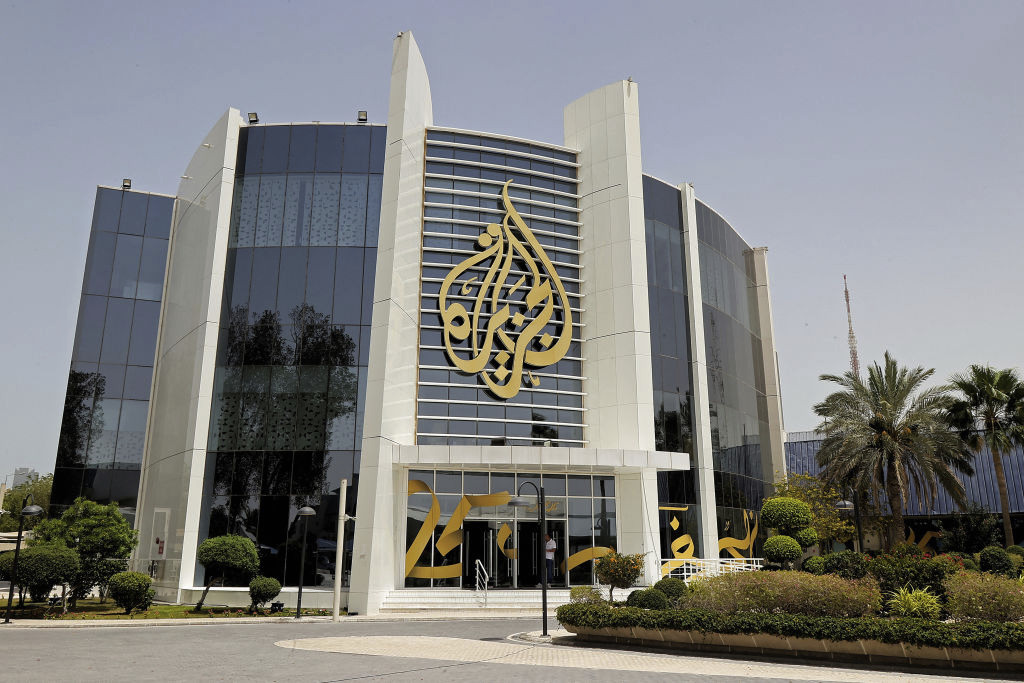 Given the mounting allegations of links between Al-Jazeera and terrorist organizations, policymakers should consider decisive steps, formally designating Al-Jazeera as an entity that supports terrorism. Pictured: The headquarters of Al-Jazeera in Doha, Qatar. (Photo by Karim Jaafar/AFP via Getty Images)
The death of another Palestinian “journalist” working for Qatar’s Al-Jazeera TV empire has once again triggered outrage and drawn condemnations from some in the international community. Yet those who rushed to denounce Israel for targeting the Gaza-based “journalist” are ignoring voluminous evidence that he and some of his Palestinian colleagues were, in fact, active members of terrorist organizations.
According to the Israel Defense Forces (IDF), Mohammed Wishah, an Al-Jazeera “reporter” killed in an April 8 Israeli airstrike, was not merely a media figure. He was a “key terrorist” in Hamas’s military wing, Izz a-Din al-Qassam, and was involved in weapons production, including rockets and drones, and actively planning attacks against Israeli soldiers and the State of Israel.
According to Israeli intelligence, Wishah exploited his job as a journalist as a cover, an operational shield that allowed him to move, gather intelligence, and advance terrorist activities under the protection of press credentials. In a statement on April 9, the IDF wrote:
“The terrorist contributed to Hamas’ force build-up efforts, was actively involved in planning attacks against IDF troops, and posed a concrete threat to forces in the area. Prior to the strike, steps were taken to mitigate harm to civilians, including the use of precise munitions, aerial surveillance, and additional intelligence.”
About two years ago, the IDF revealed that during a search at a Hamas base in northern Gaza, a laptop belonging to Wishah was seized. The laptop contained images and intelligence materials linking him to Hamas. An IDF spokesperson said at the time:
“Findings from the computer indicate that in addition to his role as a ‘journalist,’ Muhammad, born in 1986 from Al-Bureij, is a senior military operative in Hamas’ anti-tank missile array, and by the end of 2022 had moved to research and development of aerial weapons for the terrorist organization…. analysis of the computer found several weeks ago includes images linking him to his activity in Hamas”
Wishah is not the first terrorist to operate in the Gaza Strip under the guise of a “journalist.”
More than half of the Palestinian “journalists” killed in the Gaza Strip during the Israel-Hamas war, triggered by the October 7, 2023 Hamas-led invasion of Israel, were affiliated with terrorist organizations, according to a study by the Meir Amit Intelligence and Terrorism Center.
“An analysis of the identity of the 131 journalists revealed that least 78 (more than 59%) were active in or affiliated with a terrorist organization. Among them were 13 prominent members of a terrorist organization, Fatah or the Palestinian Authority. Of them 13 were overtly terrorist operatives belonging to Hamas, the Palestinian Islamic Jihad, the al-Aqsa Martyrs’ Brigades and the Popular Resistance Committees, the Popular Front for the Liberation of Palestine, the Democratic Front for the Liberation of Palestine, Fatah and the Palestinian Authority….
“Of the 78 journalists identified as having organizational affiliation, 44 were identified with Hamas…. Nineteen were affiliated with PIJ… One was an al-Aqsa Martyrs’ Brigades operative and another a Popular Resistance Committees operative. Two were affiliated with the Fronts, one with the Popular Front for the Liberation of Palestine and the other the Democratic Front for the Liberation of Palestine.”
Wishah was not the only Al-Jazeera terrorist masquerading as a journalist.
In August 2025, the IDF conducted a precise strike in Gaza City targeting Anas al-Sharif, a Hamas terrorist who posed as a journalist for Al-Jazeera. Al-Sharif, head of a Hamas terror cell, was responsible for facilitating and advancing rocket attacks against Israeli civilians and IDF forces. Intelligence and documents recovered in the Gaza Strip, including personal rosters, training lists, phone directories and salary records, confirmed his operational position within Hamas and his integration into the Al-Jazeera network.
Wishah and al-Sharif were not alone. Several Palestinian “journalists,” including some affiliated with Al-Jazeera, have in recent years been exposed as members of Hamas or PIJ. Among them:
-
- Ismail Abu Omar, an Al-Jazeera “journalist” and Hamas operative who served as commander of the terror group’s Eastern Battalion;
- Hossam Shabat, a Hamas sniper who exploited his role as an Al-Jazeera “journalist” and carried out terrorist attacks against IDF troops and Israeli civilians;
- Ismail al-Ghoul, an Al-Jazeera “journalist” who served as an engineer in the Hamas Gaza City Brigade and took part in the October 7 massacre against Israelis and foreign nationals.
These cases demonstrate a disturbing pattern: the systematic exploitation of journalism by Palestinian terrorist groups. This cynical tactic endangers genuine journalists who risk their lives covering the Israeli-Palestinian conflict. When terrorists masquerade as journalists, they blur the line between civilian and combatant, making it more difficult to distinguish between the two.
Those who condemn Israel over the death of such “journalists” would do well to direct their outrage where it truly belongs: at Hamas and other terrorist organizations that deliberately exploit the protections afforded to journalists under international law. Those who genuinely care about press freedom should be the first to condemn its exploitation by terrorists.
Equally disturbing is the role of Al-Jazeera itself. Owned, funded, and controlled by the government of Qatar, Al-Jazeera, particularly its Arabic-language channel, has long provided a platform for Hamas and the Muslim Brotherhood movement. Its coverage frequently echoes Hamas and Muslim Brotherhood narratives, and amplifies anti-Israel propaganda and antisemitic rhetoric.
Reports by the Middle East Media Research Institute (MEMRI) have documented Al-Jazeera providing a platform for guests who assert that Jews are “enemies of Muslims and all humanity” or that they control global affairs.
In May 2024, MEMRI reported:
“Prime Minister Benjamin Netanyahu vowed to shut down the Qatar-funded Al-Jazeera channel’s operations in Israel, calling it a ‘terror channel,’ and Israel Communications Minister Shlomo Karhi said it would be shut down because it acts as ‘a propaganda arm of Hamas’ by ‘encouraging armed struggle against Israel.’ The outlet was shut down and taken off the air in Israel on May 5….
“Among the Islamist terrorist organizations that Qatar and Al-Jazeera have supported over the years are the Muslim Brotherhood, Al-Qaeda, the Taliban, Hizbullah, the Al-Nusrah Front/ Hay’at Tahrir Al-Sham, ISIS, Hamas, and even the Shiite Iranian proxies in Yemen, Ansar Allah (the Houthis), which are currently engaged in direct conflict with the U.S. and other Western countries….
“Al-Jazeera was the prime power for toppling the secular authoritarian regime in Egypt, when Qatar, by means of Al-Jazeera, supported the Muslim Brotherhood in ousting then Egyptian president Hosni Mubarak. Al-Jazeera, the single most significant platform for mainstreaming jihadi and Muslim Brotherhood ideology, was the power that accorded Mohamed Morsi his victory….
“According to its website, Al-Jazeera has ‘over 70 bureaus around the globe’ and is ‘one of the largest and most influential international news networks in the world….'”
“Between 2004 and 2020, AJ+ Facebook videos had been viewed over 10 billion times, and it had amassed over 11 million followers on Facebook.”
Pakistani commentator Amna Kausar wrote last month:
“Al Jazeera just surpassed CNN and BBC as the world’s most-watched international news network. Its Arabic channel hit 400 million weekly viewers.”
Al-Jazeera Arabic has repeatedly broadcast speeches by senior Hamas figures, such as Khaled Mashaal, Ismail Haniyeh, Saleh al-Arouri, Mohammed Deif and Khalil al-Hayya. They praised “resistance” (terrorism) and demanded continued armed struggle against Israel. On the very morning of the October 7, during the Hamas-led invasion of Israel, while terrorists were torturing and murdering more than 1,200 Israelis and others, and took more than 250 as hostages — Al-Jazeera provided Hamas military commander Mohammed Deif with an exclusive television appearance — to broadcast that this was just the “first strike” and incited Arabs inside Israel to “join the war , using all means in their possession – guns, knives, Molotov cocktails, and vehicles.”
Haniyeh issued a statement on Al-Jazeera in which he described the October 7 massacre as a “great triumph” and called to expand the operation to the West Bank and to within the pre-1967 borders of Israel. On the same day, Al-Jazeera broadcast a speech by al-Arouri, deputy chairman of the political bureau of Hamas, in which he threatened that “the storming of the Zionist settlements and bases in the Gaza Envelope will pale compared to what may happen to them [Israelis].”
During the Hamas-Israel war, Al-Jazeera not only reported and relayed Hamas’s announcements; according to the Meir Amit Intelligence and Terrorism Information Center, it became an integral part of the Hamas influence, propaganda, and psychological warfare machine:
“Across all its platforms, Al Jazeera spread the psychological warfare materials produced by the Combat Media Unit of Hamas’ Izz al-Din al-Qassam Brigades, which allegedly documented ambushes and attacks on IDF forces.”
In many cases, Hamas’s military wing even used Al-Jazeera Arabic to announce attacks on IDF troops, such as:
“Urgent – Al-Qassam Brigades: shortly… footage from the ‘Lion of al-Mantar’ ambushes of the enemy’s soldiers and vehicles in the al-Shuja’iyya neighborhood in eastern Gaza will be broadcast on Al Jazeera on 25-04-2025.”
Glorifying the October 7 massacre, the program “Ma Khafiya A’tham” (“What is Hidden is Greater”), hosted by journalist Tamer al-Mishal, dedicated to the October 7 massacre a series of episodes emphasizing Hamas propaganda, sometimes using videos provided exclusively to Al-Jazeera. One episode included a video of a disguised Hamas leader Yahya Sinwar, the mastermind of the massacre, conducting a field tour above ground. The episode also included pictures of Mohammed Deif, commander of the Hamas military wing, during the preparations for the October 7 attack. The program promoted the Hamas narrative that the massacre was a jihad justified by Islam, and that the “determination, heroism, and sacrifice” of the Palestinian people enabled the success of Operation Al-Aqsa Flood (the Hamas name for the October 7 attack).
MEMRI wrote in May 2024:
“Since the October 7 attack… The network has been operating as a propaganda outlet in the service of Hamas 24/7, with hardly any coverage of other topics. The channel expresses unreserved support for Hamas, justifying the deadly attack, showing footage of it obtained from the body-cams of the terrorists, and celebrating it as a victory that has brought pride and honor to the Islamic nation.”
For many years, Al-Jazeera hosted Islamist figures such as Yusuf al-Qaradawi his show “Sharia and Life,” where he issued fatwas (religious decrees) justifying Palestinian suicide bombings against Israel as a form of “jihad” and “defense.” In one interview, Qaradawi explained that in “legitimate martyrdom operations, people use their bodies to defend their country from occupiers.” He described suicide attacks as a form of divine justice, stating:
“Allah Almighty is Just; through His infinite Wisdom He has given the weak a weapon the strong do not have and that is their ability to turn their bodies into bombs as Palestinians do.”
Qaradawi also noted on his Al-Jazeera program in February 2013 that “If they [Muslims] had gotten rid of the apostasy punishment [death], Islam wouldn’t exist today.”
According to MEMRI:
“Al-Jazeera’s role in providing a platform for promoting extremist Islamist ideologies goes back decades. The case of promoting Al-Qaeda is of particular interest. Two months before 9/11, Al-Jazeera gave an Al-Qaeda spokesman, Sulaiman Abu Ghaith, free rein to speak uninterrupted for ten minutes, and to call for 12,000 mujahideen to join Al-Qaeda.
“Al-Jazeera employed a correspondent, Tayseer Allouni, who was sentenced in Spain to seven years in prison for transferring funds to Al-Qaeda – and Al-Qaeda even issued a public statement in his support. Al-Jazeera broadcast live the killing of a U.S. soldier by an Iraqi sniper – which could only have happened if the media network had coordinated with the perpetrators of the killing.
“As for ISIS – Al-Jazeera allowed a pledge of allegiance to its leader Abu Bakr Al-Baghdadi live on air. In the middle of a TV debate on Al-Jazeera’s flagship Arabic-language program, an Islamic scholar pledged allegiance to the leader of ISIS, the Emir of the Believers, while moderator Faysal Al-Qassem did nothing to stop him.”
In 2004, on Al-Jazeera, Anis al-Naqqash, a Lebanese militant and analyst, explicitly called for attacks against US oil companies and installations and labeled the US an enemy of humanity.
It is time for the US and other Western countries to undertake an urgent and thorough review of Al-Jazeera’s activities. Given the mounting allegations of links between Al-Jazeera and terrorist organizations, policymakers should consider decisive steps, formally designating Al-Jazeera as an entity that supports terrorism.
Bassam Tawil is a Muslim Arab based in the Middle East.
 Statki czekające w pobliżu cieśniny Ormuz, 11 marca 2026 roku (Fot. REUTERS/Stringer)
 Rozmowy USA – Iran bez przełomu. Co się stanie, jeśli USA zablokują cieśninę Ormuz?