Archives

Coronavirus: A worldwide tragedy

Coronavirus: A worldwide tragedy

SHMUEL RABINOWITZ


Coronavirus returns us to our most basic values. We are home with our families, little or no international travel, little to no international trade.
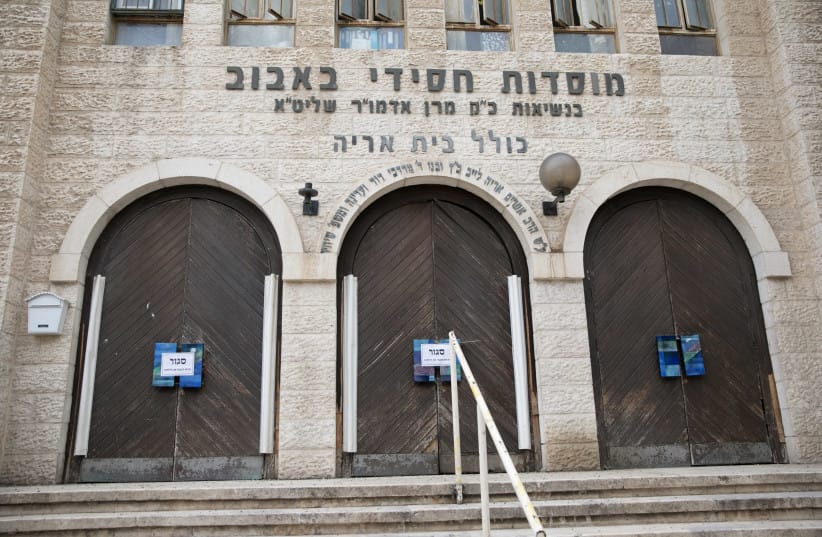
A closed talmudic school in the ultra orthodox Jewish neighborhood of Meah Shearim, following the government’s decisions, in an effort to contain the spread of the coronavirus. March 31, 2020
(photo credit: OLIVIER FITOUSSI/FLASH90)

I do not know how to begin an article I am embarrassed to write. I do not know how to organize my thoughts, how to choose the right words to express the actual nausea that has taken hold of me.

Nine hundred years have passed since an evil monk created, from the depths of his sick soul, the first blood libel against Jews, accusing the Jews of Norwich, England, of murdering a Christian child for ritual purposes on Seder night. Nine hundred years of evil libels and of atrocious violence against Jews ensued, 900 years weighing on Europe’s conscience and staining its morality.

And now, as Passover approaches, we get more and more reports of the basest sort of antisemitism, linking the plague that has infected the entire world with some sort of Jewish scheme or another.

The eye reads this news while the mind refuses to comprehend. Were we mistaken in believing that those dark days were behind us? Could it be that even in a world that considers itself “modern,” there are people who can weave such vicious, violent and dangerous tales about another nation?

The COVID-19 plague has shaken all of humanity. It returns us to our most basic values. We are home with our families, little or no international travel, little to no international trade. This is the moment of truth in which people’s greatness is revealed – those who act, volunteer, pray, lend a hand, or put all their efforts and talents into finding a cure. In the face of all this goodness, how pathetic are those who sow hatred between people in such a time.

The Jewish nation is about to celebrate Passover, the Festival of Freedom.

True freedom, say our ancient sages, is freedom from being enslaved to our desires and our egos, freedom from being enslaved to jealousy and hatred.
I pray that the light of freedom will illuminate even the darkest corners of our world. Until then, I call upon world leaders to act with determination and courage to root out the scourge of antisemitism, the tragedy of the world.


The writer is rabbi of the Western Wall and holy sites.


Zawartość publikowanych artykułów i materiałów nie reprezentuje poglądów ani opinii Reunion’68,
ani też webmastera Blogu Reunion’68, chyba ze jest to wyraźnie zaznaczone.
Twoje uwagi, linki, własne artykuły lub wiadomości prześlij na adres:
webmaster@reunion68.com


News From Israel- Apr. 27, 2020

News From Israel- Apr. 27, 2020

  ILTV Israel News


Zawartość publikowanych artykułów i materiałów nie reprezentuje poglądów ani opinii Reunion’68,
ani też webmastera Blogu Reunion’68, chyba ze jest to wyraźnie zaznaczone.
Twoje uwagi, linki, własne artykuły lub wiadomości prześlij na adres:
webmaster@reunion68.com


Israel sees lowest daily coronavirus infections in more than a month

Israel sees lowest daily coronavirus infections in more than a month

TOI STAFF


Health Ministry puts total tally at 15,443, just 145 more cases than 24 hours earlier; death toll up to 201, with 133 in serious condition

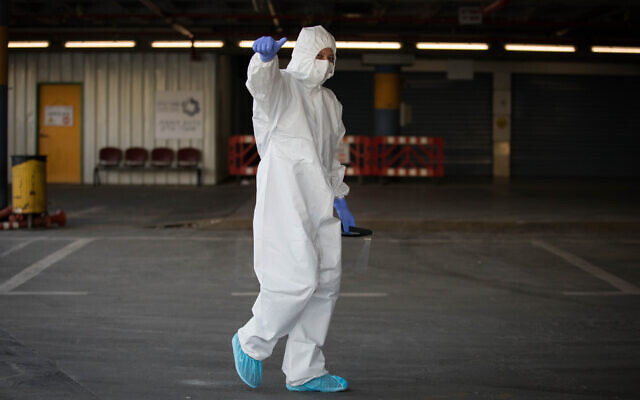
A paramedic in protective gear outside the coronavirus unit at Shaare Zedek Medical Center in Jerusalem on April 21, 2020. (Nati Shohat/Flash90)

Israel’s confirmed coronavirus cases reached 15,443 on Sunday night, the Health Ministry said, with 145 new infections recorded over the previous 24 hours — the lowest daily tally since March 20 — raising hopes that the outbreak is abating.

The country’s death toll was 201, one higher than the morning’s count.
There were no immediate details about the latest fatality.

Israel has registered 23 deaths per million citizens, according to the Worldometer tally on Sunday evening, which places it at around 40th in the world, slightly better than the world average of some 26 deaths per million.

The Health Ministry said 133 people were in serious condition, 99 of whom were on ventilators, and 82 people were moderately ill. An 11-year-old girl is among those in serious condition from the virus.

There have now been 6,731 people in Israel who recovered from the coronavirus, according to the announcement, which came a day after the World Health Organization said it could not guarantee that people cannot be reinfected after recovery.

The updated count came as Israel eased its restrictions on commercial activity.

Most stores, hairdressers and beauty salons were allowed to resume operations from midnight Saturday, if hygiene regulations related to the virus were adhered to.

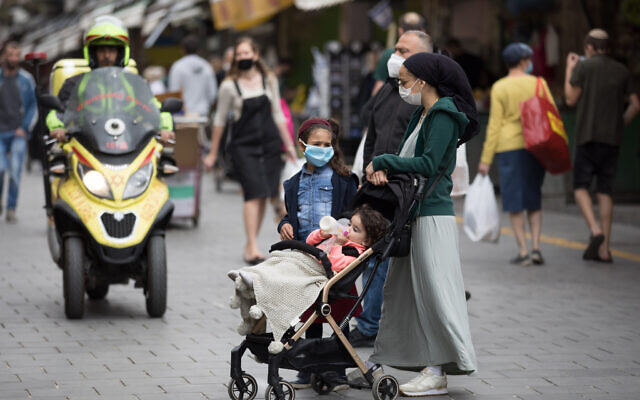
People shop for food at the Mahane Yehuda market in Jerusalem on April 24, 2020 (Nati Shohat/Flash90)

In addition, restaurants and food shops were allowed to sell products for takeaway, not just home deliveries, as long as a physical barrier is placed between the cashier and the customers.

However, hundreds of large businesses remained closed, despite approval to reopen, in protest against the government, and as they demand compensation for the recent closures and ongoing restrictions.

A day earlier, the Health Ministry had defined new parameters on which to base its decisions regarding the easing or tightening of restrictions on the public and the economy, amid widespread criticism of a confused decision-making process.

According to Hebrew media reports, any of the following conditions will likely result in increased restrictions, while remaining below these thresholds will promise continued relief:

Over 300 new sick people per day (numbers have hovered between 200 and 300 in recent days, though they did pass 500 on Wednesday, possibly due to a backlog of tests);
Over 300 seriously ill patients (currently 130 are in serious condition);
A doubling of the national number of sick every 10 days or less (currently cases are doubling around every 20 days).
The Health Ministry previously proposed a set of criteria for declaring individual areas “restricted zones,” due to a high number of coronavirus cases there.

recomended by: Leon Rozenbaum

Several mainly ultra-Orthodox neighborhoods in Beit Shemesh and Netivot, where there has been a spike in coronavirus infections in recent days, went into lockdown at 6 a.m. on Sunday morning. Meanwhile, police on Saturday took down checkpoints at the entrances to the Arab towns of Deir al-Asad and Bi’ina in northern Israel that were put on lockdown due to an outbreak there.

As of Friday, Deir al-Asad, with a rate of 1,142 cases per 100,000 people, had the highest infection rate of any community in Israel with over 5,000 residents. Bi’ina, with 22 cases out of a population of 8,355, had the 11th highest infection rate in the country — 251 per 100,000 people. The majority of towns above Bi’ina on the list were not declared restricted areas.


Zawartość publikowanych artykułów i materiałów nie reprezentuje poglądów ani opinii Reunion’68,
ani też webmastera Blogu Reunion’68, chyba ze jest to wyraźnie zaznaczone.
Twoje uwagi, linki, własne artykuły lub wiadomości prześlij na adres:
webmaster@reunion68.com


Your News From Israel – Apr. 26, 2020

Your News From Israel – Apr. 26, 2020

  ILTV Israel News


Zawartość publikowanych artykułów i materiałów nie reprezentuje poglądów ani opinii Reunion’68,
ani też webmastera Blogu Reunion’68, chyba ze jest to wyraźnie zaznaczone.
Twoje uwagi, linki, własne artykuły lub wiadomości prześlij na adres:
webmaster@reunion68.com


Amid Coronavirus, Building Bridges with Israel Despite Physical Isolation

Amid Coronavirus, Building Bridges with Israel Despite Physical Isolation

Ofer Gutman


Israel Defense Forces soldiers helping to fill and deliver oxygen tanks as part of the country’s efforts to combat the coronavirus epidemic. Photo: IDF Spokesperson’s Office.

Even before the outbreak of the coronavirus, many of our global Jewish communities were separated. At times deeply divided on politics, distant geographically, or experiencing disparate socioeconomic realities, the diversity of the global Jewish experience leads to as many opinions and passions as there are Jewish identities.

Despite these great differences, the global pandemic provides us with an opportunity for reflection on just how deeply we are connected. What affects us on one side of the world affects us on the other — and now is the time for us to come together as one Jewish family.

Reflecting on the global response to this pandemic, we must celebrate our Jewish homeland and its leadership role in driving innovation and recovery.

Israel is a nation of innovators accustomed to overcoming challenges and building from the desert up. For instance, one Israeli tech startup, Soapy, has created an anti-viral hand soap that, when paired with specialized hand-washing stations, kills viruses stronger than COVID-19.

Other Israeli startups have introduced antimicrobial fabrics that could be crafted into life-saving face masks and used around the world. Humanitarian efforts led by IsraAid are supplying personal protective equipment (PPE) and remote stress-management courses internationally. Israel’s impact and spirit has always extended far beyond its own borders, and this is certainly the case with the coronavirus.

Outside of Israel, the global Jewish community is similarly responding with great care and leadership to combat this virus. We are inspired by the stories of Rabbi Daniel Nevins, head of the Jewish Theological Seminary in New York, who recently recovered from the coronavirus and donated his plasma to aid the development of therapies against the disease. We are impressed by the students at Kohelet Yeshiva High School in Merion Station, Pennsylvania, who mobilized their digital fabrication lab to use 3-D printers to print surgical face shields for healthcare workers at their local hospital.

We see our common humanity in the decision of O Boticário, a large Brazilian cosmetics company owned by the billionaire son of Holocaust survivors, to donate 1.7 tons of gel alcohol to their city’s municipal health department to be used as hand sanitizer.

These stories from around the world remind us that the core value that Jews share, enshrined thousands of years ago as we reached the Promised Land, is that we must love and care for one another.

As we face this pandemic together, our bonds are re-awakened — and for many, the crisis has become a call to action. Jews around the world are coming together and looking for opportunities to help. Thousands of Masa Israel Fellows, for example, have chosen to stay in Israel during this crisis and lend a hand. Though they hail from dozens of countries with varying traditions, they are united by their innate connections to the country and its people.

Young doctors from the Former Soviet Union (FSU) enrolled in training programs to receive Israeli licenses, have volunteered to support Israeli medical service providers, despite the risk of their own exposure, because of the immense pressure to meet medical needs as the virus spreads. Participants in Habonim Dror North America’s Workshop program recently relocated from Israel’s center to a kibbutz in the north so that they could help sustain the country’s food supply during this crisis.

Teaching Fellows in Bat Yam are delivering food baskets to their elderly neighbors, while also shifting curricula online to provide their students with continuity and connection. Volunteers from career development programs are now assisting at phone banks in Jerusalem, Tel Aviv, and Eilat to check in with and support the elderly, including Holocaust survivors.

The desire to be agents of change is inspiring.

Despite the distance and disparate backgrounds, our community is also sustaining connections through online tools launched in response to the pandemic. We’re witnessing engagement in Jewish communities grow internationally. This is no doubt a testament to the great calling we feel to unite, to care for one another, and to advance efforts to rebuild.

This strength and determination to persevere, lead into a renewed future, and give back extends beyond Israel. This is our global Jewish story. Now is the time to show our leadership, lean on our networks, and share our humanity. We will get through this together.


Ofer Gutman is Acting CEO of Masa Israel Journey.


Zawartość publikowanych artykułów i materiałów nie reprezentuje poglądów ani opinii Reunion’68,
ani też webmastera Blogu Reunion’68, chyba ze jest to wyraźnie zaznaczone.
Twoje uwagi, linki, własne artykuły lub wiadomości prześlij na adres:
webmaster@reunion68.com