Archives

Israel’s failure to recognize the Armenian Genocide is indefensible

Israel’s failure to recognize the Armenian Genocide is indefensible

EMILY SCHRADER


Many of Israel’s leaders have publicly recognized the Armenian Genocide at various points throughout Israeli history. But as a nation, the Jewish state has refused to do this.
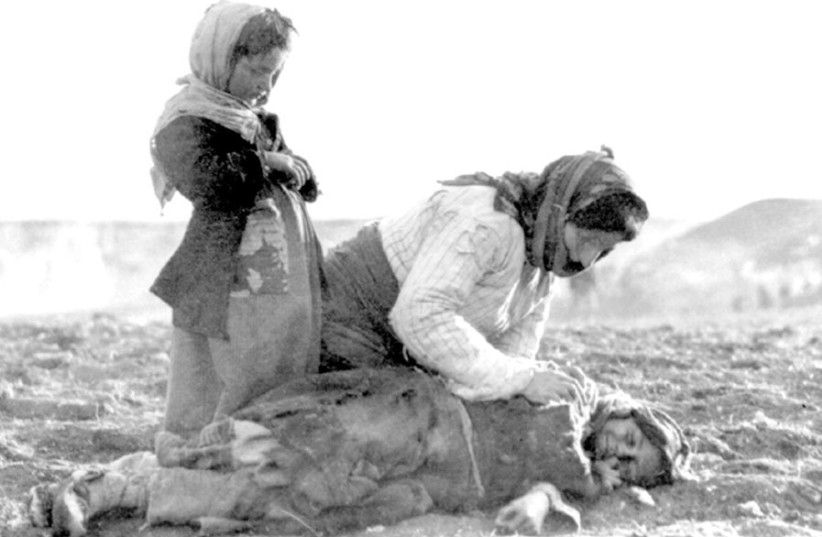
An Armenian woman kneeling beside a dead child in a field “within sight of help and safety at Aleppo.” / (photo credit: WIKIMEDIA)

This week, Israelis and Jews around the world recognize and remember the six million Jews who were barbarically and cruelly murdered in the Holocaust at the hands of the Nazis. But only a few days after Holocaust Remembrance Day (Yom HaShoah), another genocide remembrance day falls – for the Armenian Genocide. April 24 is the official memorial day for the Armenian Genocide commemorating more than a million Armenians murdered at the hands of the Ottoman Turks. Yet in Israel, this day could pass without most of the country noticing.

Despite Israel’s history and the collective trauma of ethnic cleansing and pogroms against Jews from Arab states, and of course the Holocaust, Israel has not recognized the Armenian Genocide, nor does Israel place an emphasis on educating about the Armenian Genocide. In fact, the Knesset has failed to recognize the Armenian Genocide repeatedly due to various political interests, in an embarrassing national display of moral failure.

Many of Israel’s leaders have publicly recognized the Armenian Genocide at various points throughout Israeli history. But as a nation, the Jewish state has refused to recognize the genocide due to fear of Turkey’s reaction, a state which has historically been a key ally for Israel’s security. Today, the relationship with Turkey has changed due to Turkish President Tayyip Erdogan’s marked hostility toward Israel. Yet Israel has still not recognized the Armenian Genocide.

In 2018, MK Tamar Zandberg proposed a bill to address this gap, but the bill was cancelled due to government opposition. In 2019, many government leaders called on Israel to recognize the Armenian Genocide including Blue and White’s Yair Lapid, and Likud’s Gideon Saar, but the vote was delayed and ultimately cancelled – again, due to lack government (coalition) support. This political failure in 2020 on the most basic of issues is simply unconscionable.

APRIL 24, 1915, is internationally known as the start of the Armenian Genocide. But the murderous campaign of the Turks began many years before that in the 1890s under Sultan Abdul Hamid, whose leadership oversaw the murder of 100,000-300,000 Armenians.

On April 24, the Turks doubled down, launching an ethnic cleansing campaign against Armenian Christians, more horrific than the world had ever seen. They began by rounding up and murdering 250 Armenian intellectuals, and they continued with the Tehcir Law. Armenians were robbed of their property and belongings and deported en masse. They were sent on death marches into the Syrian desert in inhumane conditions, and women and girls were raped and enslaved. Those who survived were sent to concentration camps, executed, or left to die. Nearly 50,000 Armenians were tossed into the Black Sea and left to drown. Between 1914 and 1918, 1-1.5 million Armenians were murdered by Ottoman Turks, the direct predecessors of modern Turkey, in the largest race-based genocide in history (at the time).

Unlike Germany, Turkey and Turkish leaders have adamantly refused to acknowledge the Armenian Genocide at all, even oppressing Turkish citizens who do publicly acknowledge the crime against humanity. To date, there has been no recognition and no reparations made to the Armenian people for what is seen by many historians as a precursor to the Holocaust. Even Hitler himself is reported to have said in 1939: “Who, after all, speaks today of the annihilation of the Armenians?”

Imagine if the major perpetrators of the Holocaust were never caught for their crimes, and that adding insult to injury, the State of Germany denied altogether that the Holocaust had occurred. Imagine if Germany instead punished anyone who said otherwise, and threatened to end diplomatic ties with nations who recognized the Holocaust.

On top of this, suppose Germany also had a long and rich track record of destroying concrete evidence the Holocaust ever occurred so as to quash internal dissent. This is exactly what the modern state of Turkey has done, and that in and of itself should be a crime – just as Holocaust denial is a crime in Germany today.

ISRAEL’S LEADERS from the time of its founding in 1948 have carried with them the solemn obligation and promise to ensure that “Never again” is a reality. It is a promise that we as a people reaffirm this week with Yom HaShoah, remembering the six million Jews who were murdered by the Nazis. But part of ensuring that never means never is recognising what genocide looks like.

Some of Israel’s leaders already have, such as President Reuven Rivlin, who has long called for such recognition, stating in 2015: “It was… one of my eldest brothers, who said 25 years before the Holocaust that if we do not warn against what is going on with the Armenians, what will happen afterwards when they try to do it to us…? There is a saying that the Nazis used the Armenian genocide as something that gave them permission to bring the Holocaust into reality… ‘Never again’ belongs to every one of you, all the nations.”

It’s time for Israel’s leaders to exercise true leadership and, as a state, recognize the Armenian Genocide. For the State of Israel, the Jewish state, to not recognise the Armenian Genocide is one of the greatest symbolic failures in the Israel today.

There are some lines that no political interest should be above. One of them is most certainly recognizing the Holocaust, which nearly all nations do today – but another is recognizing the Armenian Genocide, which far too many countries do not. Part of Israel’s historical challenge in recognizing the Armenian Genocide is the lack of moral clarity in the rest of the international community on this issue, giving Turkey more power to “punish” states which recognize the genocide.

At various points in Israel’s history, this may not have been a button Israel could push alone, without an existential risk. But Israel’s survival is not dependent on what Turkey and its current dictator Erdogan think of Israel today, and it’s high time that Turkey’s bullying tactics be universally and unequivocally rejected by all nations. For the world, and for Israel: Recognize the Armenian Genocide now.


Emily Schrader is the CEO of Social Lite Creative and a research fellow at the Tel Aviv Institute.


Zawartość publikowanych artykułów i materiałów nie reprezentuje poglądów ani opinii Reunion’68,
ani też webmastera Blogu Reunion’68, chyba ze jest to wyraźnie zaznaczone.
Twoje uwagi, linki, własne artykuły lub wiadomości prześlij na adres:
webmaster@reunion68.com


U.S. to attack Iran if provoked; West Bank annexation up to Israel

U.S. to attack Iran if provoked; West Bank annexation up to Israel

  TV7 Israel News


1) U.S. Secretary of State Mike Pompeo asserts that Israeli annexation of the West Bank is ultimately ‘Jerusalem’s decision’.

2) U.S. President Donald Trump orders the American Navy to attack any hostile-provocation by vessels of the Islamic Revolutionary Guards.

3) The EU Foreign Policy Chief Josep Borrell has unashamedly condemned the United States over its refusal to lift its international sanctions on the Islamic Republic.


Zawartość publikowanych artykułów i materiałów nie reprezentuje poglądów ani opinii Reunion’68,
ani też webmastera Blogu Reunion’68, chyba ze jest to wyraźnie zaznaczone.
Twoje uwagi, linki, własne artykuły lub wiadomości prześlij na adres:
webmaster@reunion68.com


Pandemic forces first-ever digital Holocaust Remembrance Day

Pandemic forces first-ever digital Holocaust Remembrance Day

M. Blum, G. Lavallee/ AFP


Survivors say no comparison between coronavirus lockdown and Holocaust, ‘indecent’ to compare the eras.

Holocaust survivor

Berthe Badehi, who hid from the Nazis as a child during World War II, has become one of the many Holocaust survivors confined in their homes to evade the coronavirus.

“It’s not easy, but we do it to stay alive,” the 88-year-old said of her current self-isolation at home in Israel. “One thing I learnt during the war was how to take care of myself.”

Movement and travel restrictions in place to contain the pandemic have forced this week’s Holocaust Remembrance Day — Yom HaShoah in Hebrew — to be exclusively digital for the first time.

In a normal year, symbolic events are organized at various locations, notably with survivors at the sites in Europe where the Nazis built concentration and extermination camps.

This year, testimonials from survivors will be streamed online and featured in a pre-recorded ceremony to be broadcast in Israel by Jerusalem’s Yad Vashem Holocaust memorial center, when Yom HaShoah begins on Monday evening.

The limitations on organizing events this year served as a reminder that in the not-too-distant future ceremonies with survivors will no longer be possible because the last of them will have passed away.

“We have talked a lot about what happens when survivors are not here,” said Stephen Smith, who heads the Shoah Foundation at the University of Southern California.

This week’s scaled-back commemorations, “made us realize what the future might be like,” Smith told AFP. “It is a test of our resolve…”

“Maybe it is an opportunity to say… we won’t get 10,000 people at Auschwitz, but maybe we can get a million people (watching) online,” he added, referring to the Nazi concentration and extermination camp in Poland.

For survivors like Badehi, any comparison between COVID-19 isolation and Nazi-era confinement in ghettos and camps is inappropriate.

“In France, during the war, we lived in fear, we hid our identity and we lost contact with our parents…”

“Today, we may be locked inside, but we have contact with our children and grandchildren through the phone and internet,” added Badehi, who volunteered at Yad Vashem until it closed due to the virus.

Dov Landau, a 91-year-old Auschwitz survivor, said it was “indecent” to make comparisons between the two eras.

“Today we are neither hungry nor thirsty. Men, women and children are unlikely to be burned alive. Sure, I’m bored… but it’s nothing serious,” he told AFP.

He regularly traveled from Israel to Auschwitz to speak to school groups, but those trips came to a stop because of the pandemic.

Beyond cancellation of educational events, COVID-19 has posed a particularly grave threat to Holocaust survivors, given their age.

The virus “is absolutely attacking the memory of the Holocaust because it is attacking the elderly,” Smith said, adding that he is aware of several survivors who have died from coronavirus-related complications.

“It is also attacking our ability to (collect) these stories,” he said.

The Shoah Foundation has developed an augmented reality application to document the journey across Europe endured by many Holocaust survivors.

One survivor whose experience was scheduled to be documented this year was Eva Schloss, whose mother married Anne Frank’s father Otto after the war.

Schloss “has an amazing story,” Smith said. “Very, very similar to Anne Frank, the only difference is that she survived.”

“She was literally in the kitchen watching Otto prepare the diary for publication,” h

Because of the pandemic, the foundation had to cancel plans to collect material with Schloss in Vienna, Amsterdam and Auschwitz.

The foundation is partnering on the augmented reality project with The March of the Living, the prominent educational program that brings young people to the sites of concentration camps.

Eli Rubenstein, a Toronto-based rabbi who heads March of the Living Canada, said he has spoken to many survivors who insisted they will be available to give testimonials next year.

“They are very strong people, full of optimism,” he told AFP.

But, he added, the delay forced by the pandemic “gives us a new sense of urgency.”


Zawartość publikowanych artykułów i materiałów nie reprezentuje poglądów ani opinii Reunion’68,
ani też webmastera Blogu Reunion’68, chyba ze jest to wyraźnie zaznaczone.
Twoje uwagi, linki, własne artykuły lub wiadomości prześlij na adres:
webmaster@reunion68.com


News From Israel 22 April

News From Israel 22 April

  ILTV Israel News


Israeli doctors and nurses are angry, as their wages are cut during quarantine, coronavirus restrictions for the upcoming holidays are published and health ministry officials explain how the nation’s sewage could help predict a second wave of the virus.


Zawartość publikowanych artykułów i materiałów nie reprezentuje poglądów ani opinii Reunion’68,
ani też webmastera Blogu Reunion’68, chyba ze jest to wyraźnie zaznaczone.
Twoje uwagi, linki, własne artykuły lub wiadomości prześlij na adres:
webmaster@reunion68.com


Researchers suggest alternating lockdown strategy for exiting corona

Researchers suggest alternating lockdown strategy for exiting corona

ISRAEL21c Staff


Split the population into two groups that alternate between lockdown and routine activity in weekly succession, say Israeli researchers.

View of a Jerusalem neighborhood on coronavirus lockdown, April 12, 2020. Photo by Nati Shohat/Flash90

If social distancing continues for a long time, social and economic stability will suffer. But what is the alternative to isolation?

Bar-Ilan University researchers, led by physicist and applied mathematician Baruch Barzel, suggest a strategy based on alternating lockdowns. The general population would be split into two groups, with each group alternating between lockdown and routine activity in weekly succession.

The combination of isolating spreaders and keeping up protective behaviors can help defeat the virus while sustaining socio-economic activity at a 50 percent level, Barzel’s group claims.

The main advantage of this strategy is that it isolates not just the sick, but also the majority of “invisible spreaders” who are presymptomatic or asymptomatic.

“Consider an individual who became infected during their active week. They are now in their pre-symptomatic period – the most dangerous stage, in which they are invisible spreaders. According to the alternating lockdown routine they are now scheduled to enter their lockdown phase,” explained Barzel.

Bar-Ilan University’s Dr. Baruch Barzel. Photo: courtesy

“Staying at home for another week, they will most likely begin to exhibit symptoms, and therefore remain in isolation until full recovery. Indeed, if following a week of lockdown they show no symptoms, they are most likely uninfected and can partake in social and professional activities during their active week. Therefore, alternating lockdown with full isolation of symptomatic spreaders ensures that at all times, the majority of invisible spreaders are inactive, as their incubation period is naturally directed towards their lockdown phase.”

Barzel and team simulated the spread of COVID-19 using a mathematical model to track individuals as they transition between stages of the disease: susceptible (those available to contract the disease), exposed (those at their pre-symptomatic stage), infected (those who develop symptoms), and recovered (those who are already immune).

They found that employing their strategy – along with proper distancing and hygiene — significantly reduces the spread and helps flatten the curve.

In their simulation, the researchers found that if the proportion of “defectors” – people who continue to be active during their lockdown phase or who hold essential positions and cannot be under lockdown – is kept at under 30%, viral spread could still be overcome.

Since the results of the study were published on the Arxive,
Barzel and his team have been approached by the Israel National Security Council and international groups advising 17 different governments.


Zawartość publikowanych artykułów i materiałów nie reprezentuje poglądów ani opinii Reunion’68,
ani też webmastera Blogu Reunion’68, chyba ze jest to wyraźnie zaznaczone.
Twoje uwagi, linki, własne artykuły lub wiadomości prześlij na adres:
webmaster@reunion68.com