Archives

Red Hot Chili Peppers to Festival in Tel Aviv

Red Hot Chili Peppers to Headline Day-Long Music Festival in Tel Aviv

Shiryn Ghermezian


The Red Hot Chili Peppers perform at the Singapore Grand Prix, Sept. 22, 2019. Photo: Reuters Plus.

The Red Hot Chili Peppers will headline the Funkyard Tel Aviv Festival at Hayarkon Park on June 10, it was recently announced.

Tickets for the day-long urban music festival were to go on sale on Monday.

The veteran rock band will perform with guitarist John Frusicante, who is returning to the group for a second time, replacing Josh Klinghoffer, who had been with the Red Hot Chili Peppers for over a decade.

The Red Hot Chili Peppers last performed in Israel in 2012, when they sold more than 50,000 tickets.

A scheduled performance in Israel in 2001 was canceled due to security reasons during the Second Intifada.


Zawartość publikowanych artykułów i materiałów nie reprezentuje poglądów ani opinii Reunion’68,
ani też webmastera Blogu Reunion’68, chyba ze jest to wyraźnie zaznaczone.
Twoje uwagi, linki, własne artykuły lub wiadomości prześlij na adres:
webmaster@reunion68.com


Your News From Israel- Feb. 10, 2020

Your News From Israel- Feb. 10, 2020

  ILTV Israel News


A vacation turns into a nightmare. Up to 14 Israelis are stuck on cruise ship off of Japan where more than 130 people are infected with the coronavirus. Welcome home! It looks like Israel is about to have another wave of immigration from Africa. And the Oscars may have ended but we have the scoop on which Oscar predictions came true.


Zawartość publikowanych artykułów i materiałów nie reprezentuje poglądów ani opinii Reunion’68,
ani też webmastera Blogu Reunion’68, chyba ze jest to wyraźnie zaznaczone.
Twoje uwagi, linki, własne artykuły lub wiadomości prześlij na adres:
webmaster@reunion68.com


Jeremy Corbyn’s place in the history of antisemitism

Jeremy Corbyn’s place in the history of antisemitism

MANFRED GERSTENFELD


To define Corbyn’s antisemitism one can best say that he is a major post-modern antisemite, which expresses itself through many diverse acts and statements.

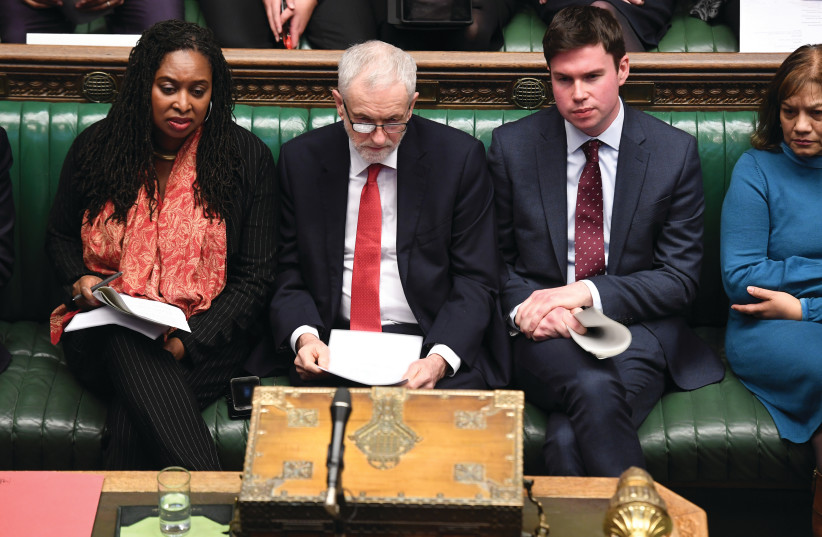
Jeremy Corbyn / (photo credit: REUTERS)

In August 2015, Jeremy Corbyn was only a candidate for the chairmanship of the Labour Party. The Guardian at that time already published that Corbyn had welcomed the extreme terrorist and genocidal antisemitic organizations Hamas and Hezbollah at the House of Commons. When Corbyn was elected chairman in September of that year, he did not feel the need to apologize for associating in a friendly way with people who desire to mass murder Jews.

Labour MPs did not revolt and protest that theirs was a mainstream party which cannot have a leader who calls terrorists who want to murder Jews his “brothers” and “friends.” With such a man at its head, Labour became almost by definition an institutionally antisemitic party. It was already somewhat tainted before as under previous leaders it had not expelled Corbyn in spite of his associations with terrorists, including the Irish IRA. This was a typical example of a radically wrong “Big Tent” approach, where people who are beyond the pale remain inside.

The history of progressive perversity goes back centuries. Under Corbyn’s leadership, Labour would write an important section of its large contemporary chapter.

In May 2016, prime minister David Cameron during question time in parliament asked Corbyn four times to withdraw his friendly remarks about Hamas and Hezbollah. Cameron said, “Those organizations in their constitutions believe in persecuting and killing Jews, they are antisemitic organizations, they are racist organizations. He must stand up and say they are not his friends.” Corbyn avoided apologizing in a straightforward way for his pro-terrorist statements.

In March 2019, scholar Alan Johnson, a Labour member, published a 135-page report which detailed the ways in which the party is institutionally antisemitic. He divided antisemitism in Labour into three categories: socialism of fools, classic racial antisemitism, and antisemitism as anti-Zionism.

In December 2019, The Daily Mail published an article on Corbyn’s 50 infamous moments of shame. It mainly listed his multiple associations with terrorists. A few weeks later the Labour chairman came out against the United States – and thus again in favor of a terrorist – saying, “The US assassination of Iranian General Qasem Soleimani is an extremely serious and dangerous escalation of conflict in the Middle East with global significance.”

Although Corbyn will resign formally only when a new Labour chair is elected in April, one can already assess his important place in the contemporary history of antisemitism. Yet it is far from simple to define it. A comparison with the leading antisemite in the United States, Louis Farrakhan, the leader of the Nation of Islam, makes this clearer. Farrakhan often expresses hatred toward Jews, and his rhetorical manifestations of antisemitism are directed at Jewish individuals.

FARRAKHAN echoed Nazi language when he used the word “termites” to describe Jews. Farrakhan has said that “satanic Jews had infected the modern world with poison and deceit.” He has called Jews “poisoners and absolute evil.”
One only has to put these statements next to the most common definition of antisemitism – that of the International Holocaust Remembrance (IHRA) – to understand that Farrakhan is an antisemite. One can do the same with British politicians who are (part-time) antisemites such as George Galloway and Lady Tonge.

Doing so with statements and acts of Corbyn doesn’t get us very far. His antisemitism is greatly different, yet far more important than Farrakhan’s in view of the position he holds. That the act of calling two Arab movements which aim to commit genocide against Jews his “brothers” and “friends” is hugely antisemitic requires little explanation. Yet none of the definitions of antisemitism includes explicitly such extreme cases.

Upon becoming Labour chairman, Corbyn almost immediately appointed the Hamas supporter Seumas Milne as executive director of strategy and communications. His leadership led rapidly to an explosion of antisemitic statements by various elected party officials.

Corbyn nominally condemned antisemitism, yet Labour greatly underperformed in dealing with the complaints about it. From a BBC Panorama program one learned that he and his immediate staff even protected people who had made antisemitic remarks.

In order to understand Corbyn’s huge contribution to the contemporary history of antisemitism, one has to comprehend a basic issue about current times that are known as “post-modernity.” In it, many themes have fragmented in a multitude of tiny parts.

So has antisemitism. To define Corbyn’s antisemitism one can best say that he is a major post-modern antisemite, which expresses itself through many diverse acts and statements. Scholars of antisemitism will have to familiarize themselves with this new concept as it is recurring.

Corbyn’s indirect antisemitic impact is far larger than seems from the above. Telegraph columnist Zoe Strimpel, who is Jewish, recently wrote about the British chattering classes, “What no dinner party-attending Jewish person can now avoid noticing is that at elite social gatherings in Britain and the US, dressing up brazen antisemitism as a form of political morality has become cool, acceptable and easy.” Jeremy Corbyn is indirectly to a substantial extent at the origins of this disastrous development in the UK.


Zawartość publikowanych artykułów i materiałów nie reprezentuje poglądów ani opinii Reunion’68,
ani też webmastera Blogu Reunion’68, chyba ze jest to wyraźnie zaznaczone.
Twoje uwagi, linki, własne artykuły lub wiadomości prześlij na adres:
webmaster@reunion68.com


Join Arab List lays out conditions for joining Blue and White government

Join Arab List lays out conditions for joining Blue and White government

Arutz Sheva Staff,


Joint List chief Ayman Odeh says his party will back formation of Blue and White government – but only if Liberman is not included.

Gantz (c) with Ahmed Tibi (r) and Ayman Odeh (l) / Ofek Avshalom

The Joint Arab List party laid out a list of demands Monday for supporting a coalition government led by the Blue and White party after next month’s election.

Joint Arab List chairman MK Ayman Odeh said the party would not give its backing to any government which includes Avidgor Liberman’s Yisrael Beytenu, Galei Tzahal radio reported.

“We have nothing in common,” said Odeh. “Liberman is a right-winger, he backs the idea of transferring the [Arab] residents of the [Wadi Ara] Triangle, he is against Arab voting, and we are as far away from him as possible.”

“There is no situation in which we could support any government that includes Liberman – we will vote against. We aren’t just about ‘Never Bibi’, we are against Bibi’s ideas and the path of the Right.”

In addition, Odeh said that for Gantz to receive his party’s endorsement after the election, Blue and White must publically vow not to apply Israeli sovereignty in parts of Judea and Samaria, despite US support for such a move.

“We recommended Gantz [after the last election], but we didn’t hear anything from him against the annexation or transfer [plans]. There is no way that we will support him again or recommend him [as prime minister] if he does not come out against this. There is no way we will endorse him if he maintains the positions he’s had in recent weeks. I want to hear from Gantz that he is against transfer.”

The recently released US peace plan backs Israeli sovereignty over roughly 30% of Judea and Samaria, while also calling for land swaps from pre-1967 Israel to a new Palestinian state. The plan suggests Israel transfer the Wadi Ara region – a strip of land adjacent to Samaria with a large Israeli Arab population – to the new Palestinian state; an idea backed in the past by Avidgor Liberman.

“Blue and White is silent in the face of Netanyahu’s attacks on the Arab population,” Odeh continued. “We won’t accept this situation. We can get to 61 seats without Liberman – the Joint List can get 16 seats. I am the most consistent person there is, and I want to replace the Right, and not just Netanyahu. We need a real Left with values that says these things.”


Zawartość publikowanych artykułów i materiałów nie reprezentuje poglądów ani opinii Reunion’68,
ani też webmastera Blogu Reunion’68, chyba ze jest to wyraźnie zaznaczone.
Twoje uwagi, linki, własne artykuły lub wiadomości prześlij na adres:
webmaster@reunion68.com


Inauguration of Beit Dakira marks renaissance of Jewish life in Morocco

Inauguration of Beit Dakira marks renaissance of Jewish life in Morocco

IRINA TSUKERMAN


According to UNESCO General-Secretary Audrey Azoulay, Beit Dakira is built “around a synagogue, one of the 37 synagogues that adorned the city until the 1950s.
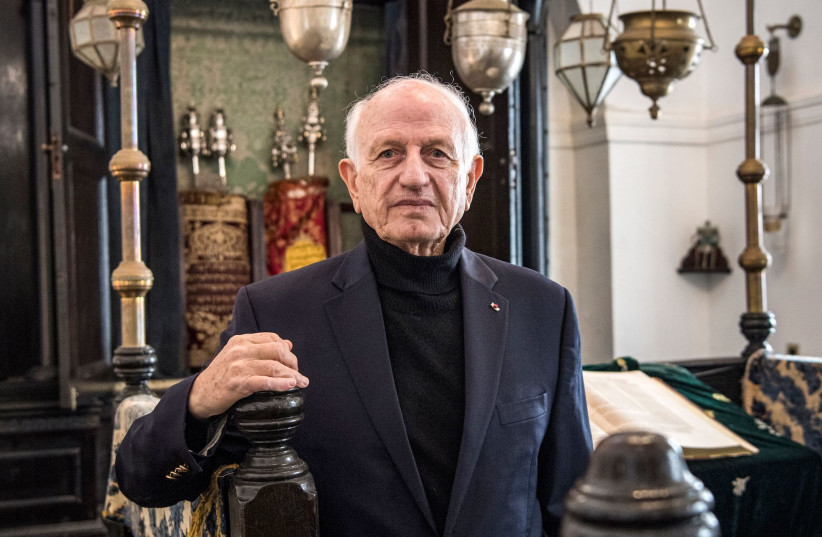
Andre Azoulay, adviser to the Moroccan king, poses for a picture at the Bayt Dakira Jewish museum in Essaouira, Morocco, Dec. 14, 2019 / (photo credit: FADEL SENNA/AFP VIA GETTY IMAGES/JTA)

Essaouira, Morocco’s Beit Dakira (“House of Memory”), a 19th-century home, received a new lease on life as a place for preserving Jewish heritage in Morocco, thanks to the extensive efforts of King Mohammed VI’s senior counselor André Azoulay and his Essaouira-Mogador Association. Beit Dakira will host cultural events, conferences, scholars-in-residence, and lively interfaith Shabbat dinners, bringing together local community members and Jewish visitors who increasingly flock to Essaouira from abroad.

King Mohammed VI inaugurated Beit Dakira on January 15 in a ceremony attended by Moroccan Jewish leaders and rabbis; UNESCO General-Secretary Audrey Azoulay; celebrities Gal Elmaleh and Raymonde Abecassis; European officials, including the German ambassador to Morocco and a Konrad Adenauer Foundation representative; participants of Moroccan Muslim-led interfaith efforts; as well as the executive director of the American Sephardi Federation, Jason Guberman.

Essaouira once had a Jewish majority. The Jewish community dwindled over time, but the spirit of mutual respect and genuine friendship has never left the port city. Each year, Essaouira hosts the traditional Moroccan Mimouna, a post-Passover holiday where Muslims and Jews jointly celebrate a special meal with sweets and music. Thanks to Azoulay, Essaouira, which is a UNESCO World Heritage Site, has been transformed from a quiet town to a cultural force as the host of 17 musical festivals throughout the year, ranging from classical and Islamic liturgical to Gnaoua (an indigenous “Moroccan Blues” repertoire) and Andalusian.

According to Azoulay, Beit Dakira is built “around a synagogue, one of the 37 synagogues that adorned the city until the 1950s. And it expresses this singularity of Essaouira, which is particularly dear to me. It was probably the only urban space from Morocco to Indonesia that for a very long time embodied for centuries this intimacy, this proximity, this porosity, or this capillarity that Islam and Judaism had in the land of Islam.”
More than just a distant memory of the rich cultural past, before the mass migration of Zionist Jews to Israel and waves of economic immigrants to Europe and North America, Essaouira is pointing in the direction of a bright new future filled with possibilities for the blossoming of Jewish culture in Morocco.

These prospects have the full backing of King Mohammed VI. Moroccan Jewish heritage is enshrined in the 2011 Moroccan Constitution, alongside African, Amazigh, Andalusian and Arab cultures. While to many young Moroccan Muslims, the Jewish history of the city exists only in their grandparents’ stories, the Essaouira-Mogador Association and Association Mimouna (a national and increasingly international initiative founded by ElMehdi Boudra) ensure that Jewish memory is realized in life through cultural events, humanitarian projects, and educational campaigns.

Still, skeptics point to the trend of young Moroccan Jews (and Moroccans in general) seeking opportunities overseas. Others discount Morocco’s exceptional integration and mutual respect for its diverse faith and ethnic communities by cynically citing antisemitic instances and claiming that all positive developments are PR moves.

Does this mean, then, that the “House of Memory” is nothing more than a nostalgic reminder of an illusory past and that the future of Morocco will resemble much the rest of the MENA region: monochromatic, clashing and without Jews? As someone who witnessed the vivacious scene during the inauguration, I would argue to the contrary that the Western notion of “nostalgia,” of longing for the past that cannot be, is not applicable here. Instead, the Japanese concept of “natsukashii” is much more relevant. A recent BBC coverage of the concept put it best:

“Natsukashii is a Japanese word used when something evokes a fond memory from your past. It’s a word you exclaim as a smile creeps across your face. For instance, when you hear a song you loved as a teenager, or when you come across an old train ticket stub in your pocket.

“In some cultures, nostalgia is often full of sadness. But natsukashii – which derives from the verb ‘natsuku,’ which means ‘to keep close and become fond of’ – indicates joy and gratitude for the past rather than a desire to return to it. In Japan, natsukashii is a reminder that you are fortunate to have had the experiences you’ve had in life.”

Nothing can ever be exactly as it once was, but it can certainly grow in a new direction and create a better future, taking into the account the legal, social and political mistakes that contributed to the need for rebirth. Some of these issues are already being addressed.

Essaouira was consecrated by King Mohammed VI as Morocco’s city of arts, culture and handicrafts, while the king’s inauguration of Beit Dakira affirms its pluralistic, multifaceted and multi-faith identity. A cultural complex – including a museum, library, tea house, 1,000-seat theater and an outdoor performance stage – are being built to reinforce Essaouira’s role as the vanguard of the Moroccan renaissance.

At the same time, the revival of its cultural identity will make it even more attractive to Moroccan Jews in other cities and abroad who are rediscovering their roots and traveling to Morocco in ever-growing numbers, including for pilgrimages.

King Mohammed VI dedicated part of a $300 million investment in Essaouira to the restoration of the city’s historic Medina, where the Jewish community had resided for centuries. This step comes after prior restorations of Jewish street signs in Marrakesh’s Mella, historic synagogues, and 167 Jewish cemeteries, for which the commander of the faithful took full responsibility.

Thanks to these developments, young Jews seeking to build families can increasingly find a welcoming Moroccan alternative to communities besieged in Europe, where antisemitism proliferates, synagogues require advance appointments even for Jews to visit, and Jews are wary of wearing kippot outside or attending mainstream educational institutions. What is needed now are opportunities for young Moroccan Jews to engage in communal life (the king has called for the Jewish community to hold elections).

Beit Dakira represents how Morocco’s present is progressively catalyzed toward achieving its full potential. In December 2018, young Moroccan Muslims (Maroune El Idrissi’s Moroccan millennium leaders) organized the first global energy school, a conference at Beit Dakira that featured business leaders, technical experts and talented young Moroccan Muslim engineers and entrepreneurs.

Azoulay delivered the keynote address and both ASF’s Jason Guberman and I spoke and conducted workshops. The next day Beit Dakira’s Haim and Célia Zafrani Research Center on the History of Relations between Judaism and Islam hosted the “Third Scientific Colloquium on Doctrine, Jurisprudence and Evolution of Hebraic Law in Morocco,” which was all the more extraordinary because the 30 senior scholars and graduate students participating were Moroccan Muslims.

This unheralded Moroccan reality was reflected in Azoulay’s remarks at the inauguration. “Allow me, your majesty, to express our immense pride, our infinite happiness, our gratitude to his majesty. This historic day bears the mark of our millennia-old, secular Morocco, which has always protected the great diversity that is the core resource of our country.”
Azoulay then presented King Mohammed VI with a Torah and a Koran, and conducted a tour of the exhibitions, including a collection of Arabic letters by Jewish merchants in Timbuktu (the Mali Jewish community hearkens back to the Sahara).

Asked afterward to comment on the inauguration, ASF’s Guberman invoked “Morocco’s culture of coexistence as embodied by the matrouz, in which ideas, languages and genres are combined and remixed. Beit Dakira, in a word, is matrouz.”

He also announced how “the Essaouira-Mogador Association and the American Sephardi Federation are working on a host of initiatives – festivals, conferences, lectures, workshops – including the 23rd New York Sephardi Jewish Film Festival, Festival des Andalousies Atlantiques, and (with Association Mimouna) the second Jewish Africa Conference and David Yulee Levy Fellowship.”

Beit Dakira is a house of memory wherein remembrance gives rise to new, present and future beginnings and limitless possibilities.


The writer is a member of Moroccan Americans in New York and has been working on relationship building with the Moroccan community for the past four years.


Zawartość publikowanych artykułów i materiałów nie reprezentuje poglądów ani opinii Reunion’68,
ani też webmastera Blogu Reunion’68, chyba ze jest to wyraźnie zaznaczone.
Twoje uwagi, linki, własne artykuły lub wiadomości prześlij na adres:
webmaster@reunion68.com