Archives

Joseph in Egypt is an American Jewish dream gone bad

Joseph in Egypt is an American Jewish dream gone bad

JOEL H. GOLOVENSKY


Joseph came to the new country destitute, without a trade, education or family, yet rose to the highest level of influence, power, wealth and fame.

WAS IT a misguided dream? / (photo credit: REUTERS)

The story of Joseph, which we have just completed in our Shabbat synagogue reading, is seen by many as the classic success story for the Jewish experience in North America.

Joseph came to the new country destitute, without a trade, education or family, yet rose to the highest level of influence, power, wealth and fame.

Like those who came to America over a century ago, Joseph wanted more than anything, to belong to the New World, to fit in.

Thus, like the Jews in America and in early 20th-century Germany, he was super-patriotic and strove to contribute far more than the expected. He didn’t just save Egypt from famine: He deliberately built and strengthened Pharaoh’s governmental authority and wealth.

Wanting so desperately to belong, Joseph scrupulously paid respect to the elite. He married into it and protected it, making sure to exempt the clergy from taxation and interference. Joseph changed his name, dressed as an Egyptian and conformed to all society’s customs and deportment. His own brothers could not recognize him, and his father could not identify his sons as Hebrews.

Yet, despite all these efforts to belong, Joseph never really made it in Egyptian society. He remained “loathsome” to many Egyptians. He could never escape being the “Hebrew.”

This was when the economy was healthy, the markets were strengthening, and the upper classes were prospering. And then came the “new king.”

If before Joseph and his brethren were publicly tolerated and privately detested, now the Hebrews were declared public enemy number one and it was open season for abuse and defilement. What happened?

Egypt had become urbanized, and the Hebrews, having left the Goshen ghetto, were dispersed throughout the land. They were very rich (because of Joseph’s preferential treatment, no doubt) and they saw themselves as Egyptians!

It was not their prior acculturation that evoked this new, government led pogrom. This had happened generations earlier. Rather, as the Bible describes their situation under the new king, there were too many Hebrews and they were ubiquitous, dispersed and everywhere assimilated among the Egyptian people. What the new king saw was not a separate group of Hebrews succeeding, but their absorption into Egyptian society freed from their label. It was their efforts to become Egyptians, to socially assimilate and to abandon their identity as Hebrews that stirred the Egyptians’ fear of perfidy and domination.

Theodore Herzl believed that it was the destitute, ghetto Jew who looked so foreign and different that excited virulent antisemitism. The story of Joseph teaches a different lesson. While the ghetto Jew is often the first to be physically attacked, the actual tripwire for the scourge is the acculturated Jews’ efforts to wholly assimilate into the fabric of society. This is when violent antisemitism breaks out in the lower classes and when sophisticated strategies of delegitimization are aggressively promoted among the more educated and cultured.

IT IS WHEN the Jews seem to be everywhere – especially within their own families – that many become unhinged from the restraints of reason, culture and common sense.

This happened in Egypt and then again in Persia, in Spain and in Germany.
A few weeks ago, my wife and I had lunch with US friends from many decades ago. Proud Jews, they came to Israel with 15 family members to celebrate their grandson’s bar mitzvah. Both of their children are intermarried, and the grandchildren seemed to identify, in part, as Jews, largely because of their grandparents.

We know the US intermarriage statistics, but now we felt it. Our friends confided that this year was the first time they were afraid to place a Hanukkah menorah in their window! They live near Silicon Valley, not exactly the boondocks. I hope their fears are exaggerated, but they are real.

Another friend told me he feels anxious when traveling in a NYC subway wearing a kippah, and that to show up there with tzitzit (ritual fringes) exposed, is to tempt fate.

Still another friend told me about hearing openly antisemitic chatter on a public bus with the driver participating.

I hope and sincerely believe that what happened to us in the past elsewhere is not happening in the US. I believe in American exceptionalism. America was founded by adherents of the Hebrew Scriptures who admired and identified with the Jews and who saw the new continent as their “promised land.” America was built as a haven for all.

America was accepting, respectful, decent. In America, People are presumed good until they prove otherwise. Jews were generally accepted as equals from the very beginning. Not in every period (the 1930s, for example), not everywhere, but consistently and broadly.

Yet the rampant assimilation and intermarriage we see today does not portend well for those Jews who remain true to their identity. Anti-Israel invective is a key tool of today’s aggression, but I think most thoughtful observers long ago concluded that opposition to a Jewish state – any Jewish state in any format, in any borders – is merely the latest formulation of the oldest hate, the same hate inflicted on the Hebrews 3,800 years ago.

As in Egypt, the Jews of America are dispersed throughout society. As in Egypt, we are seen as economically advantaged, sometimes scandalously attributed (with historical resonance) to our cunning and single-minded avarice. And as in Egypt we are assimilating on a massive scale. Not surprisingly, today as then, we are being attacked as a people, a nationality, the “nation of Israel,” and not just as a religion.

Joseph’s story in Egypt did not turn out well. It was not a dream. What is happening today in the US, within and without the American Jewish community, must awaken us all to its danger. Assimilation never ends well for us.

The writer made aliyah from the US with his family and practices law in Israel and the US. He is the founding president of the Institute for Zionist Strategies.


Zawartość publikowanych artykułów i materiałów nie reprezentuje poglądów ani opinii Reunion’68,
ani też webmastera Blogu Reunion’68, chyba ze jest to wyraźnie zaznaczone.
Twoje uwagi, linki, własne artykuły lub wiadomości prześlij na adres:
webmaster@reunion68.com


Palestinians reject “deal of century”, vow to conquer Jerusalem – TV7 Israel News 29.01.20

Palestinians reject “deal of century”, vow to conquer Jerusalem – TV7 Israel News 29.01.20

  TV7 Israel News


1) U.S. President Donald Trump unveiled the political portion of his long-anticipated peace initiative, the so-called “deal of the century”, declaring it to be a vision for peace, prosperity and a brighter future for both Israelis and Palestinians.

2) Hundreds of Islamists rallied in the Hamas-controlled territory, during which they vowed to persist in their armed struggle to oust the Jewish people from the land, which they declare to be “Palestine.”

3) Israel is moving to implement the first stages of President Trump’s plan – as Prime Minister Netanyahu intends to have the cabinet vote on a motion to apply Israeli law to the Jordan Valley and all of the settlements in Judea and Samaria.


Zawartość publikowanych artykułów i materiałów nie reprezentuje poglądów ani opinii Reunion’68,
ani też webmastera Blogu Reunion’68, chyba ze jest to wyraźnie zaznaczone.
Twoje uwagi, linki, własne artykuły lub wiadomości prześlij na adres:
webmaster@reunion68.com


Making excuses for antisemitism, then and now

Making excuses for antisemitism, then and now

STEPHEN H. NORWOOD,
RAFAEL MEDOFF


Sadly, some things never seem to change – including the excuses that some people make for antisemitic thugs.

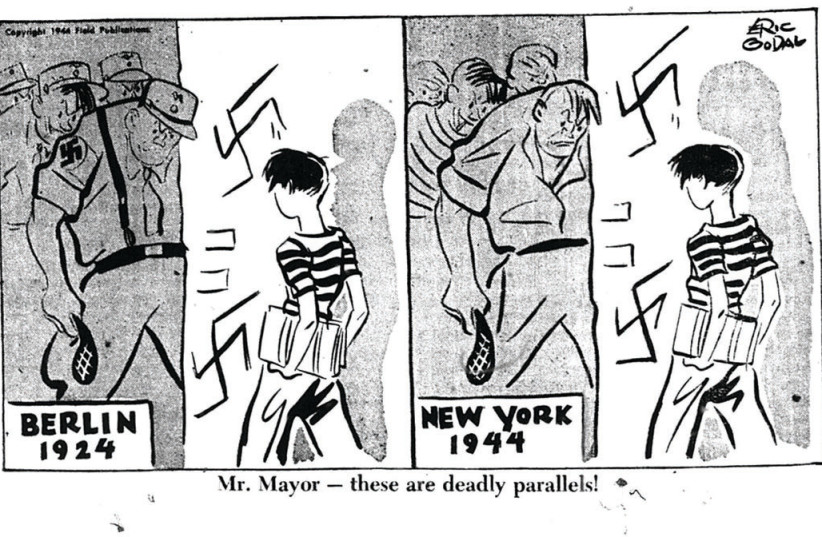
1944 EDITORIAL CARTOON by Eric Godal reflects that numerous attacks in New York City were antisemitic in nature.
(photo credit: Courtesy)

‘Synagogues in Washington Heights were smeared with antisemitic epithets, vandalized, set afire… Mobs of hoodlums have been harassing Jews… Jewish cemeteries in Brooklyn, Queens, and Long Island were desecrated…”

These harrowing descriptions of attacks on Jews and Jewish institutions in and around New York City sound as if they were taken from today’s headlines. In fact, they come from news reports and eyewitness accounts concerning a wave of antisemitic violence that swept the city in 1943-1944.

Sadly, some things never seem to change – including the excuses that some people make for antisemitic thugs.

In 1944, senior police officials were loathe to admit the attacks were numerous or antisemitic in nature, either because it made the city look bad, or because they themselves were not terribly fond of Jews.

The city’s police inspector claimed there had only been “a few isolated” incidents, which had been perpetrated by preteens indulging in “boyish pranks.” That hardly squared with the “flood” of complaints about antisemitic attacks which “poured” into the offices of the Anti-Defamation League.

A New York Post investigation into the assaults in Washington Heights found that “every Jewish resident” whom they interviewed “had stories to tell of… relatives or acquaintances beaten by gangs whose leaders almost invariably prefaced the attacks by demanding, ‘Are you Jewish?’” In the Bronx, knife-wielding hoodlums surrounded a 14-year-old Jewish boy, and when he answered their question in the affirmative, they slashed him across the face, leaving him with a scar that ran from his ear to his lip.

In a Brooklyn pool hall, twenty young men shouting “Jew bastard!” and “Dirty Jews!” badly mauled two Jewish teens. One suffered stab wounds to his leg and two black eyes from being kicked in the face. The police nevertheless refused to arrest anyone, insisting it was “just a poolroom fight.”

William Herlands, New York City’s Commissioner of Investigation, denied that the wave of violence was motivated by antisemitism. He said the attackers were just “teenage marauders” with no connection to groups such as the Christian Front and the Christian Mobilizers, whose members engaged in constant antisemitic incitement on street corners.

The New York Post pointed out that many assaults had taken place on the same corners where those groups were agitating. A 15-year-old girl interviewed by the Post boasted of taking part in “Jew-hunting” and acknowledged she had been strongly influenced by the street corner speechmakers and leaflet givers. Commissioner Herlands seemed uninterested.

In an incident with strong echoes of our own times, a woman was arrested in February 1944, for hurling antisemitic epithets at a Jewish man throughout a subway ride all the way from the Bronx to 34th Street. The judge dismissed the charge as an attempt by the Jewish victim to extract his “pound of flesh,” an allusion to the antisemitic motif in The Merchant of Venice.

There was a sexual element to some of the attacks in 1943-44, which led to another variety of excuse-making. A non-Jewish teenage eyewitness described to the New York City daily newspaper PM how the antisemitic gangs “beat the [Jewish] boys bloody” and “when they catch a Jew-girl, they’ll rip her clothes off.” Commissioner Herlands responded that most of the culprits were “mentally retarded or sexually perverted.”

Chalking up antisemitism to mental disability implicitly denies that bigotry was involved. That may aid an attacker’s legal defense, but is it a satisfactory excuse for his behavior? It would not explain, for example, why only Jewish girls (as opposed to Irish or Italian girls) were the targets in 1944. Nor does it clarify why the Monsey machete attacker was reading up on Nazism and antisemitic conspiracy theories in the weeks before he struck.

Police Commissioner Lewis Valentine offered a different excuse in 1944. He told reporters that “antisemitism is always a problem in a large, heterogeneous city such as New York.” In other words, when different ethnic and religious groups live in close proximity, violence is inevitable, according to Valentine.

We’re hearing that excuse in our own time, too. A news article in The New York Times on January 4, claimed that unnamed “experts” believe “some of the growth [in antisemitism] could be attributed to changing neighborhood demographics.” So, pushy Jews are provoking the violence by moving into areas where they have not lived previously? And therefore, pushy African-Americans are to blame for racist incidents that occur after they move into all-white neighborhoods?

The debate over how best to combat antisemitism will not be settled any time soon. Some observers focus on the need for condemnations by public figures. Others look to legislative remedies or educational initiatives. But one thing is certain: making excuses for violent antisemites is never the answer.


  • Stephen H. Norwood teaches American history and Jewish studies at the University of Oklahoma;
  • Rafael Medoff is director of The David S. Wyman Institute for Holocaust Studies, in Washington.)

Zawartość publikowanych artykułów i materiałów nie reprezentuje poglądów ani opinii Reunion’68,
ani też webmastera Blogu Reunion’68, chyba ze jest to wyraźnie zaznaczone.
Twoje uwagi, linki, własne artykuły lub wiadomości prześlij na adres:
webmaster@reunion68.com


Israeli leaders meet Trump to discuss Peace and Security – 27.1.2020

Israeli leaders meet Trump to discuss Peace and Security – 27.1.2020

   TV7 Israel News


Today’s top stories;
1) U.S. President Donald Trump held two separate meetings at the White House today with Israeli Prime Minister Benjamin Netanyahu and his main domestic political rival Blue and White Chairperson Benny Gantz – to discuss his long-anticipated, so-called, “deal of the century.”
2) Israel launched retaliatory airstrikes against Hamas positions in the Gaza Strip, in response to the indiscriminate launch of a rocket and numerous clusters of balloons that were attached to explosive devices by Islamist Palestinians from the Jihadist territory toward Israel’s southern communities.
3) Today, the world marked the international Holocaust Remembrance Day, in commemorating the memory of the victims of the 6 million Jews and 11 million others that were murdered by the Nazi regime and its collaborators during the second World War.


Zawartość publikowanych artykułów i materiałów nie reprezentuje poglądów ani opinii Reunion’68,
ani też webmastera Blogu Reunion’68, chyba ze jest to wyraźnie zaznaczone.
Twoje uwagi, linki, własne artykuły lub wiadomości prześlij na adres:
webmaster@reunion68.com


French Jews and Non-Jews deeply concerned about rising antisemitism – poll

French Jews and Non-Jews deeply concerned about rising antisemitism – poll

ILANIT CHERNICK


73% of the French public and 72% of Jews ‘consider antisemitism a problem that affects all of French society.’

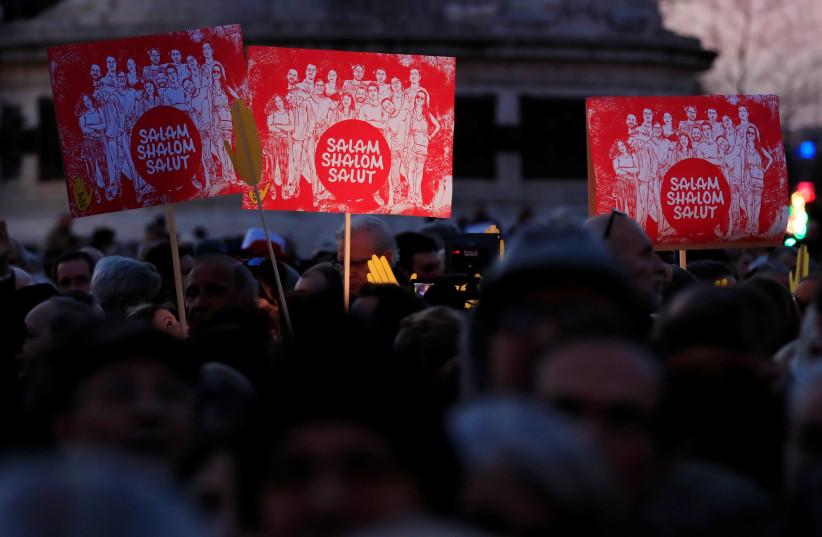
People attend a national gathering to protest antisemitism and the rise of anti-Semitic attacks in the Place de la Republique in Paris. / (photo credit: GONZALO FUENTES / REUTERS)

There is a widening consensus among both Jews and non-Jews in France that antisemitism in the country is a serious problem.

According to a survey released by the American Jewish Committee (AJC) Paris on Monday, nearly 73% of the French public, and 72% of Jews, “consider antisemitism a problem that affects all of French society.”

The survey also found that 47% of the general public and 67% of the Jewish respondents said the level of antisemitism in France is high, while 27% and 22%, respectively, say it is low.

The survey was conducted by IFOP, a leading polling firm, in partnership with Fondapol, a major French think tank. They polled 505 French Jews and 1027 French people between October 14 and November 19, 2019.

Asked about the response to antisemitism by elected officials, the survey found that Jews and the general public are in agreement about how it’s being handled.

Less than half Jewish and non-Jewish population have confidence in the way French President Emmanuel Macron and his government are dealing with antisemitism.

“Only 47% of Jews and 48% of the general public have confidence in the President of France tackling antisemitism,” AJC Paris said, adding that “46% of Jews and 41% of the public have confidence in the French government’s [approach], while 58% of Jews and 56% of the public [have faith] in local elected officials.”

Anne-Sophie Sebban-Bécache, director of AJC Paris, said that “antisemitism has become a concern for French society as a whole.

“It is not considered anymore as only the concern of Jews,” she said in a statement. “We are not as alone as we could have felt in the past to fight this scourge.”

According to the AJC Paris survey, 70% of French Jews also commented that they have been victims of at least one antisemitic incident in their lifetime, while 64% said they had suffered antisemitic verbal abuse at least once, and 23% have been targets of physical violence on at least one occasion, with 10% said they had been attacked several times.

It also pointed it out that the younger generation of Jews, aged between 18 and 24, were on the “‘frontline’ more than older cohorts in confronting antisemitism.”

The survey stated that 84% of this younger generation had suffered at last one antisemitic act, compared with 70% of all respondents; while 79% said they had suffered verbal abuse, compared with 64% of overall respondents not in this category, while 39% said they had faced an act of physical aggression, compared with 23% of the entire Jewish sample.

Visibly religious French Jews also said that they felt the most vulnerable, the survey stressed, with 74% of them saying they had been a victim of at least one act of verbal abuse, compared with 64% of the full Jewish sample.
The main locations where antisemitic incidents have occured are in the street and at school. Just over half of those surveyed, 55%, said “they had been insulted or threatened on the street, and 59% said they had suffered physical abuse in the school,” with 54% saying they were victims of verbal abuse, and 26% saying they had been victims of antisemitic violence in schools.

The workplace was also found to be a hot-bed for antisemitism with 46% of Jews surveyed saying they had been victim to verbal abuse.

In a separate poll published late Monday by the French channel of the i24News, 60% of all Israelis said they believe that the lives of French Jews are unsafe, while 62% of Jewish respondents called for French Jews to immigrate to Israel.

The poll was released ahead of the 75th anniversary of the liberation of Auschwitz at Yad Vashem.

The survey, which was also conducted by the IFOP Research Institute polled 1020 Israelis from the Jewish and Arab population ahead of the conference.
It found that 68% of Jewish respondents, and 60% of all respondents, believed that the lives of French Jews are in danger. About 7% of respondents believed it’s better for them to stay in their country.

Other concerning results found that 77% of Israeli respondents felt that the cause of antisemitism in France is because of Muslims – 92% who addressed this question were Jewish, while 15% were Arab.

Meanwhile, 61% of Israelis think that the far-Right are behind antisemitism, with 45% of Israelis saying the extreme leftists are behind antisemitism, while 22% saying Christians are behind antisemitism in the country.


Zawartość publikowanych artykułów i materiałów nie reprezentuje poglądów ani opinii Reunion’68,
ani też webmastera Blogu Reunion’68, chyba ze jest to wyraźnie zaznaczone.
Twoje uwagi, linki, własne artykuły lub wiadomości prześlij na adres:
webmaster@reunion68.com