Archives

Your News From Israel – Jan 19, 2020

Your News From Israel – Jan 19, 2020

   ILTV Israel News


Defense Minister Bennett makes history, as he bans a far-left group from the West Bank for the very first time.
The IDF begins installing new tech along the Israel-Lebanon border.
And a world famous cyclist is taking us on a once-in-a-lifetime tour through the Holy Land.


Zawartość publikowanych artykułów i materiałów nie reprezentuje poglądów ani opinii Reunion’68,
ani też webmastera Blogu Reunion’68, chyba ze jest to wyraźnie zaznaczone.
Twoje uwagi, linki, własne artykuły lub wiadomości prześlij na adres:
webmaster@reunion68.com


Following Poland’s lead, Lithuania proposes a controversial Holocaust law

Following Poland’s lead, Lithuania proposes a controversial Holocaust law

Cnaan Liphshiz


Lithuanian lawmaker pushing controversial bill which would declare that the country had no responsibility for the Holocaust.
Prime Minister Saulius Skvernelis of Lithuania / Petras Malukas/AFP via Getty Images

Poland passed a controversial Holocaust law last year that drew sharp international criticism and damaged its relations with Israel, United States and Jewish groups around the world. Many feared the law, which prohibited rhetoric accusing Poland of complicity in Nazi crimes — since the Nazis occupied Poland, Polish leaders argue — would hamper education and historical research of the genocide.

Those concerns and issues have not disappeared in the year since Poland passed the legislation. Despite several attempts to bury the hatchet, Polish President Andrzej Duda last week pulled out of a major Holocaust commemoration event in Jerusalem.

Some historians and survivors say the Polish legislation has encouraged other European nations with far more sinister Holocaust records to attempt to whitewash their own participation in the genocide.

One such country is Lithuania, where Nazi complicity was both widespread and a major reason why about 95 percent of the country’s 250,000 Jews were wiped out, according to major international research institutions about the Holocaust.

Trying to counter that narrative, a Lithuanian lawmaker for the ruling party of Prime Minister Saulius Skvernelis announced last month that a committee he heads is drafting legislation declaring that neither Lithuania nor its leaders participated in the Holocaust.

“The Lithuanian state did not participate in the Holocaust because it was occupied, just as the Lithuanian nation could not participate in the Holocaust because it was enslaved,” said the lawmaker, Arunas Gumuliauskas.

To Rosa Bloch, a 91-year-old survivor of the Kaunas, or Kovno, ghetto, the assertions are “so clearly false and outrageous that it could only have been the result of the Polish legislation,” she told the Jewish Telegraphic Agency.

“The Lithuanians saw it worked for the Poles, so they also went ahead,” Bloch said.

The Lithuanian push is perhaps more disturbing to Bloch than the Polish one “because the Lithuanians were active and cruel partners in the Holocaust. There isn’t a Lithuanian Jew alive who didn’t lose relatives to Lithuanian murderers,” she said.

The causality Bloch and many others see between the law in Poland and the legislation being contemplated in Lithuania is difficult to establish, but the projects are clearly connected.

In September, Gumuliauskas organized a meeting with Polish lawmakers about historical memory, referring to what he described as a common challenge.

“Today, when Lithuanian-Polish relations are good, third parties are trying to knock us over the head by using the prism of historical memory,” he said in an interview about the meeting. Gumuliauskas did not name the third parties.

The meeting, he added, was to promote “cooperation between historians of both countries in pursuit of common goals.”

Whatever the exact relationship between the Polish and Lithuanian pushes for exoneration – Gumuliauskas did not respond to JTA’s query on the matter — they are part of a broader effort on the part of Eastern European nations to emphasize their populations’ victimhood and contradict or diminish allegations of complicity in the Holocaust.

Whereas Western European societies have increasingly assumed responsibility for the persecution of their Jews, the opposite has happened in Eastern European nations, where education about the Holocaust was largely absent or lacking under communism.

Many in Eastern Europe today excuse their compatriots’ collaboration with Nazi Germany as “aimed at achieving independence from the Soviet Union” rather than to kill Jews, Michael Berenbaum, a former director of the U.S. Holocaust Museum’s research institute, told JTA. He also said that the Polish law was “encouraging” politicians in other countries to seek similar legislation.

Amid rising nationalism across the continent, governments in multiple Eastern European countries now celebrate Nazi collaborators, including perpetrators of the Holocaust, as patriotic heroes.

In Ukraine, the parliament passed a law in 2015 that praised “anti-communist partisans,” including Nazi collaborationists, and criminalized uttering “insults” about their memory. Streets there are named for collaborators Stepan Bandera and Roman Shukhevych, among others.

In 2014, Latvia introduced a law stipulating up to five years in jail for those who deny the role of “the foreign powers that have perpetrated crimes against Latvia and the Latvian nation” without mentioning the involvement of Latvian SS volunteers in murdering nearly all of the country’s 70,000 Jews. German SS veterans march annually through the streets of the capital Riga flanked by ultranationalist activists.

Back in Lithuania, a school is named for Jonas Noreika, a wartime leader who helped killed Jews.

Seen in this context, the proposed legislation in Lithuania is a trial balloon and “the next step in Holocaust distortion in Eastern Europe,” said Efraim Zuroff, the Eastern Europe director of the Simon Wiesenthal Center, who in recent years has focused on Holocaust history and revisionism in Lithuania.

If a nation with a Holocaust record such as Lithuania’s passes a law that exonerates it without significant diplomatic fallout, Zuroff suggested, “it could be a terrible sign for others.”

Ruta Vangaite, a bestselling author in Lithuania who has written about the Holocaust, said the law would be a “travesty.”

“On the first week of occupation, the Lithuanian government established the first concentration camp and created a battalion that killed Jews. This was the Lithuanian government. And everybody knows it,” she said.

The remarkable brutality of anti-Semitic pogroms in Lithuania is another challenge for the law’s architects. One of the most infamous happened in Kaunas, where dozens of Jews were butchered by club-wielding locals at a bus garage. Some perpetrators posed for pictures over the tortured bodies of their victims while displaying the murder weapons.

From a historical perspective, Poland has a far stronger case than Lithuania for opposing allegations of complicity in the Holocaust, according to Zuroff.

In both countries, he said, the Holocaust would not have happened if not for the Germans. And in both, locals killed thousands of Jews during the Nazi occupation.

But Poland “didn’t exist as a country” when the Nazis occupied it, and its government in exile “didn’t encourage actions against the Jews.” In Poland today, expressions of admiration for Nazi collaborators are quite rare.

By contrast, the collaborationist Provisional Government of Lithuania was responsible for countless murders in the six weeks of its brief existence.

Language used by leading Holocaust historians about the two countries reflects that difference.

On Poland, Sara Bloomfield, director of the U.S. Holocaust Memorial Museum, wrote last year in a letter to the Polish president that “The Polish nation was the victim of German aggression and suffered an exceptionally brutal occupation. Characterizations – due to either ignorance or malice – of Polish responsibility for the establishment of Nazi concentration and death camps are unquestionably historically inaccurate.”

Bloomfield also mentioned the many Poles who saved Jews alongside many others who helped kill them.

Yad Vashem, Israel’s Holocaust memorial and museum, writes on Poland that “Facing a ruthless occupation and being engaged in a constant struggle for existence, the Polish public at large paid little attention to the immensely greater distress” of the Jews.

Both museums use different terminology about Lithuania.

“The Lithuanians carried out violent riots against the Jews both shortly before and immediately after the arrival of German forces,” a U.S. Holocaust Memorial Museum summary reads, noting that most of the country’s Jews had been shot during the brief lifespan of its Quisling government.

Lithuania is the only Nazi-occupied country noted by Yad Vashem for its people’s “enthusiasm” for collaboration with Germany. Even when this enthusiasm “subsided … hostility towards Jews and denunciation persisted,” the Jerusalem museum says.

Zuroff said Lithuania’s government needs to face this record.

“While nongovernmental organizations carry out important commemoration work, the main thrust of Holocaust education is done in the school system and by prosecuting perpetrators,” he said. “These are things only a government can do.”


Zawartość publikowanych artykułów i materiałów nie reprezentuje poglądów ani opinii Reunion’68,
ani też webmastera Blogu Reunion’68, chyba ze jest to wyraźnie zaznaczone.
Twoje uwagi, linki, własne artykuły lub wiadomości prześlij na adres:
webmaster@reunion68.com


Israeli Model Says Lebanese Designer Removed Her From Paris Fashion Show Due to Her Nationality

Israeli Model Says Lebanese Designer Removed Her From Paris Fashion Show Due to Her Nationality

Shiryn Ghermezian


Israeli model Arbel Kynan. Photo: YouTube Screenshot.

An Israeli model asserted on Tuesday that a Lebanese fashion designer removed her from the lineup for his runway show, part of Haute Couture Week in Paris, because of her nationality.

“Truthfully … it’s still hard for me to digest,” Arbel Kynan said in an Instagram post in which she detailed the experience. She added, “At the end of the day, we are all human, no matter what our origin, race skin color or whatever. Be human! This is the most important!”

Kynan said she arrived in Paris a few days ago to be photographed by a “very respectable fashion company” and was told beforehand that she would also walk in the designer’s show during Haute Couture Week, which begins Monday.

“Many times, people ask us models where we are from, and on the day of the shoot they asked me where I am from and I of course answered with a big smile that I am from Tel Aviv,” she recalled.

The shoot continued as usual and finished early. A few days passed and, on Tuesday, Kynan wrote, “…just an hour ago I received an email from my agency stating that the client is Lebanese and he does not want me to take part in the show because I live in Tel Aviv, Israel — this is exactly the content of the email I received.”

Kynan later told Israeli media outlets, “These aren’t the values I was raised with.”

“I think we need to be better people,” she added.

The model did not name the designer but according to The Jerusalem Post, “there are no fewer than four Lebanese designers taking part in this year’s Haute Couture Week.”

One of the Lebanese designers showcasing in Paris this year is Elie Saab and though there is no evidence suggesting his fashion house turned down Kynan, Saab sparked outrage in Lebanon and among pro-Palestinian activists two years ago when he posted on Instagram a photo of Israeli actress Gal Gadot wearing one of his designs. Following the backlash, Saab deleted the post.


Zawartość publikowanych artykułów i materiałów nie reprezentuje poglądów ani opinii Reunion’68,
ani też webmastera Blogu Reunion’68, chyba ze jest to wyraźnie zaznaczone.
Twoje uwagi, linki, własne artykuły lub wiadomości prześlij na adres:
webmaster@reunion68.com


When A Summer Internship Becomes A Battle Over Israel

When A Summer Internship Becomes A Battle Over Israel

MEITAL FUKSBRUMER


Defending the Jewish state from the ‘A’ word charge.

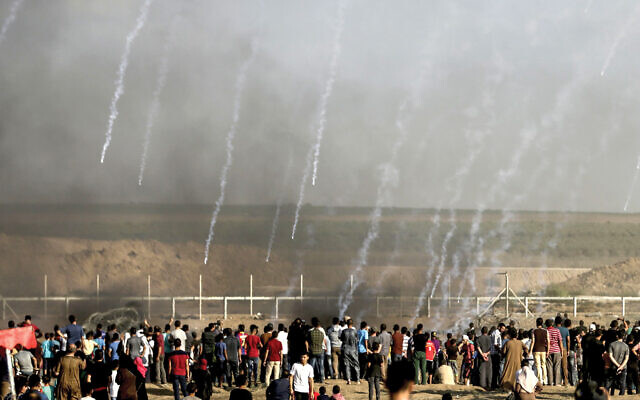
The Gaza border protests in the summer of 2018 led to a heated discussion during the author’s internship. Getty Images

Editor’s Note: The following article is the grand prize winner of the Fresh Ink for Teens/StandWithUs High School Writing Contest. More than 60 contestants from around the country answered the following question: “Describe a time when you were put in a situation where you had to defend Israel. Share your feelings, thoughts and actions in response to this experience.”

Summer internships, especially for high schoolers, are a mixed bag. A diverse group of students doing unfamiliar work, interns quickly band together in efforts to work efficiently — and to have some fun.

I was among four religious students at this particular program in New York City. Many of my fellow interns, and even superiors, were curious about my heritage and practice; I invited such discourse, as I felt conversation would yield understanding. Accustomed to my welcoming attitude, no one shied away from questioning me.

It was June 2018, the time of the Gaza border protests. During every break, I refreshed my news feed for updates on fatalities. At lunch, one of my fellow interns, a friend with a religious background like my own, inquired as to how my brother was doing, as he is an elite combat soldier in Israel. The conversation soon progressed to a discussion of the events occurring at the border.

One intern named Aria asserted, “Well, I think Israel kind of deserves it.” I recoiled, aghast at her unapologetic bias. Although I had heard anti-Israel perspectives before, her eagerness for increased violence was both unfamiliar and horrifying.

Attempting to take a moderate stance that she could affirm, I quickly replied, “I wish there was less violence on both sides.” Her response was quick and biting — there was no compromise in her tone.

“I disagree. Those who occupy land are bound to be attacked.”

Never did I actually consider that I would stand and preach Zionist ideology. I glanced at my fellow religious intern, who gave me a nod. I readied myself to unleash what my yeshiva day school education had thoroughly prepared me to say.

“Actually,” I retorted, “Israel is not an occupier. You cannot occupy what belongs to you, nor what did not have a sovereign prior.” I launched into a history lesson, beginning with the Balfour Declaration and the 1947 partition plan, then the Six-Day War, before recapping current events, disregarding her interruptions.

My disbelief was apparent when she insisted that Israel was an apartheid and bloodthirsty regime. “You don’t believe it’s [the Gaza border protests] in self-defense? You think this is aggressive action by an oppressive state?” I was flabbergasted. Had I not just recounted, in mere minutes, Israel’s history?

The author: “Actually, Israel is not an occupier.”

It was then that I realized our debate had attracted a crowd of listeners who attentively surveyed this conversation. Rejuvenated, I cited recent terror attacks and Israeli policy regarding injured terrorists — who are treated by Israeli doctors in Israeli hospitals. The murmuring that erupted as I concluded, “that doesn’t seem like an apartheid or terrorist state to me — feels like quite the opposite, actually” — was both gratifying and nerve-wracking.

I didn’t think I was convincing Aria that Israel is a compassionate democracy. There is no “winning” with an opponent who refuses to acknowledge its right to exist. I cannot make someone care about safety, about history, about justice.

I did hope, however, that the audience who tuned in went home with Israel on their mind, and a passion for defending it in their hearts.


Meital Fuksbrumer is a senior at Ma’ayanot Yeshiva High School for Girls in Teaneck, N.J.


Zawartość publikowanych artykułów i materiałów nie reprezentuje poglądów ani opinii Reunion’68,
ani też webmastera Blogu Reunion’68, chyba ze jest to wyraźnie zaznaczone.
Twoje uwagi, linki, własne artykuły lub wiadomości prześlij na adres:
webmaster@reunion68.com


Iran is not a rational enemy

Iran is not a rational enemy

BARRY WERNER


The Islamic Republic is engaged in a version of the Game of Thrones in which the iron throne is Mecca and Medina.

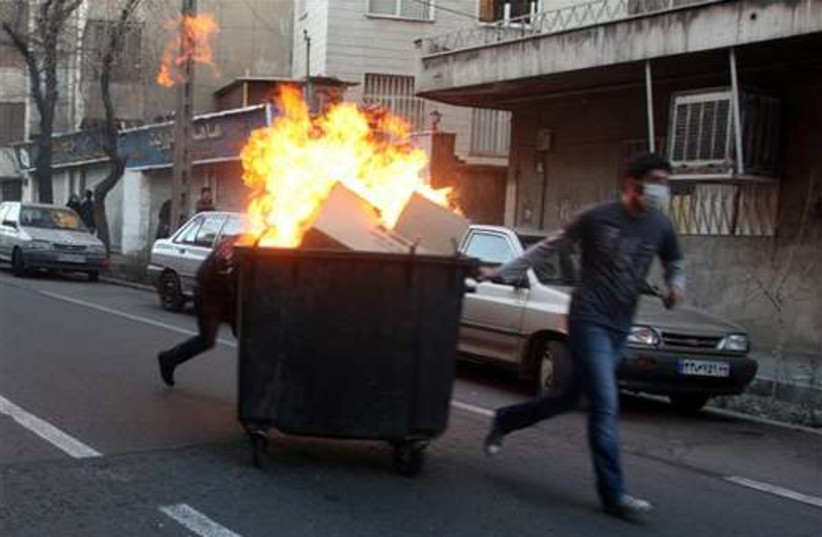
Iran protests 2 520 /  (photo credit: AP)

Iran has been at war with the West since the Islamic Revolution of 1979, but the West has refused to acknowledge it. Over the intervening years, as Iran has become more dangerous, the West did not much more than to try to appease it. President Barack Obama’s Iran nuclear deal, the Joint Comprehensive Plan of Action (JCPOA), was perhaps the worst example of that.

The turbulent Muslim world just happens to be sitting over most of the world’s oil supply. The West needs to keep importing Mideast oil without interruption, but the West is afraid of war. The West decided that the best way to deal with the situation is to pay off the Arabs and Iranians to keep them compliant. The policy of appeasing Iran has now brought us to the brink of war.

Iran is intent on dominating the Muslim World with its Shi’a form of Islam and controlling the holy cities of Mecca and Medina in Saudi Arabia. Think of it as a version of the Game of Thrones in which the iron throne is Mecca and Medina. But Iran also believes it has to destroy Israel first.

Concerning Iran, the central mistake of the West is to repeat the mantra that Iran is rational. By “rational,” they mean two different things. The first meaning is a veiled, but toothless threat intended primarily for Western public consumption. Here they say that Iran is at risk of military retaliation and that Iran will be reasonable because it wants to maintain its existence and the persistence of the Islamic Revolution.

The implication is that the West is willing to use its military might to defend its interests. The second meaning is what the West actually believes that Iran will be “reasonable” and that the West can buy off Iran without having to go to war. They think they just haven’t yet found Iran’s price. But the West is not really willing to use its military might to defend its interests. (The West tried to buy off the Arab world by giving them Israel, but Israel refused to go along with it, and now Israel is no longer available.)

Iran is not rational by either Western meaning of the term; it is not intimidated, and it is not for sale. Iran is engaged in a religious fanatical war with Israel, the US, and Western culture, but the West is in denial about the depths of that religious fanaticism. The mantra of Iran being “rational” blinds the West to the reality that Iran is taking highly irrational risks. Iran can’t afford the war it started with Israel. Iran puts expensive hardware in Iraq, Syria, and Lebanon, and Israel destroys what Iran puts there, piece by piece. Although Iran’s buildup is faster than Israel’s attempts at destroying it, Israel is making Iran pay an extraordinarily high financial and moral price. Meanwhile, the Iranian economy is collapsing, and the Iranian people are rioting in the streets, screaming in rage at the Ayatollahs.

IRAN IS PLAYING a dangerous game. Consider the context in which Iran is carrying on this war against Israel.

– The Arab world doesn’t trust Iran because it’s not Arab; Persians and Arabs have mistrusted each other throughout history. And, the Arab world is mainly Sunni.

– The other major powers in the region – the US, Russia, Turkey – don’t trust Iran.
– Israel can protect itself from the worst that Iran can do to it and return an even deadlier response.

US President Donald Trump laid down very clear red lines in the Mideast. He said he doesn’t want the US army to stay there to protect other people’s interests. If allies try to protect their interests, the US will help them. However, if US interests or citizens are attacked, Trump said he would protect those interests in full force. That means the US will help Israel, but Israel has to defend itself, and that also means that Israel has to be allowed to defend itself.

Trump and Prime Minister Netanyahu made it very clear that they do not want a war with Iran. Israel has been adroitly harassing Iran’s Iraq-Syria-Lebanon military buildup just short of provoking a hot war, too slowly for Iran to feel that it must respond with full-scale war. As long as Israel and the US can continue to degrade Iran’s military threat without going to war, then that is what they want to do. If there will be a war, it won’t be because Trump or Netanyahu are reckless warmongers.

If Iran wants a war, it will be short and bloody, and Iran will lose, but there will be a significant loss of life and destruction in Israel, in the Iranian satellites around Israel, and in Iran itself. (Think of the death and destruction that the similarly fanatic regimes of Nazi Germany and Imperial Japan were able to inflict even after it was certain they would lose World War II.)

The elimination of Qasem Soleimani was a significant blow to Iran and was long overdue. Iran retaliated by firing more than a dozen ballistic missiles directly from Iran at two US facilities in Iraq, but the damage done was reportedly minimal.

Iran is especially dangerous now. It’s in a use it or lose it situation. It can’t eat its weapons; it has to use them. But Iran is also in a bind. If Iran doesn’t carry out its retaliatory threats against the US, it may lose its place as the indisputable leader of the radical Islamist crusade against Israel. If Iran does carry out its retaliatory threats against the US, it will lose everything.

Confrontation with Iran in some form or another is inevitable. Hopefully, Iran will collapse under its own weight before it tries to start firing the more than 150,000 missiles and rockets it has scattered among the homes and backyards of Lebanon’s Shi’a civilians, aimed at Israeli civilians – before Israel is forced to defend itself with a full-blown military campaign.


The writer made aliyah at the end of 2009 and is passionately interested in Israel and its relations.


Zawartość publikowanych artykułów i materiałów nie reprezentuje poglądów ani opinii Reunion’68,
ani też webmastera Blogu Reunion’68, chyba ze jest to wyraźnie zaznaczone.
Twoje uwagi, linki, własne artykuły lub wiadomości prześlij na adres:
webmaster@reunion68.com