Piano – the main attraction of the Polish salon during Maria Szymanowska time,
Benjamin Vogel – ( Lund Szwecja )
Benjamin Vogel
Piano – the main attraction of the Polish salon during Maria Szymanowska time, Annales – Centre Scientifique de l’Académie Polonaise des Sciences à Paris, vol. 16, 2014 s. 125-41.
On one hand, the phenomenon of Maria Szymanowska lies in her unusual pianistic and compositional skills achieved without outstanding piano teachers or composition professors. She was practically self-thought in both areas.(*1) Furthermore, a divorced mother of three children, she earned her living by performing and teaching during a time when divorced women, especially women-pianists performing in public for money, were unwelcome and barely tolerated. On the other hand, her unusual career was enabled throgh the existence of cultural and musical salons, most often hosted by women. Because their cultural and social ambitions were similarly constrained by the ethical and social conventions of that time, these women became Szymanowska’s natural allies. Szymanowska herself grew up in such salon (one hosted by her family) and held her own salon meetings during the last, relatively short period of stability in St. Petersburg, broken off by her sudden death of cholera during the devastating epidemic of 1831.
Music and music-making in the salon was inextricably linked to the keyboard instrument, its place and function in salon space. The following discussion will be devoted to this subject. Its primary material will be based on iconographic sources portraying the interiors of salons, as well as the types of stringed keyboard instruments fashionable during the period under consideration. The materials are drawn from selected publications devoted to the Biedermeier period, (*2) otherwise known as the era when women (symptomatically) “were still soft and angelic,”(*3) complemented by paintings, drawings and watercolors representing the same subject, preserved in the collections of Polish museums, mainly the National Museum in Warsaw.(*4)
The bourgeois or aristocratic salon was the main room of a palace, house or apartment, where the family gathered, entertained guests, arranged all family celebrations, etc. Depending on the wealth of its owners and the size of the apartment, house or palace, the room could be a boudoir, living room, a big hall or ballroom. Regardless of whether it functioned as a cultural salon (the institution known since the sixteenth century), or just a family drawing-room, it was usually equipped with an instrument, mostly for the entertainment of women, who by custom were focused on the house and their families. Children were also taught to play an instrument; this was especially true for girls, who as adults would be expected to entertain their husbands in their leisure with music, or perform during family evenings. During the Renaissance or Baroque, most popular salon instruments (next to the aristocratic harp) were all keyboard instruments—organ positives, clavichords and harpsichords. By the first decades of the nineteenth century—the time of Maria Szymanowska—the piano became the most popular salon instrument.(*5)
The piano’s construction revealed its clavichord-harpsichord origins. Firstly, it was characterized by vertical and horizontal forms inherited from its ancestors. The vertical ones, which were derived from clavicytherium ones, which were derived from clavicytherium (vertical harpsichord), before taking the familiar to us form of the upright piano (pianino), were built in England and France as cabinets (high cabinet, sometimes with shelves for books), in Germany as a pyramid and lyre pianos (named after the shape of the upper part of instrument), and in Austria-Hungary as giraffe pianos. They were over two meters high. The much shorter pianino appeared at the beginning of the century, but gained popularity only a few decades later. Initially it was mainly popular in France, where already in 1815, in Camille Pleyel’s factory, it gained its name (pianino, from Italian – a small piano). The forms of horizontal piano were equally varied: the grand piano was derived from wing harpsichord; the square piano (rectangular) and its other polygonal variants were derived from the spinet, virginal and clavichord.(*6) The builders of horizontal pianos incorporated aspects of the Biedermeier concept of furniture usability. This has resulted, among others, in further development of instruments that combined furniture with keyboards, such as boudoir square pianos (with mirror and drawers for cosmetics and writing), sewing square pianos, tea table pianos or desk pianos. Moreover, instruments from different production centers imitated the form, construction and ornamentation of harpsichords that were previously produced at that location (early eighteenth-century pianos were in practice harpsichords with hammer action and were even called hammer harpsichords in England, Hammarklavier in Germany, gravicembalo di martelletti in Italy, and clavecin à maillets in France). Wing pianos produced by the Viennese school of pianomaking (and by builders in other lands within the Viennese sphere of influence, such as Poland) had had a slight figure and construction, while the competing Anglo-French school mimicked the strongly-built, somewhat ”angular” English harpsichords.
The function of the vertical forms of piano was more ceremonial than musical because high cabinet or giraffe pianos were designed to dazzle with rich ornamentation (the overall shape, fancy veneers and their configurations, ormolu fittings, silk, elaborately draped fabrics in different colors, low relief, and even vases or sculptures positioned on the upper lids). The horizontal instruments—the grand and square piano (which around mid-nineteenth century was supplanted by the upright piano)—had much better sound and more efficient mechanism. This resulted from the technically optimal, horizontal positioning of strings and hammer action. In consort with the differences in construction and ornamentation of the English or Viennese instrument case boxes, different hammer actions were used. The so-called Viennese action, much simpler in structure, was light and struck a relatively light string set (small diameter, not too high tension), resulting in sound that was smooth, round, but not very sonorous. Moreover, it was not efficient technically, especially after 1830, when larger hammer heads, and higher tension and diameter of the strings came in use, and the range of the keyboard was extended. In contrast, the English action was more complex in construction (hence more expensive in production), but also more dynamic, striking heavier (thicker and higher tension) strings. The keyboard, in turn, put up considerable resistance to the fingers while playing. Therefore, when the size of the hammer heads and the thickness and tension of the strings were increased, the so-called double escapement mechanism was applied to aid efficiency of fingers striking the keys.(*7)
Until the mid-nineteenth century, the Polish lands were under the influence of the Viennese school, which was mainly the result of anti-French policies imposed by the Russian authorities. Therefore most pianos that were manufactured here or imported from abroad featured Viennese action and casing design. Any attempt to promote English-style design and action, for instance such efforts by Antoni Leszczyński in Warsaw during the years 1819-1830,(*8) met with hostile criticism (even by Frederic Chopin), pointing out the heavy touch of the English action, among others. Local enthusiasts and manufacturers of instruments became interested in the latest technical solutions in English-French school on a single occasion: the two concerts performed by Szymanowska in Warsaw on Jan. 15 and Feb. 17 1827 on a Broadwood grand piano, which she purchased in England.(*9) Moreover when bringing the Broadwood piano to Warsaw, Szymanowska was exempt from paying custom duty on condition that she would allow the local piano makers to study the construction and sound properties of this instrument. They soon began to apply some of the construction elements (e.g. metal frame bars or an opening in the bottom of the case) that were new in the Polish lands, but typically they linked them with Viennese construction features that continued to be popular here. Often these were combinations of the English body construction with Viennese action; rarely the other way around.(*10)
Existing iconographic sources from the areas of Central and South Europe, that is the zone of influence of the Viennese school, confirm the dominance of the Viennese instrument in the local aristocratic salons. An anonymous watercolor from 1817 shows a music-making group in the salon of the Stiekner Palace near Strakonice in Bohemia.(*11) Six men and a women are singing to the accompaniment of a Viennese-type piano, characterized by a light elongated box made of mahogany veneer, supported by four square, tapered legs. Russian-German painter Wilhelm von Gerhardt Reutern(*12) portrayed himself in an 1829 oil painting, most likely made in St. Petersburg.(*13) In the background we see a wall of a room, decorated with numerous paintings and a typical Viennese grand piano with four pedals in front of it. The artist’s wife Charlotte, holding a needlework in hand, sits sideways to the piano’s keyboard side; a basket with sewing utensils is seen standing on the piano’s lid. An anonymous watercolor from an area of the Habsburg Empire (probably Bohemia), dated to around 1830-40, pictures a woman’s boudoir, where on the right side we see a grand piano resting on turned column legs. The front legs are linked with a crossbeam with three pedals in the middle.(*14) The instrument clearly resembles the model produced in the 1820s by a leading Viennese piano maker Conrad Graf, which was imitated in other countries, including Polish.
In the richly decorated and furnished living room of the Metternich’s Palace in Kynžvart (Königswarte), Bohemia, shown in an anonymous watercolor from 1834, a giraffe piano is the main feature.(*15) It is embellished, among others, with ormolu fittings, draped silk, purple cloth, and a gilded fireplace clock standing on the right side of case. The Great Lounge of the Kinsky Castle in Kostelec on Orlicí, Bohemia, is portrayed on Raimund Mössner’s watercolor dated to ca 1847.(*16) In the room’s left corner we see a grand piano, where a teacher gives a piano lesson to the young Countess Wilhelmine Kinsky. The instrument also appears to be the Viennese model. Finally, a watercolor from 1847 shows boudoir (ladies’ room) of Prince Karl Eugen Czernin’s daughters Maria and Carolina in Vienna, with a grand piano that is unquestionably a Viennese model. The picture was painted by the aforementioned Carolina.(*17)
In the watercolor by Johann Erdmann Hummel, from about 1820 to 1825, we see a Berlin living room, probably belonging to a bourgeois family, in which two women are talking while sitting on the sofa, two other women seat at the window facing the street (one of them with needlework in hands), and the fifth one, most likely much younger, is playing a square piano.(*18) The instrument, resting on four square, tapered legs, has modest casing without decoration that was typical of German-made pianos during this period. A much smaller, simpler and more modest middle-class living room in Berlin is shown in a color plate from about 1840. In a room full of dressers, sofas, chairs, small tables and scattered toys, a family with three children is having a meal at a round table. There is also a plain square piano, veneered with bright plain wood, and supported by square legs.(*19) Apparently it was used for children’s musical education and a place of refuge for the domestic dog and his bowl (seen underneath it).
Comparable iconographic documents showing contemporary Polish lands do not differ from the evidence of the epoch, which was discussed above. A pen drawing from 1819, found in Szymanowska’s album, depicts a salon scene with Szymanowska playing the piano and a man, probably prince Anthony Radziwiłł, playing the cello (Fig. 1).(*20)
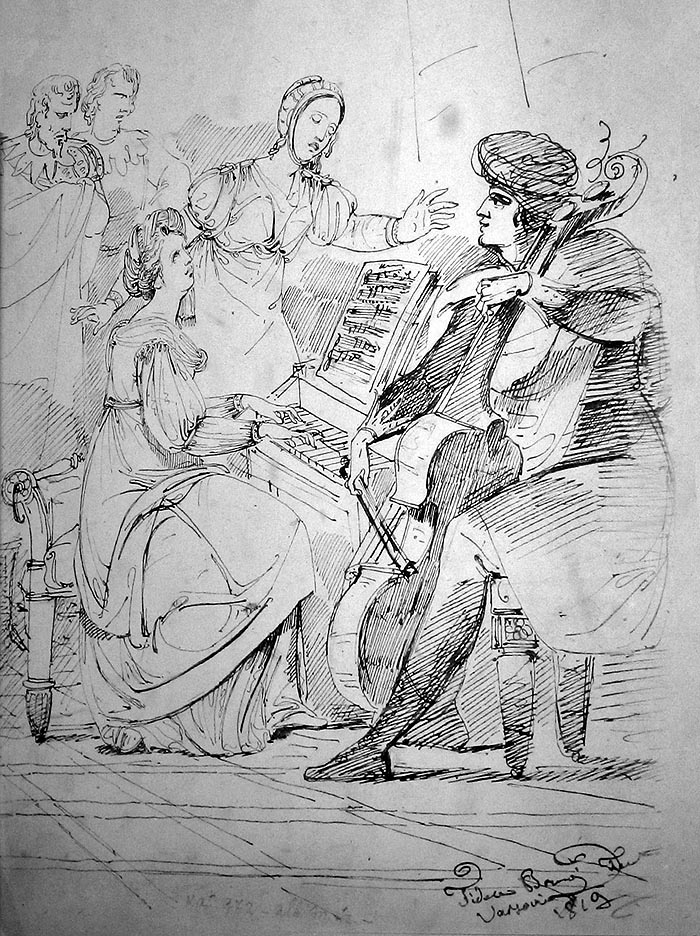
Fig 1. Author unknown, Musical evening in one of Warsaw parlors, 1819, Maria Szymanowska’s album, Polish Library in Paris
One can only guess that it is Szymanowska’s living room (or her parents Wołowskis’) at the corner of Grzybowska and Waliców St. in Warsaw, which was at least once visited by the prince for whom during the same year, Szymanowska composed the Serenade for piano and cello. Judging from the fancy dress worn by the prince (turban and baroque cuffs at the sleeves) and the costumes of two men in the background on the left (mantles and theatrical, serrated collars), the drawing appears to represent one of the then fashionable tableau vivants (living pictures).(*21) Szymanowska sits at the piano (a woman in a bonnet standing behind her might be singing, but most likely turns the pages for the pianist). The visible fragment of the piano clearly indicates a Viennese model. Another anonymous pen drawing shows a performance of the nine-year-old Anthony Kątski, in the hall of the Warsaw Merchants Club in Oct. 26, 1826 (Fig. 2).(*22)

Fig. 2. Author unknown, Little Anthony Kątski in the hall of the Warsaw Merchants Club in Oct. 26, 1826, National Museum in Warsaw
Kątski, one of the then fashionable “wonderful children,” was certainly also performing in the local bourgeois and aristocratic salons. The illustration shows a typical Viennese piano, on square, tapering legs, ending with the so-called bootees.
An anonymous watercolor from 1820 depicting Tzar Alexander I, sitting in his Warsaw office, offers another extremely interesting iconographic testimony (Fig. 3).(*23)
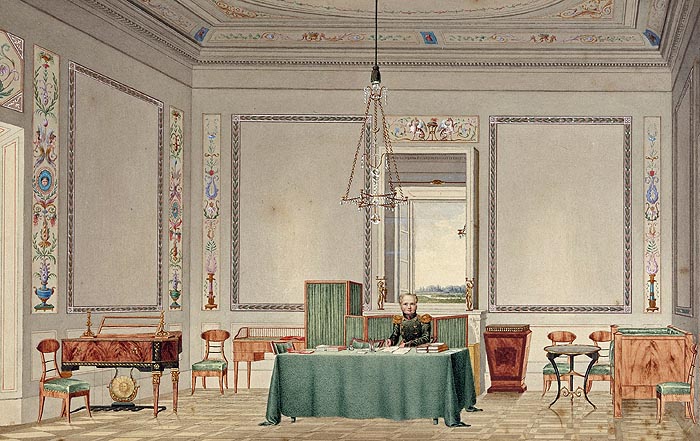
Fig. 3. Author unknown, Tzar Alexander I in his office, ca. 1820, National Museum in Warsaw
We do not know whether it represents a room in the Governor’s (now the Presidential) Palace, the Belvedere Palace or the Royal Castle. On the picture’s left side one can see a typical Viennese piano in Empire style, from the first decades of the 19th century, richly decorated with pyramid mahogany, ormolu fittings, radiant sun fitted into the arms of the pedal lyre, square legs tapering downwards, with carved and gilded tops and [matching?] bootees at the bottom. The instrument has six pedals and gilded candlesticks on the sides of the music stand. Undoubtedly it was important as a display of splendor befitting of a tzar’s office. Another watercolor by Joseph Kriehuber from 1821 shows a salon in the palace of princes Teresa and prince Maximilian Jablonowski (Fig. 4).(*24)

Fig 4. Joseph Kriehuber, Salon in the palace of prince Maximilian and princes Teresa Jablonowski, 1821, Museum in Nieborów
In the background, we see a group of guests engrossed in conversation; in the foreground a woman sits at a grand piano that is undoubtedly a Viennese model. Here too it is not known which of the Jablonowskis’ palaces is being depicted. Perhaps it is the Sanguszko Palace (now at Nowy Świat 51), occupied by Jabłonowskis during 1820s. “A salon led by beautiful (…) Teresa Jabłonowska (born Lubomirska) was well known in the aristocratic circles of Warsaw.”(*25) Probably Szymanowska also visited this salon, since later, at the time of her settlement in St. Petersburg, prince Jabłonowski visited her home on several occasions.(*26)
As already mentioned, in the society of that period, the piano was the axis of cultural, communal and family life. In the famous Self-portrait with the family by Antoni Blank, from 1825,(*27) his relatives are situated as if in musical ecstasy or a “living picture”: his spouse (Amelia ) at the piano, next to their two daughters (Ludwika and Aniela) who are holding a songbook (?), and the father (Antoni Blank himself) in a window, with a musical score placed on the window sill and his right hand in a gesture of conducting the entire family ensemble. A decorative Empire grand piano,(*28) without a doubt a Viennese one, is an important element of the painter’s composition. It rests on legs topped with a gilded women’s heads and has a pedal lyre with six (?) pedals. Similarly, the piano has a central role in the painting’s composition in an Wincenty Kasprzycki’s watercolor from 1839 (Fig. 5).(*29)
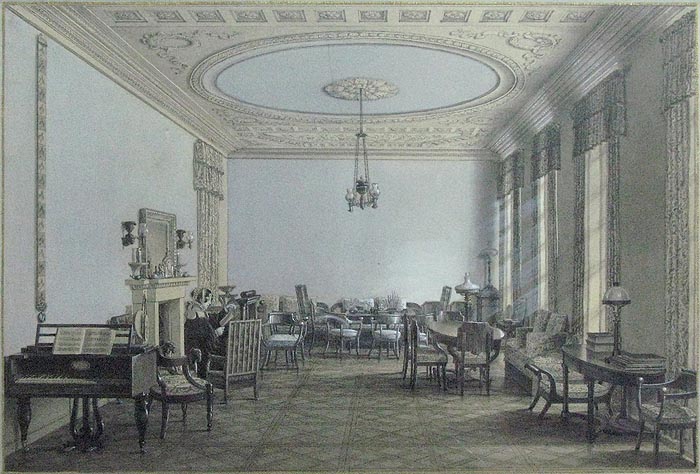
Fig. 5. Wincenty Kasprzycki, Salon interior with Fryderyk Buchholtz piano, 1839. Museum in Nieborów
The painting shows the interior of an unidentified large palace room, with a woman sitting next to the fireplace and reading a book. In the foreground, a grand piano built in Warsaw by Fryderyk Buchholtz(*30) (which we can learn from the inscription on its name board) is shown with a great precision. Its casing already has an English form, but probably, like most surviving instruments built by Buchholtz at the time, it still has Viennese hammer action inside.
Another iconographic testimony is offered by an anonymous pen drawing dated to about 1830 and found in Alexandra Radziwiłł’s album (Fig. 6).
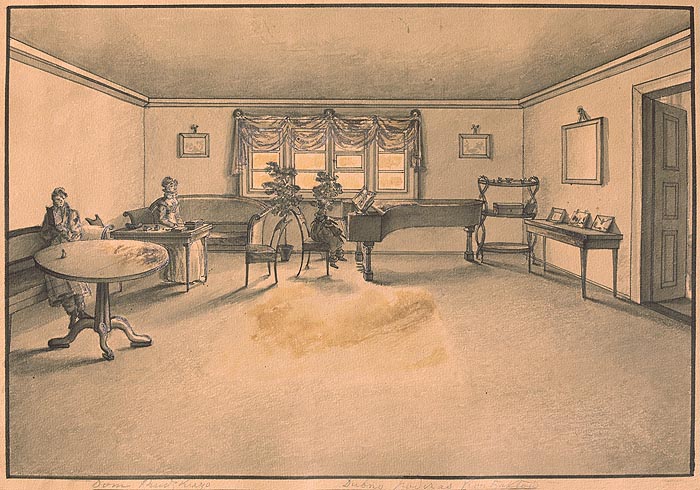
Fig. 6. Author unknown, The House of Rudzki. Dubno during contracts’ time, ca 1830, National Museum in Warsaw
The incribed title—The House of Rudzki. Dubno during contracts’ time— is bafflingly.(*31) At the end of the eighteenth century Dubno (now in the Ukraine) was famous for its ”contracts” (a kind of an annual, almost month-long fair), but after 1797 these fairs were moved to Novograd-Volynsky and then to Kiev. Perhaps in Dubno, common fairs continued to be called “contracts.” The picture shows a salon belonging to a bourgeois or noble family, but it is less affluent than other such examples discussed here. On its right side of the image, a teenage girl plays the piano and on the left side, two people, most likely her parents, are listening. The grand piano, with legs in the shape of turned columns and with five pedals, is a typical Viennese model, patterned after those produced by Conrad Graf. A similar model of the Viennese piano, on turned, columnar legs, was anonymously recorded on a watercolor from 1831, showing the salon in the palace in Krzewin (Volyn , now Ukraine, Fig. 7).(*32)

Fig. 7. Author unknown, Salon in the Krzewin palace, 1831, National Museum in Warsaw
Two groups of people can be seen in the room —adults on the right and children with their governesses on the left. Piano, in a slightly distorted perspective, is visible in the foreground on the left. The Krzewin palace and surrounding gardens were furnished by the previously-mentioned Teresa Jabłonowska, who spent the summer months here.(*33) Recorded a decade apart in watercolors, both her salons were equipped with Viennese pianos.
In a watercolor from 1834, P. Pizzala documented the interior of the Radziwiłł Palace in Szpanów (Volyn, now Ukraine, Fig. 8).(*34)
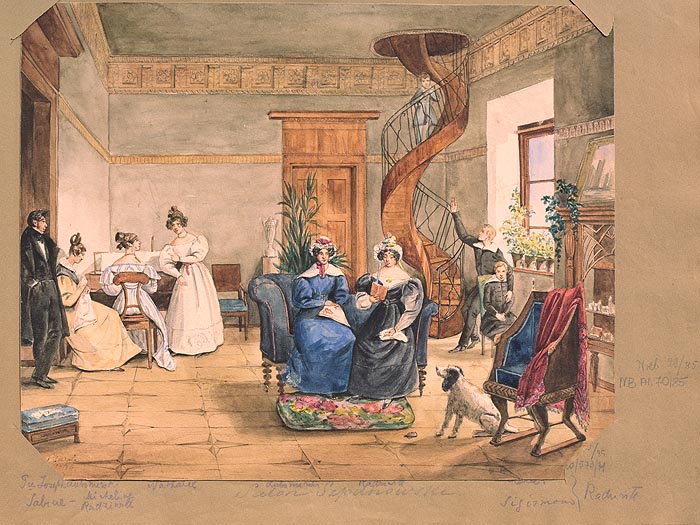
Fig. 8. P. Pizzala, Salon in Szpanów palace, 1834, National Museum in Warsaw
The names of the persons in the scene were noted on the picture’s edges. They are, starting from left—Józef Lubomirski, Sabina, Michalina Radziwiłł, Natalia Lubomirska; in the center—Dorota Lubomirska and Alexandra Radziwiłł; and on the right¬—the children of Alexandra, Karol and Zygmunt (sitting); and Henryk Lubomirski (on the stairs). It is difficult to say whether the piano seen in the background on the left is a grand or a square one, and what model is it. However, the distance between the person playing the piano and the back of the room suggests that the instrument is a grand piano. The watercolor clearly shows the typical distribution of social-cultural roles within the salon of this era—the girls gather by the piano, the boys run up-and-down the stairs. This is the case with most of the discussed iconographic sources—only on two occasions males are portrayed playing the piano (that includes the nine-year-old Antoni Kątski). One more watercolor, this one painted by the owner of Szapanów Palace, Alexandra Radziwiłł, from around 1830, shows another, smaller room of the palace, where on the right side, one can see impressive cabinet piano, again played by a young lady (Fig. 9).(*35)

Fig. 9. Aleksandra Radziwiłłowa born Stecka, Szpanów palace – salon interior with alcove, ca 1830, National Museum in Warsaw
The watercolor by Jadwiga Kieniewicz from 1840s, depicting the living room of her family mansion in Dereszewice (now Belarus), does not deviate from that scheme.(*36) It was reproduced in the book written by one of her descendants, a well-known Polish historian. The author describes the pictured scene in such words: “Hieronim, junior, [is] leaning against the piano ( … ). His father is reading a newspaper on the couch; the mother, in a bonnet, [sitting] in a chair with a high back, seems to be idle; the oldest of three sisters [is shown] with needlework in hand; the middle one plays the piano, the youngest one [is] standing next to her mother. Unpretentious, yet stylish scene: dozens of such Biedermeier interiors had been painted in Poland at the time.”(*37)
The well-known but no-longer-extant watercolor by Antoni Kolberg from 1832 (The Chopins’ family salon at the Krakow Suburb St. 5, in the Krasinski Palace)(*38) can be used to sum up this iconographic tour. It shows the interior of the living room with Chopin’s parents and sisters (Ludwika and Izabella) sitting at the table. On the right side, one can see a grand piano, most probably made by the aforementioned Warsaw piano maker Fryderyk Buchholtz, with English casing and unknown type of hammer action inside. The Chopins’ living room was typical for a middle-class family of that period. The earlier-mentioned salon of Szymanowska’s parents, the Wołowskis, was also a bourgeois one. Her father, even though he was elevated into the nobility, was a successful brewer. Undoubtedly he cared much for the proper education of his daughter. When he became aware of her musical talents, he started to invite well-known people from the musical world to their salon. In time, when the unparalleled talent of the young Maria Agata Wołowska became wider known, many other celebrities, not just locals, such as Józef Elsner and Karol Kurpiński, but also visiting foreign stars, for instance Angelica Catalani, August Alexander Klengel, Mozart (son, Franz Xaver Wolfgang) and John Field, appeared in the salon of Wołowskis. Members of the intelligentsia, especially writers and artists, including Russians who resided in Warsaw, also attended the gatherings at the Wołowski home. The Wołowskis’ and then also Szymanowskis’ salon were frequently visited by aristocrats, like the aforementioned Radziwiłł and Jabłonowski, who were eager to participate in musical attractions. Certainly Szymanowska would have been invited to their palaces as well.
With these preliminary considerations, which are based on relatively sparse iconographic documentation and only begin to address the subject, we can draw several conclusions. First, in Polish lands during the period under consideration, we are dealing primarily with aristocratic and to a lesser degree bourgeois salons. There are not many records related to bourgeois salons in Warsaw and the Polish lands because the local bourgeoisie was relatively speaking not very sizeable and economically still quite weak. Likewise, Szymanowska’s salon and the salons she visited, also during her concert tours of Europe and later in Russia, were mostly aristocratic (manor or court) salons. Undoubtedly, the grand piano was typical of the aristocratic salon, while the standard instrument of a bourgeois living room was the more modest and much cheaper square piano. On one hand, the living room piano was, so to speak, the main symbol of the hosts’ and their guests’ cultural activities, and on the other, it provided a measure of and a testimony to the quality of these cultural activities, which depended on the musical skills of the hosts and their guests. It was also mainly woman’s instrument, and even an attribute of femininity of sorts, as evidenced by Alexander Clarot´s typical watercolor portrait of Katarzyna Branicka at the piano, from 1838 (Fig. 10).(*39)
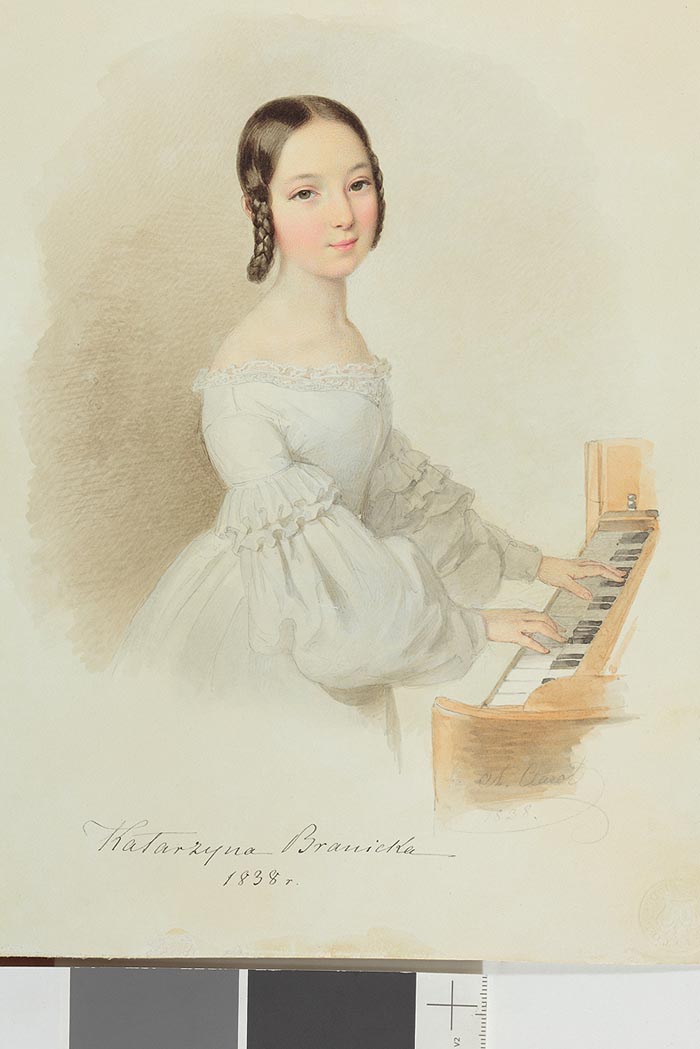
Fig. 10. Aleksander Clarot, Katarzyna Branicka at the piano, 1838, National Museum in Warsaw
As already mentioned, in the Polish territories, salon owners showed preference for pianos with Viennese casing and hammer action. This influence from the Austro-Hungarian capitol can be noted even in the second half of the century, especially in the areas closer to Vienna, like Galicia. Any attempt to promote instruments with English action was torpedoed by criticizing the hard action and keyboard, sometimes in a rather indiscriminate manner, as in the press release from 1823: “Yet one remark can be made here, i.e., that its keys [of pianos with an English action] are a bit too heavy. There is a tradition to manufacture strong keys in England, but here in Poland, where (as some traveler says) young ladies do not drink porter and this is why they do not have as much strength in their fingers as the Englishwomen, it is an obvious flaw.”(*40) We do not know whether Szymanowska’s performances on the grand piano she imported from England in 1827 have significantly contributed to changing the views of Polish music lovers on the quality and advantages of the piano with English action, and whether after her performances such instruments could be seen more often in court or urban musical salons. The fact that very few historical instruments with English action from this period survive suggests no change in the earlier trend. Szymanowska’s departure for Russia, where she permanently settled, reduced and quickly stymied the real effect of her two concerts. Pianos with English action did not become popular
*1 Renata Suchowiejko, “Between the salon and the concert hall. Maria Szymanowska’s artistic career from behind the scenes”, Musica Jagellonica 6 (2012) p. 125.
*2 Biedermeier-Möbel 1815-1835: Der feine Unterschied, ed. Heidrun Zinnkann (München: Prestel) 2007; Rainer Haaff, Biedermeier-Welten: Menschen, Möbel, Metropolen (Germersheim: Kunst-Verl. Haaff), 2009.
*3 Hildegard Westhoff-Krummacher, Als die Frauen noch sanft und engelsgleich waren: Die Sicht der Frau in der Zeit der Aufklärung und des Biedermeier (Münster: Westfälisches Landesmuseum für Kunst und Kulturgeschichte) 1995.
*4 I am much obligated to custodians Anna Grochala, Elżbieta Bogaczewicz and Stefan Mieleszkiewicz for their most kindly assistance in the preliminary iconographic research in the National Museum’s and Nieborów Museum’s collections. I am much obligated to Halina Goldberg as well for polishing my English.
*5 Compare: Beniamin Vogel, “The Piano as a Symbol of Burgher Culture in Nineteenth-century Warsaw”, The Galpin Society Journal XLVI (1993) pp. 137-46; — Fortepian polski. Budownictwo fortepianów na ziemiach polskich od poł. XVIII w. do II wojny światowej [The Polish Piano. Piano Making in Polish Territories from the Half of the 18th Century until World War II] (Warsaw: Sutkowski Edition) 1995 pp. 177-87.
*6 For more on that topic see: Beniamin Vogel, Fortepian polski, op. cit. pp. 27-9.
*7 Sebastian Erard (Sébastien Érard) received the first patent for double escapement in 1821.
*8 Beniamin Vogel, Fortepian…, op. cit., pp. 242-43.
*9 Benjamin Vogel, “Fortepiany Marii Szymanowskiej”, Polski Rocznik Muzykologiczny (2011), pp. 98—100; — “Maria Szymanowska’s Grand Pianos”, Annales – Centre Scientifique de l’Académie Polonaise des Sciences à Paris 14 (2012) pp. 245-46.
*10 Ibidem.
*11 Rainer Haaff, op. cit., p. 406 fig. 1312.
*12 Born in 1794 in Livonia (now part of Lithuania); died in Frankfurt am Main in 1856. As Russian cavalry officer he lost right hand in the battle of Leipzig in 1813. He lived in Russia and in Prussia and achieved a considerable fame as a painter.
*13 His son Basil Joseph Gerhard was born in St. Petersburg on 5 Sept. 1829.
*14 Rainer Haaff, op. cit. s. 407, fig. 1315.
*15 Ibidem, p. 351, fig. 1111.
*16 Ibidem, p. 378 fig. 1212.
*17 Ibidem, p. 347 fig. 1097.
*18 Biedermeier-Möbel 1815-183, op. cit., p. 28 fig. 6.
*19 Hildegard Westhoff-Krummacher, op. cit., p. 128, kat. no. 43.
*20 Author unknown, Wieczór muzyczny w warszawskim salonie, 1819, Maria Szymanowska’s album, Polish Library in Paris, inv. no. SHLP MAM 972. The drawing is signed: Fidelis? [Fidelas?] Brunner? [Bruder?] Fe…. / Varsoviae / 1819. See also: Benjamin Vogel, Fortepiany…, op. cit., p. 106; — Maria Szymanowska’s Grand Pianos, op. cit., p. 252.
*21 Reconstruction of the scenes from painting or sculpture by living persons, applying suitable facial expressions, clothes, body and persons positioning.
*22 National Museum in Warsaw, Gabinet Rycin i Rysunków, inv. no. Rys.Pol.14884 MNW. Phot. Stefan Mieleszkiewicz.
*23 Ibidem, inv. no. Rys.Pol.7514 MNW. Phot. Stefan Mieleszkiewicz.
*24 National Museum in Nieborów. Phot. Stefan Mieleszkiewicz.
*25 Maria Manteufflowa, Jabłonowski, Maksymilian, in: Polski Słownik Biograficzny, Vol. X (Kraków: Ossolineum) 1962 pp. 230-31.
*26 Helena Szymanowska-Malewska, Dziennik (1827-1857), ed. Zbigniew Suchodolski (Warszawa: Wydawnictwo Ancher), 1999, pp. 51, 204, 208.
*27 Jan Antoni Blank-Białecki, Autoportret z rodziną, 1825, oil on canvas, National Museum in Warsaw, inv. no. MP 4231 MNW.
*28 This instrument is often erroneously called clavichord, because there is shown Karol Kurpiński’s Wykład systematyczny muzyki na klawikord [Systematic music lecture for clavichord, 1819] on the piano’s music desk. The clavichord was long ago „out of fashion” here, but its name still used among others for a piano (probably after German Klavier).
*29 Wnętrze salonu, Museum in Nieborów, inv. no. NB 916. Phot. Stefan Mieleszkiewicz.
*30 See: Beniamin Vogel, Fortepian polski, op. cit., p. 204.
*31 National Museum in Warsaw, Gabinet Rycin i Rysunków, in Aleksandra Radziwiłłowa born Stecka album, inv. no. NB AI. 70/72 MNW. Phot. Stefan Mieleszkiewicz.
*32 National Museum in Warsaw, Gabinet Rycin i Rysunków, in Aleksandra Radziwiłłowa born Stecka album, inv. no. NB AI. 70/23 MNW, phot. Stefan Mieleszkiewicz.
*33 Alexander Przeździecki, Podole Wołyń, Ukraina: obrazy miejsc i czasów, t. 1 (Wilno: Teofil Glücksberg) 1841 pp. 24-9.
*34 P. Pizzala, Salon w Szpanowie, 1834. National Museum in Warsaw, Gabinet Rycin i Rysunków, in Aleksandra Radziwiłłowa born Stecka album, inv. no. NB AI. 70/85 MNW. Phot. Stefan Mieleszkiewicz.
*35 Aleksandra Radziwiłłowa born Stecka, Szpanów, pałac – wnętrze salonu z wnęką. 1834. National Museum in Warsaw, Gabinet Rycin i Rysunków, inv. no. NB 3728 MNW. Phot. Stefan Mieleszkiewicz.
*36 Stefan Kieniewicz, Dreszewicze 1863 (Wrocław: Ossolineum) 1986 p. 31.
*37 Ibidem, pp. 32-3.
*38 Fryderyk Chopin Institute, inv. no. A/61. See also: Hanna Wróblewska-Straus, Katarzyna Markiewicz, Fryderyk Chopin i bracia Kolbergowie na tle epoki (Warszawa: Towarzystwo im. F. Chopia) 2005 pp. 71-2.
*39 National Museum in Warsaw, Gabinet Rycin i Rysunków, inv. no. Rys.Pol.10210 MNW. Phot. Stefan Mieleszkiewicz.
*40 Gazeta Warszawska (1823) no. 67 pp. 888-89.
twoje uwagi, linki, wlasne artykuly, lub wiadomosci przeslij do: webmaster@reunion68.com