Archive | September 2015

Kanada: Powrót hiszpańskiej Inkwizycji

Kanada: Powrót hiszpańskiej Inkwizycji

Douglas Murray
Tłumaczenie: Małgorzata Koraszewska
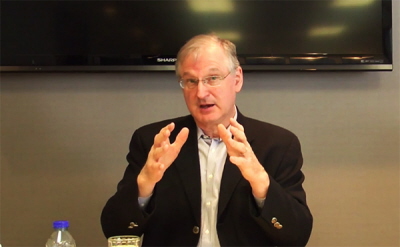

Jacques Fremont, szef Komisji Praw Człowieka Quebecu, powiedział, że użyje swoich nowych uprawnień wobec “ludzi, którzy piszą przeciwko… religii islamskiej… na stronie internetowej lub na stronie Facebooka”. (Źródło: CRDP zrzut z ekranu)

Jacques Fremont, szef Komisji Praw Człowieka Quebecu, powiedział, że użyje swoich nowych uprawnień wobec “ludzi, którzy piszą przeciwko… religii islamskiej… na stronie internetowej lub na stronie Facebooka”. (Źródło: CRDP zrzut z ekranu)


Cofnij się myślą o dwadzieścia lat i wyobraź sobie, że ktoś ci mówi, iż rozwinięte demokracje zachodnie spędzą pierwsze dziesięciolecia dwudziestego pierwszego wieku na wprowadzaniu nowych praw o bluźnierstwie. „Pewnie masz na myśli ‘uchylaniu’?”- powiedziałoby prawdopodobnie twoje mądre, młodsze wcielenie. A jeśli przekonano by cię, że, nie, nowe prawa o bluźnierstwie rzeczywiście zostaną wprowadzone w życie w niezbyt odległej przyszłości, niewątpliwie twoim kolejnym pytaniem byłoby: „Ale jak hiszpańskiej Inkwizycji udało się takie odrodzenie?”

Najnowszym krajem, który próbuje – raz jeszcze – narzucić prawa o bluźnierstwie w dwudziestym pierwszym wieku, jest Kanada. Mówię „raz jeszcze”, bo niektórzy czytelnicy pewnie pamiętają debaty w poprzednim dziesięcioleciu, kiedy dziennikarzy Marka Steyna, Ezrę Levanta i innych zaciągnięto przed operetkowe „Komisje Praw Człowieka” Kanady i kazano wyjaśniać, dlaczego kiedykolwiek powiedzieli cokolwiek, z czym nie zgadzali się państwowi komisarze. Te kanadyjskie Komisje skupiły na sobie uwagę ludzi na całym świecie, których obchodzi wolność słowa. Były to miejsca, gdzie ponury biurokrata żądał od dziennikarzy wyjaśnień, co ich skłoniło do wyrażenia jakiegoś poglądu. Naprawdę zaczynało to wszystko wyglądać nie jak tragedia powtórzona jako farsa, ale jak tępy formalizm.

Teraz jednak wydaje się, że powrócił najgorszy pomysł współczesny Kanady. Zgromadzenie Narodowe Quebecu rozważa projekt ustawy, która uznaje za niezgodną z prawem jakąkolwiek krytykę islamu i nadaje jej nową nazwę „mowy nienawiści”. Projekt ustawy 59 – jak zatytułowana jest ta najnowsza procedura totalitarna – został przedstawiony przez minister sprawiedliwości, Stephanie Vallee; i już przytaczano słowa szefa Komisji Praw Człowieka Quebecu (QHRC), Jacques Fremonta, który powiedział, że oczekuje możliwości używania tych nowych uprawnień wobec „ludzi, którzy piszą różne rzeczy przeciwko… religii islamskiej… na stronie internetowej lub na swojej stronie Facebooka”.

Jest możliwe, że cała sprawa jest po prostu maszynką do zgarniania pieniędzy – bardziej wyrafinowaną wersją starej sztuczki ustawiania malusieńkich znaków o dopuszczalnej prędkości jazdy i zbierania gotówki od każdego kierowcy, który ją mimowolnie narusza. W końcu QHRC będzie mogła zwracać się do sądu po nakaz „nakazujący [winnemu], by zaprzestał” takiej mowy i będzie mogła także narzucić grzywnę do 10 tysięcy dolarów za „szerzenie takiej mowy”. Trybunał Praw Człowieka będzie za każdym razem decydował, ile chce pieniędzy.

To prawo jest tak złe, a zaangażowani w to biurokraci tak przygnębiająco koszmarni, że doprawdy wystarczy zrobić jeden ruch, by pomóc Kanadzie w obaleniu z hukiem tego okropnego prawa. Każdy szanujący się bojownik o wolność słowa, nawet jeśli nigdy nie był w Kanadzie, z pewnością odczuwa ten sam impuls. Niewątpliwie czekają nas niemiłe czasy. Trybunał planuje publiczne udostępnienie listy osób uznanych za winnych „mowy nienawiści” – podobnej do bazy danych przestępców seksualnych. Przypuszczalnie oznacza to, że członkowie społeczności mogą sprawdzać, czy nie mieszkają blisko kogokolwiek, kto coś powiedział. Możemy więc wszyscy zostać umieszczeni w jakimś getcie wolnego słowa, gdzie mili Kanadyjczycy, którzy nie lubią wolnego słowa, nie będą nas słyszeć. Albo też będziemy musieli rozproszyć się po całym kraju z warunkiem pozostawania w dostatecznej odległości od każdego miejsca nauki, rozgłośni radiowych i tym podobne. Najlepsze ze wszystkiego jest to, że członkowie Komisji nie muszą czekać, by ktoś wniósł skargę, zanim podejmą działania. Komisji wolno wybrać się na poszukiwania rzeczy, które są obraźliwe same w sobie. Nie daje się uniknąć myśli, że mogą oni być – całkowicie nieoczekiwanie – departamentem rządowym, który nieustannie wynajduje prace, by uzasadnić swoje istnienie.

Pierwszym testem może być sprawdzenie, czy jesteśmy w stanie powiedzieć, dlaczego Michael Zehaf-Bibeau napadł w zeszłym roku na parlament w Ottawie i zabił kanadyjskiego żołnierza, który pełnił wartę honorową przy narodowym pomniku wojny. Trudno zrozumieć, jak jakiekolwiek informowanie o tym ataku może nie zostać uznane za w jakiś sposób obraźliwe dla jakiegoś muzułmanina gdzieś na świecie lub dla jakiegoś odłamu wiary islamskiej, a więc jestem pewien, że Monsieur Fremont zgodzi się, iż najbezpieczniej jest nie relacjonować o ataku na parlament kanadyjski lub zapewnić, że wszystkie gazety lub osoby indywidualne, które wspominają o takim ataku, natychmiast zostają obłożone grzywną 10 tysięcy dolarów i wpisane na listę Przestępców Mowy Nienawiści. Czy nie byłoby w istocie wygodniej dla Trybunału, gdyby po prostu wszyscy piszący byli na stałym zleceniu płatniczym i pobierałoby się grzywny od absolutnie każdego po każdym ataku terrorystycznym?

Wtedy jednak możemy zacząć stawiać pytania, choć tak przyzwyczailiśmy się w ostatnich latach, że nie możemy ich zadawać. Czy Monsieur Fremont i Minister Vallee pozwolą komukolwiek pisać o współczesnym antysemityzmie albo o najbardziej zjadliwych formach homofobii? Co prawda są to pomniejsze sprawy i nigdy nie weszłyby w zasięg kompetencji kanadyjskiego Trybunału Praw Człowieka, ale mogą pojawić się gdzieś na czyimś profilu w mediach społecznościowych lub w prasie narodowej. W takim wypadku, czy odpowiednie władze zapewnią, że żaden gej albo Żyd nie będzie miał pozwolenia na zidentyfikowanie tego zjawiska? A jeśli ktoś to zrobi, czy będzie możliwe zapewnienie, że zaprzestanie dzięki systemowi grzywien i list wstydu?

W zeszłym dziesięcioleciu system kanadyjski zrobił z siebie głupca w oczach świata. Mieliśmy nadzieję, że ten kraj dowiedział się, iż dla większości cywilizowanego świata prawa o bluźnierstwie powinny być rzeczą znaną tylko z historii. Po ostatnich wydarzeniach w Quebecu wiemy lepiej. Cały świat może zobaczyć, że w Kanadzie prawa o bluźnierstwie są melodią przyszłości.

Douglas Kear Murray

Brytyjski autor, dziennikarz i komentator telewizyjny. Występuje często w brytyjskich i amerykańskich mediach, jest autorem książek: Neoconservatism: Why We Need It (2005) and Bloody Sunday: Truths, Lies and the Saville Inquiry (2011).


twoje uwagi, linki, wlasne artykuly, lub wiadomosci przeslij do: webmaster@reunion68.com



How Nazi guard Oskar Gröning escaped justice.

How Nazi guard Oskar Gröning escaped justice in 1947 for crimes at Auschwitz

Owen Bowcott in London
and Kate Connolly in Berlin


Exclusive: UN war crimes files reveal that SS guard Gröning faced trial after the war for his
role in the Holocaust but US cold war fears led to Nazis being released


SS Unterscharführer Oskar Gröning. His UN War Crimes Commission file shows that he was one of 300 Auschwitz staff whom Poland intended to prosecute. Photograph: Museum Auschwitz-Birkenau/AP


Oskar Gröning, the convicted Auschwitz death camp guard, escaped prosecution in Britain nearly 70 years ago because of the United States’ desire to fight the cold war, according to newly discovered documents (pdf).

Researchers in London combing through the archives of the UN War Crimes Commission (UNWCC) have discovered that charges against him were being prepared just as the entire judicial process against Germans accused of committing war crimes was closed down after political intervention from above.

Gröning escaped justice until this week when the former SS bookkeeper at Auschwitz, now aged 94, was finally found guilty of being an accessory to the murder of 300,000 people and sentenced to four years in prison. It is likely to be one of the last Holocaust trials.

Although he did not kill anyone while working at the camp in Nazi-occupied Poland during the second world war, prosecutors argued that by sorting banknotes taken from the trainloads of arriving Jews he helped support a regime responsible for mass murder.

Gröning had admitted moral guilt but said it was up to the court to decide whether he was legally guilty. The trial raised the issue of whether those deemed to be small cogs in the Nazi machinery, but who did not actively participate in the killing of 6 million Jews, were guilty of crimes.

British forces captured Gröning in Germany at the end of the war and, probably as an act of revenge, initially imprisoned him in an old Nazi concentration camp. The historian Laurence Rees recorded that he was shipped to England in 1946. Gröning worked as a forced labourer but reportedly “ate good food and earned money to spend”. He joined a YMCA choir and “for four months travelled through the Midlands and Scotland giving concerts”.

Rees wrote that he “sang German hymns and traditional English folk songs” to appreciative British audiences who competed to have one of the Germans stay with them overnight.

Justice, however, was attempting to catch up with him. Records discovered by Dan Plesch, the director of the centre for international studies and diplomacy at Soas, University of London, show that Gröning’s name appears in UNWCC files dated 6 March 1947.

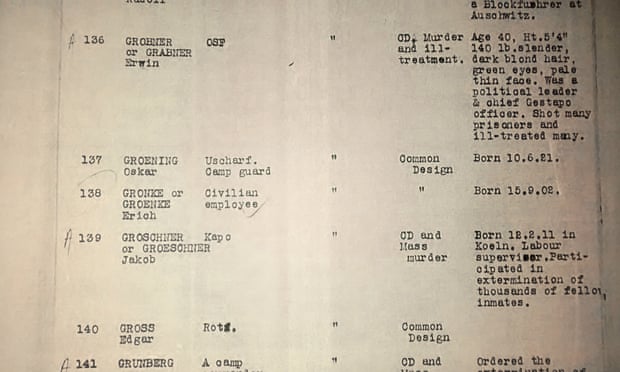
Gröning’s entry in the UNWCC file, listing him as a camp guard.
Gröning’s entry in the UNWCC file, listing him as a camp guard. Photograph: UNWCC/SOAS


He is described as SS Unterscharführer, which translates as junior squad commander and roughly equates to senior corporal or sergeant. His date of birth is given as 10 June 1921. The “date and place of alleged crime” is entered as Auschwitz 1940-45. The words “complicity in murder and ill-treatment” are written underneath.

Gröning’s war crime is recorded as “common design” – the term used by investigators at the time to denote conspiracy in acts said to include “killings, death by gas chamber, cremations of living persons and corpses, use of human beings as guinea pigs for medical experimentation … beatings, tortures, starvation, abuse and indignities”.

His file number, 4771/P/G/139-137, shows that he was number 137 in a list of 300 Auschwitz staff whom the Polish government intended to prosecute for war crimes.

Another recovered document is the minutes of a UNWCC meeting held at the Royal Courts of Justice in London on 20 March 1947. It considered, among other cases, those of the 300 Auschwitz staff on the list drawn up by Dr Marian Muszkat, the commission’s Polish representative.

Gröning was one of those listed in the proceedings as “S” – meaning suspect. “The commission was making a prima facie judgment as to whether there was a case to answer,” explained Plesch, who has examined the files. “The prosecution was required to give evidence of what the defence [in that category of cases] would be. It wrote: ‘Probable defence that they are acting under orders.’”
Oskar Gröning listens to the verdict at his trial in Lüneburg, Germany. He was convicted on 300,000 counts of accessory to murder and given a four-year sentence.
Oskar Gröning listens to the verdict at his trial in Lüneburg, Germany. He was convicted on 300,000 counts of accessory to murder and given a four-year sentence. Photograph: Tobias Schwarz/AP


The secret archive, now at Soas, contains lists of internationally approved war crimes indictments of tens of thousands of Nazis. Sixteen states, including the UK and US, worked together in London on the investigation of more than 36,000 international criminal cases between 1943 and 1948.

“Gröning’s name popped up when I searched,” Plesch said. The process of drawing up a formal summons against the captured camp guard, however, coincided with diplomatic manoeuvres to wind down the UNWCC.

On 24 April 1947, Sir Robert Craigie, a Foreign Office official who was present at the meeting the previous month that considered Gröning’s case, announced that the commission should not take any more cases.

“The priority became to rebuild Germany,” Plesch said. Consequently, a decision was taken, despite fierce opposition by countries such as Poland and Yugoslavia, to release SS suspects being held. Even though Gröning was indicted as a suspected war criminal almost 70 years ago, he was never tried at the time.

“The grand lie is that we never knew anything” about these Nazi suspects, Plesch said. “The dangerous myth is that nothing was ever done except against the Nazi leadership at Nuremberg war trials, but there was a huge effort by many countries that would have seen the likes of Gröning face trial, had it not been for the shift in policy from America.

“It was said that the west had to release these Nazis to mobilise Germany against communism but why that mobilisation should involve Nazis has never been explained.

“The British were not keen to pick arguments with the Americans. The last attempt at pursuing justice was a hunt for the camp guards responsible for executing the Allied inmates who took part in the ‘Great Escape’ from Stalag Luft III.

“By that stage no one was going to prosecute minnows like Gröning. He went back to Germany and was released.”

By the early 1950s, virtually all of those being held had been set free.

Another victim of the sudden ideological obsession with the cold war was the film made by Alfred Hitchcock about Bergen-Belsen concentration camp. It was never shown when completed due to fear of upsetting the Germans at a time when the Soviet spectre was looming.

“Gröning should have been punished at the time,” Plesch added. “It was a mistaken policy that anti-communism meant liberating the Nazis.”


twoje uwagi, linki, wlasne artykuly, lub wiadomosci przeslij do: webmaster@reunion68.com


XVI Bieg Sobiborski

XVI Bieg Sobiborski

M. Służewski


11 października 2015 r. odbędzie się XVI edycja Biegu Sobiborskiego organizowanego przez Miejski Ośrodek Sportu i Rekreacji we Włodawie. W programie imprezy znalazł się bieg główny, w którym może wziąć udział 200 osób. Przewidziane są też biegi szkolne; tu liczba uczestniczących może wynieść 350.

Impreza ma się odbyć w godz. 8.00–15.00. Bieg główny wystartuje o godz. 12.00 spod Pomnika pamięci ofiar w Sobiborze. Trasa biegu poprowadzi przez las wzdłuż torów kolejowych, a następnie tzw. Nadbużanką przez Orchówek do Włodawy. Linia mety przebiega przez ul. Rynek przy budynku „Czworobok”. Łącznie biegacze przebiegną ponad 12 kilometrów.

Poza biegiem głównym, zaplanowano również trasy dla dzieci i osób niepełnosprawnych. Osoby niepełnosprawne na wózkach zwykłych wystartują o godz. 12.00, a trasa ich przejazdu przebiegnie drogą wojewódzką nr 816 oraz drogą powiatową nr 1727L. Biegi szkolne natomiast odbędą się w godz. 10.30–12.30 na Rynku wokół „Czworoboku”.

Bieg jest niecodzienną lekcją historii o tragicznej historii obozu zagłady w Sobiborze, w którym podczas II wojny światowej w ramach „akcji Reinhard” niemieccy okupanci z pomocą ukraińskich strażników urządzili miejsce, gdzie na masową skalę mordowano ludność pochodzenia żydowskiego z Polski, Czech, Związku Radzieckiego i Europy Zachodniej.

Regulamin zawodów i formularz zgłoszeniowy dostępne są na stronie internetowej: http://zapisy.ultimasport.pl/118

Źródło: materiały promocyjne organizatora


twoje uwagi, linki, wlasne artykuly, lub wiadomosci przeslij do: webmaster@reunion68.com


Bruno Schulz

Art & Design Behind Fairy Tale Drawings, Walls Talk of Unspeakable Cruelty

ETHAN BRONNERFEB


One of three sections of wall paintings by Bruno Schulz on display at the Yad Vashem Holocaust museum in Jerusalem.


JERUSALEM — He occupies the driver’s seat with an air of insouciance, a blue helmet atop his head, two proud white steeds under his command and a sly smile across his lips. Bruno Schulz looks out at the world from his painting as if he owns it. But like much else in his life, cut short by a Nazi bullet, this is pure fantasy.

The work and story of Schulz, a Jewish writer and painter in Poland who was forced to illustrate a children’s playroom in a Nazi officer’s home and then killed, have long attracted literary attention. There was something about his humility, talent and fate that captivated writers like Cynthia Ozick, Philip Roth and David Grossman, who all made him a character in their works.
Yet until the wall drawings for children were discovered in 2001 by a documentary filmmaker, fading and peeling like ancient Roman frescoes, they were thought to have been destroyed. Spirited out of Schulz’s hometown in what is now Ukraine under contested circumstances by the Yad Vashem Holocaust museum in Israel, they have been painstakingly preserved and put on view here for the first time.
And while this haunting show, a permanent exhibition titled “Wall Painting Under Coercion,” will not end the lingering controversy over whether Schulz belongs more to Polish than to Jewish culture, or whether the wall drawings should have remained in Ukraine rather than go to Israel, it offers a poignant example of artistic defiance in the face of overwhelming cruelty.
There was something very Kafkaesque about his abhorrence of bureaucracy and authority,” said Yehudit Shendar, senior art curator at Yad Vashem. “He is sometimes called the Polish Kafka. He took courage with a brush in his hand. It became a weapon of rebellion.”

Bruno Schulz in 1934
For example, the Cinderella, Snow White and the Seven Dwarfs, and Hansel and Gretel that Schulz created for the officer’s children’s playroom bore the faces of real people: Schulz himself, his father and other members of the Jewish population in their town, Drohobych. Putting himself at the reins in his drawing struck a note of defiance, since Nazi law forbade Jews from riding in or driving carriages.

His face is also that of the witch, a reference, curators believe, to the witch hunts that Jews faced in eastern Galicia, then part of Poland, in those months after the Nazi conquest of his town in June 1941.

Instantly, some 900 Jews were rounded up and shot. Most of the rest were pressed into forced labor before being killed. Schulz was a sickly man and a talented one, and the Gestapo sergeant in charge of Jewish laborers, Felix Landau, held him aside and ordered him to decorate a riding school and his children’s nursery. It seemed to be his salvation.


The house of the Nazi officer Felix Landau and, below,
the walls where Schulz drew his murals.
Marila B., who was 11 at the time and lived in the house next to the riding school, eventually escaped through the forest with her family and lives today in Israel. She remembers the Nazi sergeant and the wall drawings because she was ordered to baby-sit for the officer’s children, aged 4 and 2.

“I would play with the children in the garden and then take them up to the playroom, and there I saw the drawings,” she said in a brief interview at the opening of the exhibition at Yad Vashem this month. Loath to be obliged to repeat her story, she asked that her full name not be published. “Landau used to walk around with a pistol in one hand and a whip in the other. He was the very embodiment of evil.”

Landau did save Schulz for more than a year, until November 1942, by providing him with work and the means for minimal sustenance. Schulz, whose literary reputation as a short-story writer had already been established, had obtained false Aryan papers and was about to escape when another Gestapo sergeant, Karl Günter, angry that Landau had killed his Jewish dentist, put a bullet in Schulz’s head. He is said to have told Landau: “You killed my Jew. Now I’ve killed yours.”

Schulz was 50 and a bachelor, and though he had published only a handful of works, he was viewed as brilliant by those who mattered most in Polish literature. His reputation later grew immensely. As Isaac Bashevis Singer put it, “What he did in his short life was enough to make him one of the most remarkable writers who ever lived.”

Always rooted in Drohobych, his work had a magical vitality to it.

Foto: Associated Press
As one of his famous lines reads, “My colored pencils rushed in inspiration across columns of illegible text in masterly squiggles, in breakneck zigzags that knotted themselves suddenly into anagrams of vision, into enigmas of bright revelation, and then dissolved into empty, shiny flashes of lightning, following imaginary tracks.”

Mr. Grossman, the Israeli author, says he discovered Schulz when someone told him that Schulz’s influence was evident in his own first novel. He had never heard of Schulz, but he picked up his stories and felt a chill of admiration and recognition. Upon learning of the infamous line about Nazis’ killing each other’s Jews, Mr. Grossman was filled with the ambition to write about the Holocaust.

In his widely admired novel “See Under: Love,” a character named Bruno escapes a ghetto under Nazi occupation and jumps into a river, joining a school of salmon.

Most of Schulz’s artwork has not survived but was also esteemed by his contemporaries. Expressionist in the way of Middle European artists of the interwar era, it mixed dreamlike fantasy with a touch of erotica. Because he was an assimilated Jew who wrote in Polish and whose hometown is now in Ukraine, the discovery of the murals was greeted in Eastern Europe as the retrieval of a piece of national heritage.

For officials at Yad Vashem, however, Schulz was killed for being a Jew, and his work belonged here. When they learned of the discovery, they negotiated with the family living in the house and the municipality to get permission to rescue the paintings from their neglected circumstances.

What happened next is disputed, but most of the paintings were removed and taken to Israel without the Ukrainian government’s permission. After years of bad feelings, a deal has been struck whereby the murals belong to Ukraine but are on long-term loan to Yad Vashem. The Ukrainian deputy culture minister attended the exhibition’s opening.

So did Mr. Grossman. He told the audience an anecdote from Schulz’s childhood. His mother caught him feeding sugar water to flies one autumn day, and she asked him what he was doing. “Helping them get through the long winter,” he replied.

That, Mr. Grossman said, is what Schulz’s work does for us all.


twoje uwagi, linki, wlasne artykuly, lub wiadomosci przeslij do: webmaster@reunion68.com