Archive | 2015/09/19

Antysemicki antysyjonizm i lewica

Antysemicki antysyjonizm i lewica

Alan Johnson
Tłumaczenie: Małgorzata Koraszewska


Krytyk Izraela: Tom Paulin
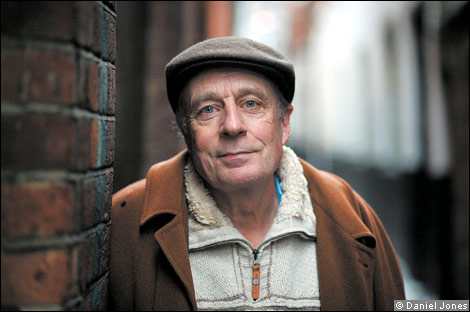
Krytyk Izraela: Tom PaulinLewicowy antysemityzm rozpoczął się podczas zakładania ruchu socjalistycznego w XIX w., kiedy niektóre części lewicy, często jako sztuczkę taktyczną, identyfikowały “Żyda” z finansami i kapitalizmem.

August Bebel, przywódca niemieckich socjaldemokratów, potrząsał głową i nazywał to „socjalizmem idiotów”.

Wiele było również idiotyzmów w Wielkiej Brytanii. „Gdziekolwiek w Europie są kłopoty, gdziekolwiek krążą pogłoski o wojnie i ludzie rozpaczają ze strachu przed zmianą i katastrofą – ostrzegała w 1891 r. Independent Labour Party (ILP) – możecie być pewni, że Rothschild z haczykowatym nosem zajmuje się swoimi grami gdzieś w pobliżu zamieszek”.

Lewicowy antysemityzm nigdy nie znikł. W ostatnich dekadach XX wieku stał się „antyimperializmem idiotów”, kiedy państwa stalinowskie w sojuszu z autorytarnymi państwami arabskimi i częściami zachodniej Nowej Lewicy prowadziły zajadłe, dobrze finansowane i długotrwałe kampanie antysyjonistyczne.

Te kampanie położyły podwaliny pod formę, jaką dzisiaj przybrał lewicowy antysemityzm – antysemicki antysyjonizm.

Antysemicki antysyjonizm wykoślawia obraz i znaczenie Izraela i syjonizmu tak długo, aż oba stają się odpowiednimi pojemnikami dla pojęć, wizerunków i idei klasycznego antysemityzmu. W skrócie: tym, czym kiedyś był demonologiczny Żyd, dzisiaj jest demonologiczny Izrael – złowrogi, krwiożerczy, przeszkoda do lepszego, czystszego, bardziej uduchowionego świata.

Antysemicki antysyjonizm ma trzy składniki. Po pierwsze, jest to program polityczny, którego celem jest likwidacja żydowskiej ojczyzny.

Alexei Sayle

Alexei SaylePo drugie, jest to demonizujący dyskurs intelektualny i system pojęć: “Syjonizm jest rasizmem”; Izrael jako “osadnik-kolonialista”, który etnicznie wyczyścił “rdzenną” ludność, przeszedł do budowy państwa apartheid, a teraz zajmuje się narastającym ludobójstwem Palestyńczyków.

Po trzecie, jest to globalny ruch społeczny (ruch Boycott Divestment and Sanctions czyli BDS).

Niepokój w sprawie Jeremy’ego Corbyna nie jest spowodowany tym, że on sam pozwala sobie na antysemityzm. Niepokój budzi fakt, że pozwala on na antysemityzm innym, jeśli tylko nie noszą mundurów i nie mówią po niemiecku. Kiedy staje przed antysemickim antysyjonizmem, pomija antysemityzm. Na przykład, bronił antysemickiego islamistę palestyńskiego, Raeda Saleha, mimo że ohydna nienawiść Saleha do Żydów była powszechnie znana (i, co więcej, udokumentowana przez sądy).

Dzisiaj nastała wiosna dla lewicowego antysemickiego antysyjonizmu. Mamy lewicowego poetę, Toma Paulina, który porównuje Izraelską Armię Obronna do SS; lewicowego pastora Kościoła anglikańskiego, Stephena Sizera, który daje link do artykułu twierdzącego, że Żydzi są sprawcami 9/11, a potem mówi, udowodnij, że nie są; lewicowego artystę komediowego, Alexeia Sayle, który dowcipkuje, że Izrael jest Jimmym Saville narodów; lewicującą członkinię Izby Lordów, Jenny Tonge, która żąda dochodzenia, czy misja ratownicza wysłana przez Izrael na Haiti miała tajny program wycinania narządów ludzkich dla Żydów w Izraelu. I tak dalej.

Lewica wpadła w ten opłakany stan, ponieważ chciała rozpuścić żydowską odrębność narodową w rozpuszczalniku postępowego uniwersalizmu. Myśleliśmy, ze proletariat dokona rewolucji, która rozwiąże raz na zawsze „kwestię żydowską”.

Kiedy jednak nie udała się europejska rewolucja socjalistyczna i zatriumfowały faszyzm i nazizm, z kulminacją w Holocauście, atrakcja uniwersalizmu lewicy była w strzępach.

W reakcji na tę erupcję nienawiści w historii świata – kiedy Europa “wyrzygała swoich Żydów”, by zacytować historyka izraelskiego Zeeva Sternhella – Żydzi nalegali na własną definicję swojego sposobu uczestnictwa w emancypacji uniwersalnej: tj. na syjonizm i stworzenie państwa Izrael.

Tragicznie, część lewicy – nie cała lewica – nie dostała tej informacji. I wszystko polega na tej porażce wyobraźni.

Antysyjonizm stał się reakcyjnym programem unicestwienia żydowskiej ojczyzny, programem, który zszedł się z nacjonalizmem arabskim, a później także z radykalnym islamizmem, które oba mogły być teraz kodowane przez lewicę jako wyjątkowo postępowe.

Znana profesor uniwersytetu, Judith Butler, powiedziała, że Hamas i Hezbollah sa teraz “częścią globalnej lewicy”. Lub, co ujął prościej Jeremy Corbyn, są „przyjaciółmi”.

W tym momencie, oczywiście, lewica jest zgubiona.


Alan Johnson

Redaktor magazynu Fathom, poświęconego problemom Izraela i innych krajów Bliskiego Wschodu, analityk w BICOM (Britain Israel Communications and Research Centre), wykładowca t


twoje uwagi, linki, wlasne artykuly, lub wiadomosci przeslij do: webmaster@reunion68.com



West ‘ignored Russian offer in 2012 to have Syria’s Assad step aside’

West ‘ignored Russian offer in 2012 to have Syria’s Assad step aside’

Julian Borger and Bastien Inzaurralde


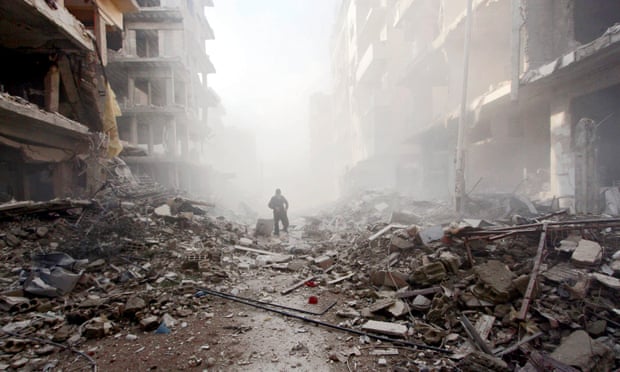
A man walks among the rubble of collapsed buildings in Douma after what activists said were airstrikes by forces loyal to Assad earlier this year.

A man walks among the rubble of collapsed buildings in Douma after what activists said were airstrikes by forces loyal to Assad earlier this year.

Exclusive: Senior negotiator describes rejection of alleged proposal – since which time tens of thousands have been killed and millions displaced

Russia proposed more than three years ago that Syria’s president, Bashar al-Assad, could step down as part of a peace deal, according to a senior negotiator involved in back-channel discussions at the time.

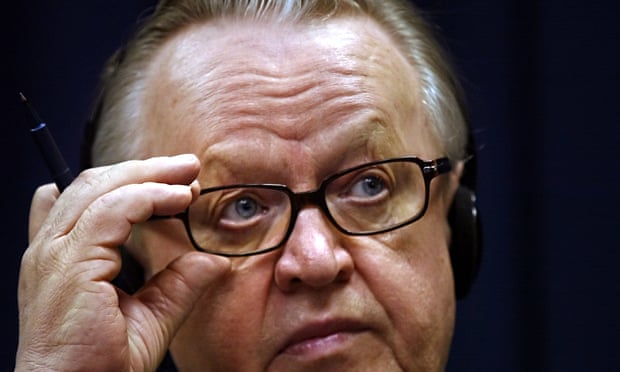
Former Finnish president and Nobel peace prize laureate Martti Ahtisaari said western powers failed to seize on the proposal. Since it was made, in 2012, tens of thousands of people have been killed and millions uprooted, causing the world’s gravest refugee crisis since the second world war.

Martti Ahtisaari said the failure to consider the Russian offer had led to a ‘self-made disaster’. Photograph: Ermal Meta/AFP/Getty Images

Martti Ahtisaari

Ahtisaari held talks with envoys from the five permanent members of the UN security council in February 2012. He said that during those discussions, the Russian ambassador, Vitaly Churkin, laid out a three-point plan, which included a proposal for Assad to cede power at some point after peace talks had started between the regime and the opposition.

But he said that the US, Britain and France were so convinced that the Syrian dictator was about to fall, they ignored the proposal.

Russia sends artillery and tanks to Syria as part of continued military buildup

Read more

“It was an opportunity lost in 2012,” Ahtisaari said in an interview.

Officially, Russia has staunchly backed Assad through the four-and-half-year Syrian war, insisting that his removal cannot be part of any peace settlement. Assad has said that Russia will never abandon him. Moscow has recently begun sending troops, tanks and aircraft in an effort to stabilise the Assad regime and fight Islamic State extremists.

Ahtisaari won the Nobel prize in 2008 “for his efforts on several continents and over more than three decades, to resolve international conflicts”, including in Namibia, Aceh in Indonesia, Kosovo and Iraq.

On 22 February 2012 he was sent to meet the missions of the permanent five nations (the US, Russia, UK, France and China) at UN headquarters in New York by The Elders, a group of former world leaders advocating peace and human rights that has included Nelson Mandela, Jimmy Carter, and former UN secretary general Kofi Annan.

“The most intriguing was the meeting I had with Vitaly Churkin because I know this guy,” Ahtisaari recalled. “We don’t necessarily agree on many issues but we can talk candidly. I explained what I was doing there and he said: ‘Martti, sit down and I’ll tell you what we should do.’

“He said three things: One – we should not give arms to the opposition. Two – we should get a dialogue going between the opposition and Assad straight away. Three – we should find an elegant way for Assad to step aside.”

Churkin declined to comment on what he said had been a “private conversation” with Ahtisaari. The Finnish former president, however, was adamant about the nature of the discussion.

“There was no question because I went back and asked him a second time,” he said, noting that Churkin had just returned from a trip to Moscow and there seemed little doubt he was raising the proposal on behalf of the Kremlin.

Ahtisaari said he passed on the message to the American, British and French missions at the UN, but he said: “Nothing happened because I think all these, and many others, were convinced that Assad would be thrown out of office in a few weeks so there was no need to do anything.”

While Ahtisaari was still in New York, Kofi Annan was made joint special envoy on Syria for the UN and the Arab League. Ahtisaari said: “Kofi was forced to take up the assignment as special representative. I say forced because I don’t think he was terribly keen. He saw very quickly that no one was supporting anything.”

In June 2012, Annan chaired international talks in Geneva, which agreed a peace plan by which a transitional government would be formed by “mutual consent” of the regime and opposition. However, it soon fell apart over differences on whether Assad should step down. Annan resigned as envoy a little more than a month later, and Assad’s personal fate has been the principal stumbling block to all peace initiatives since then.
Last week, Britain’s foreign secretary, Philip Hammond, suggested that as part of a peace deal, Assad could remain in office during a six-month “transitional period” but the suggestion was quickly rejected by Damascus.

Western diplomats at the UN refused to speak on the record about Ahtisaari’s claim, but pointed out that after a year of the Syrian conflict, Assad’s forces had already carried out multiple massacres, and the main opposition groups refused to accept any proposal that left him in power. A few days after Ahtisaari’s visit to New York, Hillary Clinton, then US secretary of state, branded the Syrian leader a war criminal.

Sir John Jenkins – a former director of the Middle East department of the UK’s Foreign Office who was preparing to take up the post of ambassador to Saudi Arabia in the first half of 2012 – said that in his experience, Russia resisted any attempt to put Assad’s fate on the negotiating table “and I never saw a reference to any possible flexing of this position”.

Jenkins, now executive director of the Middle East branch of the International Institute for Strategic Studies, said in an email: “I think it is true that the general feeling was Assad wouldn’t be able to hold out. But I don’t see why that should have led to a decision to ignore an offer by the Russians to get him to go quickly, as long as that was a genuine offer.

“The weakest point is Ahtisaari’s claim that Churkin was speaking with Moscow’s authority. I think if he had told me what Churkin had said, I would have replied I wanted to hear it from [President Vladimir] Putin too before I could take it seriously. And even then I’d have wanted to be sure it wasn’t a Putin trick to draw us in to a process that ultimately preserved Assad’s state under a different leader but with the same outcome.”
A European diplomat based in the region in 2012 recalled: “At the time, the west was fixated on Assad leaving. As if that was the beginning and the end of the strategy and then all else would fall into place … Russia continuously maintained it wasn’t about Assad. But if our heart hung on it, they were willing to talk about Assad; mind: usually as part of an overall plan, process, at some point etc. Not here and now.”

However, the diplomat added: “I very much doubt the P3 [the US, UK and France] refused or dismissed any such strategy offer at the time. The questions were more to do with sequencing – the beginning or end of process – and with Russia’s ability to deliver – to get Assad to step down.”

At the time of Ahtisaari’s visit to New York, the death toll from the Syrian conflict was estimated to be about 7,500. The UN believes that toll passed 220,000 at the beginning of this year, and continues to climb. The chaos has led to the rise of Islamic State. Over 11 million Syrians have been forced out of their homes.

“We should have prevented this from happening because this is a self-made disaster, this flow of refugees to our countries in Europe,” Ahtisaari said. “I don’t see any other option but to take good care of these poor people … We are paying the bills we have caused ourselves.”


twoje uwagi, linki, wlasne artykuly, lub wiadomosci przeslij do: webmaster@reunion68.com


When the IAF showed the Soviets who was top gun

When the IAF showed the Soviets who was top gun

Aharon Lapidot


An Israeli Air Force Phantom F-4E Phantom IIs

In July 1970, Soviet pilots embedded with the Egyptian Air Force tried to shoot down an Israeli fighter jet • The Israel Air Force retaliated with Operation Rimon 20, downing five MiGs and dealing the Soviets a humiliating blow. The first, and so far last, dogfight between Israeli and Russian air forces took place 45 years ago, on July 30, 1970, as the War of Attrition between Israel and Egypt, Jordan and the Palestine Liberation Organization was winding down.

The aerial battle took place southwest of the Suez Canal, over an area the Israeli Air Force had dubbed “Texas” as it was a local “Wild West,” a lawless area where the quicker the gunslinger, the bigger the reward.

The Israeli force comprised four Phantom and 12 Mirage fighter jets, flown by pilots who together were credited with shooting down 59 enemy aircraft. The Soviet force included 24 MiG-21 jets, at the time the most advanced of their kind.

The airborne battle was meticulously planned. A trap was set and the Soviets flew right into it, to humiliating results: Five Soviet jets were shot down, and although one Israeli Mirage sustained some damage, all Israeli jets landed safely back in their home base. Operation Rimon 20, as it would later be known, became one of the most successful operations in IAF history.

The operation was prompted by the growing Soviet involvement in Egypt, following then-Egyptian President Gamal Abdel Nasser’s demand that Moscow supply him with advanced missiles and fighter jets, so to counter the IAF’s Phantoms and Skyhawks, which consistently targeted Egyptian forces along the Suez Canal, dropping hundreds of tons of bombs on them and on targets deeper inside Egypt, seemingly undisturbed.

At the time, Israeli jets were also in the habit of flying over Cairo simply to make its skies crack with the sound of sonic booms, as if to show Nasser who was really in charge.

In two tense meetings in Moscow, the first in the fall of 1969 and the second in January 1970, the Egyptian president threatened that unless his Soviet ally gave him what he needed, he would turn to its nemesis, the United States.

The Soviets complied and Nasser’s military received SA-3 surface-to-air missiles, which were far more effective than the SA-2 missiles the Egyptian army had at the time, and three MiG-21MF squadrons, complete with munitions, auxiliary equipment, and ground and air crews. Overall, about 100 Soviet pilots were stationed in Egypt.

The presence of Russian pilots among the ranks of the Egyptian Air Force was a closely guarded secret, discovered by the IDF’s newly minted Russian-language wiretap and surveillance unit, which worked closely with Unit 515, its Arabic-language counterpart. The unit picked up a conversation in Russian between two allegedly Egyptian MiG pilots on a routine patrol flight, and the secret was out.

From a tactical standpoint, there was tacit consent between Israel and Egypt that the IAF does not breach Egyptian airspace beyond 30 kilometers (18 miles) over the Suez Canal, an area considered the Soviets’ “grazing land.” However, the Soviets soon began trying to down Israeli fighter jets.

The proverbial last straw took place on July 25, 1970, when two Soviet pilots attempted to down an IAF Skyhawk and hit its tail. Israel decided to retaliate, despite the risk entailed in poking the Russian bear.

“The decision to take on the Russians was made by the government,” Col. (ret.) Aviem Sella, who flew one of the Phantom jets that participated in the operation, recalled. “The order was unequivocal: Don’t just strive to engage the Russians — take them down. I think it was one of the only times the government made a conscious decision to fight a global power.”

The trap at the heart of Operation Rimon 20 was carefully scripted: Four Mirage aircraft were to fly into the Gulf of Suez, supposedly on a routine reconnaissance flight. Should the Soviets take the bait and try to intercept them, then more Israeli fighter jets, either hovering nearby or on the ground at the Refidim Airbase, would scramble to intercept the MiGs.

And so it was: Exactly 11 minutes into the Mirages’ flight, five Soviet MiGs — “all shiny and new, as if they just came off the assembly line,” Sella recalled — scrambled to engage. To their surprise, they were met with a formidable IAF formation.

It was the largest dogfight held on the Egyptian front at the time. Within moments, the late Col. Asher Snir, flying one of the Mirages, shot down a Soviet MiG. The pilot ejected at 30,000 feet, and floated slowly toward the ground, effectively remaining airborne during the entire fight, which prompted the Israeli pilots to use his location as a makeshift coordinate in their radio communications.

“We were saying things like ’10 kilometers from the parachute,'” Sella said.

The Soviet pilots, who were significantly less experienced than the Israeli pilots they were fighting, soon became flustered and found themselves at a great disadvantage.

Former IAF Commander Maj. Gen. (ret.) Avihu Ben-Nun, whose jet led the squadron of Phantoms that participated in the fight, recalled that “it was obvious they had little experience. It was a little frustrating, because you’re used to knowing what’s expected from the enemy when it fights you, and all of a sudden they do something different.”

According to Sella, the Soviet pilots “just fired missiles everywhere. You could tell they weren’t thinking or trying to target anything.”

When the dust settled, five Soviet MiGs had been downed. The credit went to Snir, Sella, Ben-Nun, Avraham Shalmon, and Iftach Spector.

Years later, during the Israel-Egypt peace negotiations in the late 1970s, then-Vice President Hosni Mubarak told then-Defense Minister Ezer Weizman that when Egyptian Air Force officials heard about the dogfight they rejoiced over the Soviets’ defeat. The Soviet pilots had apparently been very dismissive of their Egyptian peers, and the Egyptian pilots were happy to witness their downfall.

The Soviets, for their part, dispatched Chief Marshal of Aviation Pavel Kutakhov to Egypt the day after the dogfight. In true Soviet fashion, he warned his pilots that should any of them ever breathe a word of the events to another living soul, they would find themselves in a Siberian gulag.


twoje uwagi, linki, wlasne artykuly, lub wiadomosci przeslij do: webmaster@reunion68.com