Jonathan S. Tobin
Blood libels against Israel may reignite campus antisemitism. Administrators who tolerate the targeting of Jews, however, will have to reckon with President Donald Trump.
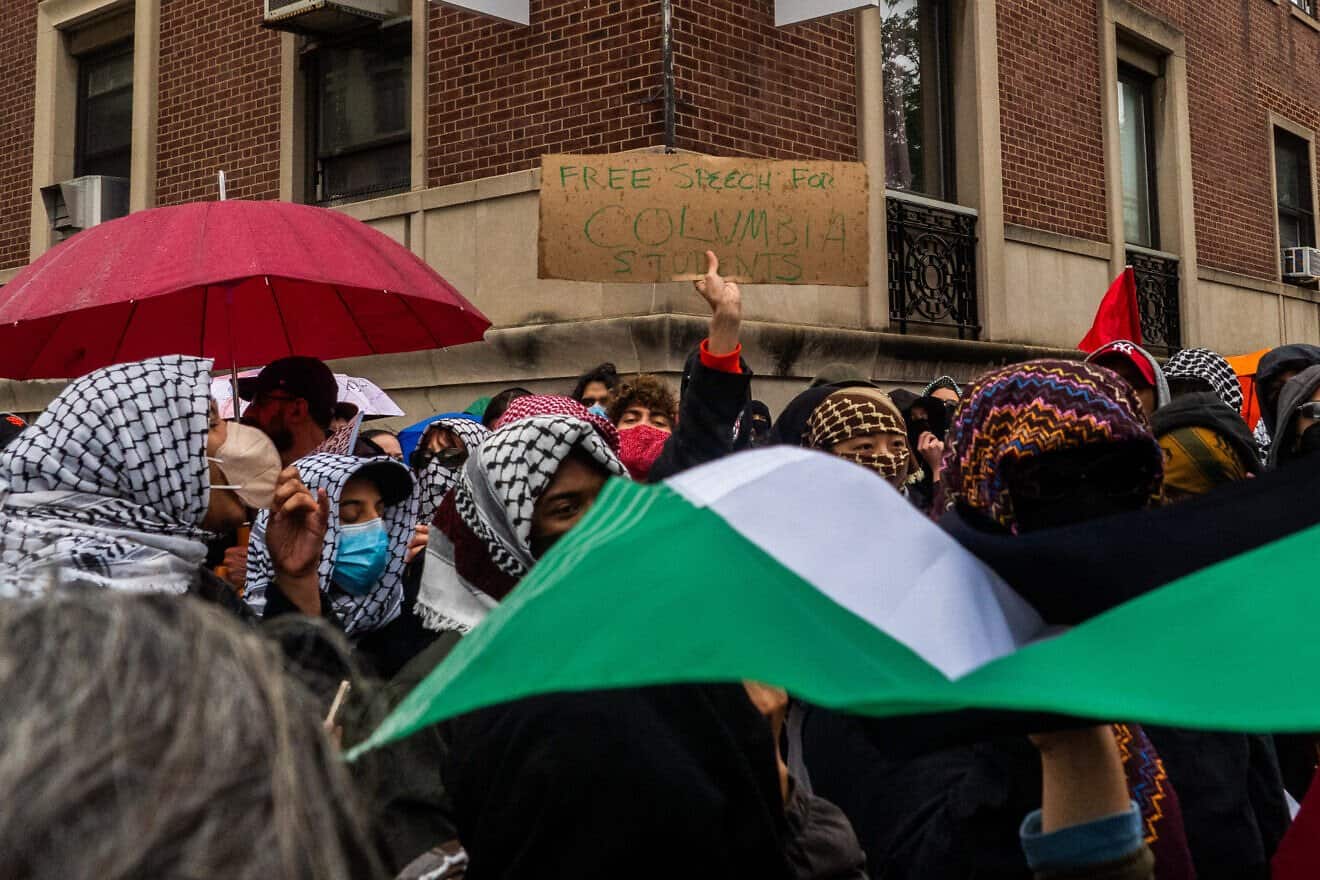 A protester holds a sign reading “Free Speech for Columbia Students” over a large crowd gathered for a pro-Palestinian protest near campus, May 21, 2025. Photo by Madison Swart/Hans Lucas/AFP via Getty Images.
By the end of the second academic year since the Hamas-led Palestinian Arab attack against southern Israeli communities on Oct. 7, 2023, the unprecedented increase in antisemitism on American college campuses appeared to have abated. Some of the steam seemed to have gone out of the organized mobs of pro-Hamas demonstrators who took part in encampments and building takeovers while chanting for the destruction of Israel and Jewish genocide (“From the river to the sea”) and for terrorism against Jews wherever they lived (“Globalize the intifada”).
More importantly, the administrators who tolerated and encouraged the abuse of Jews—something they never would have stood for had the victims been any other minority group—had met a force they feared just as much, if not more, than truculent leftist faculty members and students. President Donald Trump came into the picture with an aggressive and ambitious plan to make campuses safe for Jewish students and roll back factors that had made the post-Oct. 7 surge of antisemitism possible.
By the time this past spring semester had ended, the second-term president’s effective threats of defunding those institutions that had tolerated and encouraged Jew-hatred had forced many schools to shut down the wave of illegal activity. The high tide that had flooded colleges under the Biden administration seemed to have ebbed.
Two forces collide
Still, as students return to campus for the fall semester, complacency about the problem would be a mistake. If anything, the coming months could turn out to be even more problematic for Jewish students as two equally powerful forces collide: the anti-Israel and antisemitic fervor that is the result of the war in Gaza eclipsing every other left-wing cause in importance, and the determination of Trump to end the reign of woke leftism in academia.
In recent months, as the campuses quieted down for the summer, the drumbeat of incitement against Israel, Zionism and Jews has increased rather than died down. Hamas propaganda about Israel committing “genocide” in Gaza and deliberately starving Palestinians in the Strip has been mainstreamed by corporate media outlets, making headlines worldwide.
These blood libels have become part of the conventional wisdom about the Middle East among liberal and left-wing elites in journalism, academia, cultural establishments and unions, as well as in the Democratic Party. That has caused even many Jews who fear being out of sync with liberal fashion to engage in unfair criticism of Israel, which essentially legitimizes anti-Zionist invective and the cause of letting the Hamas monsters behind the unspeakable atrocities survive the war they started on Oct. 7.
Most schools now understand that Trump means business and that he fully intends to punish academic institutions that let Jew-hatred flourish with defunding measures that will devastate their budgets. While most of them are far from ready to comply with the full range of demands, none want their campuses to become the focus of administration or congressional inquiries, let alone wake up and discover that Washington is pulling the money that represents the lifeblood for even the richest of universities.
That means they will, as many were in the spring, be ready to suspend and expel students who engage in campus takeovers. Nevertheless, the forces behind the pro-Hamas mobs are just as determined to exploit the successes in the information wage that the terrorists, their funders and enablers in the media have won.
So, as American higher education reopens for business, it’s far from clear which of these two immovable forces will prevail. The one thing we do know is that the stakes in this battle of wills between liberal educational bureaucrats and the Republican administration are not merely a matter of political advantage for Trump or his opponents.
Those at risk if the administration’s defunding threats and justified demands for reforms to abolish the root causes of campus antisemitism are ignored or fail to have the intended effect will not be Trump’s appointees. It is Jewish students who will suffer if administrators believe that they are better off appeasing leftist antisemites instead of the president. Their ability to move about their schools without fear of intimidation and even violence, as well as to engage in academic life without having to disavow their people, their faith and Israel, hinges on whether the administration makes it clear that the consequences of another antisemitic surge will prove serious.
A woke bureaucracy
The forces behind the pro-Hamas agitation on campus have not been eliminated by Trump. The same factors that had ignited the firestorm of Jew-hatred throughout many of the country’s institutions of higher learning remain in place.
The administration’s campaign to deal with campus antisemitism came down like a ton of bricks on elite institutions like Columbia and Harvard. The president’s task force dealing with the subject demanded that they not only take stringent measures to curb the activities of the pro-Hamas mobs but also address the inherent factors that had made them possible.
Trump’s ambitious goal was not only to make schools safer for Jewish students but to roll back the hold of leftist doctrines that made the post-Oct. 7 troubles inevitable. While a turning point may have been reached in which these forces will now start to decline, these institutions have not been converted from woke strongholds to their previous position as defenders of the Western canon, the neo-Marxists have warred against.
The reign of bureaucrats implementing the woke catechism of diversity, equity and inclusion (DEI) that sought to exacerbate racial divisions, as well as falsely labeling Jews as “white” oppressors, is largely still there. So, too, are the overwhelmingly leftist faculties and administrators who have been thoroughly indoctrinated in the toxic myths of critical race theory, intersectionality and settler-colonialism.
The progressive takeover of academia has been slowly unfolding as the left has completed its long march through American educational institutions for decades. It reached its high point during the moral panic of the Black Lives Matter summer of 2020, following the killing that spring of George Floyd by a Minneapolis police officer. But as interest in dividing all Americans along immutable racial lines waned, the neo-Marxist ideas that animated this movement are held up as a new orthodoxy throughout the humanities and among educational bureaucrats.
Woke policies didn’t just predispose people to dislike Israel. They influenced the curricula taught at schools, as well as the hiring of professors and admissions, creating left-wing bubbles where antisemitic denial of Jewish history and rights became normative. And as “free Palestine,” the phrase that has come to encapsulate a belief in destroying the State of Israel and demonizing Jewish peoplehood, became the primary obsession of the American left, the Oct. 7 terrorist attacks helped mobilize students, faculty, school employees—aided and abetted by outside agitators and funders—to turn campuses into hostile environments for Jews.
Foreign students and funding
So, while the people who run American higher education understood that the election in 2024 of a president who prioritized the fight against antisemitism endangered their businesses, the inmates of these academic asylums remain just as interested in turning the fall 2025 semester into another ordeal for Jews and supporters of Israel.
Nor has the funding for these antisemitic groups, like Students for Justice in Palestine and others, from both foreign sources, such as the emirate of Qatar and left-wing foundations like those controlled by the Soros family, dried up.
One factor that may alleviate the problem has been Trump’s focus on the role of foreign students in campus disturbances.
Trump hasn’t yet banned the entry of students from abroad, especially Muslim-majority countries. Nor has he succeeded, as he still hopes to do, in deporting some of the leaders of the pro-Hamas and antisemitic illegal demonstrations and takeovers.
Syrian-born Mahmoud Khalil, who helped lead the chaos at Columbia, has (with the support of many liberal Democrats who have wrongly depicted him as a martyr to free speech and some empathetic judges) been able to remain in the country, despite the administration’s best effort to deport him.
Many other foreign students, who make up significant percentages of the student bodies of many leading schools like New York University, the Massachusetts Institute of Technology, Harvard and Columbia, have essentially self-deported since they, like Khalil, have undoubtedly lied on their visa applications and are vulnerable to legal action. Others who were similarly intent on coming to the United States to benefit from the education system here while undermining the values of the American republic and spreading Islamist doctrines have taken Trump’s hint and decided not to come to the United States this fall.
But there are likely enough still here, along with a cadre of leftist activists, to create havoc at schools in the name of the supposedly starving Palestinian people and against Israel.
Trump must double down
Averting another situation such as the one that unfolded after Oct. 7 will require two things to happen.
One is that the Trump administration must be prepared to double down on its threats against colleges and universities that behave as they did two years ago and let antisemites run amok.
Moreover, rather than work solely toward striking more deals with schools, such as the one they struck with Columbia, Trump’s team must escalate their efforts to pull funding and force them to give up their DEI bureaucracies, as well as dismantle those departments, like those in Middle East studies, that are engines of antisemitism.
At the same time, those whose job it is to defend Jews, in general, like the Anti-Defamation League and American Jewish Committee, and Jewish students, in particular, such as Hillel International, need to understand that they must cease opposing Trump’s efforts to reform academia and end DEI. Measures that are supposed to aid Jewish students that do not attack the reasons why they are under attack are useless and say more about the bankruptcy of many leading mainstream Jewish groups than anything else.
The coming months may prove trying for American Jews as they undergo another trial by fire, fueled by lies about Israel. The same leftist-Islamist alliance that has done so much damage in the last two years seeks to ignite another storm of antisemitism on campuses.
Still, they need to remember that they are not alone in this fight. Trump’s prioritization of the battle against Jew-hatred has put colleges and universities that would otherwise be inclined to abandon their Jewish students on notice that there will be a cost to doing so. We can only hope that this will be enough to force school administrations into actions that will finally rid academia of this scourge.
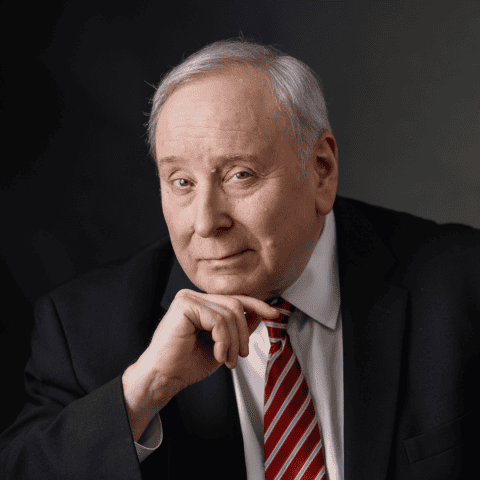 Jonathan S. Tobin is editor-in-chief of the Jewish News Syndicate, a senior contributor for The Federalist, a columnist for Newsweek and a contributor to many other publications. He covers the American political scene, foreign policy, the U.S.-Israel relationship, Middle East diplomacy, the Jewish world and the arts. He hosts the JNS “Think Twice” podcast, both the weekly video program and the “Jonathan Tobin Daily” program, which are available on all major audio platforms and YouTube. Previously, he was executive editor, then senior online editor and chief political blogger, for Commentary magazine. Before that, he was editor-in-chief of The Jewish Exponent in Philadelphia and editor of the Connecticut Jewish Ledger. He has won more than 60 awards for commentary, art criticism and other writing. He appears regularly on television, commenting on politics and foreign policy. Born in New York City, he studied history at Columbia University.
 Jak donosi Al Dżazira, Katar negocjuje zawieszenie broni w Demokratycznej Republice Konga.
 Pan Romek ma pytanie