Archive | 2025/08/03

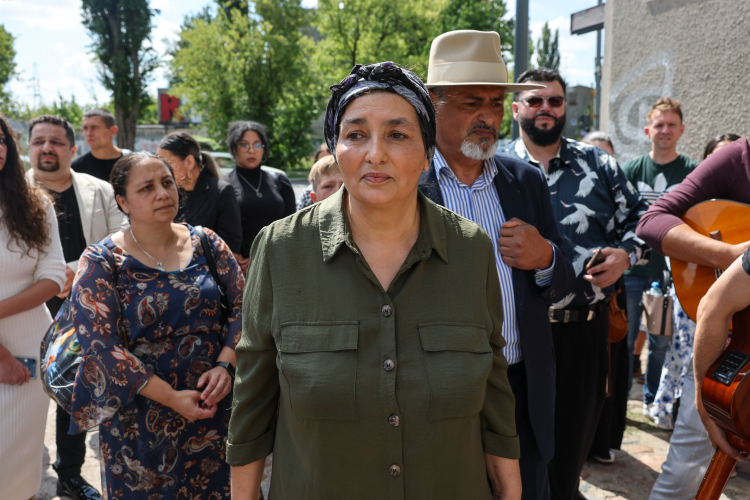
Dzień Pamięci o Zagładzie Romów; kwiaty w miejscu obozu cygańskiego w Łodzi

Obchody Międzynarodowego Dnia Pamięci o Zagładzie Romów i Sinti, fot. PAP/Marian Zubrzycki


Dzień Pamięci o Zagładzie Romów; kwiaty w miejscu obozu cygańskiego w Łodzi

jus/ aszw/


W Łodzi 2 sierpnia, w dniu pamięci o zagładzie Romów upamiętniono męczeństwo Romów w czasie niemieckiej okupacji, składając kwiaty przy tzw. Kuźni Romów. To jeden z budynków tzw. obozu cygańskiego w Litzmannstadt Getto.

2 sierpnia 1944 r. Niemcy przystąpili do likwidacji tzw. obozu cygańskiego w Auschwitz-Birkenau. W komorach gazowych zamordowano wówczas 2897 Romów. Dla upamiętnienia tego tragicznego wydarzenia od 1997 roku 2 sierpnia obchodzony jest jako Międzynarodowy Dzień Pamięci o Zagładzie Romów.

Izabela Terera z Muzeum Tradycji Niepodległościowych w Łodzi powiedziała w sobotę (2 sierpnia) przed tzw. Kuźnią Romów przy ul. Wojska Polskiego 84 w Łodzi, że w tym szczególnym miejscu, gdzie przywoływana jest pamięć nie tylko o 5 tysiącach Romów i Sinti z pogranicza austriacko-węgierskiego zamordowanych na przełomie 1941 i 1942 roku w obozie cygańskim w Litzmannstadt Getto i w niemieckim obozie śmierci Kulmhoff w Chełmnie nad Nerem, ale o wszystkich ofiarach zagłady Romów.

Jan Wiśniewski ze Stowarzyszenia Centrum Doradztwa i Informacji dla Romów w Polsce podkreślił, że dla społeczności romskiej Kuźnia Romów jest symbolem wielu miejsc zagłady. Powitał zebranych w języku romskim.

– Poprosiłem Pana Boga w naszym języku. Poprosiłem Pana Boga, żeby wybaczył wszystkim ich grzech. Żeby wybaczył oprawcom, wybaczył ofiarom i niech Pan Bóg ich przyjmie do Królestwa Niebieskiego – powiedział Wiśniewski.

– Dlaczego tak się stało? Otóż mieli na to przyzwolenie. Dlatego nas, Romów, chcieli wyniszczyć. Twierdzili, że jesteśmy niebezpiecznym elementem. Do dziś mamy wrażenie, że jesteśmy pariasami tego świata – powiedział Wiśniewski.

Dodał, że społeczność romska chce zachować swoją kulturową odrębność, bo świat będzie piękny tylko wtedy, kiedy będzie różnorodny i kolorowy.

– Apeluję do was młodych. Bądźcie czujni na to, co inni mówią, żeby więcej taka historia się nie powtórzyła – powiedział Jan Wiśniewski zwracając się do uczestniczącej w uroczystościach młodzieży.

– Miałem zaszczyt i przyjemność pracować w zespole, który ustanawiał wspólnie z Sejmem Rzeczypospolitej ten dzień jako oficjalny Dzień Pamięci o Zagładzie Romów i Sinti. Teraz ten dzień obchodzony jest na całym świecie. To pokazuje otwartość społeczności polskiej względem naszej społeczności Romów – powiedział Karol Kwiatkowski z Centralnej Rady Romów.

Dodał, że Romowie nie zrobili nic złego, a byli mordowani tylko za to, że byli Romami.

– Widzimy różnego typu niepokojące sygnały na całym świecie, jak mocno znów faszyzm odżywa. Nie pozwólmy, żeby odżył – dodał Karol Kwiatkowski.

Wymienił miejsca, gdzie dochodziło do Porajmos, czyli zagłady Romów. Poza Litzmannstadt były to m.in. Auschwitz, Treblinka, Jasenowic w Chorwacji. Wspomniał, że losy i historia Romów są trudne, dlatego edukacja jest najważniejszym elementem przyszłości i budowania tożsamości społeczności Romów.

Podczas składania kwiatów przed Kuźnią Romów kapela Roland Bilicki and Gypsy Band zaśpiewała pieśń „Kaj O Bergi” (Gdzie jest góra) – tradycyjny utwór przekazywany ustnie z pokolenia na pokolenie. Członkowie kapeli wyjaśnili PAP, że jest to pieść wykonywana w czasie smutnych, uroczystości i wydarzeń.

W dniu pamięci o zagładzie Romów Łódź odwiedziły grupy młodzieżowe z Polski, Niemiec i Ukrainy oraz grupa polskiej młodzieży z Niemiec, która poznaje historię Holocaustu oraz historię kraju swoich rodziców i dziadków.(PAP)


Zawartość publikowanych artykułów i materiałów nie reprezentuje poglądów ani opinii Reunion’68,
ani też webmastera Blogu Reunion’68, chyba ze jest to wyraźnie zaznaczone.
Twoje uwagi, linki, własne artykuły lub wiadomości prześlij na adres:
webmaster@reunion68.com

Aid to Gaza: A tragic cycle of exploitation

Aid to Gaza: A tragic cycle of exploitation

Fiamma Nirenstein


The international community, especially in Europe, appears more interested in rewarding Hamas than in stopping it.

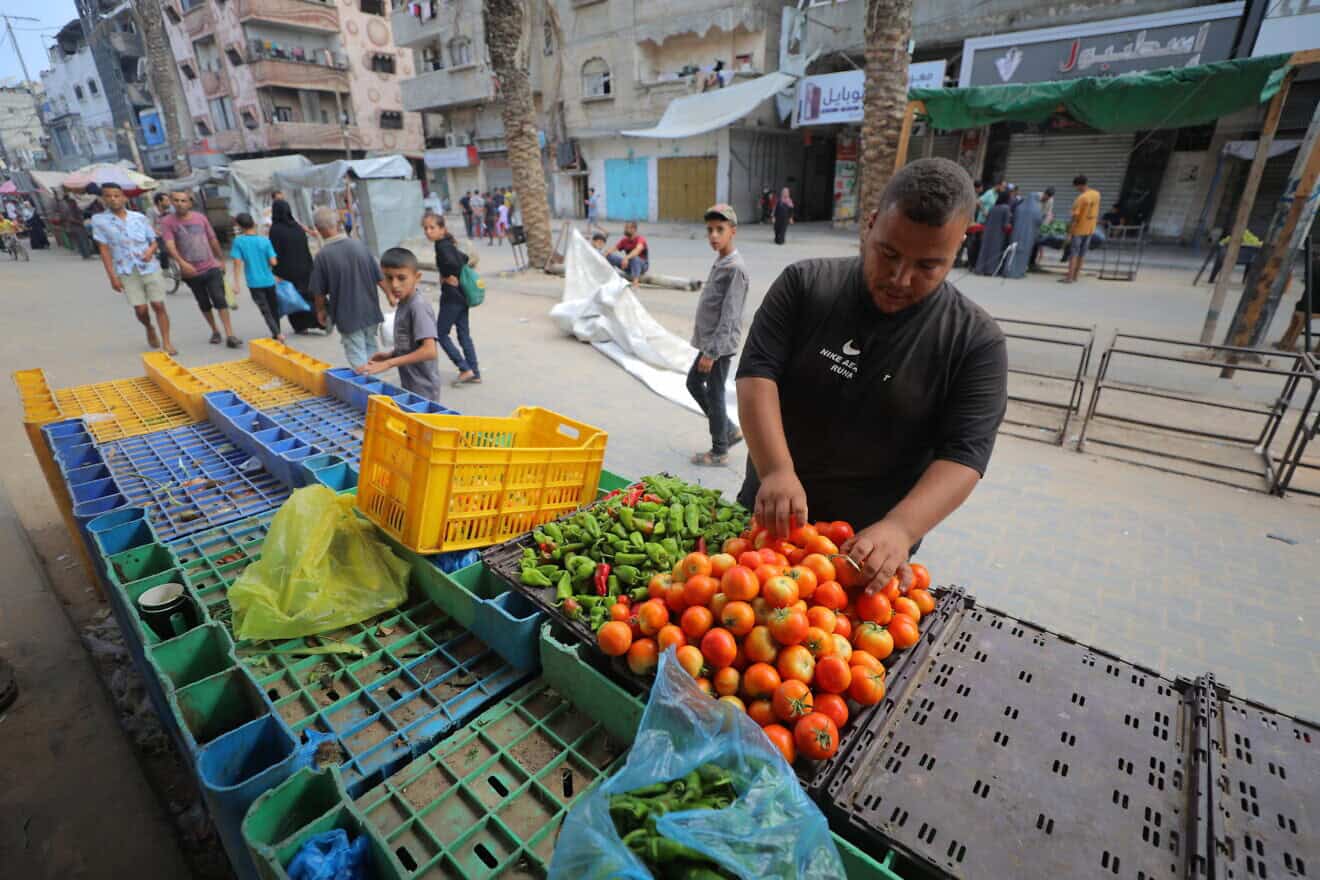
A Palestinian merchant at the market in Gaza City, on July 21, 2025. Photo by Ali Hassan/Flash90.

Tons of humanitarian aid continue to pour into Gaza, flown in from Europe, Egypt and Jordan, distributed by Americans, monitored by officials such as David Satterfield and Stephanie Hallett, and confirmed even by the United Nations. Millions of meals are being delivered. Yet none of it is altering the grim reality on the ground.

That’s because the aid game is not being played on a level field. Hamas is not a government trying to feed its people. It is a terrorist organization committed to sacrificing its own population for PR victories. We need only recall Yahya Sinwar’s own words: He spoke of needing 1 million Palestinian casualties to accuse Israel of genocide. A chilling admission and a strategic plan.

Genocide? Let’s look at the numbers. In 1967, Gaza had a population of about 350,000. Today, it is approaching 2.5 million. The only thing multiplying faster than its population is the spread of misinformation.

Israel once placed real hope in Gaza. When it unilaterally withdrew in 2005, dismantling 21 thriving Jewish communities and evacuating 9,000 Israeli citizens, it did so in the name of peace. The dream was that Gaza might flourish, perhaps even grow into a prosperous Palestinian state rooted in agriculture and technology, living side by side with Israel. What followed was not peace, but an armed fortress funded by Qatar and Iran, crisscrossed by more than 500 kilometers of terror tunnels.

Despite ongoing rocket fire, Israel has facilitated a continuous stream of humanitarian aid into Gaza. U.N. figures confirm it. But what actually reaches the people is another story. Since May 2010, Hamas has looted 1,753 aid trucks, 87% of all deliveries. Of the 27,434 tons of food meant for civilians, Hamas has stolen 23,353 tons.

We see it daily: Raw footage of ordinary Gazans scrambling for food while armed Hamas operatives open fire not on Israelis, but on their own people. And when the Israeli military responds to armed threats, headlines portray it as indiscriminate brutality rather than defensive necessity.

Why? Because the media needs a villain. And in their narrative, the ideal villain is a white, Jewish, Western “oppressor.” Every military response, every act of Israeli self-defense, is filtered through a lens of ideological bias. The facts? Irrelevant. The context? Ignored. This isn’t journalism; it’s propaganda.

Consider the story of Mohammed al-Mutawaq, the child paraded as a malnourished victim of Israeli cruelty. The New York Times later admitted that he suffered not from starvation, but from a severe genetic illness. But that correction came too late, if it registered at all. The image had already served its purpose, fueling the false narrative that malnutrition in Gaza is the result of Israeli policy, not Hamas theft.

This is more than dishonest. It is dangerous. The international community—especially in Europe—appears more interested in rewarding Hamas than in stopping it. While hostages remain in captivity, while Hamas uses food as a weapon and people as shields, the European Union is preparing to vote for Palestinian statehood, a gesture that would hand Hamas its greatest political victory since Oct. 7, 2023.

And still, world leaders ask: “Why won’t Hamas negotiate?” The answer is simple: They don’t need to. Every concession, every ceasefire, every aid truck hijacked without consequence is a sign of Western weakness—and a step closer to Hamas’s long-term goal: the destruction of Israel.

When the United Nations votes on Palestinian statehood, nothing will change on the ground. Hostages will remain in Gaza. Aid will continue to be stolen. Civilians will keep dying not because of Israeli actions, but because of Hamas’s deliberate policy of human suffering.

And the world will become more dangerous—for Israelis, for Palestinians and for anyone who believes that truth still matters.


Dr. Fiamma Nirenstein is an Italian-Israeli journalist, author, and senior research fellow at the Jerusalem Center for Public Affairs. An adviser on antisemitism to Israel’s foreign minister, she previously served in the Italian Parliament (2008–2013) as Vice President of the Foreign Affairs Committee. A founding member of the Friends of Israel Initiative, she has written 13 books, including Israel Is Us (2009), and is a leading voice on Israeli affairs, Middle Eastern politics, and the fight against antisemitism.


Zawartość publikowanych artykułów i materiałów nie reprezentuje poglądów ani opinii Reunion’68,
ani też webmastera Blogu Reunion’68, chyba ze jest to wyraźnie zaznaczone.
Twoje uwagi, linki, własne artykuły lub wiadomości prześlij na adres:
webmaster@reunion68.com


Shock Poll: Does the Silent Majority in Australia — and Beyond — Actually Exist?

Shock Poll: Does the Silent Majority in Australia — and Beyond — Actually Exist?

Michael Gencher


Car in New South Wales, Australia graffitied with antisemitic message. The word “F***” has been removed from this image. Photo: Screenshot

On July 29, 2025, a national poll in Australia delivered a deeply unsettling message: perhaps the “silent majority” that we believed in for so long — those decent, fair-minded Australians who would reject antisemitism when it crossed a line — was never really there to begin with.

The survey revealed that just 24% of Australians hold a positive view of Jews, while 28% express negative views, and the rest are indifferent or unsure.

This is not the fringe — it is the center. And it lands after two years of unrelenting escalation, during which antisemitic incidents in Australia have surged by over 300%. Synagogues have been firebombed. Jewish businesses have been attacked. Marches in our cities have featured chants glorifying terror and calling for the annihilation of the Jewish State.

For the past two years, we’ve watched the unthinkable become normalized — and still, the silence has persisted. We reassured ourselves that when things got bad, or worse, Australians — quiet, pragmatic, egalitarian — would draw a line. We believed that behind the chaos of social media and the radicalism of campus protests, there was a steady, principled middle who would never let hate take hold. But perhaps we were wrong. Or perhaps we simply misread the signs.

We saw moments that encouraged hope: political leaders condemning antisemitism after high-profile incidents; universities adopting or referencing definitions of antisemitism — though often watered down, selectively applied, or lacking enforcement; and a few faith and community leaders standing shoulder to shoulder with Jewish communities in symbolic gestures of unity. We mistook these signals as proof that the mainstream was with us — that the loudest voices did not represent the majority.

But those signs were often just that — symbolic. Many condemnations were performative. Institutional policies were rarely enforced. And while we heard reassurances from officials that “most Australians reject hate,” we now know they didn’t have the data to back it up.

So why did we believe?

The truth is that the idea of a silent majority is emotionally powerful. It reassures us that we are not alone. It suggests that while antisemitism may be loud, decency is quietly stronger. It gives us permission to believe in the goodness of our neighbors, even when the evidence is thin. It tells us that democracy will self-correct, that morality will prevail in the end.

But increasingly, that belief feels more like a coping mechanism than a reality. We’ve clung to it without data, without proof, and — if we’re honest — without election results to support it. Because the alternative is terrifying: the alternative is that the center is not asleep, but absent.

And if the silent majority doesn’t exist — if it never did — what then?

It means that antisemitism isn’t just being ignored; it’s being tolerated. It means that when politicians offer symbolic recognition of a Palestinian state while Hamas still holds hostages and preaches genocide, they are not defying their electorate — they may be reflecting it. It means that when university encampments promote terror and intimidate Jewish students, and administrators do nothing, it’s not cowardice — it may be calculated silence. It means that we are not surrounded by quiet allies, but by people who either don’t care or don’t know.

It also means that we can no longer wait for “them” to speak up.

This isn’t just happening in Australia. Across the Western world, the same pattern is emerging. In Canada, antisemitism on campuses is surging, and the government now flirts with symbolic recognition of a Palestinian state — not as part of peace negotiations, but as a political signal. In Ireland, Spain, Norway, and the UK, similar moves have rewarded those who glorify terror while ignoring those who seek dialogue. In the United States, antisemitism reached record highs last year, with Jewish students and communities increasingly ostracized for daring to speak the truth.

These are not isolated developments — they are part of a deeper pattern: the moral center is shrinking, and the hateful fringes are being normalized.

At StandWithUs Australia, we fight back with facts, with education, and with pride. We equip students and communities to speak up for truth, to push back against hatred. But we cannot do this alone. We are a small community. And now, more than ever, we need others to stand publicly — not silently — with us.

Because if the silent majority was ever real, now is the time to speak. And if it remains silent now, then we must confront the hardest truth of all: that it was never there to begin with.

In that case, the path forward changes.

We must stop seeking quiet affirmation and instead build loud, unignorable support. We must shift from trusting that others will step up, to ensuring that we are strong enough to lead. We must teach, advocate, organize, and call out moral cowardice for what it is — whether it comes from universities, governments, media, or community leaders.

Because if we’ve learned anything from the past two years, it’s that silence isn’t safety.

And comfort, no matter how convincing, is not the same as courage.


Michael Gencher is executive director StandWithUs Australia, an international nonpartisan education organization that supports Israel and fights antisemitism.


Zawartość publikowanych artykułów i materiałów nie reprezentuje poglądów ani opinii Reunion’68,
ani też webmastera Blogu Reunion’68, chyba ze jest to wyraźnie zaznaczone.
Twoje uwagi, linki, własne artykuły lub wiadomości prześlij na adres:
webmaster@reunion68.com