Jonathan S. Tobin
Tehran’s Islamist despots can’t be trusted to abide by agreements. Throwing them a lifeline, which they will use to go on spreading death and terror, would be a major blunder.
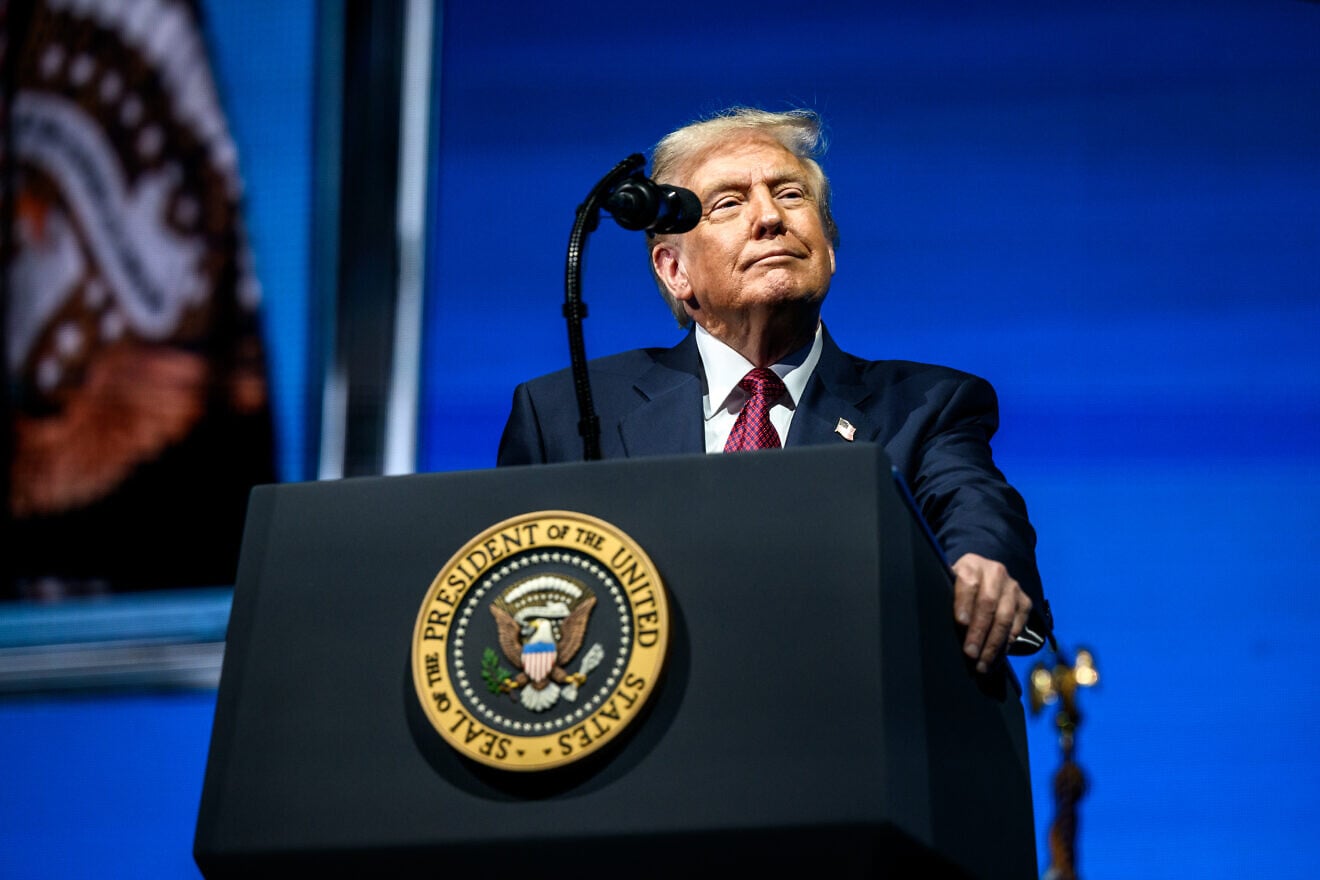 U.S. President Donald Trump delivers remarks at the America Business Forum Miami at the Kaseya Center in Miami, Fla., Nov. 5, 2025. Credit: Molly Riley/White House.
President Donald Trump was re-elected to the presidency to drain the swamp in Washington, push back the tide of illegal immigration and roll back the dead hand of toxic woke leftism in American government and society. He wasn’t returned to the White House to enact regime change in Iran or anywhere else. Those two basic truths are the foundation of any argument on behalf of the United States not getting actively involved in the effort to topple the Islamists theocrats in Tehran.
Still, there’s another angle from which to consider that question.
Whatever else was on his agenda or that of his voters, it is equally true that the second Trump administration was not summoned into existence to re-enact the failed foreign policy of former President Barack Obama. And that’s the main thing for the president and his team to remember as they engage in negotiations this week with Iran.
The Islamist regime is sending senior officials to Turkey, where they plan to meet with the president’s special envoy to the Middle East, Steve Witkoff, as well as his son-in-law and informal adviser, Jared Kushner. The United States says that a whole range of issues, including Iran’s nuclear program, missiles and terrorism, is on the table. The Iranians say they want only to discuss the nuclear issue.
Obama’s Iran folly
But that is a formula for Iran to do what it has always done with Western, and especially American, envoys who are desperate for a deal with the mullahs: prevaricate and string the diplomats along until they give up or give in to Tehran’s demands.
That’s what happened to Obama’s Secretary of State John Kerry, who arrived at talks with Iran in 2013 with a strong hand backed by global sanctions that had shaken a regime that was tottering due to domestic unrest. Over the course of the next two years, Kerry abandoned Obama’s demands and campaign promises to end Iran’s nuclear program and to end its role as the world’s leading state sponsor of terror. The result was the 2015 Iran nuclear deal that actually guaranteed that the country would eventually get a nuclear weapon, rather than preventing it from building or acquiring one.
It rescued the Islamist theocrats from the predicament that they had created at home and flooded it with billions in cash used to suppress dissent at home and spread terror around the Middle East.
That’s exactly what Iranian Supreme Leader Ayatollah Ali Khamenei is hoping will happen again in talks with Trump’s team. It comes at a time when his government has been shaken by massive protests in the past few weeks, which have been suppressed by the murder of as many as 30,000 protesters. Khamenei knows he needs a lifeline. He knows that a repeat of last summer’s joint Israeli-American air campaign aimed at weakening the regime’s ability to project terror abroad might be the spark that finally blows up the Islamist government. A deal right now with Washington will ensure that it survives and lives to fight the “great Satan”—ironically, the United States, the same entity that may give it a lifeline—and Israel, the “little Satan.
That would be bad enough. But the spectacle of repeating the pattern of Obama’s appeasement of Iran by repudiating his promises to the Iranian people that “help is on the way” would be a disaster for Trump’s foreign policy and embolden foes around the globe.
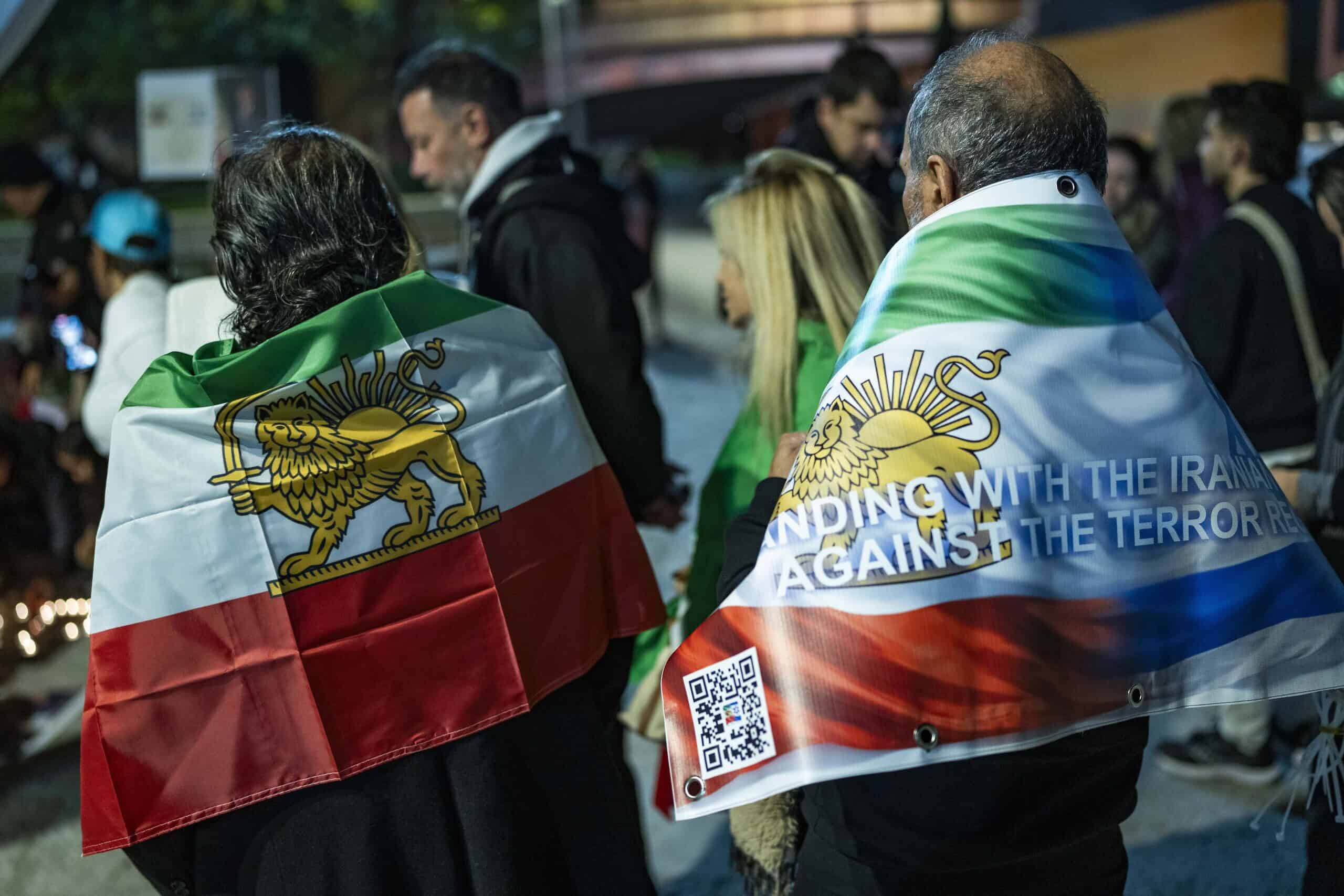 Members of the Iranian Jewish community in Holon, in central Israel, hold a demonstration in support of people and protesters in Iran, Jan. 24, 2026. Photo by Erik Marmor/Flash90.
A ‘red line’ precedent
It would also seem to be a repeat of another Obama fiasco. Obama backed off on his 2012 threat to Syrian President Bashar Assad, saying if the despot were to use chemical weapons against his own people, then it would cross a “red line” and ensure a U.S. military response. Nothing came of that; it was another milepost on the road to American decline. By punting on the threat and offshoring the job of dealing with the problem to Russia, Obama threw away American credibility, handing Tehran and its allies a huge and undeserved victory for its plans for regional hegemony.
For the same thing to happen to Trump would be an even greater disaster since his foreign-policy successes have been based on the fact that foreign adversaries and allies have been reluctant to test his mettle in a confrontation. If, under pressure from critics on the far right and far left who oppose a strong stance against Iran, Trump wilts, then no one will or should take his threats seriously again.
It’s entirely true that Trump and the American people would prefer to avoid using military force against Iran, as well as have zero interest in fighting a land war there or engaging in “nation-building.” Washington won’t repeat President George W. Bush’s mistaken policies that landed America and its troops in an Iraqi quagmire. But neither can Trump afford to demonstrate weakness just at the moment when he needs to project strength if he is to deal with this and other ongoing difficulties, like ending the war in Ukraine.
Witkoff and Kushner’s hubris
The dilemma here is partly the trap that talking with an insincere negotiating partner always provides. Trump, Witkoff and Kushner all believe themselves to be master negotiators because of their past work in real estate, coupled with the administration’s successes during the president’s first term, such as brokering the Abraham Accords between Israel and four Muslim-majority countries.
Yet they have already signaled that, like Kerry, they are far too eager for a deal with a regime that is at its best and most lethal when it is pretending to be reaching an agreement with the United States.
The problem, however, transcends the hubris that Witkoff and Kushner will pack in the bags they take to Istanbul. It is also about how to define the Trump approach to foreign policy.
“America First” means viewing the world through a realist prism rather than one determined by fantasies about a rapprochement with people whose main goal is to destroy the West. It also means overturning the conventional wisdom of the D.C. establishment about the value of appeasing the Islamist terror regime and ensuring that it is not allowed to use its oil wealth, nuclear program or its terrorist forces to destabilize the Mideast. And it means helping those who are aiding American foreign-policy goals without necessarily doing all the fighting for them.
Far from an isolationist creed, Trump’s vision is one that is essentially about projecting and embodying American strength abroad. That’s in direct contrast with the sort of weakness that led to the outbreak of wars in the Middle East and Ukraine in the four years Biden was warming Trump’s seat in the Oval Office.
That’s why Trump joined Israel’s attack on Iran’s nuclear program last June and inflicted the sort of damage that makes it unlikely that they will be able to use it to achieve their dream of regional hegemony.
And it’s also why Trump ought not to fall into the trap of negotiations with Iran just at the moment when a decisive push against them, both via sanctions and strategic strikes, might enable the Iranian people to overthrow the regime that has murdered and oppressed them for the last 47 years.
It’s not just that everyone knows that no deal with Iran could be verified by independent monitors of either its media or that the regime could be trusted to keep. They’ve cheated on the nuclear pact they made with Obama and virtually every other deal the regime has signed since the Islamist movement toppled the Shah of Iran in 1979.
Making Trump a lame duck
So, if Trump backs down on anything less than a change in the fundamental character of the Iranian regime and its transformation into a reasonable neighbor rather than the home base for terrorism, the damage he’ll be doing to himself will be as great as it is to the Iranian people’s hopes for a governmental alternative.
Few presidents have more at stake in maintaining their reputations than those who can’t be trifled with or bested in a negotiation. Surrendering to Iran will inevitably lead to surrendering to Hamas in Gaza. It would also end any hope of concluding Russia’s war with Ukraine on terms the West can live with or deterring global power grabs by an empowered China. It would also impair his ability to act for the rest of his term in office, which is still three full years.
We can’t know what the ultimate outcome of a U.S. or a joint U.S.-Israel attack on Iran looks like or what all the consequences of such a policy would be. But we do know that failing to follow through on his threats would make Trump a lame duck on foreign policy and pin on him the responsibility for future massacres of Iranians by their Islamist tyrants. That’s a price the president simply cannot afford.
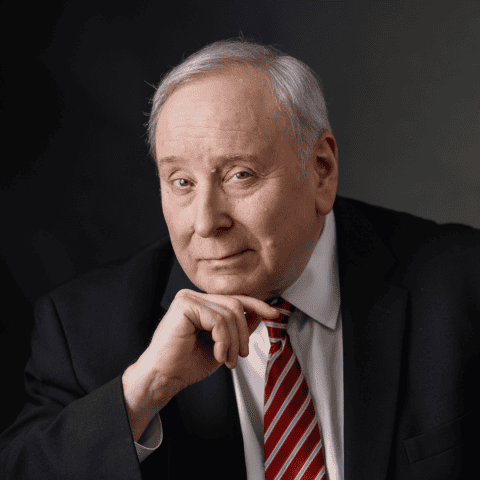 Jonathan S. Tobin is editor-in-chief of the Jewish News Syndicate, a senior contributor for The Federalist, a columnist for Newsweek and a contributor to many other publications. He covers the American political scene, foreign policy, the U.S.-Israel relationship, Middle East diplomacy, the Jewish world and the arts. He hosts the JNS “Think Twice” podcast, both the weekly video program and the “Jonathan Tobin Daily” program, which are available on all major audio platforms and YouTube. Previously, he was executive editor, then senior online editor and chief political blogger, for Commentary magazine. Before that, he was editor-in-chief of The Jewish Exponent in Philadelphia and editor of the Connecticut Jewish Ledger. He has won more than 60 awards for commentary, art criticism and other writing. He appears regularly on television, commenting on politics and foreign policy. Born in New York City, he studied history at Columbia University.
 Przejście graniczne z Egiptem w Rafah. (Fot. REUTERS/Stringer)
 Strefa Gazy: Przejście graniczne z Egiptem w Rafah otwarte. Na razie tylko częściowo