
Archive | 2026/02/01

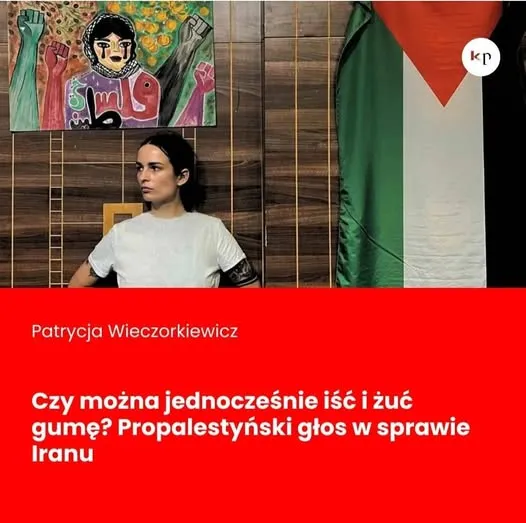
Iść, żuć gumę i nie myśleć, czyli anatomia ideologicznego odruchu


Iść, żuć gumę i nie myśleć, czyli anatomia ideologicznego odruchu

Anna Grabowska (Anne Goldschmid)


Wystarczyło, że zobaczyłam sam tytuł. Nawet nie musiałam czytać tekstu, nie znałam jeszcze nazwiska autorki, a już wiedziałam, kto go napisał. “Czy można jednocześnie iść i żuć gumę?” – pytanie pozorne, retoryczne ale oczywiście z tezą wpisaną w samą konstrukcję zdania. Bo po co pytać, łatwiej ustawić rozmowę od pierwszej linijki, czyli: jedni potrafią myśleć wielowątkowo, inni wcale. Jedni są “świadomi”, inni prymitywni a co najmniej moralnie podejrzani. Ten ton, ta pewność, to intelektualne samozadowolenie podszyte moralnym potępieniem znałam aż za dobrze. Znałam je, bo wcześniej już się z nimi zderzyłam. Jeszcze w czasie słynnej “humanitarnej” flotylli do Gazy, gdy skrytykowałam jeden z tekstów Patrycji Wieczorkiewicz. Spokojnie, rzeczowo, bez inwektyw i bez personalnych wycieczek. W odpowiedzi zostałam nazwana “fanatyczką mordowania dzieci”. Gdy zapytałam, na jakiej podstawie, nie padł żaden cytat, żaden argument, żadne odniesienie do treści mojej wypowiedzi. Jedynym “dowodem winy” zdaniem Wieczorkiewicz była flaga Izraela w moim zdjęciu profilowym.

I w tym momencie wszystko stało się jasne. Nie chodziło o poglądy ani argumenty. Nie chodziło nawet o spór. Pani Patrycji chodziło o znak. Flaga wystarczyła, by uruchomić cały repertuar gotowych reakcji – automatycznych i bezrefleksyjnych, jak ślinotok u psa Pawłowa. Bodziec zadziałał. Ideologiczny odruch został wyzwolony. Nie było już potrzeby myślenia, słuchania, rozróżniania. Nastąpiła sekwencja: dehumanizacja, moralne potępienie, zamknięcie rozmowy. Czyli jak zwykle, nie była to reakcja kogoś, kto się nie zgadza, tylko reakcja ideologii, która rozpoznaje wroga po symbolu, a nie po treści.

Dokładnie ten sam mechanizm działa w tekście Patrycji Wieczorkiewicz opublikowanym przez Krytykę Polityczną. Już w leadzie czytamy: “Gdzie są ci od ‘wolnej Palestyny’, kiedy w Iranie władza morduje demonstrantów? – pytają osoby, które do dziś usprawiedliwiają izraelskie zbrodnie w Gazie”. To zdanie nie jest niewinnym pytaniem, tylko od razu zbiorowym oskarżeniem. Nie pada ani jedno nazwisko, ani jeden cytat, ani jedno konkretne zdanie, które miałoby owo “usprawiedliwianie zbrodni” dokumentować. A więc, najpierw tworzy się figurę moralnie skażonego przeciwnika, a potem – z pełną powagą – rozprawia się z jego rzekomą hipokryzją. Jeśli unieważni się rozmówcę moralnie, nie trzeba już z nim rozmawiać.

Autorka pisze dalej: “Gdy na początku 2024 roku zaangażowałam się w sprawę palestyńską, sprzeciwiając się zbrodniom popełnianym przez Izrael w Strefie Gazy, niektórzy zarzucili mi hipokryzję”. W jednym zdaniu zawarte są trzy skróty myślowe; po pierwsze, Izrael zostaje nazwany sprawcą “zbrodni” bez żadnego rozróżnienia między kontekstem wojny, intencją, Hamasem, tarczami ludzkimi. Po drugie, każdy, kto pyta o Iran, zostaje zredukowany do kogoś, kto “zarzuca hipokryzję”, a więc działa w złej wierze. Po trzecie, znika pytanie zasadnicze: czy można jednocześnie potępiać śmierć cywilów w Gazie i mówić o roli Iranu jako sponsora Hamasu? W tym tekście – nie można. To już byłby dysonans.

Wieczorkiewicz pisze też, że jej krytycy twierdzą, iż “wspiera islamski zamordyzm”. To kolejna figura zastępcza. Krytycy nie imputują intencji. Wskazują fakt: Iran finansuje, zbroi i ideologicznie wspiera Hamas od lat 90. To nie jest wyssana z palca opinia, tylko udokumentowana rzeczywistość. Ale w tym tekście fakt natychmiast zamienia się w “nagonkę”, bo fakt burzy “świętą” konstrukcję ideologiczną.

Widać to aż nadto jaskrawie we fragmencie poświęconym Adamowi Szostkiewiczowi, który – jak pisze autorka – “od lat zajmuje się dbaniem o pozytywny wizerunek Izraela w Polsce”. Czyli znowu, żadna polemika z argumentem, a przypisanie intencji. Jeśli ktoś nie mówi tego, co trzeba, ergo, tego co mówi Wieczorkiewicz, to znaczy, że “dba o wizerunek”, “relatywizuje” I oczywiście “uprawia hasbarę”. Słowo “hasbara” pojawia się tu jak wytrych: “Czy wynika on z intelektualnego lenistwa, czy jest cynicznym graniem hasbarą?”. Pytanie pozorne, bo odpowiedź przecież już została zasugerowana. Hasbara w tym tekście nie jest pojęciem opisowym, jest epitetem, po którym nie trzeba już niczego dowodzić.

Dalej czytamy: “To klasyczny whataboutism: nieautentyczna troska, której celem nie jest pomoc ofiarom, lecz zdyskredytowanie innych ofiar”. To zdanie ewidentnie ironiczne, bo dokładnie to samo robi autorka. Kiedy tylko pojawia się Iran, natychmiast rosną jak grzyby po deszczu: Arabia Saudyjska, Emiraty, CIA z 1953 roku, Zachód, imperializm. Whataboutism owszem, zostaje potępiony – pod warunkiem, że stosuje go ktoś inny.

Kiedy Wieczorkiewicz pisze: “Protest jest formą nacisku, więc jeśli nie ma być czysto symboliczny, potrzebne jest miejsce podatne na nacisk” – próbuje nadać swojej bierności pozór realizmu. Według niej skoro “nie mamy wpływu na Iran”, to protesty w jego sprawie są rzekomo bezsensowne. Chciałoby się powiedzieć: litości, to zdanie rozpada się przy pierwszym kontakcie z historią. Według tej logiki bezsensowne były protesty przeciw apartheidowi, solidarność z dysydentami w ZSRR i demonstracje w obronie kobiet w Afganistanie. Protest nie jest tylko narzędziem nacisku, ale narzędziem delegitymizacji reżimu. Irańczycy wiedzą to doskonale – dlatego ryzykują życie, wiedząc, że świat patrzy.

I w tym miejscu trzeba nazwać rzecz po imieniu. To, z czym mamy do czynienia, nie jest “ostrą krytyką Izraela”, lecz antysemityzmem symbolicznym. Formą uprzedzenia, która nie potrzebuje już Żyda z imienia i nazwiska. Wystarczy znak, flaga lub symbol, który uruchamia cały aparat potępienia. Kiedy autorka pisze o “apologetach izraelskich zbrodni”, o “hasbarze”, o “relatywizowaniu”, nie odnosi się przecież do konkretnych tez czy wypowiedzi. Odnosi się do przynależności symbolicznej. Flaga Izraela w zdjęciu profilowym staje się dowodem winy i substytutem argumentu. To ta sama logika, która pozwala mówić: nie wiem, co powiedział, ale na bank wiem, kim jest.

Antysemityzm symboliczny próbuje być elegancki. Mówi rzekomym językiem wrażliwości i praw człowieka, a jednocześnie odbiera prawo do głosu tym, którzy zostali oznaczeni znakiem. W tej logice nie ma znaczenia, czy ktoś krytykuje rząd Netanjahu, czy popiera rozwiązanie dwupaństwowe, czy sprzeciwia się ofiarom cywilnym. Jeśli ma izraelską flagę, jeśli broni prawa Izraela do istnienia, zostaje zredukowany do “fanatyka”, “propagandysty”, “współwinnego”. Doświadczenie, w którym za spokojną krytykę tekstu pada oskarżenie o “fanatyzm mordowania dzieci” – z uzasadnieniem sprowadzającym się do flagi – nie jest incydentem. Jest po prostu modelem działania.

Antysemityzm symboliczny zawsze ma alibi: “krytykuję państwo, nie ludzi”. Tyle że w praktyce to nie państwo dostaje etykietę “fanatyka”. Dostaje ją konkretna osoba, która nie schowała się w bezpiecznej strefie “ani-ani”. Ideologia boi się widzialności, bo widzialność przypomina o czymś niewygodnym: że Żydzi mają państwo, sprawczość i prawo do obrony – i nie muszą tłumaczyć się z istnienia żadnym Paniom Wieczorkiewicz.

W dalszej części tekstu pojawia się galeria memów i groteskowych obrazów: “dwa dumne lwy”, “Netanjahu w rycerskiej zbroi”, “Greta Thunberg z Chameneim”. To taka walka z chochołem, zamiast zmierzyć się z realnymi argumentami, autorka wybiera internetowy folklor. Pewnie, to taka łatwizna dla zwolenników memów, bo pozwala nie mówić o roli Iranu jako sponsora Hamasu ani o sprzężeniu antysyjonizmu z antysemityzmem.

Gdy wreszcie pada zdanie: “Czasem solidarność polega na uznaniu, że nie każda tragedia świata musi zostać rozwiązana według naszych wyobrażeń i kompasu moralnego”, brzmi jak bardzo mądra puenta, a w istocie jest to usprawiedliwienie bezczynności. Solidarność, która nic nie kosztuje, nie wymaga wyboru i nie pociąga za sobą żadnego ryzyka, nie jest solidarnością. Jest dobrym samopoczuciem.

Patrycja Wieczorkiewicz pisze, że “nie płakałaby po ajatollahach”, ale jednocześnie robi wszystko, by każda realna próba osłabienia ich władzy została uznana za imperialistyczną zbrodnię. Odrzuca interwencję, presję, odpowiedzialność. Zostaje estetyczna pozycja “ani-ani”. Czyli jaka to polityka? Żadna. To komfort obserwatora, który zawsze stoi po właściwej stronie historii, bo nigdy nie musi podejmować decyzji.

Ten tekst nie jest analizą Iranu. Jest niewdzięczna formą ideologicznego tłumaczenia, że czarne jest białe. Jest świadectwem ideologii działającej jak odruch warunkowy. Wystarczy flaga, nazwisko i wystarczy bodziec. Reszta dzieje się sama. Ideologia zastępuje myślenie. Patrycja Wieczorkiewicz po raz kolejny udowadnia, że ideologia, która nie potrzebuje dowodu, nie potrzebuje też prawdy. 


Link do artykułu P. Wieczorkiewicz: https://krytykapolityczna.pl/…/iran-protesty-gdzie…/

Anna Grabowska – urodzona i mieszkająca we Francji wspaniała syjonistka z solidnymi polskimi i żydowskimi korzeniami. Autorka udzieliła pozwolenia na publikację niektórych wpisów z jej Facebooka w „Listach z naszego sadu”.


Zawartość publikowanych artykułów i materiałów nie reprezentuje poglądów ani opinii Reunion’68,
ani też webmastera Blogu Reunion’68, chyba ze jest to wyraźnie zaznaczone.
Twoje uwagi, linki, własne artykuły lub wiadomości prześlij na adres:
webmaster@reunion68.com


Israel Issues Veiled Warning to Turkey as Countries Clash Over Gaza Role


Israel Issues Veiled Warning to Turkey as Countries Clash Over Gaza Role

Ailin Vilches Arguello


Turkish President Tayyip Erdogan attends a press conference with German Chancellor Friedrich Merz at the Presidential Palace in Ankara, Turkey, Oct. 30, 2025. Photo: REUTERS/Umit Bektas

Israeli Defense Minister Israel Katz on Tuesday warned regional powers — in an apparent swipe at Turkey — to abandon any ambitions of restoring an empire, as tensions mount over postwar reconstruction in Gaza and competing efforts to assert regional influence.

At a joint press conference with Greek Defense Minister Nikos Dendias in Athens, Katz said Israel was determined “not to allow actors seeking to undermine regional stability to establish a foothold through terrorism, aggression, or military proxies — in Syria, in Gaza, in the Aegean Sea, or in any other arena.”

“Those who dream of dragging the region backward, establishing control through terror, or rebuilding empires at the expense of sovereign states will encounter a resolute alliance of free, strong nations capable of defending themselves,” Katz continued.

Last week, US President Donald Trump announced the establishment of the “Gaza Board of Peace” as part of his administration’s 20-point peace plan intended to end the war in Gaza and advance the process into phase two.

Despite vocal opposition from Israel, Trump has invited Turkey — along with Egypt, Argentina, and several other countries — to take part in his newly created initiative.

Israeli officials have repeatedly rejected any Turkish role in Gaza’s postwar reconstruction, warning that Ankara’s push to expand its regional influence could bolster Hamas’s terrorist infrastructure. Turkey has been a longtime backer of Hamas, the Palestinian terrorist group that ruled Gaza before the war and currently controls just over 40 percent of the enclave’s territory.

Beyond now holding a seat on the Board of Peace, Turkey, a NATO ally, is also seeking a role in a multinational force expected to be deployed to the war-torn enclave to oversee reconstruction efforts, prompting Israeli warnings that Ankara could use its position to shield Hamas from disarmament.

Multiple media outlets reported that Turkish President Tayyip Erdogan has yet to decide whether to accept Trump’s invitation to join the US-led initiative in Gaza, with the country’s participation in the international force still uncertain.

On Monday, Israeli Prime Minister Benjamin Netanyahu vowed that neither Turkish nor Qatari forces would be allowed in Gaza under the US-backed postwar reconstruction bodies, acknowledging a “certain dispute” with Washington over the issue.

“Turkish or Qatari soldiers will not be in the Strip,” the Israeli leader said in a speech to the Knesset. 

Qatar and Turkey “are barely members of an advisory committee of one of the three commissions, in which they don’t have any authority or any influence or any soldiers,” Netanyahu continued. 

Even as talks advance on phase two of Trump’s peace plan, Netanyahu stressed that Israel is still awaiting the return of slain hostage Ran Gvili’s remains, as stipulated in the first stage of the agreement.

“Phase two means one simple thing: Hamas will be disarmed, and Gaza will be demilitarized,” he said. “We are committed to these goals, and they will be achieved, either the hard way or the easy way.”

Under Trump’s Gaza peace plan, the international board of peace would oversee an interim technocratic Palestinian government in the enclave, supported for at least two years by an International Stabilization Force (ISF).

The ISF — comprising troops from multiple participating countries — will oversee the Gaza ceasefire between Israel and Hamas, train local security forces, secure Gaza’s borders with Israel and Egypt, and protect civilians while maintaining humanitarian corridors.

In addition, the ISF would seemingly be expected to take on the responsibility of disarming Hamas — a key component of Trump’s peace plan to end the war in Gaza which the Palestinian terrorist group has repeatedly rejected.

Earlier this month, Erdogan warned that the ISF would fail to earn the trust of the Palestinian people without Turkey’s involvement, signaling Ankara’s determination to assert influence over Gaza’s postwar future.

“It would be impossible for any mechanism to gain the trust of the Palestinian people without Turkey’s involvement,” the Turkish leader said. 

“We are in a key position for such a mission due to our deep historical ties with the Palestinian side, the security and diplomacy channels we have maintained with Israel in the past, and our regional influence as a NATO member country,” he continued.


Zawartość publikowanych artykułów i materiałów nie reprezentuje poglądów ani opinii Reunion’68,
ani też webmastera Blogu Reunion’68, chyba ze jest to wyraźnie zaznaczone.
Twoje uwagi, linki, własne artykuły lub wiadomości prześlij na adres:
webmaster@reunion68.com


What We’re Really Asking Today: Could Another Holocaust Happen?


What We’re Really Asking Today: Could Another Holocaust Happen?

Daniel Staetsky


Illustrative: Demonstrators protest in solidarity with Palestinians in Gaza, amid the ongoing conflict between Israel and Hamas, in London, Oct. 28, 2023. Photo: Reuters/Susannah Ireland

In the West today, Jews and non-Jews speak anxiously about antisemitism. They debate incident statistics, survey results, attitudes toward Israel, and the distinction — supposedly crucial — between hostility to Jews and hostility to the Jewish State.

Enormous intellectual and financial energy is invested in measuring all of this. Yet these debates are largely beside the point. They are a proxy for a darker, unspoken question: could another Holocaust happen?

Statistics cannot answer that question. They were never designed to. Nor can opinion surveys, however sophisticated.

After more than a decade of empirical research into antisemitism in Western societies, I have reached a conclusion that will sound extreme but is, I believe, unavoidable: another catastrophe for the Jews is not only possible but increasingly probable.

This is not because of a sudden resurgence of old-fashioned hatred, but because Western societies are undergoing a profound spiritual and political transformation — and Jews are once again positioned as expendable.

The West has largely de-Christianised. In the vacuum left behind, it is constructing an alternative creed powerful enough to provide meaning, cohesion, and moral orientation to societies that are fragmented, diverse, and unsure of themselves. One of these creeds is pro-Palestinianism. It functions not merely as a political stance, but as a civic religion.

Civic religion is not a new concept. It refers to the shared rituals, symbols, and moral narratives that bind a nation together when traditional faith weakens. What is new is the content. Pro-Palestinianism offers a simple moral universe — victim and oppressor, innocence and guilt — at precisely the moment when Western societies feel incapable of enforcing older lines of belonging and authority.

This helps explain several developments that otherwise appear baffling.

First, the speed and intensity of the Gaza War protests. Within days of October 7, 2023 — before the war had meaningfully unfolded, before casualty figures could be invoked — hundreds of thousands were already mobilised across Britain and Western Europe. The slogans evolved over time, but the mobilisation was instant and relentless. This was not spontaneous outrage reacting to unfolding facts. It was something closer to ritualised response.

There is no need to invoke conspiracy. The machinery behind this mobilisation is visible and long-established. Its urgency does not stem from the Middle East, but from Europe itself. Western societies are grappling with the integration of large immigrant populations, many from Muslim-majority countries, for whom identification with the Palestinian cause is emotionally immediate. Aligning national moral narratives with this cause is a low-cost way to signal inclusion, empathy, and shared purpose. Call it appeasement if you like; the deeper issue is insecurity. Societies that lack confidence in their own values are reluctant to discipline, because discipline presupposes a shared line — and the line is gone.

Second, the sheer disproportionality of the Palestinian issue in European politics. Governments fall, ministers resign, parties form, and retailers boycott over Gaza, while conflicts with far greater strategic relevance — Russia’s war in Ukraine, for example — fade into the background. Palestinian flags saturate cultural spaces, from city streets to school fundraisers to the inner doors of pub toilets. Avoiding the messaging now requires active withdrawal from public life.

This is not noble universalism. It is selective moral inflation. Gaza has “won” the competition for Western attention because it serves an internal function. Casting Israel as a supreme criminal and Palestinians as ultimate victims fits the sensibilities of newly arrived populations whose integration is deemed essential, and progressive movements unhappy with what they deem racism and elite supremacy in their own nations. Pro-Palestinianism promises social harmony, or at least the appearance of it. The reward is cohesion; the price is intellectual honesty.

Third, the widespread willingness to ignore — or actively deny — the atrocities of October 7. The denial is often explained as bad faith or manipulation. I think something simpler is at work. The violence was too alien, too disturbing for contemporary Western sensibilities. It does not fit the moral script that pro-Palestinianism requires. And so it must be softened, relativised, or erased. This is not endorsement of terrorism; it is narrative necessity. Civic religions, like traditional ones, cannot tolerate facts that undermine their moral clarity.

Finally, there is the strangest alliance of all: pro-Palestinianism’s ability to unite groups with fundamentally incompatible worldviews. The most striking case is the enthusiastic embrace of the Palestinian cause by segments of the LGBT community. The contradiction is obvious. Israel is the most LGBT-tolerant society in the Middle East; Palestinian and broader Muslim societies are not. In Gaza, homosexuality can be a capital offense. Yet the alliance persists.

This is not confusion. It is strategy. In Western societies, LGBT rights remain culturally contested, particularly among immigrant communities. Embracing a shared moral cause costs little and builds goodwill where it is most needed — at home, not abroad. Pro-Palestinianism functions as a bridge, allowing incompatible groups to coexist under a single moral banner.

Put together, these puzzles point to a single conclusion. The West is experiencing a genuine spiritual crisis. The sensibilities of the West today are secular; Islam is not attractive for the same reason that Christianity was abandoned. Nihilism cannot integrate diverse populations. And they are diverse. Very large minorities among the young generations in major Western European cities, at times 20%-40%, are Muslim or of Muslim heritage. A new glue is required — one that is emotionally compelling, morally binary, and accessible across cultural divides. Pro-Palestinianism fits the role perfectly.

But civic religions have consequences. They demand sacrifices. Historically, societies stabilise themselves by offloading tension onto those least able to resist. Jews, numerically small and symbolically charged, have always been vulnerable in such moments. There is little reason to believe this time will be different.

I am not predicting gas chambers. At least, I do not insist on them. History rarely repeats itself so neatly. Disenfranchisement, exclusion, informal expulsion, and moral abandonment are more likely. They will be framed, as always, in the language of justice and peace.

The uncomfortable truth is this: pro-Palestinianism did not arise despite Western weakness, but because of it. And until Western societies confront the spiritual emptiness that made this new faith necessary, they will continue to demand offerings. Jews have seen this altar before.


Dr. Daniel Staetsky is an expert in Jewish demography and statistics. He is based in Cambridge, UK.


Zawartość publikowanych artykułów i materiałów nie reprezentuje poglądów ani opinii Reunion’68,
ani też webmastera Blogu Reunion’68, chyba ze jest to wyraźnie zaznaczone.
Twoje uwagi, linki, własne artykuły lub wiadomości prześlij na adres:
webmaster@reunion68.com