Jonathan S. Tobin
The Ivy League school is falsely claiming that it is standing up for Jews by stonewalling the Trump administration’s efforts to punish blatant hatred on campus since Oct. 7.
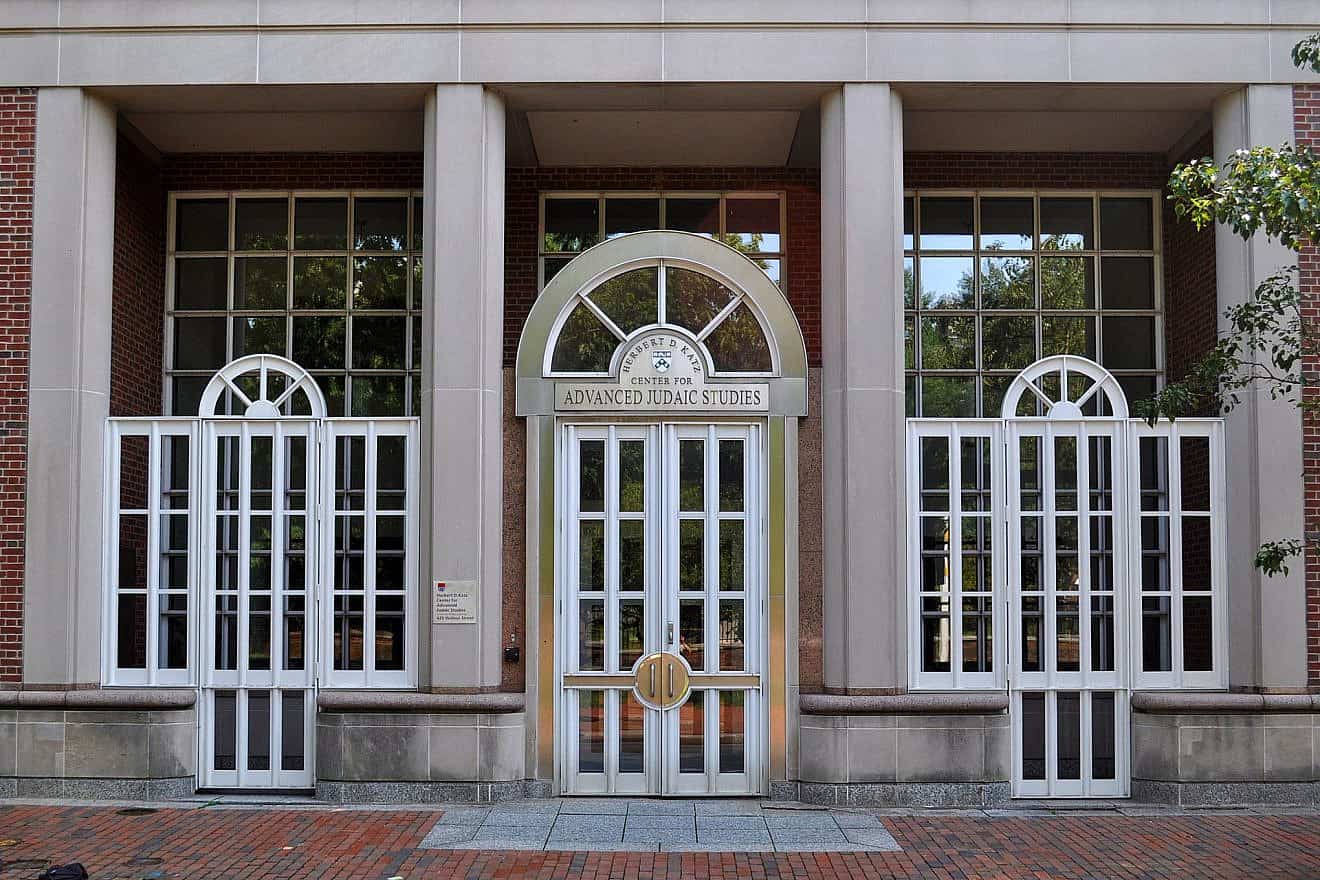 The University of Pennsylvania’s Katz Center for Advanced Judaic Studies. Credit: NM Giovannucci via Wikimedia Commons.
Give credit to the University of Pennsylvania for one thing. It’s not short on chutzpah.
The school has brazenly tolerated and even encouraged widespread and blatant acts of antisemitism on campus since the Hamas-led Palestinian Arab attacks in Israel on Oct. 7, 2023. But when an agency of the federal government sought to probe what had happened, Penn stonewalled requests for cooperation and transparency.
Faced with such intransigence, the U.S. Equal Employment Opportunity Commission (EEOC) issued a subpoena asking for the school’s records, including the identification of employees who could have been exposed to alleged harassment and the names of all employees who complained about the behavior. In its quest to find people potentially affected, the EEOC demanded a list of employees in Penn’s Jewish Studies Program. That was in addition to a list of all clubs, groups, organizations and recreation groups related to the Jewish religion, including points of contact and a roster of members, and the names of employees who lodged antisemitism complaints.
Who is defending the Jews?
But instead of complying with an effort to fight antisemitism, the school again said “no.” It is now alleging that the request is unconstitutional and a violation of the privacy of its employees and students. More than that, as its legal response asserted, it is now claiming to be defending Jewish students, employees and faculty by failing to cooperate with the government investigation.
In this bizarro view of reality, Penn is acting as if it is the government agency that is seeking to investigate antisemitism and defend its victims from behavior the university allowed to happen—that is the party that is targeting Jews. Predictably, corporate liberal media like The New York Times and The Guardian are cheering on the academic institution and claiming that it’s the Trump administration in the wrong.
Just as predictably, this stand is being supported by many members of Penn’s Jewish faculty, many of whom may privately acknowledge that there is antisemitism is present in their ranks but simply don’t want to go on record supporting anything the Trump administration does.
In this way, this drama is playing out in a similar fashion to the arguments about the Trump administration’s efforts to punish universities like Harvard, which is guilty of the same behavior the University of Pennsylvania is being called to account for. Harvard and many other schools have refused government settlement offers that would force them to pay fines and change their policies with respect to the treatment of Jews and the demonization of the State of Israel.
They have stuck to that position even if it means that, as is the government’s obligation under the Title VI provision of the 1964 Civil Rights Act, they will lose hundreds of millions of dollars in federal funding. This shows that they value their right to be antisemitic more than they do their mission to conduct medical research. Instead, Trump’s liberal critics have spun the issue as one revolving around their assertion that the administration is attempting to suppress the free speech and academic freedom of Hamas supporters. Even many in the liberal establishment condemned the government’s stand as harming vital institutions rather than conceding that these schools were morally compromised and needed to be held accountable.
A refusal to act
There may be room for debate about the advisability of the EEOC’s far-ranging subpoena. Indeed, Lori Lowenthal Marcus, the legal director of The Deborah Project, a public interest law firm devoted to fighting antisemitism, who supports the administration’s efforts, said the EEOC’s request was too broad and should have been accompanied by promises of confidentiality. But what is not in doubt is that the University of Pennsylvania is essentially gaslighting the public on the issue. Far from shielding Penn’s Jewish community from potential discrimination, the school’s virtue-signaling about its willingness to stand up to the president is rooted in a refusal to actually roll back an atmosphere of bigotry that it and the rest of the academic establishment have created when it comes to one specific minority in their midst.
As has been the case elsewhere in academia, Jews were harassed and targeted for intimidation by pro-Hamas mobs chanting slogans calling for Jewish genocide (“From the river to the sea”) and terrorism against Jews everywhere (“Globalize the intifada”). Then-president Liz Magill testified before Congress in December 2023 that it depended on “the context” as to whether advocacy for Jewish genocide was against the school’s rules. Just a month before Oct. 7, the school hosted a “Palestine Writes” conference on campus, where Jew-hatred was already rampant, despite complaints by Pennsylvania Gov. Josh Shapiro, who is Jewish.
When the Jewish community and other decent people complained about all this, the university slow-walked or simply failed to provide any accountability for those responsible for the creation of what was clearly a hostile environment for Jewish students and faculty.
So, it was hardly surprising the EEOC sought to investigate what had happened at Penn. The agency was not alone in this regard. Their action followed lawsuits filed in federal courts by Penn students, formal complaints initiated at the U.S. Department of Education, as well as public statements by university board members, donors and alumni, many of whom have disassociated themselves from the university because it failed to counteract or reverse what had become a dismal situation for Jews at the West Philadelphia campus. And it’s not as if the school administration had not acknowledged the problem, as a letter issued by Magill a month after Oct. 7 stated, in which she acknowledged that the school was facing a crisis.
“I am appalled by incidents on our own campus, and I’ve heard too many heartbreaking stories from those who are fearful for their safety right here at Penn,” she said in 2023. “This is completely unacceptable.”
Why are they getting away with it?
Nevertheless, Penn’s response to the EEOC has been to pretend as if none of this has happened and to disingenuously pose as the defenders of the very population it has allowed to be abused. And much of the court of public opinion seems to be buying it.
Why are they getting away with it?
One reason is partisanship. Throughout academia in general, liberals and Democrats dominate.
Within the liberal arts, those who dissent from left-wing ideology have become something of an endangered species. Since the ability to get tenured academic appointments depends on the votes of senior colleagues, this has created a situation in which fewer and fewer professors are anything but liberals. This is especially true at elite schools. While current figures for the ideological or partisan breakdown of professors at Penn are not available, a recent survey at a comparable institution—Yale University—revealed that 82.3% of the 1,666 faculty members examined were registered Democrats or on record supporting Democratic candidates, while only 2.3% were Republicans. Of 43 departments that grant undergraduate degrees, 27 had zero Republican faculty members.
The growing lack of ideological diversity on campuses is having a direct impact on the surge of Jew-hatred. Given the hatred for Trump on the left, these people seem willing to oppose virtually anything his administration does, even when it is fighting something as awful as antisemitism.
More to the point, most so-called “progressives” in academia have bought into the fashionable toxic ideas of critical race theory, intersectionality and settler-colonialism that not only exacerbate racial divisions, but also falsely label Jews and Israel as “white” oppressors. It is this belief system, coupled with the woke catechism of diversity, equity and inclusion (DEI), that fosters indoctrination and punishes dissent, and has made elite campuses like that of Penn places where Jew-hatred has flourished.
This should lead reasonable persons, regardless of their political affiliation, to concede that addressing the problem requires a fundamental shift in how these schools conduct hiring and admissions, as well as to re-evaluate what sort of teaching they tolerate. Yet much of academia—bolstered by the political left and even conventional liberals who just hate Trump—continues to prefer to pretend that the real problem is the president and others who have noticed this scandalous situation.
This is not the first time that the political left has claimed that Trump’s efforts to combat antisemitism, which are more far-reaching and serious than anything his predecessors have attempted, are themselves antisemitic. In 2019, when Trump, following the precedent of rulings handed down by previous administrations, signed an executive order declaring that the Title VI protections of the Civil Rights Act applied to Jews, many on the left treated it as not just wrong but an act of hatred in itself. This was similar to the refusal to comply with the EEOC subpoena. At the time, many on the left said that declaring that being Jewish was a category of persons that deserved protection under the law somehow made Jews vulnerable to official discrimination.
Trump derangement syndrome
It made no sense. But when it comes to this particular issue, it seems that the president’s opponents, including those who are themselves Jewish, are simply too stricken with what is commonly called “Trump derangement syndrome” to be able to think clearly about his actions. This is true even when they might otherwise agree that antisemitism is something that not only shouldn’t be tolerated but ought to be punished, as the law states, with the loss of federal funds.
Marcus sees this as a manifestation of something that goes even deeper than partisan loyalties and attitudes toward Trump. “If you are a Jew and you believe that the University of Pennsylvania is a place where faculty and staff have experienced antisemitism, then what the EEOC is doing is an effort to right a wrong,” Marcus says. “I personally know there are many Jews at Penn who believe there has been and is a hostile environment created or at least condoned by Penn. But because of the way the subpoena was worded, Penn, with the help of the media, was able to successfully manipulate the mass, generational PTSD which most Jews have inherited as the result of the millennia-long persecution of Jews.”
She says this “reflexive response” to the creation of any list of Jews that includes names and identifying information is boiled down to a simple assertion that “the EEOC wants a list of Penn’s Jews.” Marcus thinks the unspoken ending of that phrase is “to round us up.” As a result, these Jews are “circling the wagons” around the very institution that is actually enabling antisemitism and thwarting administration efforts to do something about it.
We can only hope that, as with other aspects of the administration’s necessary and unprecedented push to rid academia of its bias against Jews, the courts won’t ultimately side with the institutions. In the meantime, instead of joining in the efforts to smear efforts to roll back the progressive project that has enabled the current crisis, responsible Jewish academics, organizations and community leaders should be applauding Trump’s stand and labeling Penn’s conduct for what it is: brazen gaslighting that seeks to cover up their guilt.
 – Jonathan S. Tobin is editor-in-chief of the Jewish News Syndicate, a senior contributor for The Federalist, a columnist for Newsweek and a contributor to many other publications. He covers the American political scene, foreign policy, the U.S.-Israel relationship, Middle East diplomacy, the Jewish world and the arts. He hosts the JNS “Think Twice” podcast, both the weekly video program and the “Jonathan Tobin Daily” program, which are available on all major audio platforms and YouTube. Previously, he was executive editor, then senior online editor and chief political blogger, for Commentary magazine. Before that, he was editor-in-chief of The Jewish Exponent in Philadelphia and editor of the Connecticut Jewish Ledger. He has won more than 60 awards for commentary, art criticism and other writing. He appears regularly on television, commenting on politics and foreign policy. Born in New York City, he studied history at Columbia University.
 Wielki mufti, Hadżdż Amin al-Husajni, spotyka się z Hitlerem w listopadzie 1941 r.
 Dlaczego edukacja o Holokauście zawiodła