Jonathan S. Tobin
The Michigan primary was a referendum on the Jewish presence in the public square. The consequences of normalizing his antisemitism will impact much more than the pro-Israel group.
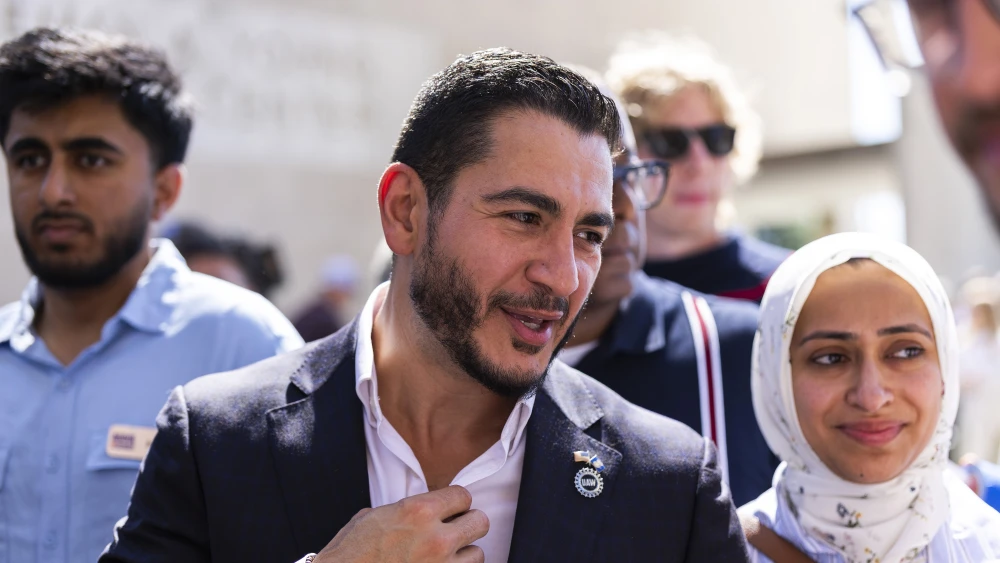 Michigan Democratic Senate primary winner Dr. Abdul El-Sayed arrives with his wife, Sarah Jukaku, at a press conference in front of the Spirit of Detroit statue in Detroit on Aug. 5, 2026. He faces former Republican Rep. Mike Rogers in November. Photo by Finn Gomez/Getty Images.
It would be difficult to underestimate the impact of Dr. Abdul El-Sayed on American politics. His victory in the Michigan Senate Democratic primary over Rep. Haley Stevens (D-Mich.) has inspired endless commentary and analysis about the sources of his personal appeal, the shortcomings of his opponent, the state of the electorate and the failures of pollsters to come even close to predicting the results. And it won’t be until we see how he fares against his Republican opponent, former Rep. Mike Rogers, in the general election, that we will have a better idea of how most Americans—and not just Democratic primary voters—feel about his beliefs.
But there should be no mistaking one thing: Democrats have given a person whose most important issue was demonizing Jewish participation in American politics a narrow plurality. By rallying around him and unifying behind his candidacy, as the defeated party establishment has already done, they are normalizing a hateful position against a segment of citizenry. They are declaring that politics driven by traditional tropes of antisemitism and money is not merely debatable, but a stand they can all get behind if it means winning a majority in the U.S. Senate.
Anti-Zionism is antisemitism
Like other public antisemites on the left and right, the 41-year-old El-Sayed has declared his love of the Jewish people and his “commitment to Jewish safety” after winning the primary by less than one percentage point—about 15,000 votes out of more than 1.5 million. Similar sentiments have been heard before by Democrats associated with the progressive “Squad” in the U.S. House of Representatives, like fellow Michigander Rashida Tlaib and Rep. Ilhan Omar (D-Minn.). New York City Mayor Zohran Mamdani has also attempted to deflect justified charges of antisemitism. All of them, like El-Sayed’s pledges, are equally insincere.
He and other left-wing opponents of Israel claim that they are merely “criticizing” Israel’s current government and expressing sympathy for Palestinian Arabs in the Gaza Strip. They also say that by attacking the pro-Israel lobby AIPAC, they are merely decrying the influence of money in American politics and seeking to prevent special interests or a foreign country from attempting to “buy” Congress.
But these excuses aren’t merely deceptive. They are a flimsy cover for stands that seek not so much to put AIPAC in its place as to remove Jews from the American public square—other than those who join with Jew-haters to try to demonize a key aspect of Jewish identity and faith.
They do not “criticize” Israel as much as they wish to delegitimize the existence of the one Jewish state on the planet. They want to strip it of its rights and ability to defend itself against an international movement that seeks its destruction.
Their opposition to an “ethno-state” is limited only to the Jewish one and indifferent to the dozens that are Muslim. Their desire to rid the electoral system of the influence of campaign spending is limited to those individuals and entities that organize support for Israel. They have no problem with the people, organizations or interests supporting those who back Islamists. They claim that American citizens who back their country’s Israeli ally are malign actors working on behalf of foreign influence. Yet they see nothing wrong with the infinitely greater resources being spent in the United States by Islamist nations like Qatar to spread and normalize Jew-hatred.
They aim to drive AIPAC out of American politics, and yet, they take money, as El-Sayed did, from those affiliated with the Council on American-Islamic Relations (CAIR), a group not merely openly antisemitic but founded as a front for Hamas. And they seek to isolate and silence those who point to the growing influence of the Muslim Brotherhood, which is linked to CAIR.
All of this illustrates that the anti-Zionism that drives the efforts of a growing cadre of Muslim politicians such as El-Sayed is indistinguishable from a hatred of Jews. El-Sayed explicitly seeks to redefine Judaism and eliminate one of its key elements—love of the land of Israel and its centrality in Jewish life—to clear himself of justified charges of antisemitism.
Democrats keep shifting left
In the last decade since progressives began an effort to wrest control of the Democrats from its establishment after their presidential candidate, Hillary Clinton, was defeated by President Donald Trump, a wave of left-wing candidates have sought to transform the party.
It began not just with the election of the four charter members of the left-wing congressional “Squad” in 2018, but with the refusal of the party establishment to isolate or condemn Tlaib and Omar when they initially engaged in open antisemitism. Then-House Speaker Nancy Pelosi didn’t just prevent the censure of Omar for her now-infamous antisemitic tweet stating, “It’s all about the Benjamins, baby,” referencing money and the lobbying group AIPAC, and analogizing Israel to the Taliban.
In fact, Pelosi went on to pose with them for the cover of Rolling Stone magazine to show that she and Democrats embraced what they rightly saw as politicians who spoke for their party’s base, which were not merely open to socialism but also hated Israel and were hostile to Jews. They were also afraid of being accused of Islamophobia, which in practice in the 21st century isn’t hatred for Islam but a willingness to notice Muslim Jew-hatred.
What matters about those events is that set of choices has informed and explained Democratic Party politics in the years since then.
That’s why in the aftermath of the Hamas-led Palestinian-Arab assault in southern Israel on Oct. 7, 2023, the reaction from so many Democrats has been to turn on the Jewish state. Many Democrats believe that former Vice President Kamala Harris was defeated by Trump in 2024 because she and former President Joe Biden were insufficiently hostile to Israel, despite their hamstringing of the Jewish state’s post-Oct. 7 war effort and slow-walking of arms deliveries.
And it is why the Democratic caucuses in both the House of Representatives and the Senate are now on record as supporting an embargo on aid to Israel, including defensive weapons like the Iron Dome anti-missile system.
Accepting blood libels
They defend this as a reaction to what they claim is the brutality of Israel, but what they are really telling us is something else. They are making clear that the majority of their officeholders, party cadres, liberal mainstream media allies, and academic and cultural thought leaders have accepted the toxic left-wing ideologies that define Jews and Israel as “white” oppressors. This belief that they are always in the wrong, no matter what they do, and that those who wish to destroy the Jewish state are oppressed minorities always in the right is at the heart of the surge of antisemitism since Oct. 7.
That is how blood libels and other fabricated propaganda about Israel committing “genocide” in Gaza, deliberately starving Palestinians or dragging (and even blackmailing) the Trump administration to go to war against Iran have become not so much widely believed on the political left but viewed as unquestionably true.
That is the political eco-system that made possible the rise of someone like El-Sayed. Without it, it would have been unthinkable for a candidate to win a major party nomination for the U.S. Senate via a campaign that was largely based on the idea that the most important challenge facing the American people is the existence of a lobbying group that seeks to promote support for Israel. The fact that AIPAC’s reach and resources are dwarfed by other lobbying groups that represent major industries and that it spends less than leftist mega-donors, like the family of George Soros, on candidates who, among other causes, oppose Israel is dismissed. El-Sayed’s campaign is driven by anti-Jewish bigotry, not concern about campaign finance laws.
Yet beyond the specifics of the efforts to maliciously and falsely portray AIPAC as a sinister group manipulating the system against U.S. interests, there is something more at stake in this debate. Those who single out AIPAC and have shockingly buffaloed most Democrats into saying they won’t take contributions from it or its members are seeking to drive Jews out of the American public square.
Just as bad, Democrats who still claim to support Israel and who don’t condemn AIPAC, like Senate Minority Leader Chuck Schumer (D-N.Y.) and Sen. Kirsten Gillibrand (D-N.Y.), endorsed El-Sayed after the primary. For them, partisanship is more important than opposing antisemitism. That same mindset caused Senate Democrats to boycott a hearing chaired by Sen. Ted Cruz (R-Texas) on the growing influence of the Muslim Brotherhood in the United States and elsewhere.
It is entirely true that part of El-Sayed’s appeal is linked to a hunger for populism and a rejection of failed political establishments across the political spectrum. He is also profiting from the lack of historical memory among so many Americans who are willing to fall for the siren call of far-left economics that he promotes (despite the wealthy health professional’s declaration that he is not a socialist).
His charisma and political skills, and, by contrast, Stevens’s dull political persona, also played a role in the outcome. Though she was a genuine moderate, her ability to marginalize him and fend off his claims that she was the candidate of a “foreign” lobby was also undermined by her fear of alienating anti-Israel and antisemitic sentiment in a party where both were already normalized. Her reflexive criticism of Israel and willingness to acquiesce to the demonization of Israeli Prime Minister Benjamin Netanyahu—a now-standard trope of pro-Israel Democrats—also made it difficult to point out that El-Sayed’s positions were as immoral and prejudicial as they were wrongheaded.
Yet even supporters of El-Sayed, like Michelle Goldberg, The New York Times’ anti-Zionist columnist, noted his megalomaniacal tendencies, so typical of hate-mongers, which cause him to believe that those who oppose him can’t be sincere.
A test for 2028
The existence of a large Arab and Muslim-American population in Michigan—and the ubiquity of anti-Jewish prejudice in that particular community—was another factor, though one that hasn’t been replicated in U.S. politics, except in certain circumstances, as Mamdani’s victory in New York City showed.
Still, El-Sayed’s support was largely limited to white privileged voters, along with his Arab and Muslim base. The credentialed elites are the base of the Democratic Party these days, not the working-class voters it once represented and now largely scorns. He did poorly among African-Americans, who are a vital constituency for Democrats. As much as Jews and blacks have split on many issues, convincing African-Americans to buy into the idea that a pro-Israel lobby was the country’s greatest problem was a tough sell.
Nevertheless, the consequences of a campaign that normalizes El-Sayed’s vile tactics will be felt throughout the political system and American discourse.
It remains to be seen whether Rogers will be more effective in pointing out El-Sayed’s extremism. It will also be interesting to see if African-Americans turn out for a candidate with little to say to them in the numbers Democrats need to prevail.
Much attention will also focus on Michigan’s Jewish community, mainly in and around Detroit, which makes up only 1.4% of the state’s electorate. It is still overwhelmingly politically liberal and loyally votes the Democratic ticket. If a significant minority reflexively votes for the Democratic candidate, as was the case with Mamdani in the 2025 New York City mayoral election, regardless of El-Sayed’s contempt for Jewish interests and rights, it will be a sign of the moral collapse of liberal Jewry.
It should be remembered that in March, a domestic terrorist, Ayman Mohamed Ghazali, crashed his pickup truck—loaded with gasoline and commercial fireworks—into Temple Israel, a large Reform synagogue in West Bloomfield Township, Mich. Fortunately, no one was hurt except for the attacker himself, who was shot and killed by law enforcement. El-Sayed rationalized that crime by saying it was understandable since the terrorist was upset about the death of his brother, a Hezbollah commander in Lebanon, who was killed as a result of Israel’s efforts to prevent the Iranian proxy group from attacking their country.
If, rather than a test of the appeal of El-Sayed’s antisemitism, the election hinges on a verdict about the Trump administration, the Democrats may be able to carry their candidate over the finish line. If so, then the problem won’t be just the addition of an antisemite to the Senate. It will be a signal sent to his party as well as the still relatively small minority of Republicans that share his prejudices, that targeting Jews will be both acceptable and good politics in 2028.
 Jonathan S. Tobin is editor-in-chief of the Jewish News Syndicate, a senior contributor for The Federalist, a columnist for Newsweek and a contributor to many other publications. He covers the American political scene, foreign policy, the U.S.-Israel relationship, Middle East diplomacy, the Jewish world and the arts. He hosts the JNS “Think Twice” podcast, both the weekly video program and the “Jonathan Tobin Daily” program, which are available on all major audio platforms and YouTube. Previously, he was executive editor, then senior online editor and chief political blogger, for Commentary magazine. Before that, he was editor-in-chief of The Jewish Exponent in Philadelphia and editor of the Connecticut Jewish Ledger. He has won more than 60 awards for commentary, art criticism and other writing. He appears regularly on television, commenting on politics and foreign policy. Born in New York City, he studied history at Columbia University.
 Warszawa, 6.08.2026. Wiceprezes Instytutu Pamięci Narodwej Mateusz Szpytma w Senacie w Warszawie. Fot. PAP/Leszek Szymański
 Senat nie zgodził się na powołanie dr. Mateusza Szpytmy na stanowisko prezesa IPN