
Archive | 2026/08/05

Wędrówki ludów – epizod hiszpański

Źródło zdjęcia: zrzut z ekranu wideo.


Wędrówki ludów – epizod hiszpański

Andrzej Koraszewski


Małe hiszpańskie miasto Ceuta niespodziewanie znalazło się na ustach światowych mediów. Miasto ma mniej niż sto tysięcy mieszkańców, a kilka dni temu odwiedziło je plus minus 60 tysięcy turystów bez paszportów. Premier Tusk napisał na X, że Hiszpania powinna prowadzić taką politykę imigracyjną jak Polska, a żona naszego ministra spraw zagranicznych opublikowała obszerny artykuł na łamach „The Atlantic”, informując, że skrajna prawica zrobiła z tego wydarzenia burzę w szklance wody. Większość przybyszów, którzy wdarli się do Hiszpanii, została zawrócona do Maroka. Masowa wycieczka kosztowała życie około stu osób (ale nadal nie ma dokładnych danych).

Jak podkreśla Anne Applebaum, ważna jest mapa. Istotnie, Ceuta znajduje się na przylegającym do Maroka niewielkim półwyspie i jest jedną z ostatnich pereł w koronie hiszpańskich kolonii. Hiszpania objęła ten półwysep w posiadanie w XV stuleciu i jest do niego bardzo przywiązana. Amerykańska żona polskiego ministra przypomina, że chociaż miasteczko jest hiszpańskie, to od Hiszpanii kontynentalnej oddzielają je morze i bariery administracyjne, więc żadnego zagrożenia dla Europy nie było, chociaż prawdą jest, że nowe rozporządzenia Madrytu utrudniają odsyłanie nieproszonych gości.

Historia (czy może histeria) podobno rozpoczęła się od obwieszczenia na TikToku o tym, jak łatwo dostać się z Maroka do Hiszpanii, a dokładniej do pozostałości jej kolonii na kontynencie afrykańskim. Autorka artykułu zauważa, że błyskawicznie pojawiły się liczne oferty sprzętu potrzebnego do szybkiego i sprawnego dotarcia drogą wodną do brzegów półwyspu. Władze Ceuty nie były na te masowe odwiedziny przygotowane, a władze marokańskie niespecjalnie przeszkadzały. Anne Applebaum wydaje się nie wykluczać, że mogły pomagać, chociaż zdecydowanie istotniejsze w jej rozważaniach jest minimalizowanie znaczenia tego wydarzenia, które – jak pisze – zostało przez skrajną prawicę nadmiernie wyolbrzymione.

Faktem jest, że Maroko zgłasza roszczenia do półwyspu. Jakąś rolę mogli tu również odegrać Algierczycy (których wśród przybyszów do Ceuty było całkiem sporo, ale nie mamy dokładnych danych). „Gazeta Wyborcza” wysłała do Ceuty swoją reporterkę, Emilię Bromber, która wysmażyła ociekający ckliwością, głodny kawałek o biednych muzułmanach, iżby ludzie dowiedzieli się, co zobaczyła na własne oczy. W samej Hiszpanii trwa burza, która może wpłynąć na scenę polityczną, ale – jak wiadomo – przewidywanie przyszłości jest niebezpiecznym zajęciem.

Jak pisze Ayaan Hirsi Ali na swojej stronie Substacka „Restopring the West,

„Kryzys na granicy Hiszpanii stał się kryzysem narodowym”. Jej zdaniem ta historia jest ostrzeżeniem przed kolejnymi naruszeniami granic, które łatwo zorganizować, kiedy państwo wycofuje się z egzekwowania prawa i wykonywania swoich funkcji. W hiszpańskim miasteczku wielotysięczny, dobrze zorganizowany tłum młodych mężczyzn bez trudu sforsował lądowe przejście graniczne, strzeżone przez kilku niczego niespodziewających się mundurowych. W tym samym czasie inni okrążali falochron drogą wodną. Oczywiście możemy szukać winnych, zastanawiać się, dlaczego nie zauważono aktywności w mediach społecznościowych w Maroku i praktycznie zupełnie otwartych przygotowań do tej akcji. Jak pisze autorka: „Czwartkowe wydarzenia wpisują się w tendencję widoczną od lat. Ich rezultat był całkowicie przewidywalny”.

We wspomnianym artykule Anne Applebaum znajduje się nawet informacja o fali syryjskich imigrantów sprzed dekady, chociaż autorka nie wspomina o roli, jaką odegrała w tej masowej inwazji nielegalnych imigrantów Turcja, gdzie przemyt ludzi stał się nie tylko niezwykle intratnym procederem, ale również częścią działań organów państwowych. (Bliżej domu, patrząc na granicę między Polską a Białorusią, mogliśmy zauważyć, jak tworzenie szlaków nielegalnej imigracji staje się świetnym narzędziem destabilizacji sąsiedniego kraju).

„Europejskie ramy prawne dotyczące azylu, stworzone po II wojnie światowej, powstały z myślą o zupełnie innej epoce. Miały służyć rozpatrywaniu wniosków niewielkich, jasno określonych grup dysydentów politycznych lub bezbronnych rodzin uciekających przed ukierunkowanymi prześladowaniami ze strony państwa. – pisze Hirsi Ali -To, z czym Hiszpania mierzy się obecnie, ma zasadniczo odmienny charakter: są to liczne, mobilne grupy młodych mężczyzn działających poza legalnymi kanałami, dążących do uzyskania dostępu do możliwości ekonomicznych z pominięciem standardowych procedur weryfikacji.”

Kolumbowy błąd Angeli Merkel powtarza dziś rząd Hiszpanii – problemy nielegalnej imigracji są tuszowane, a władze państwowe świadomie wybierają zarządzanie narracją zamiast otwartej debaty publicznej i prób stawienia czoła narastającym problemom. Lawinowo rośnie liczba nielegalnych imigrantów, brakuje integracji, lawinowo rosną koszty opieki socjalnej, a także przestępczość (czytaj: rabunki, pobicia i gwałty), której sprawcami są ludzie, którzy nie zamierzają respektować prawa goszczącego ich kraju.

Dobrze zorganizowana inwazja w hiszpańskiej enklawie zakończyła się odesłaniem gości do Maroka (podobno pozostało w mieście „zaledwie” kilka tysięcy), więc – jak pisze Ayaan Hirsi Ali – jest to przede wszystkim ostrzeżenie dotyczące charakteru tej współczesnej wędrówki ludów.

Brak egzekwowania prawa oznacza bezprawie.

„Sytuację pogarsza fakt, że Hiszpania wykonuje zaledwie około jedno na dziesięć wydanych nakazów deportacji. W ubiegłym roku socjalistyczny rząd wydał 53 695 decyzji o deportacji. Wykonano jedynie 5 705 z nich. Tak niski poziom egzekwowania prawa jest w praktyce przyznaniem, że rządy prawa kończą się na drzwiach sal sądowych.”

Równocześnie widzimy (podobnie jak wcześniej w innych krajach Europy Zachodniej) proces masowej legalizacji nielegalnych przybyszy. W Hiszpanii z ponad miliona złożonych wniosków zaakceptowano pół miliona, co – zdaniem hiszpańskich urzędników odpowiadających za imigrację – po zakończeniu procesu łączenia rodzin będzie oznaczać około trzech milionów legalnych już imigrantów, których skłonność i zdolność do integracji stoi pod znakiem zapytania.

„Poza bezpośrednimi wyzwaniami dla organów ścigania istnieje elementarna prawda, której europejscy przywódcy z uporem graniczącym z absurdem nie chcą uznać: rozbudowane państwo opiekuńcze i nieszczelne granice nie mogą współistnieć – pisze Ayaan Hirsi Ali. – Można mieć jedno albo drugie, ale nie oba jednocześnie. W całej Hiszpanii infrastruktura publiczna ponosi konsekwencje tego złudzenia. Usługi społeczne, szpitale i szkoły podstawowe dysponują ograniczonymi zasobami, tworzonymi i finansowanymi przez podatników. Gdy tysiące osób przybywają z naruszeniem prawa, natychmiast wymagają pomocy państwa, schronienia i obsługi administracyjnej. Państwo, które udaje, że jego zasoby są niewyczerpane, ostatecznie zniszczy system zabezpieczenia społecznego dla wszystkich.”

Anne Applebaum ma rację – nie jest prawdą, jakoby w ciągu jednej nocy 60 tysięcy afrykańskich imigrantów przedarło się do strefy Schengen. Nikt tego jednak nie twierdzi. Zobaczyliśmy pokaz gwałtownego przełamania granicy, który jest częścią większego obrazu – kryzysu, który od lat pogłębia się w wielu krajach Europy Zachodniej, więc teoretycznie może to być okazja do uczciwej debaty nad realnym problemem. Kraje, które nie potrafią zabezpieczyć własnych granic, stają się ziemią niczyją. Artystyczne i biurokratyczne zapewnienia, że wszystko jest w najlepszym porządku, często zyskują oklaski, ale rzeczywistości nie zmieniają. Niestety, wzmacniają czarnosecinnych obrońców prawa i sprawiedliwości i to w stopniu znacznie większym, niż pani Applebaum potrafi to sobie wyobrazić.


Zawartość publikowanych artykułów i materiałów nie reprezentuje poglądów ani opinii Reunion’68,
ani też webmastera Blogu Reunion’68, chyba ze jest to wyraźnie zaznaczone.
Twoje uwagi, linki, własne artykuły lub wiadomości prześlij na adres:
webmaster@reunion68.com


A Dangerous Deal: Trump’s Board of Peace and Hamas


A Dangerous Deal: Trump’s Board of Peace and Hamas

Khaled Abu Toameh


  • The original goal of Trump’s peace plan was not to relocate Hamas’s arsenal. It was to eliminate it permanently.
  • Weapons stored in warehouses remain weapons that function. Explosives stored today can be easily recovered tomorrow. Rocket factories that are preserved can resume production. Tunnels that are mapped rather than destroyed can be used again.
  • The issue has never been where Hamas keeps its weapons. The issue has always been Hamas having access them.
  • Transferring weapons from one Palestinian group to another is not demilitarization.
  • Even more disturbing is the new deal’s assertion that “no weapons shall be transferred or handed to Israel or non-Palestinian parties.”
  • Equally disturbing is the new roadmap’s conditioning of disarmament on an Israeli withdrawal from the Gaza Strip….
  • Why should a terrorist organization that carried out the October 7, 2023 massacre in Israel be allowed to dictate the conditions of its own disarmament? No country fighting ISIS or al-Qaeda would first withdraw its forces and only then hope terrorists voluntarily surrender their weapons. Hamas should not be negotiating the terms of its defeat. It should be compelled to unconditionally surrender and disarm.
  • This is the same Ghazi Hamad [senior Hamas official] who publicly vowed that Hamas would repeat the October 7 massacre time and again until Israel is eliminated: “The Al-Aqsa Flood [the name Hamas uses to describe the October 7 massacre] is just the first time, and there will be a second, a third, a fourth, because we have the determination, the resolve, and the capabilities to fight.”
  • Anyone who thinks that the newly established NCAG will somehow confront Hamas and impose its authority over the terrorist organization is living under an illusion.
  • The far more likely scenario is that Hamas will continue to call the shots from behind the scenes while allowing another Palestinian body to assume responsibility for governance, civil service salaries, reconstruction, and collecting international aid.
  • This would essentially replicate the Hezbollah model in Lebanon, where a heavily-armed Iran-backed terrorist militia coexists with a formal government while retaining independent military power and ultimate political influence.
  • Within hours of the announcement of the roadmap, Iran’s Islamic Revolutionary Guard Corps dismissed the plan outright, declaring… that “the resistance” (Hamas) would remain steadfast until what it called the “final victory” over Israel.
  • Iran understands Hamas better than anyone else because it has financed, armed and trained the terrorist organization for decades. If the Iranian regime is openly rejecting the prospect of Hamas’s disarmament, why should anyone else believe that Hamas intends to honor the agreement?

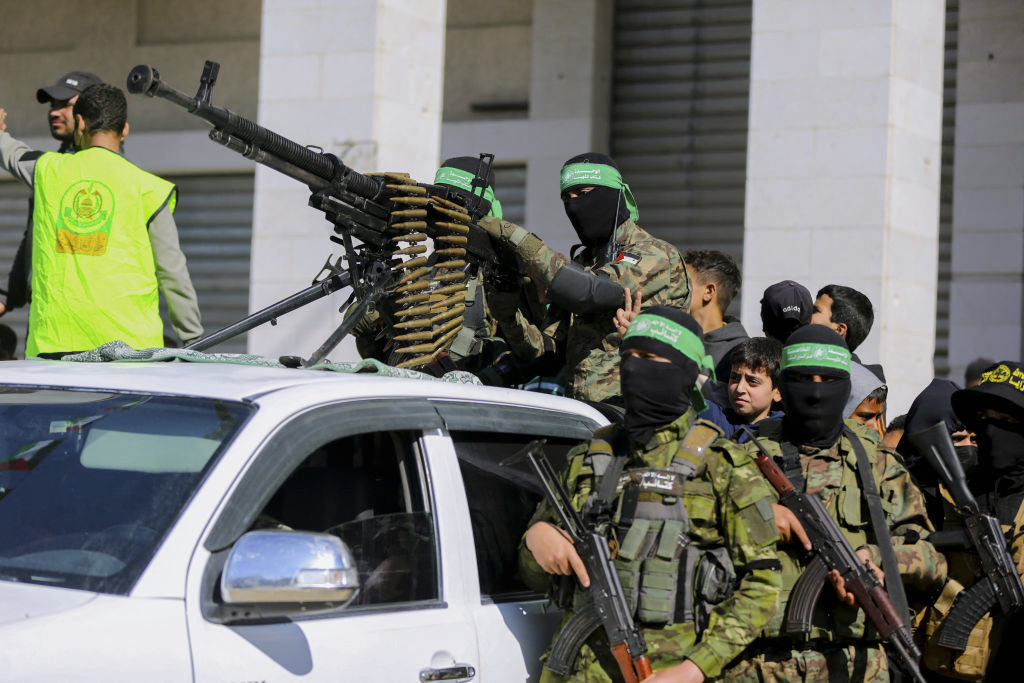
The original goal of Trump’s peace plan was not to relocate Hamas’s arsenal. It was to eliminate it permanently. Weapons stored in warehouses remain weapons that function. Explosives stored today can be easily recovered tomorrow. Rocket factories that are preserved can resume production. Tunnels that are mapped rather than destroyed can be used again. Pictured: Hamas terrorists in Gaza City on January 25, 2025. (Photo by Abood Abusalama/Middle East Images via AFP)

For nearly a year, the international community insisted that there could be no future for the Gaza Strip unless Hamas was stripped of every weapon, every tunnel, every missile factory, and every military capability.

US President Donald J. Trump’s September 2025 peace plan was explicit: Gaza would be demilitarized, terrorist infrastructure destroyed, and weapons rendered permanently unusable.

Article 13 of Trump’s 20-point plan states:

“All military, terror, and offensive infrastructure, including tunnels and weapon production facilities, will be destroyed and not rebuilt. There will be a process of demilitarization of Gaza under the supervision of independent monitors, which will include placing weapons permanently beyond use through an agreed process of decommissioning, and supported by an internationally funded buy back and reintegration program all verified by the independent monitors.”

Now, however, that clear objective appears to have been replaced by something radically different. Instead of eliminating Hamas’s arsenal, negotiators are discussing storing weapons, transferring them to another Palestinian party, and even allowing Hamas members to retain “personal firearms.”

The original goal of Trump’s peace plan was not to relocate Hamas’s arsenal. It was to eliminate it permanently. Replacing “demilitarization” with “storage” is a win for Hamas and other Palestinian terrorist groups in the Gaza Strip.

The latest deal between Trump’s Board of Peace and Hamas, titled “A Roadmap for Completing the Implementation of President Trump’s Comprehensive Peace Plan in Gaza,” states:

“A process to decommission and store heavy weapons, military production sites, depots of weapons, and tunnels, shall begin after completing the remaining commitments under Sharm Sheikh Protocol, the entry of NCAG [National Committee for the Administration of Gaza] and deployment of ISF [International Stabilization Force].”

How did the promise of permanent demilitarization become a discussion about warehouses full of Hamas weapons? Weapons stored in warehouses remain weapons that function. Explosives stored today can be easily recovered tomorrow. Rocket factories that are preserved can resume production. Tunnels that are mapped rather than destroyed can be used again.

The issue has never been where Hamas keeps its weapons. The issue has always been Hamas having access them.

The assumption that the NCAG or ISF would be able to prevent terrorists from regaining control over the stored weapons is totally misleading. Even more disturbing is the new deal’s assertion that “no weapons shall be transferred or handed to Israel or non-Palestinian parties.”

Transferring weapons from one Palestinian group to another is not demilitarization.

Equally disturbing is the new roadmap’s conditioning of disarmament on an Israeli withdrawal from the Gaza Strip:

“This process [to decommission and store heavy weapons, military production sites, depots of weapons, and tunnels] shall be linked to an Israeli withdrawal, in phases, from the areas under its control in Gaza and the decommissioning of [Israel-backed] armed militias.”

Why should a terrorist organization that carried out the October 7, 2023 massacre in Israel be allowed to dictate the conditions of its own disarmament? No country fighting ISIS or al-Qaeda would first withdraw its forces and only then hope terrorists voluntarily surrender their weapons. Hamas should not be negotiating the terms of its defeat. It should be compelled to unconditionally surrender and disarm.

While discussions about disarmament were underway, Hamas reportedly began distributing more automatic rifles to operatives under the guise of “personal ownership.” Israel’s Kan News quoted an unnamed Palestinian source as saying that the goal of the rifle distribution was to ensure that weapons stay in the hands of Hamas members. “Hamas will not disarm. Period,” the source asserted.

Before the first stage had even been implemented, Hamas was already looking for loopholes.

Shortly after the new roadmap was announced, senior Hamas official Ghazi Hamad said in an interview with Saudi-owned Al-Arabiya TV:

“The weapons will be stored and not handed over, and this is conditional on Israel’s commitment. What we agreed upon with the mediators is storing the weapons, not surrendering them. Our political and civilian role in Gaza continues. Hamas has not and will not abandon its national project to reclaim the Palestinian land. We consider the current phase exceptional due to the circumstances that the Gaza Strip is going through.”

This is the same Ghazi Hamad who publicly vowed that Hamas would repeat the October 7 massacre time and again until Israel is eliminated:

“We must teach Israel a lesson, and we will do this again and again. The Al-Aqsa Flood [the name Hamas uses to describe the October 7 massacre] is just the first time, and there will be a second, a third, a fourth, because we have the determination, the resolve, and the capabilities to fight.”

This quote alone should destroy confidence in Hamas’s promises to the Board of Peace.

Anyone who thinks that the newly established NCAG will somehow confront Hamas and impose its authority over the terrorist organization is living under an illusion. Hamas has ruled the Gaza Strip since 2007. It controls thousands of armed men, intelligence networks, clan alliances, financial resources, and a deeply entrenched political and security apparatus. No technocratic committee can simply arrive and displace an organization that has spent nearly two decades ruthlessly consolidating its power.

The far more likely scenario is that Hamas will continue to call the shots from behind the scenes while allowing another Palestinian body to assume responsibility for governance, civil service salaries, reconstruction, and collecting international aid.

This would essentially replicate the Hezbollah model in Lebanon, where a heavily-armed Iran-backed terrorist militia coexists with a formal government while retaining independent military power and ultimate political influence.

Supporters of the new roadmap argue that international observers and the ISF will oversee implementation. International observers may monitor warehouses and oversee the delivery of humanitarian assistance, and the ISF may train Palestinian security forces. They will not confront Hamas if it decides to rearm. They definitely will not risk their lives dismantling some terrorist infrastructure.

Within hours of the announcement of the roadmap, Iran’s Islamic Revolutionary Guard Corps dismissed the plan outright, declaring that the effort to disarm Hamas “will achieve nothing” and had already failed. Tehran pledged that “the resistance” (Hamas) would remain steadfast until what it called the “final victory” over Israel.

Iran understands Hamas better than anyone else because it has financed, armed and trained the terrorist organization for decades. If the Iranian regime is openly rejecting the prospect of Hamas’s disarmament, why should anyone else believe that Hamas intends to honor the agreement?


Khaled Abu Toameh is an award-winning journalist based in Jerusalem.


Zawartość publikowanych artykułów i materiałów nie reprezentuje poglądów ani opinii Reunion’68,
ani też webmastera Blogu Reunion’68, chyba ze jest to wyraźnie zaznaczone.
Twoje uwagi, linki, własne artykuły lub wiadomości prześlij na adres:
webmaster@reunion68.com


Why Tisha B’Av — and the Current Moment — Are Not the End of the Story


Why Tisha B’Av — and the Current Moment — Are Not the End of the Story

Pini Dunner


The Western Wall in Jerusalem. Photo: Wikicommons.

The Tisha B’Av experience is utterly unique. You sit on the floor in the half-dark, your shoes off, your voice cracking through the dirge-like cadences of Eichah, and then you recite — line by line, calamity by calamity — the worst tragedies that have ever happened to the Jewish people. 

The destruction of two Temples. The expulsions. The massacres. The Crusades. The pogroms. The death camps. It is, without question — and deliberately so — the saddest day in the Jewish calendar, a day set aside to stare directly into the abyss of our tragic history and weep.

And yet, as I went through the Tisha B’Av motions this year, sitting on the floor and reciting the Kinnot, something struck me with unexpected force. This day of mourning — this concentrated distillation of every Jewish tragedy into twenty-five hours of grief and lamentation — carries within it the very antidote to the sorrows it commemorates. 

Because here is the astonishing thing: we are still here to mourn them, but every enemy catalogued in those Kinnot is gone. 

Just consider that for a moment. The very fact that there is a Jew in 2026 who can sit on the floor and cry over Jerusalem destroyed by Roman legionaries is itself the punchline to a two-thousand-year-old joke that Rome did not live to hear. Titus is dust. We are not.

Or consider the Crusaders. In the spring and early summer of 1096, mobs sweeping toward Jerusalem turned their swords, clubs, maces and spears on the flourishing Jewish communities of the Rhineland — Speyer, Worms and Mainz, the great triad of communities that stood at the heart of the emerging Ashkenazi world. These were thriving centers of Torah, commerce and communal life. Within a matter of weeks, they were annihilated.

In Worms, approximately eight hundred Jews were slaughtered. In Mainz, the greatest carnage of all, more than eleven hundred were brutally murdered. Speyer escaped destruction on the same scale only because its bishop intervened to protect the community. 

The chronicles that survive this tragedy read like Eichah itself. Had you stood among the mutilated bodies of Mainz’s murdered Jews in the summer of 1096, you would have been certain — utterly certain — that it was over for good. After all, who could possibly rebuild from that?

But what happened next is astounding. The Crusader horde led by the repulsive Count Emicho — many thousands strong, and convinced that the murder of Jews was a holy task — never made it to Jerusalem. 

They marched toward Hungary and laid siege to the fortress of Moson. Then, just as victory seemed within reach, panic swept through their ranks. The Hungarian defenders surged out, the Crusading army disintegrated, and many of them were slaughtered or drowned. 

The force that had imagined itself an instrument of divine judgment collapsed before it ever reached the Holy Land. The wheel had turned, and it turned fast. 

Meanwhile, the Jews of the Rhineland began the astonishing work of rebuilding. Within years, synagogues and communities were restored. Within generations, the great centers of Rhineland Torah learning had re-emerged, producing scholars, liturgy and faith energy that would shape Jewish life for centuries.

It is a pattern so consistent that it has become almost tediously reliable. The Nazis built an empire meant to last a thousand years and to stand upon the ashes of our people. It lasted twelve. Its leaders died in bunkers, fled like fugitives, or stood in the dock at Nuremberg. Ten of the principal defendants ended their lives at the end of a hangman’s rope. 

The men who orchestrated the horrors of October 7 imagined that they were writing the opening chapter of the end of Israel. Instead, one by one, they are being eliminated. Yahya Sinwar — the arch-mastermind, the man who thought he had lit the fuse of our destruction — was hunted down and killed. 

And it isn’t only the leaders. A few weeks ago, the IDF eliminated Mohammed Abu Taima, a Nukhba commander who participated in the October 7 assault and infiltrated Kibbutz Nirim. 

He is not the only one. Scroll through your X feed. Day after day, terrorists who participated in the massacre — some of whom filmed their crimes on GoPros — are being located, targeted and eliminated, in real time, on our watch.

I am fully aware that not everyone sees hope in the present moment. There are those who look at the world around us and predict doom. They point to the surging antisemitism on our streets and campuses, the diplomatic isolation of Israel, the exhaustion of a nation at war, the fracturing of old alliances, and the rise of politicians like Zohran Mamdani to positions of power and influence. 

And they say: this time it is different. This time we will not come back.

Here is the uncomfortable truth: in a narrow and immediate sense, they may not be entirely wrong. Things may get darker before they get lighter, and the road ahead may be harder for Jews and for Israel than any of us would wish. 

But darkness has a peculiar power. The final hours before dawn can feel like the blackest part of the night, deceiving the frightened eye into believing that the sun will never rise. And that is precisely the moment when judgment fails. 

The Jews who survived Mainz in 1096 could not see 1120. The Jews of 1943 could not see 1948. Standing inside a disaster, it is nearly impossible to believe that there will be an afterward — and harder still to imagine that the afterward might be positive. And yet there always, always is.

To be clear, this is not naive optimism. It is the single most well-documented fact in the entire span of human history — a fact written in the disappearance of every civilization that ever raised its hand against the Jews, and in the stubborn, miraculous persistence of the Jewish people. 

The Shabbat immediately following Tisha B’Av is Shabbat Nachamu. Before we have even wiped away our tears, the Haftarah roars back at us with the words of the prophet Isaiah (Is. 40:1): נַחֲמוּ נַחֲמוּ עַמִּי – “Comfort, comfort My people.” 

Just days after the deepest grief, as if to insist that mourning was never intended to be a destination, the prophet who was among the sharpest in his predictions of tragedy guarantees comfort and relief from that very same tragedy.

So let the pessimists have their say. I will not argue that the night is not dark. But I will point out that we have been here before. We have stood in the ruins of the Rhineland, in the ruins of the Temple, and in the ruins of Europe. We buried our dead. We said Kaddish. We wiped our eyes.  And then we got up, dusted ourselves off and rebuilt what was gone — bigger and better than before.

The Jewish people are going to fight back. And make no mistake: we are going to win. Not because we are stronger, cleverer or more numerous than our enemies. We will win for the same reason we have always won: Because they are chapters, and we are the book. 

Because while the remnants of the army that thought it had ended Jewish life in the Rhineland were scattering across Hungary, there was already a Jewish child being born amid the ruins of Mainz who would grow up to teach Torah. 

Be comforted, My people – the tears of Tisha B’Av are real, but they are not the end of the story. Dawn is coming — it always does — and when it breaks, as it broke over the Rhineland, over the DP camps and over a reborn Jerusalem, we will still be standing.


The author is a rabbi in Beverly Hills, California. 


Zawartość publikowanych artykułów i materiałów nie reprezentuje poglądów ani opinii Reunion’68,
ani też webmastera Blogu Reunion’68, chyba ze jest to wyraźnie zaznaczone.
Twoje uwagi, linki, własne artykuły lub wiadomości prześlij na adres:
webmaster@reunion68.com