Archive | 2026/08/08

Tolo mieszka z Ukrainką, Pola jedzie do Izraela. Jak dziś opowiadać o poszukiwaniu tożsamości

‘Podróżnicy’ (Fot. Shutterstock)


Tolo mieszka z Ukrainką, Pola jedzie do Izraela. Jak dziś opowiadać o poszukiwaniu tożsamości

Witold Mrozek


Z trzech sztuk dwie podejmują temat migracji i tożsamości – warto się im przyjrzeć, bo nie są to dziś tematy, po które polski teatr chętnie by sięgał. Przeczytać Mossakowskiego można choćby po to, żeby się z nim pokłócić.

Paweł Mossakowski, wieloletni recenzent filmowy “Gazety Co Jest Grane” i doświadczony producent filmowy, jest też nagradzanym dramatopisarzem. Właśnie ukazał się zbiór jego sztuk “Podróżnicy” – tom obyczajowych opowieści z publicystycznym zacięciem.

Między Polską, Szwecją, Izraelem

Tytułowi „Podróżnicy”, najpoważniejszy dramat tomu, przedstawiają losy pary polskich Żydów, Poli i Kuby, na tle przemian Polski i ich własnych tożsamości. W pierwszym, najdłuższym akcie są młodymi, zakochanymi ludźmi, których rozdzielają Marzec 1968 i nasilająca się nagonka, za którą odpowiada nie tylko rządząca partia, ale też zwykli ludzie – w sklepie czy na ulicy. To nie tylko utrata pracy, docinki czy szykany, ale też przemoc fizyczna. Nietrudno dopatrzyć się tu aluzji do dzisiejszych nacjonalistycznych kampanii nienawiści. Niestety, trafnych. „Bo robi się atmosfera. A w atmosferze żulia czuje się bezkarna” – mówi synowi Fryda, matka Kuby.

Czas drugiego aktu przypada na drugą połowę lat 70. XX wieku – mowa o strajkach w Ursusie i Radomiu, powstaniu KOR-u. Kuba odwiedza Polę w Szwecji. Wyjechał z Polski na chwilę, jest gastarbeiterem. W kraju wydaje wiersze w samizdacie, trzyma z opozycją. Ona ma męża i stabilne życie, ale myśli o kolejnym wyjeździe. Jednocześnie wzmacnia się w niej tożsamość żydowska, którą wiąże z Izraelem.

Trzeci akt rozgrywa się w latach 90. Kuba odwiedza Polę w Izraelu i opowiada o kraju, gdzie się urodzili, o który walczył i w którym ostatecznie został dobrze zarabiającym wydawcą. Mówi, że w Polsce „…dziś wypada być Europejczykiem, światłym i otwartym. Ale to wszystko wisi na cienkim włosku. Za piękną fasadą jest ciemnota, ksenofobia, masa kompleksów i zawiści. I ta druga Polska dojdzie kiedyś do głosu. A nie chciałbym wtedy w niej mieszkać” – i dlatego chce wyemigrować tam, gdzie dawna ukochana.

Kuba, świeżo przybyły z Polski, ma w sobie wiele więcej wiary w izraelskie państwo niż mieszkająca tam od lat Pola. Jej syn, były żołnierz, został ciężko okaleczony w wojsku – ale nie na wojnie, tylko w wypadku podczas ćwiczeń. Jest mowa o jakichś wojnach w przeszłości i grożących w przyszłości, ale z kim te wojny – o tym mowy nie ma. Izrael spotyka tu jednak też sporo krytyki. Pola sceptycznie mówi o militaryzacji Izraela, jednocześnie jej wybór miejsca do życia jest zdecydowany i za nim stoi. I jej biografia tłumaczy dlaczego. „Podróżników” Teatr Żydowski w Warszawie wystawił w marcu 2023 roku.

Polski malarz, ukraińska sprzątaczka

W „Kotach” głównym bohaterem jest Tolo, artysta malarz po pięćdziesiątce, rozdarty między dwoma kobietami: Doris, żoną na emigracji w USA, i ukraińską imigrantką Iriną, która sprząta w jego domu i z którą coś zaczyna go łączyć. Wątek migracji znów jest istotny – Irina mimo traumatycznych wspomnień radzi sobie w Polsce nieźle, Doris w Stanach – chyba gorzej. Tolo nie chce zmian, nie chce dołączyć do żony, zostawiać swojego języka i swojego życia.

Jednocześnie dookoła trwają, jak się zdaje, rządy PiS. Tolo ma z nimi problem jako artysta cenzurowany przez Ministerstwo Kultury. Trochę szkoda, że ten wątek osuwa się w za łatwą parodię i groteskę. I nie mam tu na myśli tego, że to, co robił PiS, nie było straszne. Dużo straszniejsze niż parodiowane u Mossakowskiego debaty medialne czasów „dobrej zmiany” (czy to źle, że na obrazie orzeł zwraca głowę w lewą stronę?) były mechanizmy konformizmu czy zwyczajnej niechęci do uznanych artystów, które sprawiały, że na takie analityczne dylematy w rzeczywistej Polsce PiS nie byłoby po prostu miejsca. Skądinąd, głowa orła patrzy w lewo, bo obok miała być druga – jak na bizantyjskim godle również i dzisiejszej Rosji. Twórca nie dokończył obrazu, bo się zawahał – i ten moment zawahania oraz wycofania się, samodzielnej rezygnacji z mocnego gestu, jest dla mnie ciekawszy niż parodiowani tu przygłupi telewizyjni krytycy.

Skróty dramaturgiczne chwilami może za łatwo zmieniają się u Mossakowskiego w skróty myślowe. Jak przy Doris, która szybko dostaje pracę na amerykańskim uniwersytecie, ale też bardzo szybko ją traci, bo zwraca się do osoby studenckiej niewłaściwymi zaimkami. Dzisiejsze konflikty tożsamościowe i kulturowe są trochę zbyt ważne i złożone, by sprowadzać je do jednego grepsu, nawet w ramach symetrii uzupełnionej molestującym szefem w innej pracy, jakby z drugiej strony. Zbyt duża kondensacja nie służy ważnym, niełatwym i skomplikowanym tematom, które Mossakowski podejmuje. Przynajmniej w lekturze. Jak będzie na scenie?

Z drugiej strony w tych historiach – mieszczących w sobie wiele mniejszych podhistorii, trochę zbyt ciasno upchanych – sporo jest nieco niedzisiejszego, w dobrym sensie, ciepła. Nawet jeśli przydarza się ono na chwilę. Jak wtedy, gdy w „Kotach” Irina i Tolo zbliżają się do siebie albo gdy zbliżają się do siebie znów Pola i Kuba.


Paweł Mossakowski, „Podróżnicy”, wydawnictwo Moc Media, Warszawa 2026

Paweł Mossakowski, 'Podróżnicy', wydawnictwo Moc Media, Warszawa 2026

Paweł Mossakowski, ‘Podróżnicy’, wydawnictwo Moc Media, Warszawa 2026 Fot. Materiały prasowe


Redagowała Agata Żelazowska


Zawartość publikowanych artykułów i materiałów nie reprezentuje poglądów ani opinii Reunion’68,
ani też webmastera Blogu Reunion’68, chyba ze jest to wyraźnie zaznaczone.
Twoje uwagi, linki, własne artykuły lub wiadomości prześlij na adres:
webmaster@reunion68.com

Iran’s War on the Arabs: Time for the Gulf to Stand with Israel


Iran’s War on the Arabs: Time for the Gulf to Stand with Israel

Khaled Abu Toameh


  • Over the past week, the Iranian regime has demonstrated once again that its ambitions extend far beyond destroying Israel.
  • It is a war against the entire Middle East and, ultimately, against the United States and the West.
  • Tehran then launched missiles and drones not only against US assets but also against infrastructure in Arab countries across the Gulf, in addition to Jordan, presumably so they would pressure US President Donald J. Trump to call off US firepower and return instead to waste-of-time negotiations for a waste-of-time “deal” that Iran would not honor in the first place.
  • In reality, the negotiations have been worse than a waste of time… The negotiations actually caused harm. They gave the regime time to retrieve missiles it had hidden and to resume firing, with targeting assistance from China and Russia, on US forces and allies in the Gulf.
  • Iranian regime ideology rejects peaceful coexistence and normalization between Arabs and Israelis — as does the ideology of the Muslim Brotherhood, currently embodied by Qatar and Turkey.
  • Taken together, these terrorist organizations form what Tehran proudly calls the “Axis of Resistance.” It is, in reality, an axis of terrorism. Its purpose is not just to destroy Israel. Its objective is to spread Iran’s revolutionary Shiite Islamist ideology, undermine moderate Arab governments, expel American influence from the Middle East, and ultimately wage jihad (holy war) against the West.
  • The Arab states therefore have every reason to openly align themselves with the United States and Israel in confronting the Iranian threat.
  • This is not about choosing sides in someone else’s conflict. It is about defending their own sovereignty, their own interests, their own citizens, and their own future.
  • The lesson of the past week: So long as the regime in Tehran remains committed to exporting its “Islamic Revolution” and maintaining its network of terrorist proxies, there can be no genuine security or stability in the Middle East.
  • Until the Iranian regime abandons its expansionist ambitions or loses the capacity to pursue them, the Middle East will remain trapped in recurring cycles of violence. Until then, the Arab states would be wise to recognize that this is their fight as much as Israel’s.

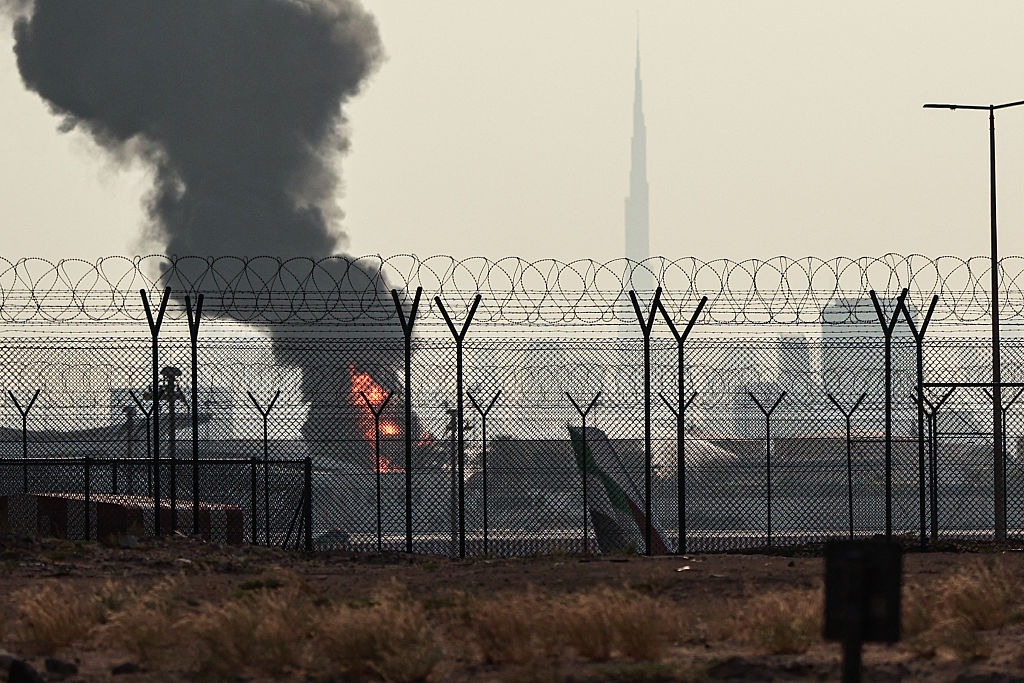
Over the past week, the Iranian regime has demonstrated once again that its ambitions extend far beyond destroying Israel. Tehran has launched an unprecedented campaign of missile and drone attacks against several Arab states, targeting critical infrastructure, ships, airports, oil facilities, power stations, desalination plants, ports and even residential neighborhoods. Pictured: Flames and smoke from an Iranian drone attack next to Dubai International Airport on March 16, 2026. (Photo by AFP via Getty Images)

For decades, governments of many Arab states have viewed Iran’s aggression primarily through the prism of its conflict with Israel. That illusion has now been shattered.

Over the past week, the Iranian regime has demonstrated once again that its ambitions extend far beyond destroying Israel. Tehran has launched an unprecedented campaign of missile and drone attacks against several Arab states, targeting critical infrastructure, ships, airports, oil facilities, power stations, desalination plants, ports and even residential neighborhoods.

These attacks should remove any doubt: Iran’s war is not only against Israel. It is a war against the entire Middle East and, ultimately, against the United States and the West.

The latest escalation also exposes the fatal flaw in the Memorandum of Understanding signed between Washington and Tehran only weeks earlier. The agreement was supposed to reduce tensions and guarantee safe navigation through the Strait of Hormuz. Instead, Iran immediately violated its commitments.

Beginning on July 6, Iran resumed attacks on commercial ships in the Strait of Hormuz, despite pledging to ensure safe passage for international vessels. The attacks prompted American military strikes against Iranian targets. Tehran then launched missiles and drones not only against US assets but also against infrastructure in Arab countries across the Gulf, in addition to Jordan, presumably so they would pressure US President Donald J. Trump to call off US firepower and return instead to waste-of-time negotiations for a waste-of-time “deal” that Iran would not honor in the first place.

The Iranian regime has never demonstrated any willingness to abide by agreements if they conflict with its revolutionary ideology or strategic objectives. The latest memorandum of understanding between Iran and the US has gone the way of countless previous understandings with Tehran: reduced to little more than worthless paper.

In reality, the negotiations have been worse than a waste of time, except to see if any deal might be possible with a regime that just murdered more than 50,000 of its own citizens in January alone. The negotiations actually caused harm. They gave the regime time to retrieve missiles it had hidden and to resume firing, with targeting assistance from China and Russia, on US forces and allies in the Gulf.

This chain of events is hardly surprising, and the same disaster applies to Iran’s terrorist proxies.

Hamas repeatedly violated ceasefire agreements before launching its October 7, 2023 invasion of Israel. Hezbollah has ignored international resolutions demanding its disarmament while repeatedly violating ceasefire agreements. Yemen’s Houthis have continued attacking international shipping despite multiple diplomatic initiatives and understandings.

Negotiating with terrorist organizations or the regime that sponsors them has consistently produced the same result: more violence and terrorism.

The current wave of Iranian attacks illustrates precisely why.

Over the past few months, Iran has carried out sustained missile and drone attacks against at least seven Arab countries.

Commercial vessels in the Strait of Hormuz were struck. Kuwait, Bahrain, and Jordan came under coordinated missile and drone attacks. Qatar was targeted for a second time in one week. Kuwait suffered direct hits on an oil facility, a power station, and a desalination plant, and was forced to suspend flights at Kuwait International Airport. Saudi Arabia issued emergency missile alerts as Iranian projectiles threatened its territory.

Even Oman, which has long maintained cordial relations with Tehran and served as an intermediary between Iran and the US, was not spared.

Tehran claims that it targets only American military facilities. Reality tells a different story.

Civilians have been killed, residential areas struck, and airports, hotels, ports, oil facilities and other civilian infrastructure have suffered significant damage.

These are not attacks on military facilities. They are acts of state terrorism, targeting purely civilian infrastructure and designed to intimidate entire societies.

The Arab League was correct in condemning the attacks as “heinous and reckless” violations of Arab states’ sovereignty. It warned that Iran’s actions represent “a serious and unprecedented escalation threatening the security and stability of the entire region.”

The Arab League also reaffirmed its “full solidarity and unwavering support” for the Arab countries targeted by Iran.

These statements are welcome, but words alone will not stop the Iranian regime.

For years, Iran has systematically built an empire of armed proxies across the Arab world. Iran dominates Lebanon through Hezbollah. It exercises enormous influence over Iraq through Shiite militias. It transformed Yemen’s Houthis into a heavily armed force capable of threatening one of the world’s most important maritime trade routes. It continues to bankroll Hamas and Palestinian Islamic Jihad in the Gaza Strip and the West Bank. Iran’s influence extends deep into Syria as well.

Taken together, these terrorist organizations form what Tehran proudly calls the “Axis of Resistance.” It is, in reality, an axis of terrorism. Its purpose is not just to destroy Israel. Its objective is to spread Iran’s revolutionary Shiite Islamist ideology, undermine moderate Arab governments, expel American influence from the Middle East, and ultimately wage jihad (holy war) against the West.

That agenda was underscored this week in a statement attributed to Iran’s Supreme Leader Mojtaba Khamenei, declaring that “the American enemy” should prepare for “unforgettable lessons” from Iran and the “Axis of Resistance.”

This is not the language of a regime seeking peace. It is the language of a regime openly threatening continued war.

Iran’s aggression is steadily eroding whatever sympathy it once enjoyed among many Arabs. The regime’s true face has become impossible to conceal. This new belligerence should be a turning point for Arab governments.

According to the news website MBN:

“Ahmed Alkhuzei, a leading analyst in Bahrain, said that as the war drags on, people increasingly experience its consequences in their daily lives. As a result, he said, they are more likely to see Tehran not as a victim but as a destabilizing force whose actions directly threaten their security and prosperity.

“‘Iran is being recast from a distant geopolitical actor into the immediate source of instability,’ he told MBN.”

Iran is not merely Israel’s problem. Its missiles threaten Gulf capitals. Its proxies destabilize Arab governments. Its attacks endanger Arab economies. Iranian regime ideology rejects peaceful coexistence and normalization between Arabs and Israelis — as does the ideology of the Muslim Brotherhood, currently embodied by Qatar and Turkey.

One of Tehran’s principal strategic objectives has always been to sabotage the Abraham Accords and prevent further normalization between Israel and its Arab neighbors. Iran understands that regional peace and cooperation weaken its revolutionary narrative and diminish the influence of its terrorist proxies.

The Arab states therefore have every reason to openly align themselves with the United States and Israel in confronting the Iranian threat.

This is not about choosing sides in someone else’s conflict. It is about defending their own sovereignty, their own interests, their own citizens, and their own future.

The lesson of the past week: So long as the regime in Tehran remains committed to exporting its “Islamic Revolution” and maintaining its network of terrorist proxies, there can be no genuine security or stability in the Middle East.

The Islamabad Memorandum of Understanding has already collapsed: it rested on the false assumption that the Iranian regime could be trusted to honor its commitments. The Islamic Republic’s own history, and its latest missile and drone attacks against the Arab world, prove otherwise.

Peace cannot be built upon deals with a regime that views every agreement merely as another tactical pause in its long war against the US, Israel, and its Arab neighbors.

Until the Iranian regime abandons its expansionist ambitions or loses the capacity to pursue them, the Middle East will remain trapped in recurring cycles of violence. Until then, the Arab states would be wise to recognize that this is their fight as much as Israel’s.


Khaled Abu Toameh is an award-winning journalist based in Jerusalem.


Zawartość publikowanych artykułów i materiałów nie reprezentuje poglądów ani opinii Reunion’68,
ani też webmastera Blogu Reunion’68, chyba ze jest to wyraźnie zaznaczone.
Twoje uwagi, linki, własne artykuły lub wiadomości prześlij na adres:
webmaster@reunion68.com


‘This Is Our Holy Mission’: Accused Hamas Financier Tied to Official Who Denied Oct. 7 Atrocities on Piers Morgan


‘This Is Our Holy Mission’: Accused Hamas Financier Tied to Official Who Denied Oct. 7 Atrocities on Piers Morgan

Debbie Weiss


Hamas fighters on Feb. 22, 2025. Photo: Majdi Fathi via Reuters Connect

A Turkish man accused by US prosecutors of funneling money and supplies to Hamas through a purported humanitarian organization worked closely with Ghazi Hamad, the senior Hamas official who on Monday used an interview with British broadcaster Piers Morgan to deny that the terror group deliberately murdered and abducted civilians on Oct. 7. 

Mohammad Yousef Hasna, 45, from Istanbul, was arrested Friday in Britain and ordered held while the US seeks his extradition to New York. He faces charges of conspiring to provide material support to Hamas, conspiring to finance terrorism and financing terrorism, each carrying a maximum sentence of 20 years in prison. 

Prosecutors said Hasna used a senior position in what they described as a sham international humanitarian organization to deliver food, supplies and funding to Hamas, working closely with the group’s senior leadership. The US government said he had worked with Hamad, a member of Hamas’s governing body and its current spokesman, since at least 2023. 

Hamad appeared Monday on “Piers Morgan Uncensored,” where he denied that Hamas had deliberately targeted civilians during the Oct. 7 attack, saying that “maybe there were some mistakes by individual” Hamas operatives and insisting that “it is not our thinking” to kill civilians. Morgan challenged him over the killing of civilians and seizure of hostages, accusing Hamas of crossing “every moral, ethical and humanity line.”

Asked when Hamas would disarm under the US-backed Gaza agreement, Hamad did not give a date. He said the group had accepted the deal because of “forced necessity” and the conditions in Gaza, but added that Hamas had not changed its “mentality” or its goal of ending what it calls the “occupation,” even though Israel withdrew from the Gaza Strip in 2005. 

“This is our holy mission,” Hamad said, adding that Hamas might pursue it through “different tactics, different tools, different methods.”

Morgan also pressed Hamad over Hamas’s treatment of the hostages abducted on Oct. 7. Hamad claimed the group had been “very, very kind” to them, saying they were fed and provided with “all kinds of protection and shelter.” 

The British broadcaster, who has come under fire for featuring controversial guests including former Pink Floyd frontman Roger Waters, who went on an anti-Israel tirade on Morgan’s show, then confronted Hamad with remarks he made weeks after the attack that appeared to contradict his denial that Hamas intended to kill civilians. In an Oct. 24, 2023 interview with Lebanon’s LBC television, Hamad said the Oct. 7 assault was “just the first time, and there will be a second, a third, a fourth,” and vowed that Hamas would continue until Israel was destroyed.

“It is not our thinking. It is not our mentality to kill civilians,” Hamad told Morgan.

Hamad had previously headed Hamas’s Ministry of Social Development, which prosecutors said Hasna coordinated with while arranging aid deliveries. 

NGO Monitor, a Jerusalem-based research group that examines foreign charities’ dealings with the ministry and UN agencies operating in Gaza, said the allegations against Hasna point to a larger pattern of Hamas exploiting international aid networks. 

“The systematic diversion of millions in aid has been used to finance the terror infrastructure used in the October 7 atrocities. This arrest and extradition request reflects a growing recognition, at least in Washington, of the urgent need to disrupt Hamas’ financing structures,” NGO Monitor founder and president Gerald Steinberg said.

According to Steinberg, Hamad should never have been featured on Piers Morgan. 

“As an architect of the October 7 atrocities and head of the MoSD, Hamad’s rightful place is in court, not as a celebrity guest,” Steinberg told The Algemeiner.

NGO Monitor said it had documented coordination between the ministry and several US-based nonprofits, including Mercy Corps, American Near East Refugee Aid, known as ANERA, and Rahma Worldwide, which together have received more than $100 million from the US Agency for International Development, or USAID, the federal foreign-aid agency whose operations were shut down by the Trump administration in 2025 and largely transferred to the State Department. The groups have worked with the ministry on projects involving cash assistance, construction and other aid programs. 


Zawartość publikowanych artykułów i materiałów nie reprezentuje poglądów ani opinii Reunion’68,
ani też webmastera Blogu Reunion’68, chyba ze jest to wyraźnie zaznaczone.
Twoje uwagi, linki, własne artykuły lub wiadomości prześlij na adres:
webmaster@reunion68.com